Getting Your Hospital Shortlist: How Foreigners Choose the Best Hospitals in China
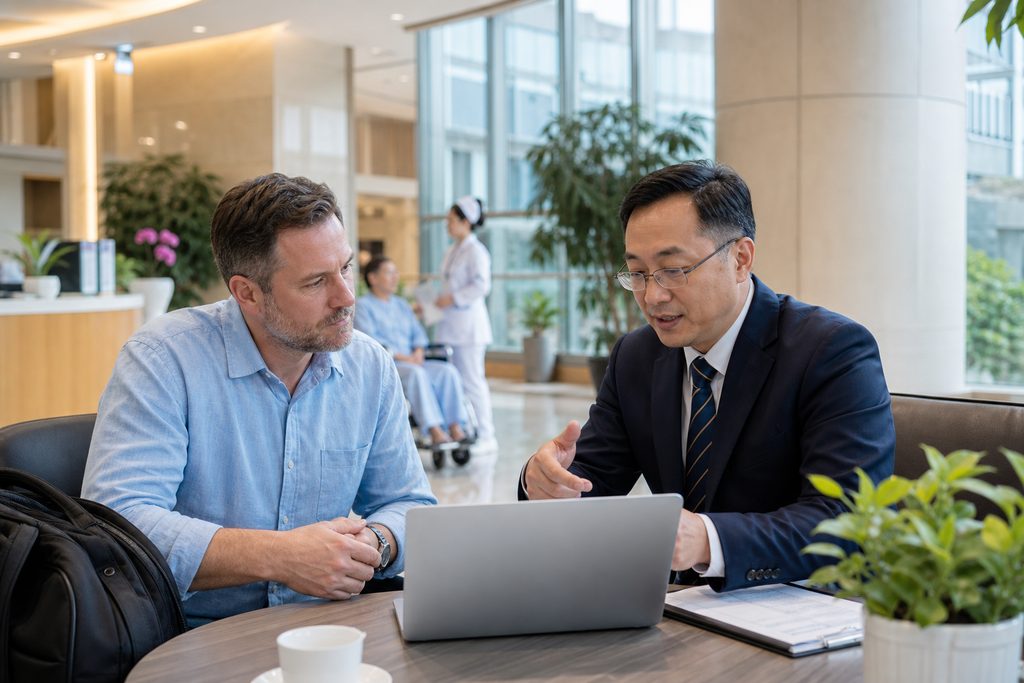
According to China’s National Health Commission, over 300,000 international patients traveled to the country for medical care in 2023. That is a striking number. Many arrive with one question: how do you build a hospital shortlist you can trust from six thousand miles away? For most people, the answer starts with the best hospitals in China for foreigners — and the honest truth is that the process is less about finding a single famous name and more about matching your specific surgery, budget, and language needs to the right tier of institution.
The complication is that “best” means different things depending on whether you need a cardiac bypass, a knee replacement, a complex spine procedure, or a second opinion. A hospital that excels in oncology may not be the smartest choice for orthopedics. And China’s top public hospitals, while world-class in surgical volume, operate very differently from Western facilities. This guide breaks down how to build a realistic shortlist — without wasting months on research or falling for marketing noise.
Getting Your Hospital Shortlist: The Short Answer
Start with two filters: specialty reputation and foreign-patient infrastructure. The Fudan University hospital rankings, updated annually, remain the most authoritative public benchmark for clinical strength in China. They cover 45 specialties and rank hospitals into five tiers (A++++ through A) for overall excellence. For international patients, the second filter matters just as much — does the hospital have a dedicated international department with English-speaking coordinators? Without that, even a top-ranked hospital becomes nearly impossible to navigate.
So the short answer: your shortlist should include 3 to 5 hospitals that score well in your specific specialty and operate a functioning international or VIP wing. That combination is rarer than most patients expect. China has over 35,000 hospitals. Only the top 5% — roughly 340+ top-ranked hospitals across 37 cities — meet our baseline for clinical quality. Of those, a smaller subset can genuinely serve a foreign patient who speaks no Mandarin.
Who This Is Right For — and Who It Isn’t
Building a hospital shortlist for treatment in China makes sense for a specific profile of patient. But it is not the right move for everyone, and being honest about that saves you time and money.
Good candidates for a China hospital shortlist typically include:
- Patients facing high-cost elective surgeries at home — cardiac bypass, joint replacement, complex spine fusion — where Chinese prices run 1/5 to 1/10 of US rates
- Patients who need a second opinion from a high-volume specialist, particularly in cardiac surgery, oncology, orthopedics, or reproductive medicine
- Patients with chronic conditions who want to combine treatment with TCM rehabilitation or wellness programs
- Patients who can plan 2–4 weeks in-country and have a family member or companion available to help with logistics
Who should not pursue this path:
- Patients requiring emergency or trauma care — medical travel to China is for planned, elective treatment, not acute emergencies
- Patients with unstable conditions that make long-haul flights medically risky
- Patients who expect the exact same administrative experience as a Western private hospital — Chinese public hospitals, even top-tier ones, are high-volume environments
- Patients who cannot tolerate uncertainty around scheduling — public hospital surgery dates are confirmed only after an in-person consultation, never before arrival
If you fall into that last group, a private international hospital like United Family or Jiahui may suit you better. They offer Western-style care, English-speaking staff, and direct insurance billing. But that comfort comes at a price — typically 2 to 3 times the cost of a public hospital’s international wing.
The Options, Compared
China’s hospital landscape for foreign patients splits into three tiers. Each has a distinct profile, and the right choice depends on your diagnosis, budget, and tolerance for administrative friction.
| Hospital Type | Clinical Strength | English Support | Typical Cost vs. US | Insurance Billing | Best For |
|---|---|---|---|---|---|
| Top Public Hospital (Fudan Top 100) | Highest surgical volume, leading specialists | Limited — international wing only | 1/5 to 1/8 | Pre-pay, then claim reimbursement | Complex surgery, rare conditions, second opinions |
| Public Hospital International/VIP Wing | Same specialists as main hospital | Good — dedicated coordinators | 1/3 to 1/5 | Pre-pay, some direct billing | Patients who want top specialists plus language support |
| Private International Hospital (JCI) | Good, but lower case volume for rare procedures | Excellent — Western-style care | 1/2 to 2/3 | Direct billing common | Routine surgery, family medicine, patients who prioritize comfort |
Most patients we work with end up in the middle column: a public hospital’s international wing. You get access to the same senior surgeons who perform 14,000+ cardiac procedures a year at a place like Fuwai Hospital, but with an English-speaking coordinator handling registration, payment, and scheduling. The trade-off is cost — international wings charge roughly 1.5 to 2 times the standard public rate. For a knee replacement that might mean $15,000 instead of $9,000. Still dramatically cheaper than the $50,000+ typical in the United States.
If you are comparing JCI accredited hospitals China list options, note that JCI accreditation is not the same as Fudan ranking. JCI measures safety, documentation, and process standards — it does not rank clinical outcomes or surgical volume. A hospital can be JCI-accredited and still not be the best choice for a complex spinal fusion. Use JCI as a baseline for international-patient readiness, not as a proxy for surgical excellence.
How to Choose a Hospital in China for Surgery: The Specialty Filter
Here is the section that most generic “best hospital” lists skip. The single most important step in building your shortlist is filtering by your specific procedure, not by overall hospital reputation. China’s Fudan rankings publish a specialty reputation list for 45 departments — oncology, cardiac surgery, orthopedics, neurosurgery, reproductive medicine, and dozens more. A hospital ranked A++++ overall may not appear in the top 10 for your condition. And vice versa.
Take cardiac surgery. Fuwai Hospital in Beijing performs more cardiac surgeries annually than any hospital in the world — over 14,000 per year. For a coronary artery bypass graft, that volume translates into refined surgical technique and a complication rate that compares favorably with leading US centers. But if you need a complex spinal deformity correction, you would be better served by a hospital with a top-ranked orthopedics department, such as Peking University Third Hospital or Shanghai Changzheng Hospital. The same logic applies to oncology — cancer care is highly subspecialized, and the right choice for liver cancer is not automatically the right choice for breast cancer.
So how do you actually do this filtering? Start with the specialty, not the city. Search for the department ranking for your condition. Then cross-reference that list against hospitals that operate an international wing. That intersection — specialty strength plus foreign-patient infrastructure — is your true shortlist. For most specialties, that leaves you with 2 to 4 hospitals in 2 to 3 cities. That is a manageable number. You can then request written second opinions or video consultations from two of them and compare.
This is also where the question of medical tourism hospital shortlist China gets answered honestly. Medical tourism in China is not like Thailand or India, where private hospitals market packaged deals directly to foreign patients. China’s best clinical care sits in public institutions. Accessing those institutions requires working through their international departments or a service coordinator who can navigate the system. There is no single “medical tourism hospital” in China that tops every specialty. The shortlist is always specialty-specific.
What It Costs
Cost is the reason most Western patients consider China in the first place. The numbers are concrete, and the savings are real. But they vary significantly by hospital tier, city, and case complexity.
For a total knee replacement in Shanghai, you can expect to pay between $9,000 and $18,000 at a top public hospital’s international wing. The same procedure in the United States averages $35,000 to $50,000. That is the knee replacement cost Shanghai reality: roughly one-third to one-fifth of US pricing. Private international hospitals in Shanghai — Jiahui, Parkway, United Family — charge $20,000 to $30,000 for the same surgery. Still cheaper than the US, but the gap narrows.
Spine surgery tells a similar story. A single-level lumbar fusion at a top Beijing hospital runs $12,000 to $22,000, depending on implant choice and length of stay. The spine surgery package Beijing price at a private international facility might reach $35,000. In the US, the same procedure typically exceeds $80,000. These figures include the hospital stay, surgeon fees, anesthesia, and standard implants. They do not include travel, accommodation, visa fees, or interpreter services.
What drives the variance? Three factors. First, hospital tier — public standard wing is cheapest, public international wing is 1.5–2x, private international is 2–3x. Second, implant choice — imported implants (often preferred by Western patients) cost more than domestic equivalents. Third, case complexity — a straightforward single-level fusion costs far less than a multi-level reconstruction with instrumentation. Always request an itemized quote before committing. And confirm whether the quote includes post-operative rehabilitation, which is often billed separately.
For remote services, the numbers are smaller. A written second opinion from a top specialist costs $300–500. A video consultation with a senior expert runs $500–800. A multidisciplinary team review costs $1,500–2,000. These fees are typically credited in full if you later proceed with on-the-ground coordination within 90 days — a policy worth asking about.
Practical Considerations: Visas, Records, and Language
Let’s talk logistics, because this is where shortlists fall apart. You can identify the perfect hospital and still hit a wall if the paperwork is not in order.
First, the visa. Foreign patients traveling to China for medical treatment apply for an S2 visa, which is the short-stay category used for private affairs including medical treatment. The S2 is not a “medical visa” — no such standalone category exists. Your hospital or coordinator should provide an invitation letter and treatment confirmation to support the application. Family members accompanying you also apply for S2 visas. If your treatment requires a stay longer than 180 days, the S1 category applies. Visa approval is never guaranteed, and requirements vary by embassy, so confirm the latest rules with your local Chinese consulate before booking flights.
Second, medical records. Chinese specialists expect complete documentation: imaging (MRI, CT, X-ray), pathology reports, surgical history, current medication list, and a summary from your treating physician. All documents should be translated into Chinese — professional medical translation, not machine translation. A poorly translated report can lead to misdiagnosis or unnecessary repeat testing. Budget $200–400 for professional translation of a standard record set.
Third, payment. Public hospitals in China operate on a pre-payment model. You deposit funds upfront, and the hospital deducts charges as they occur. International credit cards are accepted at international wings and private hospitals, but not always at standard public counters. Wire transfers are common for larger deposits. Insurance is typically reimbursement-based — you pay out of pocket, then file a claim with your insurer. Private international hospitals with JCI accreditation are more likely to offer direct billing with major insurers.
Fourth, language. This cannot be overstated. A top public hospital in China sees 10,000+ outpatient visits per day. Signage is in Chinese. Registration kiosks are in Chinese. Pharmacy queues are in Chinese. Even the international wing has limited English coverage — usually one or two coordinators managing dozens of patients. A bilingual medical companion who handles queueing, payment, pharmacy pickup, and translation costs from $300 per day. For most patients, that is not a luxury. It is the difference between a smooth visit and a lost afternoon.
Finally, follow-up after returning home. Chinese surgeons are generally responsive to post-operative questions via email or WeChat, but they cannot manage your long-term rehabilitation. Arrange a local physician before you travel, and ask your Chinese surgeon for a detailed discharge summary and rehabilitation protocol in English. Most will provide this, but you must request it explicitly.
Frequently Asked Questions
No. Public hospitals in China require an in-person consultation before scheduling surgery. You cannot lock in a surgery date from overseas. What you can do is arrange a video consultation or written second opinion first, confirm the treatment plan, then travel for the in-person evaluation. The international wing can then schedule surgery, typically within 1–3 weeks of the consultation, depending on the surgeon’s availability and your medical urgency.
The Fudan University hospital rankings are published annually and are widely considered the most authoritative public benchmark in China. They rank hospitals into tiers (A++++ through A) for overall strength and publish top-10 lists for 45 specialties. JCI accreditation is a separate international standard focused on safety and process. Both are legitimate, but they measure different things. Cross-reference both, and verify any hospital’s international wing directly before committing.
Chinese law provides a medical dispute resolution process, but it differs significantly from Western malpractice systems. You should understand the hospital’s complaint procedure before signing any treatment consent. Practically speaking, the best protection is choosing a hospital with a strong international wing and clear communication protocols. Ask about the hospital’s adverse event reporting process and whether they carry international liability coverage. Do not sign consent forms you cannot read — request English translations.
For planned, elective procedures at top-tier hospitals, the clinical safety record is strong. The risk profile shifts when patients choose lower-tier facilities to save money, or when they attempt to navigate the public system without language support. The biggest practical risks are administrative: lost records, miscommunication about medications, scheduling confusion. Those risks are manageable with proper coordination. The surgical risks themselves are comparable to any high-volume Western center when you are treated at a Fudan top-100 hospital.
For most surgeries, plan on 3 to 4 weeks. That typically includes 2–3 days for initial consultation and pre-operative testing, 3–7 days for the hospital stay, and 1–2 weeks for early recovery and follow-up before flying home. Complex procedures like multi-level spine fusions may require 5–6 weeks. Your surgeon will advise on the specific timeline, but do not book return flights until the surgical plan is confirmed.
Your Next Step
Building a hospital shortlist for medical treatment in China is a research-intensive process, but the payoff is real: access to high-volume specialists at a fraction of Western prices. The shortlist always starts with your specific specialty, then filters for international-patient infrastructure. We are China Medical Services, and we help international patients navigate that process — from hospital matching to appointment coordination to bilingual companionship on the ground. We are not a hospital, and we do not provide diagnoses or treatment recommendations. If you want an independent, data-driven shortlist based on your specific condition, start with a free consultation. We will tell you honestly whether China is the right choice for your case — and if it is, which hospitals belong on your list.
That is the core message: the right hospital is not the most famous one. It is the one that matches your procedure, your budget, and your need for language support. Build the shortlist carefully, and the rest of the journey gets much easier. Request a free hospital shortlist consultation and we will help you narrow the options.
For more medical information and treatment options in China, visit chinamedservices.com (China Medical Services).
