Gamma Knife Radiosurgery China: Single-Session Brain Tumor Treatment with Sub-Millimeter Accuracy
Key Takeaways
- Gamma Knife radiosurgery in China delivers sub-millimeter precision in a single outpatient session, often at 60-80% less than US prices.
- Top Chinese neurosurgery centers now use the latest Leksell Gamma Knife Icon, enabling frameless treatments for certain cases.
- Navigating a foreign hospital system independently is the biggest barrier—language gaps and registration protocols can delay treatment by weeks.
- Understanding the full cost structure and hospital selection before you travel is the single most important step you can take.
The Problem: A Brain Tumor Diagnosis with Limited Options
Hearing the words “brain tumor” changes everything. For many patients, the news comes with a second blow: the recommended treatment is either financially devastating or unavailable within a safe timeframe. In the United States, a single Gamma Knife radiosurgery session often costs between $40,000 and $70,000. Even with insurance, out-of-pocket maximums can leave a family facing bills that exceed a year’s income. And the alternative—open craniotomy—carries its own set of surgical risks and a recovery that can stretch for months.
Approximately 1 in 4 brain tumors discovered in adults are benign but still require intervention because of their location or growth pattern. Acoustic neuromas, meningiomas, pituitary adenomas, and metastatic lesions don’t always need an open incision. They need focused radiation. That is exactly what Gamma Knife provides. But access to this technology, and the ability to pay for it, is unevenly distributed across the globe.
Some patients wait. They watch a meningioma grow on serial MRIs, knowing that intervention is inevitable, hoping the next scan won’t show progression. Others deplete savings or sell property. Neither path feels like a real choice.
Who We Are
We are not a hospital. We do not provide medical treatment, clinical diagnoses, or radiological interpretation. Our team at China Medical Services functions as your logistical architects—we bridge the gap between you and China’s top-tier neurosurgery departments. We maintain a database of 340+ top-ranked hospitals across 37 cities, and we use that knowledge to match your specific diagnosis to the right clinical team. We handle visa guidance, appointment coordination, bilingual medical companion services, and all the operational friction that stands between a patient and life-changing treatment. You focus on your health. We handle everything else.
Why Gamma Knife Radiosurgery in China Delivers Results
Technology That Rivals Any Western Center
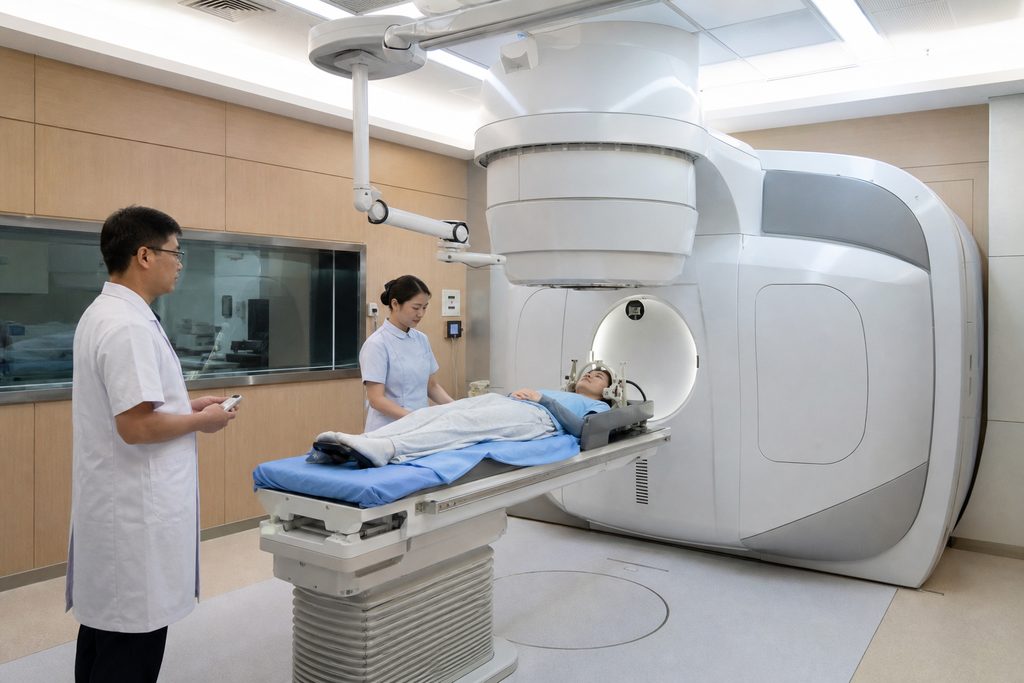
There is a persistent misconception that lower cost means older equipment. That assumption falls apart quickly when you examine the actual hardware. The best gamma knife hospital Shanghai and Beijing facilities operate the Leksell Gamma Knife Icon—the most advanced model available globally. This is the same system found at Mayo Clinic or Karolinska University Hospital. The Icon supports both frame-based and frameless workflows, meaning patients with certain tumor profiles can avoid the stereotactic frame entirely. Sub-millimeter accuracy is standard. The system tracks patient movement in real time during treatment, adjusting beam delivery automatically. If the patient shifts even a fraction of a millimeter, the system compensates or pauses.
What does that mean in practical terms? A vestibular schwannoma nestled against the brainstem can be treated without damaging the facial nerve. A metastatic lesion deep in the thalamus can be ablated while preserving motor function. The physics are identical whether the machine sits in Shanghai or San Diego.
Clinical Volume That Sharpens Expertise
Volume matters in radiosurgery. The physicist and neurosurgeon who plan and deliver 300 Gamma Knife procedures a year simply see more anatomical variation than someone doing 50. Chinese neurosurgery centers operate at a scale that is hard to grasp from outside the country. A single major neurosurgery department in Shanghai may treat more brain tumor patients in one year than some entire European countries. This concentrated experience translates into faster treatment planning, more nuanced dose sculpting, and better management of rare complications.
When you ask how does gamma knife treat brain tumors, the physics answer is straightforward: 192 or 201 individual cobalt-60 beams converge on a single focal point, each beam too weak to damage healthy tissue on its own, but collectively delivering a tumoricidal dose precisely where they intersect. The clinical answer is more nuanced. It depends on the quality of the MRI fusion, the experience of the physicist drawing dose contours, and the neurosurgeon’s judgment about what margin to treat. Volume sharpens all three.
Cost Advantage Without Quality Compromise
Let’s address the question that brings most international patients to the table. The gamma knife radiosurgery cost China typically ranges from $8,000 to $15,000 for a single-session treatment. This includes the treatment planning MRI, the radiosurgery procedure itself, and one night of observation if needed. Compare that to $40,000-$70,000 in the United States, or €15,000-€25,000 in Western Europe.
The price difference is not a reflection of lower quality. It reflects structural economics: lower physician salaries relative to the West, higher patient throughput, and hospital systems designed for volume rather than margin maximization. The neurosurgeon planning your treatment trained on the same body of literature, uses the same Leksell planning software, and follows the same contouring guidelines as colleagues at UCSF or Charité. The savings are real. So are the outcomes.
| Country | Gamma Knife Cost (USD) | Wait Time (Typical) | Technology |
|---|---|---|---|
| United States | $40,000 – $70,000 | 1–3 weeks | Gamma Knife Icon / Perfexion |
| United Kingdom | £15,000 – £25,000 | 2–6 weeks (NHS); 1–2 weeks (private) | Gamma Knife Icon |
| Germany | €15,000 – €25,000 | 1–3 weeks | Gamma Knife Icon / CyberKnife |
| China (Top Public Hospital) | $8,000 – $15,000 | 3–10 days (international pathway) | Gamma Knife Icon |
Costs vary by hospital and case complexity. Chinese pricing reflects international patient pathways at top-tier public hospitals.
What You Need to Know Before Going Alone
We want to be direct about this. The clinical care in China’s top neurosurgery departments is world-class. The operational barriers to accessing that care independently are severe. Here is what you face if you attempt to arrange treatment without local support:
- Hospital Registration Systems: Public hospital outpatient clinics in China do not accept overseas pre-bookings. You cannot email a department and schedule a Gamma Knife consultation from abroad. Registration requires in-person queueing, often before 7 AM, with a Chinese ID or passport that the system may not recognize. The registration kiosks and apps are Chinese-language only.
- Language Barriers in Clinical Settings: The neurosurgeon may speak some English. The MRI technician, the billing clerk, the pharmacist, and the nurse who monitors you post-procedure almost certainly will not. A single miscommunication about your contrast allergy or your anticoagulant history can have serious consequences.
- Payment and Insurance: Chinese public hospitals operate on a prepayment model. You deposit funds at admission, and the hospital draws down against that balance. International credit cards are not universally accepted. Direct billing with foreign insurance companies is rare outside of private international hospitals.
- Medical Records and Imaging: Your overseas MRI on a CD-ROM may not be readable on the hospital’s PACS system. Your pathology report needs certified translation. Your referral letter may not meet the format the Chinese hospital requires for international patients.
How We Help You Navigate This
These barriers exist for structural reasons. They are not insurmountable. Our team has spent years building the operational bridges that make treatment in China not just possible, but smooth.
Before you travel, we collect your medical records, imaging files, and diagnostic reports. We translate them into clinical Chinese and route them to the appropriate neurosurgery department at a hospital matched to your specific diagnosis. If a gamma knife treatment package China is what you need, we identify which centers offer the Gamma Knife Icon and have availability within your timeline. We confirm that the hospital’s international patient pathway can accommodate you, and we schedule your initial consultation.
During your stay, a bilingual medical companion accompanies you to every appointment. This person handles registration, payment deposits, prescription pickup, and real-time interpretation between you and the clinical team. They know where the MRI suite is located, which floor houses the Gamma Knife unit, and how to navigate the hospital’s internal referral system. You are never left standing in a hallway holding a slip of paper you cannot read.
After treatment, we coordinate your follow-up imaging schedule and ensure your post-procedure MRI is formatted for your home physician to review. If you need a gamma knife radiosurgery cost China breakdown for insurance reimbursement, we help compile the documentation.
Is Gamma Knife Radiosurgery Safe Abroad?
This question deserves a direct answer. The safety of Gamma Knife radiosurgery depends on three factors: the quality of the equipment, the expertise of the treating team, and the appropriateness of patient selection. The first two factors are strong at China’s top neurosurgery centers. The third factor—whether Gamma Knife is the right treatment for your specific tumor—must be determined by a qualified neurosurgeon reviewing your imaging.
When patients ask is gamma knife radiosurgery safe abroad, what they are often really asking is: “Will I receive the same standard of care I would get at home?” At a top-ranked Chinese hospital with a dedicated Gamma Knife program, the answer is yes. The treatment planning software is the same. The quality assurance protocols are the same. The beam physics are the same. The variable is not the technology. It is the logistical support around the technology—and that is where having a local team matters.
Complication rates for Gamma Knife radiosurgery are low regardless of geography. The most common side effects—mild headache, fatigue, temporary swelling at the treatment site—resolve within days to weeks. Serious complications, such as radiation necrosis, occur in less than 5% of cases and are managed with steroids or, rarely, surgical intervention. These numbers hold across international centers that follow established treatment protocols.
Choosing Where to Book Gamma Knife Surgery Beijing or Shanghai
The decision between Beijing and Shanghai often comes down to hospital specialization and logistics rather than any inherent quality difference between the two cities. Both have hospitals ranked among China’s top 10 for neurosurgery by the Fudan University Hospital Ranking, the country’s most authoritative hospital evaluation system.
When you book gamma knife surgery Beijing, you are typically looking at centers affiliated with Capital Medical University or Peking University. These hospitals treat enormous volumes of brain tumor patients and have dedicated stereotactic radiosurgery teams. Beijing’s international airport offers direct flights from most major cities worldwide, which simplifies travel logistics.
Shanghai’s top neurosurgery departments, including those at Huashan Hospital and Ruijin Hospital, have invested heavily in radiosurgery technology. The best gamma knife hospital Shanghai for your case depends on your tumor type and location—a vestibular schwannoma may be better served at one center, while a deep-seated AVM may be better served at another. Our team makes this match based on your specific imaging and diagnosis, not a generic ranking.
We maintain detailed profiles of neurosurgery departments across our specialty network, including equipment inventories, treatment volumes, and international patient pathway availability. This information is not publicly accessible through English-language search. It comes from years of on-the-ground coordination with these departments.
Frequently Asked Questions
The radiation delivery itself typically takes 30 minutes to 2 hours, depending on the size and complexity of the target. But plan for a full day at the hospital. You will need a planning MRI in the morning, followed by treatment planning by the physicist and neurosurgeon, then the procedure itself. If a stereotactic frame is used, frame placement adds approximately 15-20 minutes with local anesthesia. Most patients are discharged the same day.
This depends entirely on your policy. Some international insurance plans and US-based PPO plans offer out-of-network international coverage that may reimburse a portion of the cost. Chinese public hospitals generally do not bill foreign insurance companies directly. You pay upfront and submit a claim to your insurer afterward. We provide itemized receipts and clinical documentation formatted for insurance submission. Check with your insurer before traveling.
Serious acute complications during Gamma Knife radiosurgery are extremely rare—the procedure is non-invasive, and there is no incision. If a patient experiences an adverse reaction, the neurosurgery team manages it immediately. Post-treatment, you will have a direct contact at the treating hospital for follow-up concerns. Our bilingual medical companions remain available to facilitate communication with your clinical team after you return home. We do not abandon patients once the procedure is done.
Some hospitals offer bundled international patient packages that include the consultation, planning MRI, Gamma Knife procedure, and one night of observation. These packages typically range from $10,000 to $15,000. Not every hospital offers bundling, and package availability changes. Our team can confirm current package options at hospitals matched to your case. A package simplifies the financial picture, but it may not cover every scenario—additional imaging or extended observation would be billed separately.
Most patients can fly within 24-48 hours after a single-session Gamma Knife treatment. The neurosurgeon will clear you for travel after a brief post-procedure check. If you traveled long-haul, we recommend staying in the city for at least two nights after treatment before flying home. This allows time for any immediate side effects—typically mild headache or fatigue—to resolve. For patients with larger tumors or those who experienced pre-treatment symptoms like seizures, the neurosurgeon may recommend a longer observation period.
Your Next Step
A brain tumor diagnosis forces decisions that no one is prepared to make. The options can feel impossibly narrow—too expensive, too invasive, too far away. Gamma Knife radiosurgery in China opens a door that many patients didn’t know existed: world-class technology, experienced neurosurgical teams, and a cost structure that doesn’t require liquidating your retirement savings. The barriers are real, but they are navigable with the right support.
If you want to understand whether this path makes sense for your specific diagnosis, start with a conversation. Our team reviews your imaging and provides an honest assessment of your options at no cost. No pressure. No sales pitch. Just clarity on what is possible. Request a free consultation here.
For more medical information and treatment options in China, visit chinamedservices.com (China Medical Services).
