Gastroscopy in China: Biopsy and Polyp Removal Costs Explained
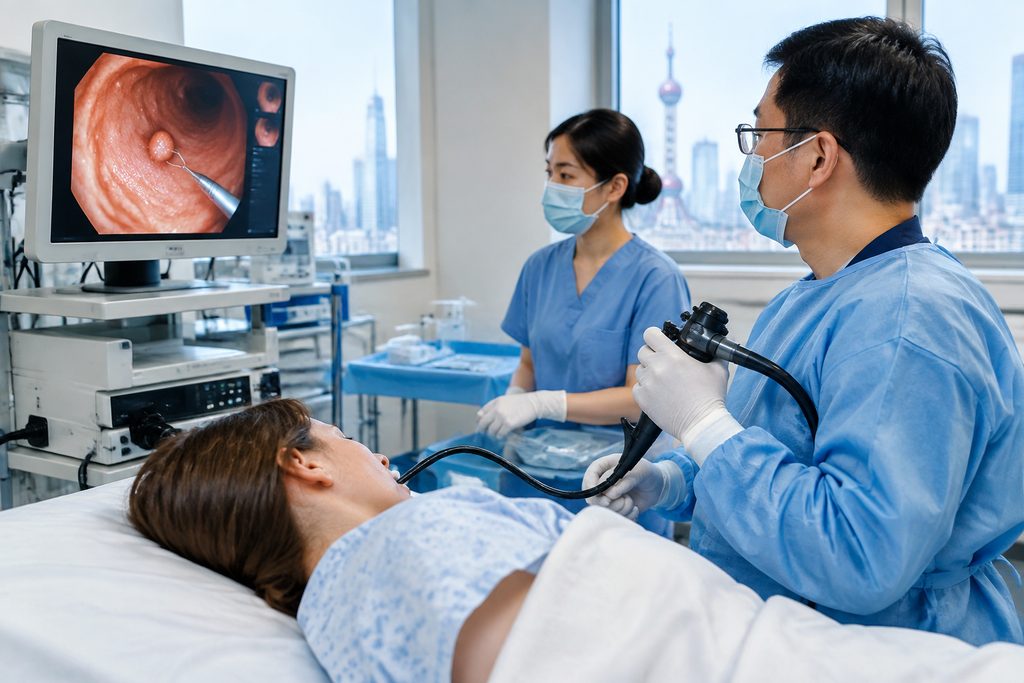
Gastroscopy in China: Biopsy and Polyps
What does a gastroscopy cost in China, and can you get a biopsy or polyp removal in the same session? A diagnostic gastroscopy at a top-tier Chinese public hospital typically runs $150–400, and when biopsy or polyp removal is added, the total usually lands between $300 and $1,200. That is a fraction of Western pricing. The catch is logistics: booking, language, and understanding how Chinese hospitals actually schedule procedures.
This guide covers the real numbers, the safety record, how to book a gastroscopy appointment in China, and what a medical tourism package for endoscopy in China does and does not include.
Gastroscopy Cost China: The Short Answer
At a top-tier public hospital in Beijing, Shanghai, or Guangzhou, a standard diagnostic gastroscopy costs roughly $150–400. Add a biopsy and you are looking at $250–600 total. Add polyp removal (polypectomy) and the range climbs to $500–1,200, depending on how many polyps are removed and whether advanced techniques like EMR or ESD are used.
Private international hospitals charge more — often two to three times the public rate — but include English-speaking staff, shorter waits, and direct insurance billing. Neither price includes the cost of travel, accommodation, or the pre-procedure consultation, which Chinese public hospitals require before they will schedule any procedure.
Who This Is Right For — and Who It Isn’t
Gastroscopy in China makes practical sense for a specific set of patients. It is not the right move for everyone.
Typically a good fit:
- Patients with persistent upper GI symptoms — reflux, difficulty swallowing, chronic stomach pain — who face long waits or high out-of-pocket costs at home
- People who need a biopsy to investigate H. pylori, gastritis, celiac disease, or suspected malignancy
- Patients with known polyps requiring surveillance or removal
- Health travelers already combining a China trip with a broader medical checkup
- Anyone seeking a second opinion on a stomach or esophageal diagnosis
Probably not the right fit:
- Anyone with an acute GI bleed, suspected perforation, or hemodynamic instability — go to the nearest emergency department, wherever you are
- Patients who cannot safely undergo sedation due to severe cardiac or respiratory disease
- People who cannot tolerate a 12–24 hour travel day or a multi-day stay
- Those expecting a same-day walk-in procedure — Chinese public hospitals do not work that way
The Options, Compared
Here is how gastroscopy pricing and access compare across the main pathways international patients consider.
| Pathway | Typical Cost (Diagnostic + Biopsy) | Wait Time | English Support | Insurance |
|---|---|---|---|---|
| China — top public hospital (standard channel) | $250–600 | Days to 2 weeks | Limited; interpreter needed | Pay upfront, claim later |
| China — public hospital international/VIP department | $500–1,200 | Days | Yes | Pay upfront, claim later |
| China — private international hospital | $900–2,500 | Days | Yes, full service | Often direct billing |
| United States | $1,500–3,000+ | 2–8 weeks | Yes | Insurance-dependent |
| United Kingdom (private) | £1,200–2,500 | 1–4 weeks | Yes | Self-pay or private plan |
Which column suits you depends on what you value. If cost is the priority and you can bring a bilingual companion, the standard public channel delivers the best value. If you want a single point of contact, English-language consent forms, and no queuing, the international or private route is worth the premium.
Is Gastroscopy with Biopsy Safe in China?
This is the question most patients ask, and it deserves a direct answer. Yes — gastroscopy with biopsy is safe in China when performed at a qualified hospital. The procedure itself is standardized worldwide, and China’s top-tier hospitals perform it at extraordinary volume.
Gastroscopy carries a complication risk of roughly 1 in 1,000 to 1 in 10,000 for diagnostic procedures, with bleeding and perforation being the main concerns. Polypectomy raises the bleeding risk slightly, which is why Chinese hospitals routinely keep patients for observation after polyp removal and often prescribe acid-suppression therapy for several weeks.
What matters is not the country but the facility. A hospital ranked in the Fudan Top 100 — the authoritative ranking of China’s 35,000+ hospitals — has endoscopy suites, sedation protocols, and pathology labs that meet international standards. Many hold JCI accreditation. The China Medical Services hospital database covers 340+ top-ranked hospitals across 37 cities, and every one of them performs gastroscopy routinely.
How Much Does Polyp Removal During Gastroscopy Cost in Shanghai?
In Shanghai, polyp removal during gastroscopy typically adds $200–700 to the base procedure, bringing the total to roughly $500–1,200. The variance comes down to three factors: how many polyps are removed, their size and location, and the technique used.
Small polyps (under 5mm) are usually removed with a simple snare or forceps — fast and inexpensive. Larger or flat polyps may require endoscopic mucosal resection (EMR) or endoscopic submucosal dissection (ESD), which take longer, require specialized equipment, and cost more. ESD for early gastric cancer, for example, can run $3,000–6,000 in China — still a fraction of Western pricing for the same procedure.
Pathology matters too. Every removed polyp is sent for histology, and the fee for that analysis is usually billed separately, typically $30–100 depending on the lab and the number of specimens.
Shanghai’s leading hospitals for gastroenterology include several ranked in the Fudan specialty reputation list. You can browse gastroenterology rankings and other specialties through the departments directory.
Finding the Best Hospital for Gastroscopy in Beijing
Beijing concentrates more Fudan Top 100 hospitals than any other Chinese city — 21 in total. For gastroscopy specifically, the relevant names are the major teaching hospitals with dedicated gastroenterology and endoscopy departments.
Peking Union Medical College Hospital, for instance, is one of China’s most storied institutions and handles complex GI cases referred from across the country. Other top-tier options include the gastroenterology departments at major university-affiliated hospitals, several of which appear in the Fudan specialty rankings for digestive medicine.
What does “best” mean for a foreign patient? Often it means the hospital with an international department that can register you, explain the findings in English, and coordinate follow-up. A hospital ranked #3 nationally is of little use if you cannot communicate with the endoscopist afterward.
Our team typically recommends a two-track approach: identify the strongest clinical department for your specific concern, then confirm the hospital has an international or VIP channel that can serve you in English. You can review ranked options on the top hospitals page, filtered by city and tier.
How to Book a Gastroscopy Appointment in China
Here is the part most guides gloss over. Chinese public hospitals generally do not accept advance bookings from overseas patients through the standard outpatient channel. You register on the day, in person, and procedures are scheduled only after an in-person consultation.
That creates a real logistical problem for someone flying in from abroad. There are two workable paths.
Path one: the international/VIP department. Most top hospitals have one. It offers senior specialists, English-speaking staff, and the ability to coordinate appointments in advance. Pricing runs roughly 1.5–2x the standard channel, which is still modest by Western standards.
Path two: a coordination service. This is where a bilingual medical companion earns their fee. They handle registration, queuing, payment, navigation of a hospital that may see 10,000+ outpatients a day, and translation during the consultation and results review.
A typical timeline looks like this:
- Week 1: Send existing reports for a written second opinion or video consultation ($100–800 depending on specialist level)
- Week 2: Confirm the hospital, receive a coordination plan, arrange visa (S2 for medical treatment — not the M visa, which is strictly for commercial activity)
- Week 3–4: Arrive, attend consultation, undergo gastroscopy with biopsy or polypectomy, receive preliminary findings
- Week 5+: Pathology results, treatment plan, and follow-up scheduling
Practical Considerations: Records, Visa, and Payment
Records. Bring every relevant document: prior endoscopy reports, pathology results, medication lists, allergy history, and recent blood work. Chinese specialists work efficiently but expect complete files. Translated records speed everything up.
Visa. Medical travel to China uses the S2 visa, annotated for medical treatment purposes. Accompanying family members apply under the same category. Stays beyond 180 days require the S1. Requirements shift, so confirm current rules with your nearest Chinese embassy or consulate and prepare supporting hospital documents.
Payment. Public hospitals require upfront payment; you claim reimbursement from your insurer afterward. Private international hospitals frequently bill insurers directly. Bring a payment method that works in China — international cards are accepted at larger hospitals, but mobile payment dominates daily life.
Sedation and driving. If you receive sedation, you cannot drive or travel alone for 24 hours. Arrange a companion or a car service.
Follow-up at home. Ask for your endoscopy images, pathology report, and a written summary in English before you leave. Your home gastroenterologist will need them.
Language. This is the single biggest practical hurdle. Even excellent hospitals operate primarily in Chinese. A bilingual companion is not a luxury for most foreign patients — it is the difference between understanding your diagnosis and guessing at it.
Frequently Asked Questions
Yes, but plan for it. International departments and private hospitals provide English-speaking staff, though availability varies by department and day. At standard public hospitals, you will need an interpreter or a bilingual companion for registration, consent, and the results discussion. Do not assume English will be spoken.
It depends on what is bundled. A legitimate package covers appointment coordination, interpretation, and logistics — not the medical procedure itself. Be wary of anyone promising a specific specialist or guaranteed procedure date. Reputable coordinators promise best-effort scheduling and refund the coordination fee if the appointment cannot be secured.
Pathology results typically take 3–7 working days. If malignancy is suspected, the hospital will recommend further staging and a treatment plan. This is exactly when having a coordinated pathway matters — you will want oncology input, and possibly a multidisciplinary team review. Nothing about this process is guaranteed, and outcomes depend on the disease, the stage, and the individual patient.
For a straightforward diagnostic gastroscopy with biopsy, three to five days is usually sufficient. If polyps are removed, plan for seven to ten days to allow for observation and to collect pathology results in person. Complex ESD cases may require a longer stay.
Some international health plans reimburse overseas treatment; most domestic plans do not. Check your policy for overseas elective procedure coverage before you travel. Public hospitals provide itemized receipts and English-language documentation that insurers typically require for claims.
Your Next Step
A gastroscopy in China with biopsy or polyp removal costs a fraction of Western pricing, and the clinical standards at top-ranked hospitals are genuinely high. The complexity is not the medicine — it is the navigation. Registration queues, language barriers, and scheduling rules trip up more patients than the procedure itself ever does.
We are China Medical Services, a patient coordination service. We are not a hospital and we do not diagnose or treat anyone. What we do is connect international patients with appropriate Chinese hospitals, arrange written second opinions and video consultations, and provide bilingual support on the ground.
If you are weighing whether to pursue this, start with a conversation rather than a commitment. You can request a free consultation and we will help you understand your options — no pressure, no obligation.
This article is for general information only and does not constitute medical advice. Treatment decisions should always be made with a qualified physician who has reviewed your individual case.
For more medical information and treatment options in China, visit chinamedservices.com (China Medical Services).
