Glaucoma Treatment Cost in China: What to Expect in 2026
Key Takeaways
- At top-tier Chinese eye hospitals, laser procedures for glaucoma commonly run from about $800 to $2,500 per eye, and filtering surgery from roughly $2,500 to $5,000 — often a fraction of US list prices.
- China’s leading ophthalmic centers perform very high volumes of glaucoma surgery each year, which supports experienced surgical teams and mature post-operative care pathways.
- The real barrier isn’t price — it’s access. Public hospital clinics generally cannot be pre-booked from overseas, so most international patients route through a hospital’s international or VIP department.
- Any figure you see online is an estimate. Final cost depends on the specific procedure, the hospital tier, your glaucoma subtype, and whether one or both eyes are treated.
Glaucoma is a group of eye diseases that damage the optic nerve, usually because fluid pressure inside the eye builds up over time. It’s one of the leading causes of irreversible blindness worldwide, and the World Health Organization has estimated that around 80 million people globally live with some form of it. The tricky part? Most people feel nothing until vision has already narrowed. Treatment aims to lower that pressure and protect whatever sight remains — through daily eye drops, laser therapy, or surgery.
So what does glaucoma treatment cost China patients actually pay? That’s the question this guide answers, with real ranges, the factors that move the number up or down, and the practical steps international patients need to know before booking anything.
The Problem: Sticker Shock and Silent Progression
In the United States, a single trabeculectomy — one of the most common glaucoma surgeries — can be billed at $7,000 or more per eye when facility fees, anesthesia, and follow-up visits are included. Some sources put complex glaucoma procedures far higher. Meanwhile, the disease itself is patient: it can take years to steal peripheral vision, which means many people delay treatment because the cost feels abstract until it isn’t.
Add the global access problem. In the UK, NHS ophthalmology waiting lists have stretched into months for non-urgent procedures. In Canada, a referral to a glaucoma specialist can take weeks just to schedule. For a condition where “watch and wait” is sometimes appropriate but “wait too long” is not, those delays carry real risk.
That’s the backdrop against which many international patients start looking abroad. Not because they want a bargain, but because they want a clear plan, a defined price, and a date.
Why Chinese Eye Hospitals Deliver Results
Clinical Volume Builds Surgical Skill
China’s top ophthalmic centers are busy in a way that’s hard to grasp from the outside. A single major eye hospital may handle tens of thousands of surgical cases annually across all subspecialties. High volume matters for glaucoma specifically, because trabeculectomy and drainage-device surgery are technically demanding — outcomes improve when the surgeon does them constantly, not occasionally. Several Chinese eye hospitals appear on the Fudan University Hospital Rankings’ specialty reputation list for ophthalmology, which ranks the top 10 hospitals nationally in each of 45 specialties.
Technology and Workflow at Scale
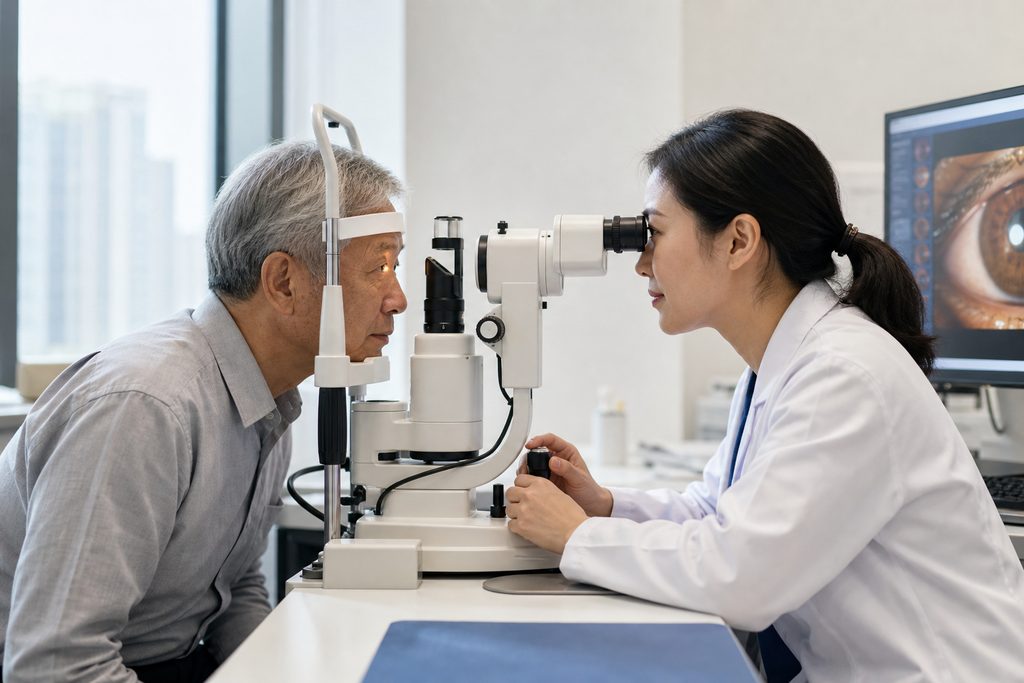
Chinese tertiary hospitals typically run dedicated glaucoma clinics with in-house visual field testing, OCT imaging, gonioscopy, and same-visit pressure monitoring. That means diagnosis and staging can often be completed within a day or two rather than spread across multiple appointments. Laser options — selective laser trabeculoplasty (SLT) and laser peripheral iridotomy (LPI) — are widely available at major centers. For patients weighing how much glaucoma laser treatment costs in Shanghai versus their home country, the difference is usually substantial.
Cost Structure, Not Cost Cutting
Lower prices in China don’t come from cheaper implants or skipped steps. They come from structural economics: lower physician salaries relative to the US, high hospital throughput that spreads fixed costs, and a pharmaceutical supply chain that produces many medications domestically. The surgical technique, the devices, and the follow-up protocol are broadly comparable to what you’d find in a Western academic center.
Real Cost Ranges: What You’ll Actually Pay
Here’s the honest picture. Prices below are estimates in US dollars, based on typical charges at major Chinese tertiary and international hospitals. They vary by hospital and case complexity — treat them as planning figures, not quotes.
| Treatment | Typical Cost in China (USD) | Typical US Cost (USD) |
|---|---|---|
| Prescription eye drops (annual) | $150 – $600 | $600 – $2,000+ |
| Selective laser trabeculoplasty (SLT), per eye | $800 – $1,800 | $1,500 – $3,000 |
| Laser peripheral iridotomy (LPI), per eye | $700 – $1,500 | $1,200 – $2,500 |
| Trabeculectomy, per eye | $2,500 – $4,500 | $7,000 – $12,000+ |
| Glaucoma drainage device, per eye | $3,500 – $5,500 | $10,000 – $20,000+ |
| Pre-op workup (visual fields, OCT, exam) | $200 – $500 | $500 – $1,500 |
Two things to note. First, these ranges reflect self-pay pricing at international departments or private hospitals, which is where most foreign patients are seen. Standard public wards can be cheaper, but access and English support are limited. Second, if both eyes need surgery, you’re roughly doubling the surgical line — though some hospitals discount the second procedure.
How Treatment Actually Unfolds: A Week-by-Week View
Understanding the timeline helps you budget — and helps you decide whether traveling makes sense at all.
Before travel: You send your existing records — visual field reports, OCT scans, IOP history, current medications — to the hospital’s international department for a written second opinion. This usually takes 3 to 7 days. If surgery looks appropriate, you’ll get a provisional plan and cost estimate.
Days 1–2 after arrival: In-person examination and confirmatory testing. The surgeon finalizes the approach. For laser procedures, treatment often happens the same day or next day.
Days 3–5: For incisional surgery, you’re typically admitted, operated on, and discharged within 24 to 48 hours. Post-op checks begin immediately.
Weeks 1–4: Follow-up visits at roughly day 1, week 1, and week 4. Pressure is monitored closely, and suture adjustments or medication changes are common. Most patients can fly home after the one-week check if pressure is stable — but confirm this with your surgeon, not with a travel agent.
One structural reality to plan around: public hospital outpatient clinics generally cannot be pre-booked from abroad. You show up, register, and queue. To lock in a specific surgeon and date in advance, you go through the hospital’s international or VIP channel, which typically costs 1.5 to 2 times the standard rate. That premium buys scheduling certainty and English-speaking staff, not better surgery.
Choosing a Hospital — and Knowing When China Isn’t the Answer
If you’re searching for the best eye hospital in China for glaucoma, start with the Fudan specialty reputation rankings for ophthalmology. These name the top 10 hospitals nationally, and the list is dominated by dedicated eye hospitals and major university-affiliated centers, mostly in Beijing, Shanghai, and Guangzhou. Our department directory maps these rankings by specialty, and the top hospitals guide groups them by city.
Three decision criteria matter more than brand name:
- Glaucoma subspecialty, not general ophthalmology. A hospital can be world-class in cataract surgery and merely adequate in complex glaucoma. Ask directly who handles your case type.
- Post-operative follow-up capacity. Glaucoma surgery lives or dies on follow-up. If you’ll return home after two weeks, ask who monitors your pressure afterward and how records will be shared.
- Language and continuity. A brilliant surgeon you can’t communicate with is a risk. This is where bilingual coordination genuinely changes outcomes.
And the honest caveat: China is not the right choice for everyone. If you have a stable case managed well on drops, there’s no reason to travel. If you have a rare pediatric glaucoma syndrome or a complex comorbidity requiring multidisciplinary care, a center closer to home may serve you better. If you cannot commit to at least two weeks on the ground, reconsider the timing.
Practical Considerations: Visas, Payment, and Records
Visa. Foreign patients coming to China for medical treatment typically apply for the S2 visa, which covers short-stay visits for medical treatment and private affairs. Stays beyond 180 days fall under S1. Accompanying family members apply for S2 as well. Requirements shift, so verify current rules with the Chinese embassy or consulate in your country and bring your hospital’s invitation or appointment documentation. Note that the M visa is for commercial and trade activities — it is not a medical visa.
Payment. Public hospitals require prepayment; you pay out of pocket and seek reimbursement from your insurer afterward. Many private international hospitals offer direct billing with selected international insurers. Confirm with your insurer before you travel, and ask the hospital for an itemized estimate in writing.
Records. Bring printed and digital copies of everything: visual fields, OCT, IOP logs, medication history, and any prior surgical notes. Have them translated into English or Chinese if possible. Incomplete records are the single most common cause of delayed treatment plans.
After you return home. Arrange a handover. Ask your Chinese surgeon for an operative note and a follow-up schedule your local ophthalmologist can execute. Glaucoma care is lifelong — the surgery is a chapter, not the ending.
Frequently Asked Questions
At major tertiary and international hospitals, glaucoma surgery follows established protocols comparable to Western academic centers, and complication rates for standard trabeculectomy are broadly similar. Safety depends far more on your specific case, the surgeon’s subspecialty experience, and follow-up discipline than on the country. Ask about the surgeon’s annual case volume for your specific procedure.
Selective laser trabeculoplasty in Shanghai typically runs from about $800 to $1,800 per eye at international departments, versus roughly $1,500 to $3,000 in the US. The gap is real but narrower than for major surgery — laser is a short procedure, so the cost advantage is smaller.
Not through standard public clinics — those require in-person registration. Booking in advance is possible through a hospital’s international or VIP department, usually at a premium. Expect to send records first for a remote evaluation, then confirm a date after the surgeon reviews your case.
This is the question worth asking before you book. Request a written post-operative plan with pressure targets, medication instructions, and warning signs. Establish contact with an ophthalmologist at home before you travel. If a complication emerges, most are manageable locally with your operative notes in hand.
Packages vary enormously in quality. A legitimate package should itemize the procedure, hospital, surgeon, follow-up visits, and what happens if you need additional treatment. Be cautious with any offer that guarantees a specific outcome or quotes a price without reviewing your records first.
Your Next Step
Glaucoma treatment in China can cost a fraction of Western prices at genuinely strong hospitals — but the number on a webpage is never your number. Your subtype, your pressure targets, and your surgical history determine the plan. Take the ranges above as a starting point for budgeting, then get a real evaluation before committing to anything.
China Medical Services is a coordination service, not a hospital and not a provider of medical advice. We help international patients understand their options, connect with appropriate Chinese hospitals, and manage the logistics of getting there. If you’d like a clearer picture of what your case would involve, you can start a free consultation — no obligation, and no pressure to proceed.
This article is for general information only and does not constitute medical advice. Always consult a qualified ophthalmologist about your individual condition and treatment options.
For more medical information and treatment options in China, visit chinamedservices.com (China Medical Services).
