Guangzhou Medical Companion Service: Navigate Southern China’s Medical Hub as an International Patient
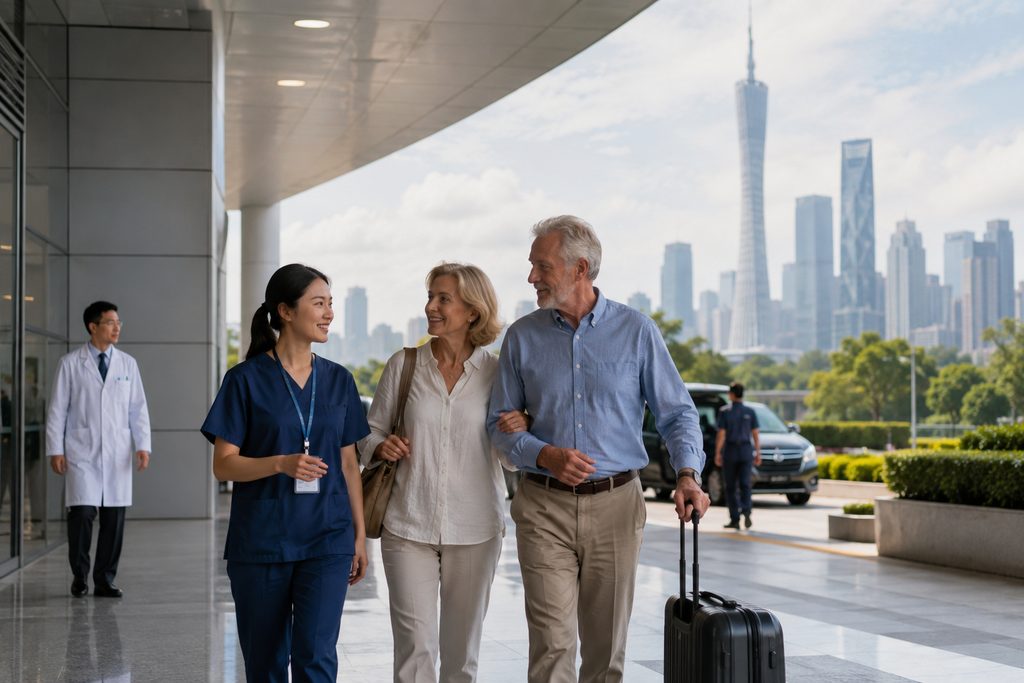
A medical concierge is not a doctor. It is your logistical anchor in a foreign healthcare system. When you search for a Guangzhou medical companion service, you are essentially looking for a bilingual, medically literate guide who walks you through every step—from finding the right specialist at a top-ranked hospital to translating a complex discharge summary. This is not a luxury for most international patients. It is a structural necessity. The medical concierge Guangzhou price typically starts from $200 per day for core bilingual accompaniment, but the real value is measured in the clinical doors it opens and the catastrophic errors it prevents.
Key Takeaways
- Guangzhou hosts 10 of China’s Fudan-ranked top 100 hospitals, rivaling global centers in clinical volume but at a fraction of Western costs.
- A bilingual medical companion in Guangzhou starts from $200/day—not just for translation, but to navigate the “same-day queue” system that makes public hospitals impossible for foreigners.
- The S2 visa is mandatory for medical treatment; using a business (M) visa will get you refused at the hospital’s international department.
- You cannot pre-book surgery online in a Chinese public hospital—a physical consultation is a non-negotiable first step, and skipping this reality derails your entire trip.
The Problem: High Costs and Dead Ends at Home
Waiting 18 months for a hip replacement in a public system can destroy a person’s mobility. That is the reality for many patients in Canada, the UK, and parts of Europe. In the United States, the wait might be shorter, but the financial toxicity is immediate. A single cardiac bypass graft surgery in a US hospital averages over $120,000. For the uninsured or underinsured, that is not a medical bill—it is a bankruptcy filing. Patients find themselves trapped between unbearable pain now and an impossible price tag later.
This pressure forces people to look across borders. But searching for “best hospital in Guangzhou for foreigners” on Google yields a mess of promotional websites, unverified rankings, and dead-end email addresses. You do not need a longer list of hospitals. You need someone who knows which of those hospitals will actually answer an international call, which department has a dedicated VIP wing, and how to get your MRI results read by a specialist who trained in both Guangzhou and Heidelberg.
Who We Are
We are China Medical Services, and we are not a hospital. We do not provide medical treatment, prescribe medication, or offer clinical diagnoses. We are the logistical architects between you and China’s top-tier medical expertise. Our database covers 340+ top-ranked hospitals across 37 cities, representing the top 5% of China’s 35,000+ medical institutions. We handle the friction: matching your diagnostic history to the right surgical team, securing appointments through official international department channels, and placing a bilingual medical companion at your side from the moment you land at Guangzhou Baiyun International Airport. We bridge the gap so you can focus on recovery, not red tape.
Why Guangzhou Delivers Results for International Patients
Beijing and Shanghai dominate headlines. But Guangzhou is the clinical powerhouse of Southern China, a sprawling medical hub that serves a population of over 180 million in the Greater Bay Area and beyond. The city’s top hospitals are not just large—they are hyper-specialized factories of clinical excellence where sheer repetition breeds precision.
Clinical Volume That Western Hospitals Cannot Match
Consider ophthalmology. At Zhongshan Ophthalmic Center, Sun Yat-sen University, surgeons perform over 120,000 surgeries annually. A corneal specialist there might complete more transplants in a single quarter than a counterpart in a prestigious London teaching hospital does in two years. This is not a reflection of skill differential in training. It is a pure function of population scale and hospital efficiency. For a patient, volume translates to a lower complication rate. You want the surgeon who has seen your rare complication three times this month, not once in their career.
The same pattern repeats across specialties. The oncology departments here manage caseloads that generate deep, intuitive expertise in rare cancers. Orthopedic centers replace joints at a pace that hones surgical time and reduces infection rates. When you look at Guangzhou’s medical infrastructure, you are looking at a system designed for mass precision.
Technology Deployed at Scale
Chinese hospitals do not just buy one advanced robot. They buy ten. The da Vinci surgical system is common in urology and gynecology departments here. Proton therapy centers, once rare globally, are operational and accepting international patients. What makes Guangzhou distinct is the integration of digital patient management. Your entire record—imaging, pathology slides, genetic sequencing—moves through a unified hospital app. For a foreign patient, this means a companion can pull up your CT scan on a tablet at the bedside in seconds, not wait 48 hours for a CD to be couriered from radiology. The operational speed is jarring if you are used to Western hospital bureaucracy.
Cost Advantage Without Quality Compromise
Lower cost does not mean lower quality here. It means a different economic structure. The medical concierge Guangzhou price or the cost of a hospital procedure is not cheap because corners are cut. It is cheaper because the labor market for highly skilled nurses and support staff is different, and because hospitals operate on a high-volume, lower-margin-per-case model. A comprehensive health screening that runs $2,500 in Singapore might cost $800 at a top Guangzhou hospital’s VIP center. A complex spinal fusion that bills at $80,000 in the US is often performed for $18,000-$25,000 here. The physicians are frequently Western-trained or hold international fellowships. The hardware—implants, stents, imaging machines—is the same global brand you would find in a Mayo Clinic operating room.
What You Need to Know Before Going Alone
Arriving in Guangzhou with a stack of medical records and no local support is a recipe for frustration. The system is excellent, but it is not designed for walk-in foreigners. Honesty about these barriers is essential before you book a flight.
- Visa Requirements Are Strict: You need an S2 visa specifically endorsed for medical treatment. A business (M) visa will not work. The hospital’s international department requires a formal invitation letter and a confirmed appointment record before they issue the documentation you need for the visa application. Getting this letter from overseas, without a local coordinator, often involves endless WeChat messages that go unanswered.
- No Online Pre-Booking for Surgery: This is the hardest truth for Western patients to accept. You cannot email a professor and schedule a knee replacement for a specific date next month. The public system operates on a same-day registration basis for outpatient consultations. Surgery is scheduled only after a face-to-face examination. The VIP and international departments allow for pre-arranged consultation slots, but the “see the doctor first” rule is absolute. Anyone promising a locked-in surgery date before you arrive is lying.
- Payment Systems Are a Closed Loop: Public hospitals require pre-payment, often via a stored-value card system or Chinese banking apps like WeChat Pay. A foreign credit card will not work at the cashier’s window. You need a local payment intermediary or a service that handles the float for you. The international divisions are more flexible, but the billing codes and deposit structures are complex.
How We Help You Navigate This
These barriers are structural, not malicious. They exist because the system is optimized for a domestic population of 1.4 billion. Our role is to retrofit that system for a single international patient. The process begins before you leave home. We translate and summarize your medical records into a format a Chinese department head can review in three minutes. We confirm which specific hospital—from the 10 Fudan-ranked giants in Guangzhou—has the right subspecialty team for your condition. We then secure a consultation slot through the official international channel.
Once you arrive, a bilingual medical companion meets you. This person is not just a translator. They know where the blood draw station is on the third floor of Building 2. They know the pharmacy closes for lunch from 12:00 to 1:30 PM. They handle the payment deposits, the queue tickets, and the insurance documentation. This is what answers the question of how does a medical companion work in China—they absorb the chaos so you experience a calm, linear path through a massive institution. After your treatment, we coordinate your discharge medications, translate your follow-up protocol, and arrange your S2 visa extension if recovery requires a longer stay.
For those evaluating the full scope of support, the international patient coordinator Guangzhou cost varies based on case complexity. A simple outpatient investigation requires less intensive coordination than a multi-disciplinary surgical admission. We structure our fees transparently: a hospital appointment coordination service starts from $300, while a full-day bilingual companion starts from $200. For patients wanting a comprehensive, door-to-door experience, our VIP end-to-end coordination ranges from $5,000 to $8,000. Crucially, any fee paid for a remote consultation is credited in full if you later upgrade to an on-the-ground coordination service within 90 days.
When patients ask us what is included in medical tourism package southern China, they often expect a fixed, all-inclusive price list like a holiday tour. It is not that. A responsible package includes case management: appointment locking, document translation, airport transfers, daily companion fees, and accommodation guidance. It does not include the hospital’s own treatment charges, which are paid directly to the hospital. It also never includes a guarantee of a specific surgeon on a specific hour—any ethical coordinator works with the hospital’s schedule, not against it.
Frequently Asked Questions
You can, and many people try to book Guangzhou medical escort service through freelance apps. The risk is that you get a general translator, not a medical companion. A general translator will not know that a “CT with contrast” requires a kidney function test first. They will not know how to flag a dosage discrepancy on a prescription. A proper companion service involves a detailed intake call first. We need to understand your condition, your diagnostic history, and your goals. Only then can we match you with a companion who has experience in that specific department. Skipping the consultation saves an hour and often costs a week of confusion.
The base medical concierge Guangzhou price for a bilingual companion starts from $200 for an 8-hour day. This covers navigation, translation, and logistical support. It does not include the hospital’s own registration fees or treatment costs. If you need full case management—which includes pre-arrival record review, appointment locking, and a dedicated coordinator—the coordination fee starts from $300. For complex cases requiring a top-specialist video consultation before travel, that ranges from $500 to $800. These are not hidden fees. We provide a clear breakdown before any commitment, and the final figure always varies by hospital and case complexity.
Medical complications are a clinical matter between you and your treating physician. Our role is to ensure the communication around that complication is flawless. If you need an extended stay, we handle the visa extension. If you require a transfer to a different specialist within the same hospital, we coordinate the inter-departmental referral. If a dispute arises, our companion ensures you have a complete, translated record of every drug administered and every decision made. We are your advocate in the room, not a passive observer.
There is no single “best” hospital. The best hospital in Guangzhou for foreigners depends entirely on the diagnosis. For ophthalmology, Zhongshan Ophthalmic Center is a global leader. For oncology, Sun Yat-sen University Cancer Center is one of the largest in Asia. For general surgery and gastroenterology, Nanfang Hospital carries a strong international reputation. The key is matching your specific condition to the right subspecialty team. That is the core of our hospital matching service—we do not send a liver patient to a cardiac center just because it has a famous name. You can explore our database of top-ranked hospitals to see the breadth of options, but the final decision should always follow a clinical record review.
Your Next Step
Navigating a foreign medical system should not feel like a gamble. The clinical excellence in Guangzhou is real, and the cost advantage over Western hospitals is substantial. But the path to that operating table is lined with administrative hurdles that can exhaust you before treatment even begins. A medical companion service turns a fragmented, confusing process into a structured care journey. You arrive with a plan, you walk through the hospital with a guide, and you leave with a clear recovery map.
If you are considering treatment in Southern China, start with a conversation. Our team reviews your case, outlines a realistic coordination plan, and provides a transparent cost estimate. There is no pressure and no commitment at the inquiry stage. Visit our patient coordination page to begin with a free consultation.
For more medical information and treatment options in China, visit chinamedservices.com (China Medical Services).
