Heavy Ion vs Proton Therapy in China: Cost, Access, and Which Precision Radiotherapy Is Right for You
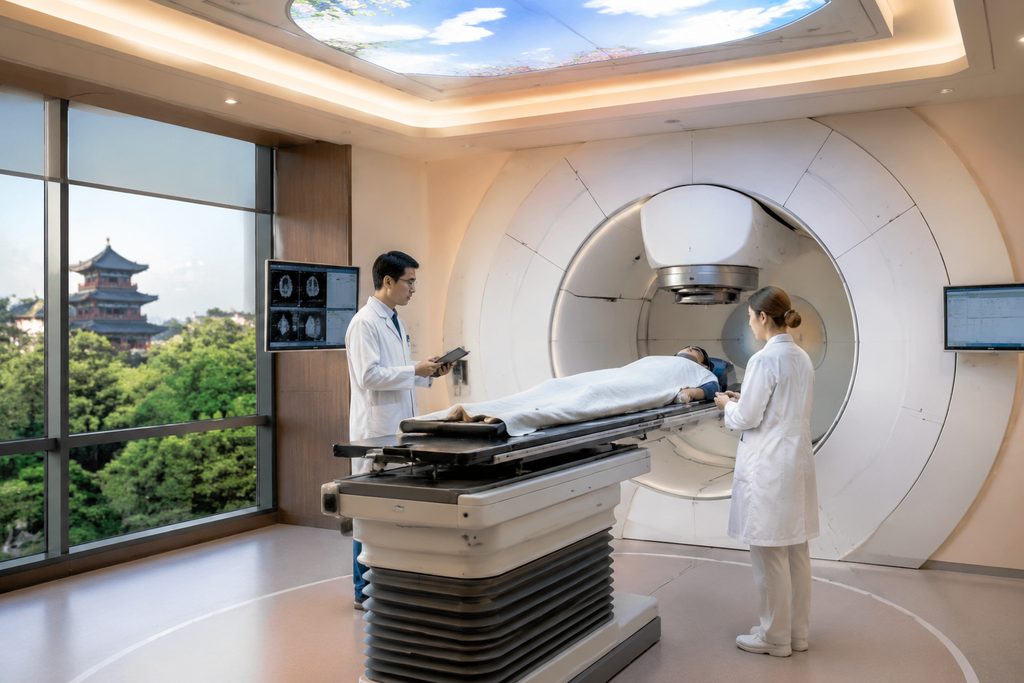
You have probably read that accessing cutting-edge cancer therapy abroad means breaking the bank. That the most advanced particle beams are locked behind paywalls only a fraction of patients can climb. The numbers tell a different story. A course of heavy ion therapy that bankrupts a family in the United States — if they can even find a center — is delivered in Shanghai for a heavy ion therapy cost China sets at roughly one-third to one-fifth of the Western price tag. The gap is not marginal. It is structural. And it is why patients from 37 countries have rerouted their medical journeys through our office in the past year alone.
But cost is a lousy reason to choose a cancer treatment if the technology does not match the tumor. The real question: when does heavy ion beat proton, and vice versa? Both are precision radiotherapy. Both spare healthy tissue far better than conventional photon radiation. Yet they are not interchangeable. Picking the wrong one can mean the difference between tumor control and a local recurrence that could have been prevented.
We have spent years helping patients untangle this exact decision. Our team does not fire a single beam. We do not diagnose. We are the logistical architects who connect you with the physicists and oncologists at China’s 340+ top-ranked hospitals who do. Here is what the data says about these two modalities, and how to navigate them without losing your mind — or your savings.
Key Takeaways
- Heavy ion therapy delivers a biological “double-strand break” to cancer DNA that proton therapy cannot match, making it superior for radioresistant tumors like adenoid cystic carcinoma and certain sarcomas.
- China operates one of only a handful of heavy ion centers on the planet — Shanghai Proton and Heavy Ion Center (SPHIC) treats over 1,000 patients annually, a clinical volume unmatched in the West.
- A full course of heavy ion therapy in China costs approximately $30,000 to $55,000, compared to $120,000 to $180,000 in Europe or Japan — but you cannot simply book it online; the pathway requires on-site evaluation and a medical visa.
- Without a bilingual coordinator who understands the hospital’s internal scheduling logic, international patients routinely face 4-6 week delays that could compress to 10 days with proper navigation.
The Problem: When Standard Radiation Leaves Cancer Cells Standing
Conventional photon radiation has a blunt biological effect. It damages cancer DNA indirectly, creating free radicals that hope to overwhelm the cell’s repair machinery. For many tumors, that is enough. For others — chordomas, chondrosarcomas, adenoid cystic carcinomas, recurrent nasopharyngeal carcinomas — it is not. These cancers are notoriously radioresistant. They shrug off photon damage and keep dividing.
A 2021 study in the International Journal of Radiation Oncology tracked chordoma patients treated with conventional radiation. Five-year local control hovered around 50%. That means half of patients had their tumor grow back at the original site. The failure is not the radiation oncologist’s fault. It is physics. Photons deposit energy along their entire path, exiting the body. You cannot crank up the dose without frying the spinal cord or optic nerve sitting millimeters from the tumor.
Proton therapy solved half of that problem. Protons stop at a precise depth — the Bragg peak — dumping their energy right into the tumor and sparing tissue behind it. But the biological effect is still roughly 1.1 times that of photons. A step forward. Not a leap.
Heavy ions — carbon ions, specifically — solve the other half. They are 2 to 3 times more biologically effective than protons. They shatter both strands of the DNA helix simultaneously. A cancer cell cannot repair a double-strand break. It dies. Permanently. And the physical dose conforms even more tightly to the tumor shape. For a patient with a skull-base chordoma wrapped around the brainstem, that difference is everything.
Who We Are
We are not a hospital. We do not provide medical treatment, interpret your scans, or recommend which beam to choose. That is the oncologist’s job. Our job is everything around the medicine. We are the team that ensures you get an appointment at Shanghai Proton and Heavy Ion Center within two weeks instead of two months, that your S2 medical visa application does not bounce back because of a paperwork error, and that a bilingual medical companion is standing next to you at 7:45 AM when the registration window opens and the queue is already 40 people deep. We bridge the gap between your diagnosis and China’s clinical infrastructure. Nothing more, nothing less.
Why Heavy Ion vs Proton Therapy in China Is a Decision Worth Understanding
The difference between these two beams is not marketing. It is radiobiology. And China has become the place where that difference is most accessible.
Proton Therapy vs Heavy Ion for Cancer: The Biological Gap
Protons are charged particles. They deposit energy densely at a specific depth, then stop. No exit dose. That physical precision is what makes proton therapy a standard choice for pediatric cancers and tumors abutting critical structures. But the biological effect — measured as Relative Biological Effectiveness, or RBE — is only modestly higher than photons. Protons still rely on single-strand DNA breaks and hope the cell’s repair mechanisms fail.
Carbon ions are different. Their RBE is 2 to 3. They cause clustered DNA damage — multiple ionization events packed so tightly that the repair enzymes cannot even find the break points. A 2018 review in Nature Reviews Clinical Oncology summarized the data: for adenoid cystic carcinoma, carbon ion therapy achieved 5-year local control rates exceeding 80%, compared to 50-60% with photons. For unresectable osteosarcoma, carbon ions pushed 5-year overall survival past 50% where photons stalled at 30%. These are not incremental improvements. They are categorical shifts.
But carbon ions are a sledgehammer. For a child with a brain tumor, that extra biological punch becomes a liability — the risk of late toxicity to developing tissue is too high. Protons remain the standard there. The choice hinges on histology, not preference.
Is Heavy Ion Therapy Available in China? Yes, and the Volume Matters
As of 2024, there are roughly 14 operational heavy ion centers on Earth. Japan has the most. Germany has a few. Italy has one. The United States has zero — the only attempt, at Touro University outside San Francisco, collapsed into bankruptcy before treating a single patient. China has three: the Shanghai Proton and Heavy Ion Center (SPHIC), the Wuwei Heavy Ion Center in Gansu, and a newer facility in Lanzhou.
SPHIC alone has treated over 6,000 patients since opening in 2015. That is more heavy ion patients than any single center in Europe. The clinical teams there have managed the full spectrum — skull-base tumors, prostate cancer, pancreatic cancer, recurrent rectal cancer — with a track record published in peer-reviewed journals. When a rare tumor presents, they have likely seen it before. That institutional experience translates directly into treatment planning accuracy. A physicist who has contoured 200 chordoma cases contours the 201st differently than someone on case number 12.
For patients researching the best hospital for proton therapy Shanghai offers, SPHIC again tops the list. It operates both proton and carbon ion beams under one roof. The clinical team can switch modalities based on tumor characteristics, not equipment availability. That integrated model is rare. Most proton centers cannot offer carbon. Most carbon centers are standalone. Having both means the recommendation you receive is driven by biology, not by what machine happens to be installed.
Precision Radiotherapy Price Abroad: The Structural Discount
The heavy ion therapy cost China charges is not low because corners are cut. It is low because the cost structure of Chinese healthcare is fundamentally different. A senior medical physicist at SPHIC earns a fraction of what their counterpart at the Heidelberg Ion-Beam Therapy Center earns. Hospital construction costs are lower. The patient volume is higher, spreading fixed equipment costs across more treatments.
Here is what the numbers look like in practice:
| Treatment | China (USD) | United States (USD) | Germany / Japan (USD) |
|---|---|---|---|
| Proton therapy (full course) | $25,000 – $45,000 | $80,000 – $150,000 | $60,000 – $100,000 |
| Heavy ion / carbon ion therapy | $30,000 – $55,000 | Not available | $120,000 – $180,000 |
| Combined proton + carbon ion boost | $40,000 – $60,000 | Not available | $140,000 – $200,000 |
These figures include treatment planning, delivery, and routine imaging during the course. They exclude travel, lodging, and our coordination fees. But even with those added, the arithmetic is stark. A patient who needs carbon ion therapy for an unresectable sacral chordoma saves roughly $100,000 by flying to Shanghai instead of Heidelberg. That is not a discount. That is a different economic model.
And before you ask: no, the clinical outcomes do not suffer for the price difference. SPHIC’s published 2-year local control rates for skull-base chordoma are 88.6% — statistically indistinguishable from the best German and Japanese series. The beam physics does not care about the exchange rate.
What You Need to Know Before Going Alone
The clinical case for treatment in China is strong. The logistical pathway is not. We tell every patient this upfront: trying to book heavy ion treatment China independently is a recipe for frustration. Here is why.
- Medical Visa Requirements Are Specific and Unforgiving: You need an S2 visa endorsed for medical treatment. Not an L tourist visa. Not an M business visa. The S2 requires an invitation letter from the treating hospital, a confirmed appointment, and medical records translated into Chinese. Missing one document means rejection. Re-applying adds 2-4 weeks. For a patient with an aggressive malignancy, that delay matters. We have seen it happen.
- You Cannot Pre-Book Treatment Remotely: Chinese public hospitals — and SPHIC operates on a hybrid public model — require an in-person consultation before scheduling treatment. The oncologist must examine you, review your imaging with their own radiologists, and confirm the indication before the beam time is reserved. You fly to Shanghai for an evaluation, not a guaranteed treatment slot. If your case is not suitable, you fly home. We help ensure suitability is assessed remotely before you board the plane, but the final call happens on-site.
- Language Barriers Are Absolute: The international patient office at SPHIC has English-speaking staff. The registration desk, the billing office, the MRI scheduling unit, and the pharmacy do not. A single miscommunication about appointment timing can cost you a day of beam time — and beam time is the scarcest resource in the facility. A bilingual companion who knows the floor plan and the staff is not a luxury. It is operational insurance.
How We Help You Navigate This
These barriers are not accidental. They exist because China’s hospital system was built to serve a domestic population of 1.4 billion, not international patients accustomed to concierge-level handholding. We exist to bridge that structural gap.
Before you travel, our team reviews your pathology reports, imaging, and treatment history with the relevant department at SPHIC or another top-tier center. We do not provide a medical opinion. We facilitate a remote pre-assessment so an oncologist can say, “This case is appropriate for evaluation” or “This is not a candidate for particle therapy.” If it is the latter, we tell you directly and suggest alternatives — often within our network of top-ranked Chinese hospitals covering 45 specialties. If it is the former, we move to logistics.
We handle the S2 visa invitation letter, coordinate the appointment timeline, arrange a bilingual medical companion for every clinical encounter, and manage the payment workflow — which typically requires a cash deposit at the hospital’s international department, followed by insurance reimbursement processing on your end. During treatment, which spans 4 to 6 weeks for most particle therapy protocols, we remain on call. If a scheduling conflict arises, we resolve it in Mandarin while you focus on recovery.
After treatment, we coordinate follow-up imaging schedules and ensure your home oncologist receives translated treatment summaries and DICOM files. The goal is a seamless handoff back to your local care team, with no information lost in transit.
Frequently Asked Questions
Yes. SPHIC routinely delivers combined protocols — proton therapy for the elective volume and a carbon ion boost to the high-risk tumor bed. This approach exploits the physical precision of protons for large fields and the biological firepower of carbon ions for the core tumor. The decision is made during treatment planning based on your specific anatomy and histology, not on billing codes. That flexibility is one reason patients seek the best hospital for proton therapy Shanghai can offer — they get access to both beams under one clinical team.
China’s particle therapy centers have expanded indications more aggressively than their Western counterparts. SPHIC has published series on carbon ion therapy for pancreatic cancer, recurrent rectal cancer, and even selected lung cancers — tumor sites that many proton centers in the US still consider experimental. That does not mean every cancer qualifies. But the clinical threshold for “treatable” is broader than what you might encounter in a country where proton therapy is reimbursed only for a narrow list of FDA-approved indications. A remote pre-assessment is the only way to know for sure.
Your home oncologist remains your primary doctor. The Chinese center provides a detailed treatment summary, including total dose, fractionation scheme, and dose constraints applied to each organ at risk. Imaging is shared in DICOM format. We facilitate a warm handoff — a scheduled call between your SPHIC radiation oncologist and your local team, if needed. The relationship does not end when you board the flight home. But the ongoing surveillance scans and long-term toxicity management happen locally.
No. The cost difference reflects structural economics: lower staff salaries, higher patient throughput, and government-subsidized equipment. SPHIC’s carbon ion synchrotron was built by Siemens. The treatment planning software is the same RayStation platform used in Europe. The quality assurance protocols follow international standards. The beam is physically identical. What you are not paying for is the inflated reimbursement rates and administrative overhead baked into the US and German healthcare systems.
Your Next Step
The decision between proton and heavy ion therapy is ultimately a clinical one — made by a radiation oncologist who has reviewed your films and understands your tumor’s biology. But the decision about where to access that expertise, and how to navigate the system once you do, is logistical. That is where we come in. If you are weighing particle therapy options and want to understand whether China fits your clinical and financial picture, reach out for a free consultation. We will help you map the pathway before you book a single flight.
For more medical information and treatment options in China, visit chinamedservices.com (China Medical Services).
