Herniated Disc Treatment in China: Microdiscectomy & Endoscopic Surgery Costs
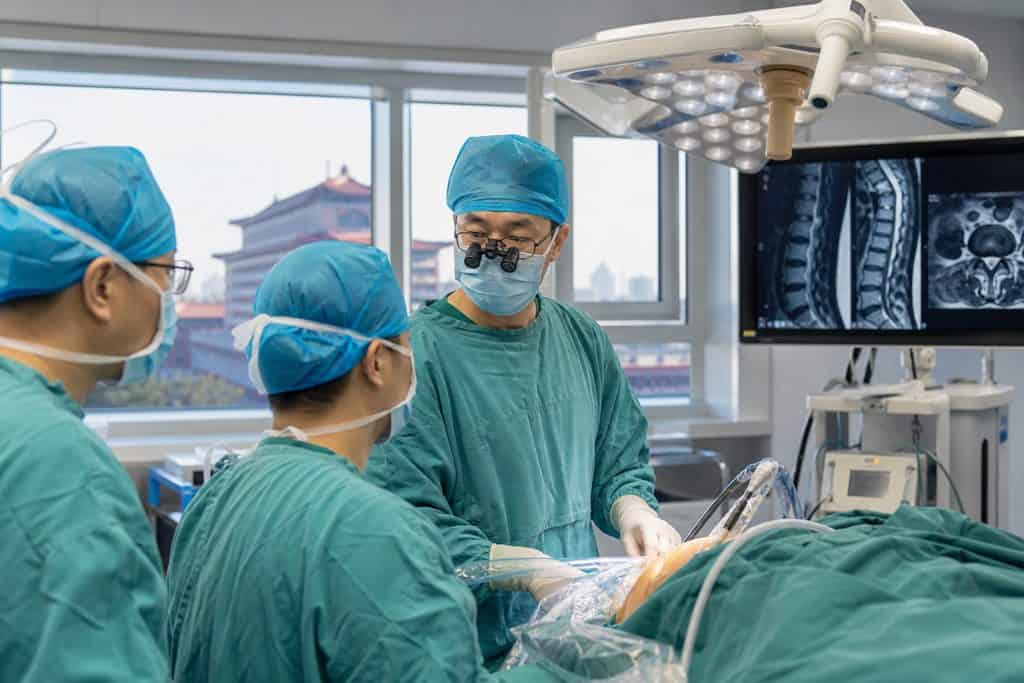
A patient in Miami gets quoted $35,000 for a single-level lumbar microdiscectomy. That same week, a patient in London is told the NHS wait for the identical procedure will stretch past 11 months. Meanwhile, at a major Shanghai orthopedic center, the same surgery is performed routinely — with full endoscopic visualization, a 1.5 cm incision, and a total hospital bill that rarely crosses $12,000. The surgeon has done over 400 of these this year. That gap — in cost, in wait time, in sheer repetition — is what drives a growing number of international patients to look seriously at herniated disc treatment in China.
Key Takeaways
- A microdiscectomy in a top-tier Chinese hospital costs between $8,000 and $15,000 — roughly 70% to 80% less than the US cash price for the same procedure.
- China’s leading spine centers now perform fully endoscopic discectomies through incisions under 2 cm, with discharge often within 24 hours and return to light activity in under two weeks.
- Navigating a Chinese public hospital independently is extremely difficult without Mandarin fluency — the registration, payment, and inpatient systems are not built for international patients.
- Any surgical plan requires an in-person consultation first. No reputable Chinese hospital will schedule a spine operation without examining you, reviewing your imaging, and confirming the diagnosis face-to-face.
The Problem: When Back Pain Becomes a Waiting Game You Cannot Afford to Play
Herniated discs are not rare. Approximately 1 in 20 adults will experience a symptomatic lumbar disc herniation at some point, and when conservative treatment fails — physical therapy, epidural injections, medication — surgery stops being optional. It becomes the only path back to walking without pain, sleeping through the night, or simply sitting through a workday. The standard surgical answer is a microdiscectomy: remove the extruded disc fragment pressing on the nerve root, decompress the spinal nerve, close up. It is one of the most successful operations in orthopedics, with success rates consistently above 85% in well-selected patients.
But access is the problem. In Canada, the median wait time from specialist referral to orthopedic surgery sits around 28 weeks, per the Fraser Institute’s 2023 survey — and that is the median. Some patients wait over a year. In the UK, NHS England data shows that in early 2024, over 40% of patients referred for trauma and orthopedics waited longer than the 18-week target. The US solves the wait time problem for those with premium insurance or cash, but it creates a different barrier: the average negotiated rate for a lumbar microdiscectomy in the United States hovers between $20,000 and $50,000 depending on the facility and geography. For uninsured or underinsured patients, the numbers are simply out of reach.
So you have two groups of patients. One group is waiting in pain, watching their quality of life erode month by month. The other group has the diagnosis and the surgical recommendation, but the financial math does not work. Both groups are searching for the same thing: high-quality spine surgery, performed by a surgeon who does this specific operation hundreds of times a year, at a price that does not wipe out their savings. That search increasingly leads to China.
Who We Are
We are not a hospital. We do not provide medical treatment, we do not diagnose conditions, and we do not make clinical recommendations. Our team acts as your logistical bridge to China’s top-tier medical system — we connect international patients with the right spine surgery department, coordinate the hospital’s international patient pathway, arrange bilingual medical companions for every step of the in-hospital process, and handle the visa guidance, accommodation logistics, and post-operative recovery coordination. Think of us as the people who make sure you walk into the right hospital, see the right specialist, understand every word spoken in the consultation, and never stand alone at a registration counter wondering which queue to join. We have spent years building relationships with the international departments of hospitals ranked in the top 5% of China’s 35,000+ medical institutions. We know which centers run high-volume endoscopic spine programs. We know which ones have English-speaking discharge coordinators. And we know, from hard experience, exactly what goes wrong when a foreign patient tries to navigate this system alone.
Why China’s Spine Surgery Programs Deliver Results That Rival Any Western Center
Surgical Volume Creates Proficiency No Amount of Training Can Replace
Here is a number that should make you pause. At a major orthopedic hospital in Beijing — one of the busiest spine surgery centers in the world — a single senior spine surgeon may perform over 500 lumbar discectomies in a calendar year. Compare that to the average US orthopedic spine surgeon, who performs roughly 25 to 50 discectomies annually according to published survey data. Volume matters in spine surgery. The learning curve for endoscopic discectomy is steep — studies suggest a surgeon needs at least 60 to 80 cases to achieve proficiency with the full-endoscopic transforaminal approach. Chinese surgeons at high-volume centers cross that threshold in months, not years. By the time an international patient arrives, the surgeon they are seeing has likely done more discectomies that quarter than many Western surgeons do in a career. This is not a claim about innate skill. It is a structural reality of a system where top orthopedic hospitals run 12 to 15 operating rooms daily, with spine cases scheduled back-to-back from 8 a.m. until evening.
The clinical outcomes reflect this. Published studies from Chinese spine centers report success rates for endoscopic lumbar discectomy — measured by significant improvement in Oswestry Disability Index scores and visual analog pain scales — consistently in the 85% to 92% range, which aligns with or exceeds outcomes reported in major Western spine registries. Complication rates for microdiscectomy — dural tears, nerve root injury, recurrent herniation — fall within the same 2% to 5% range seen at top US and European centers.
Endoscopic Techniques That Most Western Patients Never See as a First Option
Walk into an average US orthopedic practice with an MRI showing a contained lumbar disc herniation at L4-L5, and the surgical recommendation will almost certainly be a standard open microdiscectomy. Tubular retractors, maybe. A 3 to 4 cm incision. General anesthesia. One night in the hospital. Return to work in four to six weeks. That is the standard of care, and it works. But China’s top spine centers have moved aggressively toward full-endoscopic techniques — percutaneous transforaminal endoscopic discectomy, or PTED, and the interlaminar approach for L5-S1 herniations — as first-line surgical options for appropriate candidates. The incision is 7 to 8 millimeters. The procedure is often done under local anesthesia with sedation. The patient is typically discharged within 24 hours. Recovery time is compressed: many patients return to desk work within one to two weeks and resume light physical activity within a month.
This is not experimental surgery. The Yeung Endoscopic Spine System has been refined over two decades. Randomized controlled trials comparing endoscopic discectomy to open microdiscectomy show equivalent or superior outcomes for leg pain relief, with significantly less postoperative back pain, shorter hospital stays, and faster return to function. The reason most Western patients do not get offered this option is simple: the learning curve is real, and most community spine surgeons do not have the case volume to justify mastering it. At China’s high-volume centers, where a single department may run multiple endoscopic lists per week, the technique is routine. For a patient searching for the least invasive option with the fastest recovery, that difference matters enormously.
The Cost Equation: Structural Reasons, Not Quality Trade-offs
Let’s address the obvious question directly. When someone hears that the microdiscectomy cost China ranges from $8,000 to $15,000 — compared to $25,000 to $50,000 in the United States — the immediate assumption is that something must be sacrificed. It is not. The cost difference is structural. Chinese hospital systems operate on dramatically lower labor costs: a senior spine surgeon’s compensation, while competitive within China, is a fraction of what a US surgeon earns. Hospital facility fees are lower. Implant costs — for the endoscopic systems, radiofrequency probes, and surgical instruments — are often domestically manufactured to international quality standards at lower price points. Malpractice insurance costs, which add a significant overhead burden to US surgical fees, are far lower in China’s system.
What you are not paying for is a compromise on the surgery itself. The operating rooms at a top-tier Chinese orthopedic hospital use the same brands of C-arm fluoroscopy, the same endoscopic visualization towers, and the same sterilization protocols as any major Western spine center. Many of these hospitals hold JCI accreditation — the same international healthcare quality standard used by hospitals in the US, Europe, and the Middle East. The surgeons train internationally, publish in English-language spine journals, and present at global conferences. The value proposition is not “cheap surgery.” It is high-volume, technology-forward spine care delivered in a system where the underlying economics make the final bill dramatically lower — without cutting corners on the clinical product.
For a patient paying out of pocket, the savings are life-changing. A microdiscectomy that would consume an entire year’s savings in the US can be paid for — including round-trip international flights, three weeks of accommodation in Shanghai, and all hospital fees — for under $20,000 total. That is still a significant sum. But it is a number that makes surgery possible for people who would otherwise remain in pain indefinitely.
What You Need to Know Before Attempting This Alone
The clinical case for coming to China is strong. The logistical reality, if you try to navigate it independently, is punishing. We have seen patients arrive at the wrong hospital campus, miss consultations because they could not read the SMS appointment confirmation in Chinese, and spend hours wandering a 2,000-bed hospital complex unable to find the MRI department. These are not hypothetical scenarios. They happen regularly. Here are the barriers you will face:
- Public Hospital Registration Requires In-Person Presence and Chinese-Language Navigation: China’s public hospitals — including the prestigious ones ranked on the Fudan Hospital list — do not allow international patients to book surgical consultations remotely through a website or email. You cannot send your MRI abroad and get a surgery date. The system requires you to appear in person, register at the outpatient department (often via a touchscreen kiosk that only displays Chinese), pay a registration fee, and wait to see the specialist. That specialist will then order new imaging if needed, review your case, and — if surgery is indicated — begin the inpatient admission process. Every step involves paperwork, payment counters, and queues that assume Mandarin fluency.
- Payment Systems Are Not Built for International Transactions: Chinese hospitals operate on a prepayment model. You deposit funds at admission, and the hospital draws down from that deposit as charges accrue. International credit cards are not reliably accepted at public hospital cashier counters. You will need a Chinese bank account or a local payment method like WeChat Pay or Alipay — both of which require a Chinese phone number and bank card to set up with sufficient transaction limits. Trying to wire funds from an overseas account to a hospital’s corporate account, without a local intermediary, can take days and may fail without explanation.
- Medical Records, Imaging, and Discharge Documentation Will Be in Chinese: Your MRI report, your surgical consent form, your discharge summary, your medication instructions — all of it will be written in Chinese unless you are in a dedicated international department. If you need to submit these records to your home-country physician or insurer, they will require certified translation. If something is unclear about your post-operative restrictions, you cannot simply call the surgeon’s office and ask in English.
These barriers exist for structural reasons. China’s public hospital system was built to serve a domestic population of 1.4 billion people at extraordinary scale and speed. It was not designed with the international patient in mind. That is not a flaw — it is simply the reality of a system optimized for a different primary user. But it means that attempting to access that system without local expertise and language support is not just inconvenient. It is a genuine risk to the quality and safety of your care.
How We Help You Move From Diagnosis to Recovery Without the Friction
Our team exists to solve each of these barriers systematically. The process begins before you book a flight. You send us your imaging — MRI scans, CT if available — and your medical history. We translate the relevant clinical documents into Chinese and present your case to the international patient department of the hospital best matched to your specific disc pathology. Not every herniated disc is the same. A far-lateral L4-L5 herniation may be best served by a surgeon who specializes in the transforaminal endoscopic approach. A large central L5-S1 disc herniation with significant thecal sac compression may require a surgeon whose primary practice is the interlaminar endoscopic technique. Our job is to route your case to the right hands — not just the most famous hospital name, but the specific department and surgical team whose daily case mix aligns with your condition.
Once the hospital confirms they will accept your case, we handle the appointment scheduling through the hospital’s official international patient channel. This is not a backdoor or a shortcut. It is the legitimate pathway that hospitals themselves have established for foreign patients — the same pathway used by embassy-referred patients and corporate medical evacuation cases. We coordinate your visa invitation letter for the S2 visa category, which covers medical treatment purposes. We arrange airport pickup, accommodation near the hospital, and a bilingual medical companion who meets you at the hospital entrance on consultation day and stays with you through registration, consultation, payment, imaging, and admission.
During your hospital stay, the companion is your voice. They translate the surgeon’s preoperative explanation, ensure you understand the anesthesia consent, relay your questions about recovery protocols, and confirm your discharge medication instructions in English. After discharge, we coordinate follow-up appointments, arrange any necessary rehabilitation or TCM-based recovery support — acupuncture and tuina massage are commonly used adjuncts for post-spine-surgery recovery in China — and ensure your discharge summary and imaging reports are translated for your home physician. We stay involved until you are on the plane home with a clear recovery plan and a point of contact for any questions that arise later.
This is case management, pure and simple. We do not sell access. We do not promise a specific surgery date or guarantee a particular surgeon. What we guarantee is that we will handle every logistical, linguistic, and administrative barrier between you and the medical care you need — and if we cannot secure the appointment you need, our coordination fee is refunded in full. Any fees paid for consultation or coordination services are credited in full toward on-the-ground coordination if you proceed with treatment within 90 days. We have no financial incentive to steer you toward surgery you do not need. Our only interest is making sure that if you do need the procedure, you get it from the right team, in the right facility, without the chaos of going it alone.
Frequently Asked Questions
For a single-level lumbar microdiscectomy at a top-tier public hospital’s international department, expect a total bill between $8,000 and $15,000. This typically includes the surgeon’s fee, anesthesia, operating room charges, implant costs if any, a one- to two-night inpatient stay, and basic post-operative medications. Endoscopic discectomy falls in a similar range — sometimes slightly lower due to shorter hospitalization. These numbers are for the hospital charges only. They do not include flights, accommodation, or our coordination services. Final pricing always depends on the specific hospital, the complexity of the herniation, and whether additional procedures are required. We provide a detailed cost estimate before you commit to anything.
Shanghai prices tend to sit at the upper end of the national range — typically $10,000 to $15,000 for a microdiscectomy at a major teaching hospital’s international wing. Beijing is comparable. Cities like Guangzhou, Chengdu, or Hangzhou may come in slightly lower, often in the $8,000 to $12,000 range, while still offering surgeons trained at the same caliber of institution. The hospital’s reputation, the specific international department’s pricing structure, and the surgeon’s seniority all influence the final number. Shanghai’s advantage is concentration: the city has multiple hospitals with dedicated international patient centers and English-speaking staff, which reduces logistical friction. For patients prioritizing a smooth experience, that may justify the modest premium.
Most endoscopic discectomy patients are discharged within 24 hours of surgery. Light walking is encouraged immediately. Desk work can typically resume within 7 to 14 days. The incision — under a centimeter — heals quickly. The main restriction is avoiding heavy lifting, prolonged sitting in one position, and bending or twisting under load for the first four to six weeks. As for flying home: we generally recommend staying in China for at least 10 to 14 days post-operatively. This allows time for the first follow-up appointment, suture removal if needed, and observation for any early complications. Long-haul flights should be broken up with frequent standing and walking to reduce the risk of deep vein thrombosis. Your surgeon will clear you for travel based on your specific recovery progress — never book a tight return flight without that clearance.
Can I book herniated disc surgery China package that includes everything?
You can coordinate a comprehensive care package through our
For more medical information and treatment options in China, visit chinamedservices.com (China Medical Services).
