Hip Replacement in China: What to Expect, From Cost to Recovery
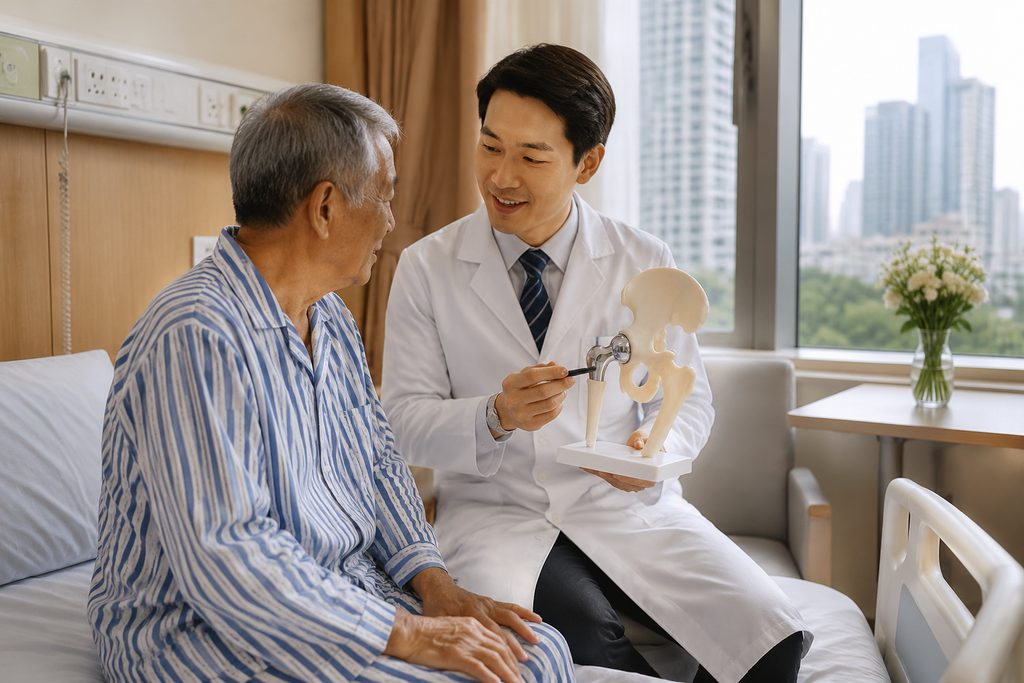
Roughly 450,000 total hip replacements are performed in the United States every year, according to the American Academy of Orthopaedic Surgeons, and the average billed charge for the procedure now tops $40,000 before insurance adjustments. China’s leading orthopedic centers handle volumes that rival major Western systems, at a fraction of that price. The hip replacement cost in China typically lands between $8,000 and $18,000 at a top-tier public hospital — all-in, including implants, surgery, hospital stay, and initial rehabilitation. That single number is why so many international patients start searching. But the number is also where the honest conversation begins, because cost is the easy part. The harder parts are choosing the right hospital, understanding how Chinese public hospitals actually schedule surgery, and planning a recovery that may last months.
This guide walks through what a hip replacement in China really looks like for a foreign patient — the realistic costs, the hospital landscape, the timeline, and the logistical traps that catch people who try to arrange everything themselves.
Hip Replacement in China: The Short Answer
A total hip replacement in China costs roughly $8,000 to $18,000 at a top public hospital, or $25,000 to $45,000 at a private international hospital, compared with $40,000 to $70,000 in the United States. Surgery itself takes 1 to 2 hours, most patients stand within 24 hours, and full recovery runs 3 to 6 months.
Here is the caveat that matters more than any price tag. Chinese public hospitals generally do not allow you to book surgery directly from overseas. You must be seen in person at an outpatient clinic first, and only then can a surgeon schedule the operation. That rule exists at nearly every major public hospital, and it reshapes how you plan the entire trip.
Key takeaway: The price advantage is real, but it comes with a process. Expect one in-person consultation before any surgical date is confirmed — and budget your travel around it.
Who This Is Right For — and Who It Isn’t
Hip replacement is a well-established procedure, and China’s top orthopedic departments perform thousands of them annually. That does not mean it suits every patient reading this.
You are likely a reasonable candidate if:
- You have osteoarthritis, avascular necrosis, or a fracture that a qualified surgeon has already said needs replacement
- You are medically stable enough to fly long-haul and undergo general or spinal anesthesia
- You can stay in China for at least 2 to 3 weeks, and ideally longer for early rehabilitation
- You are paying out of pocket or have insurance that reimburses internationally
- You have someone — a spouse, an adult child, or a hired companion — who can travel with you
You should think carefully before pursuing this if:
- You have uncontrolled cardiac disease, active infection, or poorly managed diabetes
- You are severely obese in a way your surgeon considers a contraindication
- You cannot tolerate a long flight in the weeks after surgery
- You need complex revision surgery with custom implants — not every center stocks them
- You have no support person and no budget for professional accompaniment
Being honest about the second list is what makes the first list worth anything. If you fall into it, staying home may genuinely be the better call.
The Options, Compared
Four realistic paths exist for a Western patient considering hip replacement. Each carries a different price, timeline, and level of hand-holding.
| Option | Typical Cost (USD) | Wait Time | Language Support | Best For |
|---|---|---|---|---|
| US private hospital | $40,000–$70,000 | 3–8 weeks | Native English | Patients with full insurance coverage |
| UK NHS | Free at point of use | 18–52 weeks | Native English | Patients who can wait and qualify |
| China top public hospital (international department) | $8,000–$18,000 | 1–4 weeks after consultation | English-speaking staff in international wing | Self-paying patients wanting top surgeons |
| China private international hospital | $25,000–$45,000 | Days to 2 weeks | Full English service, direct insurance billing | Patients prioritizing comfort and speed |
Which column suits you depends less on budget than on tolerance for process. If you want a Western-style hospital experience with English at every desk, the private international tier delivers it — at roughly double the public price. If you want the best surgeon and the lowest cost, the public international department is the answer, and you accept a less polished service environment.
Which Hospital, and Where
Orthopedics is one of 45 specialties ranked annually in China’s Fudan Hospital Rankings, and the top programs cluster in a handful of cities. Beijing, Shanghai, and Guangzhou hold the densest concentration of high-ranking orthopedic departments.
For a foreign patient, Shanghai is often the practical first choice. The city has more than a dozen top-tier hospitals, a large English-speaking expatriate infrastructure, direct international flights, and private hospitals that can serve as a fallback. If you are specifically searching for the best orthopedic hospital in Shanghai for hip replacement, the answer sits within the Fudan-ranked public hospitals and their international departments, plus several JCI-accredited private facilities.
Beijing carries the largest single concentration of top-ranked hospitals in the country. Guangzhou and Chengdu offer strong alternatives with lower living costs during recovery. Our directory of Fudan-ranked hospitals by city lets you filter by location and specialty tier, and the orthopedics specialty page lists the top-ranked departments nationwide.
Is Hip Replacement Surgery Safe in China?
This is the question every patient asks, usually late at night, usually after reading a horror story somewhere online. So let’s take it seriously.
China’s top hospitals are not fringe facilities. The leading centers are accredited by JCI, staffed by surgeons who trained partly abroad, and handle surgical volumes that exceed most Western hospitals. Joint replacement registries and implant traceability systems have been mandatory at major centers for years. Infection rates at top-tier hospitals are broadly comparable to international benchmarks.
Where the risk actually lives is elsewhere. It lives in choosing a mid-tier hospital because it was cheaper. It lives in skipping the pre-operative workup. It lives in flying home on day five against medical advice. And it lives in arriving without a Chinese-speaking companion and misunderstanding a discharge instruction.
So: is hip replacement surgery safe in China? At a top-ranked hospital, with proper screening and a realistic recovery plan, the clinical risk profile is similar to what you would face in Europe or North America. At an unvetted hospital with a rushed timeline, it is not. The variable is not the country. It is the specific hospital and the specific plan.
No hospital, and no coordinator, can promise a surgical outcome. Anyone who guarantees results is telling you something about themselves, not about medicine.
What It Costs, and What Drives the Variance
The $8,000 to $18,000 range at public hospitals is not arbitrary. Several factors move the number significantly.
- Implant type. A standard metal-on-polyethylene implant costs far less than a ceramic-on-ceramic or titanium modular system. Implants alone can swing the total by $3,000 or more.
- Hospital tier. A Fudan-ranked orthopedic department charges more than a provincial hospital. You are paying for surgical volume and experience.
- International department vs. standard ward. The international wing typically runs 1.5 to 2 times the standard price, in exchange for English-speaking staff and shorter waits.
- Length of stay. Most patients stay 5 to 10 days. Complications or slow mobilization extend it.
- Bilateral or revision surgery. Both cost substantially more than a primary unilateral replacement.
What is typically included: surgeon fees, anesthesia, the implant, operating room charges, hospital bed, standard medication, and basic post-operative imaging. What is usually not included: flights, accommodation, meals outside the hospital, physiotherapy after discharge, and any treatment for unrelated conditions discovered along the way.
Payment at public hospitals is generally upfront, with insurance reimbursement handled afterward in your home country. Private international hospitals often bill insurers directly. If you are weighing a medical tourism China hip replacement all inclusive arrangement, read the inclusions line by line — “all inclusive” rarely covers everything.
How Long Is Recovery After Hip Replacement Abroad?
The question of how long is recovery after hip replacement abroad has two answers: the clinical one and the travel one. They are not the same.
Clinical timeline:
- Day 0–1: Surgery, then assisted standing and first steps within 24 hours at most modern centers
- Day 2–5: Daily physiotherapy, walking with a frame or crutches, wound checks
- Day 5–10: Discharge, typically when you can walk and manage stairs safely
- Week 2–6: Progressive weight-bearing, outpatient physiotherapy, return to light daily activity
- Month 3: Most patients resume driving and desk work
- Month 6–12: Full functional recovery for the majority
Travel timeline: Most surgeons advise against long-haul flights for 2 to 4 weeks after surgery because of clot risk. That means a realistic China trip spans 3 to 5 weeks total — arrival, consultation, surgery, hospital stay, and a supervised early recovery period before you fly home.
This is the single most underestimated part of the entire plan. Patients budget for surgery and forget to budget for time.
Practical Considerations for Foreign Patients
Records. Bring your existing X-rays, MRI or CT scans, blood work, medication list, and any prior surgical reports. Digital copies are fine, but English translations help the consultation move faster. A written second opinion before you travel can clarify whether surgery is even the right next step — our team can arrange one through the relevant orthopedic department.
Visa. Foreign patients coming to China for treatment generally use the S2 visa, which covers short-stay medical treatment and private affairs, with supporting documentation from the receiving hospital. Stays beyond 180 days fall under S1. Accompanying family members apply under the same category. Requirements change, so confirm current rules with the nearest Chinese embassy or consulate before booking anything. Note that the M visa is for commercial and trade activity and is not the right category for medical travel.
Language. China’s top hospitals see tens of thousands of outpatients daily. Signage, registration systems, and pharmacy instructions are predominantly in Chinese. The international department mitigates this; the standard ward does not. A bilingual medical companion — someone who handles registration, queueing, payment, wayfinding, and translation — is the difference between a manageable trip and a bewildering one. Our China Medical Services team provides exactly this kind of on-the-ground support.
Follow-up at home. Arrange a physiotherapist and an orthopedic review in your home country before you leave. Ask your Chinese surgeon for a discharge summary in English, plus imaging and implant documentation. Your home surgeon will want the implant model and lot number on file.
Frequently Asked Questions
Not directly at a public hospital. The standard rule is that a surgeon must see you in person at an outpatient clinic before scheduling surgery. Some private international hospitals will discuss a case remotely and hold a provisional date, but the final decision still follows an in-person assessment. Plan for one consultation trip before the surgical date.
Rarely as direct billing, occasionally as reimbursement. Most Western insurers treat overseas elective surgery as out-of-network, meaning you pay upfront and file a claim afterward. Some international health plans with global coverage do reimburse a portion. Call your insurer before you commit, and get the answer in writing.
This is a real concern, and it deserves a direct answer. Complications such as infection, dislocation, or clot can appear weeks after surgery. Before you leave China, confirm that you have an English-language discharge summary, implant documentation, and a named contact at the treating hospital. Line up a home-country orthopedic surgeon who agrees in advance to handle follow-up. If a serious complication develops, you would be treated locally — returning to China mid-recovery is rarely practical.
Public international departments offer the strongest surgeons at roughly half the private price, with less comfortable facilities. Private international hospitals offer English-speaking staff, shorter waits, direct insurance billing, and a Western-style environment at a premium. Neither is wrong. The choice depends on how much you value comfort and predictability relative to cost.
Your Next Step
The core message is simple: hip replacement in China can cost a fraction of Western prices at genuinely world-class hospitals, but the savings only materialize if the hospital, the process, and the recovery timeline are planned properly. Get those three right and the value is substantial. Get them wrong and the savings evaporate in complications and wasted travel.
We are not a hospital and we do not provide medical advice. We are a coordination service — we help international patients identify the right department, arrange written second opinions and video consultations, and provide bilingual support on the ground once you arrive. If you would like to understand your options before committing to anything, start with a free consultation. No pressure, no obligation — just a clearer picture of what your path forward looks like.
This article is for general information only and does not constitute medical advice. Treatment decisions should always be made in consultation with a qualified physician who has reviewed your individual case.
For more medical information and treatment options in China, visit chinamedservices.com (China Medical Services).
