HKU-Shenzhen Hospital Oncology: A Realistic Guide for International Patients
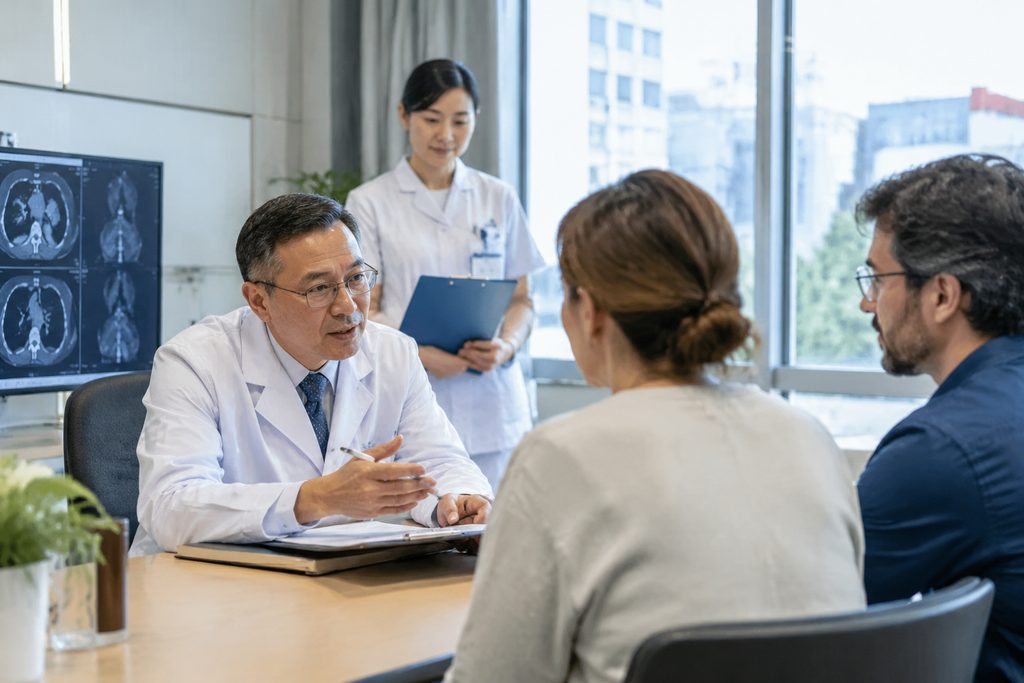
Cancer treatment abroad sounds overwhelming. In simple terms, you are asking whether a specific hospital in Shenzhen — one with a Hong Kong university partnership — can treat your cancer well, at a price you can afford, without the logistics collapsing around you. The short answer: HKU-Shenzhen Hospital does treat international oncology patients, but the path is not a simple online booking. It runs through a documented referral process, an S2 visa, and a realistic assessment of whether this particular hospital fits your specific diagnosis and stage.
Our team at China Medical Services has coordinated oncology referrals across Shenzhen, Beijing, Shanghai, and Guangzhou. We know what actually happens on the ground. We do not promise cures. We do not sell access. We explain how the system works, what it costs, and where it breaks — so you can decide with your eyes open.
How This Actually Works, Step by Step
You cannot simply email HKU-Shenzhen Hospital and book a chemotherapy bed from overseas. Chinese public hospitals, including university-affiliated ones, operate on a face-to-face consultation model for standard outpatient care. International patients follow a different route — the hospital’s International Medical Center (IMC) — but the sequence still requires documentation before arrival.
Here is the real sequence:
- You send your existing records. This means pathology reports, imaging (CT, MRI, PET-CT), blood work, surgical notes if applicable, and a summary from your current oncologist. English is fine. The hospital’s oncology team reviews these first.
- A written second opinion or video consultation happens. The hospital assesses whether your case falls within their treatment scope. Not every cancer is appropriate for every center. A stage IV pancreatic cancer patient and a stage II breast cancer patient will get very different answers.
- You decide on a treatment plan. If the hospital accepts your case, they propose a plan: surgery, chemotherapy, radiotherapy, targeted therapy, immunotherapy, or a combination. The plan includes an estimated cost range.
- You apply for an S2 visa. This is the short-stay visa category used for private medical treatment in China. Your accompanying family member applies for their own S2. The hospital issues an invitation letter and treatment confirmation to support the visa application.
- You arrive, register at the IMC, and begin treatment. The IMC handles English-speaking coordination, billing, and scheduling. You prepay in installments. Insurance reimbursement, if applicable, happens after the fact with your overseas insurer.
That is the clean version. The messy version involves translation delays, appointment lead times, and the fact that a hospital may review your records and say no. We have seen both outcomes.
HKU-Shenzhen Hospital Oncology for International Patients: What the Hospital Actually Offers
The University of Hong Kong-Shenzhen Hospital (HKU-SZH) is a large public teaching hospital in Futian District, Shenzhen. It was established as a collaboration between the Shenzhen municipal government and the University of Hong Kong. The oncology department operates within a broader cancer center structure, offering chemotherapy, radiotherapy, targeted therapy, and immunotherapy. Surgical oncology is coordinated with the relevant surgical departments.
For international patients, the relevant entry point is the International Medical Center. This is not a separate hospital. It is a dedicated service layer within the same facility that provides English-speaking coordination, faster scheduling than the standard public queue, and consolidated billing. The IMC is where the HKU-Shenzhen Hospital international patient price gets quoted — and that price is higher than what a local Chinese patient pays through the standard public channel. Expect a multiplier of roughly 1.5 to 2 times the domestic rate.
Is HKU-Shenzhen Hospital JCI accredited? As of the latest available information, HKU-Shenzhen Hospital has pursued international accreditation and operates with Hong Kong-influenced clinical governance, but we advise confirming current JCI status directly with the hospital before making any commitment. Accreditation status can change, and it is not the only signal of oncology quality. The more relevant question is whether the oncology team has specific experience with your cancer type. That is what a written second opinion helps clarify.
A Realistic Timeline
Patients underestimate how long the pre-arrival phase takes. Here is a realistic range based on cases we have coordinated:
| Stage | Duration | What Happens |
|---|---|---|
| Document collection and translation | 3–10 days | You gather reports. If any are not in English or Chinese, certified translation adds time. We can assist with medical document translation. |
| Hospital record review | 5–14 days | The oncology team reviews your case. Busy departments may take longer. Follow-up is often needed. |
| Written second opinion or video consultation | 7–21 days | Depending on specialist availability. Top oncology consultants have packed schedules. |
| Treatment plan and cost estimate | 3–7 days after review | The IMC issues a formal plan with a price range. This is the document you need for financial planning. |
| S2 visa processing | 5–15 business days | Varies by embassy or consulate. Some nationalities face longer processing. The hospital’s invitation letter is essential. |
| Arrival to first treatment | 3–10 days | Registration, additional baseline tests, and scheduling. Surgery may require a longer lead time than chemotherapy. |
Total realistic window: four to ten weeks from your first inquiry to sitting in a treatment chair. Anyone promising faster is not being honest about how Chinese hospital administration works.
What Can Go Wrong — and What Happens Then
The honest failure modes matter more than the success stories. Here are the ones we see most often:
The hospital declines your case. This happens. A hospital may determine that your cancer is too advanced for meaningful intervention, or that your specific subtype is better treated elsewhere. The recourse is to ask for a written explanation and consider a second opinion at another center. China has multiple top-tier oncology programs — our department rankings cover oncology specifically, and several hospitals in Beijing, Shanghai, and Guangzhou consistently rank among China’s top 10 for cancer care.
Your records are incomplete. You think you have everything. The hospital wants a specific immunohistochemistry stain or a molecular pathology report you do not have. The recourse is to request the missing test from your home oncologist — which can take weeks — or arrange the test upon arrival in Shenzhen, which delays treatment further.
The cost estimate changes. The initial quote assumes a standard protocol. If your case requires an additional targeted therapy or a longer radiotherapy course, the price moves. The recourse is to ask for a revised written estimate before each new treatment phase. You are never locked into a single upfront payment for the entire course.
Visa delay. The S2 visa is generally straightforward with a hospital invitation letter, but consular processing varies. The recourse is to apply early and keep the hospital informed. We cannot guarantee visa approval — no legitimate service can.
How to Evaluate Whether HKU-Shenzhen Is the Right Choice for You
The question is not “Is this a good hospital?” The question is “Is this the right hospital for my specific cancer, my budget, and my logistical constraints?”
HKU-Shenzhen makes sense for international patients in several scenarios. If you live in or near the Guangdong-Hong Kong-Macau Greater Bay Area, the location is practical. If you want a Hong Kong-influenced clinical culture with mainland Chinese pricing, it offers a middle ground. If your cancer is a common solid tumor — lung, breast, colorectal, liver, nasopharyngeal — the oncology department handles high volumes of these cases.
But it is not always the best choice. For rare or complex hematological malignancies, a center like Peking Union Medical College Hospital or Ruijin Hospital in Shanghai may offer deeper subspecialty expertise. For certain surgical oncology cases, a hospital with a higher annual surgical volume in your specific procedure may be preferable. Our Top 100 hospital database breaks down strengths by city and specialty, which helps narrow the field before you commit to one institution.
Cancer treatment cost in Shenzhen for expats runs roughly one-fifth to one-tenth of comparable U.S. prices, depending on the protocol. A standard chemotherapy cycle that might bill at $15,000–30,000 in the United States often lands between $3,000 and $8,000 in Shenzhen’s international department. Radiotherapy courses show similar ratios. Targeted and immunotherapy drugs are the exception — imported biologics cost roughly the same in China as elsewhere, though domestic biosimilars can be significantly cheaper.
Medical tourism packages for oncology in China exist, but we advise caution. A “package” that bundles treatment, hotel, and airport pickup sounds convenient. It also obscures what you are actually paying for. The hospital’s treatment charges should always be itemized separately from any coordination or concierge fees. If a package price seems too low, ask what is included and what is not. You do not want to discover that your “all-inclusive” package excludes the actual chemotherapy drugs.
Practical Considerations: Records, Visa, Payment, Insurance, Language
Records. Bring everything. Original pathology slides are sometimes requested for re-staining and re-reading by the Chinese pathology team. Digital copies of scans should be on a CD or USB, not just printed films. A concise, dated summary from your treating oncologist — in English — helps the Chinese team orient quickly.
Visa. The S2 visa is the correct category for medical treatment stays under 180 days. Apply with the hospital’s invitation letter, your passport, a completed application form, and proof of funds. Family members accompanying you apply for their own S2 visas. Do not apply for an M visa — that is for commercial and trade activities, not medical care. We have seen patients arrive on the wrong visa and face entry complications.
Payment. Chinese public hospitals require prepayment. The IMC typically asks for a deposit at registration, then top-ups as treatment progresses. Bring a credit card that works internationally, or arrange a wire transfer in advance. Cash in large amounts is impractical and sometimes restricted.
Insurance. Most Chinese hospitals, including HKU-Shenzhen’s IMC, do not bill international insurers directly. You pay out of pocket, then submit claims to your insurer. Check your policy’s overseas treatment coverage before you travel. Some policies require pre-authorization for international oncology care.
Language. The IMC staff speak English. The broader hospital — the pharmacy, the imaging department, the billing office — may not. This is where a bilingual medical companion earns their fee. They handle registration queues, medication pickup, test scheduling, and translation during consultations. Our companion service provides exactly this support, from $300 per day, so you are not standing in a crowded Chinese hospital corridor trying to explain a chemotherapy side effect through a translation app.
Frequently Asked Questions
You start with a remote review. Send your medical records to the hospital’s International Medical Center, either directly or through a coordinator. The oncology team reviews your case, and if accepted, you receive a treatment plan and cost estimate. Only then do you apply for the S2 visa and arrange travel. You cannot simply book a treatment slot online without this review process.
The international patient price varies by cancer type, stage, and protocol. Expect roughly 1.5 to 2 times the domestic Chinese rate, which still lands far below U.S. prices for comparable care. A written second opinion costs between $300 and $500. A video consultation with a top oncology specialist runs $500 to $800. Treatment itself is quoted case by case after record review.
The hospital has pursued international accreditation and operates with Hong Kong-influenced governance, but JCI status should be confirmed directly with the hospital at the time of your inquiry. Accreditation is one signal among many. The oncology department’s specific experience with your cancer type matters more for your outcome.
Ask for a written explanation. Then consider a second opinion at another Chinese oncology center. China has multiple hospitals ranked among the top 10 nationally for oncology, and a different center may have a subspecialty program better suited to your diagnosis. A decline from one hospital is not a decline from the entire Chinese medical system.
No. Each person traveling for medical accompaniment applies for their own S2 visa. The patient’s visa is tied to the hospital invitation letter. The family member’s S2 is issued for private affairs — accompanying a patient qualifies. Apply together with the same supporting documents.
Your Next Step
HKU-Shenzhen Hospital is a legitimate option for international oncology patients — but it is not the only option, and it is not the right option for every diagnosis. The smart move is to get your records in front of the right oncology team before you book a flight. That is what we help with.
We are China Medical Services. We coordinate written second opinions, video consultations, and on-the-ground support across China’s top-ranked hospitals. We do not practice medicine, and we do not sell guaranteed access. We help you understand your options, get honest answers, and move forward with confidence when you are ready. If you want to explore whether HKU-Shenzhen or another Chinese oncology center fits your case, start with a free consultation — we will tell you straight what is realistic.
For more medical information and treatment options in China, visit chinamedservices.com (China Medical Services).
