Homeschooling in China During Medical Travel: Education Support for Children
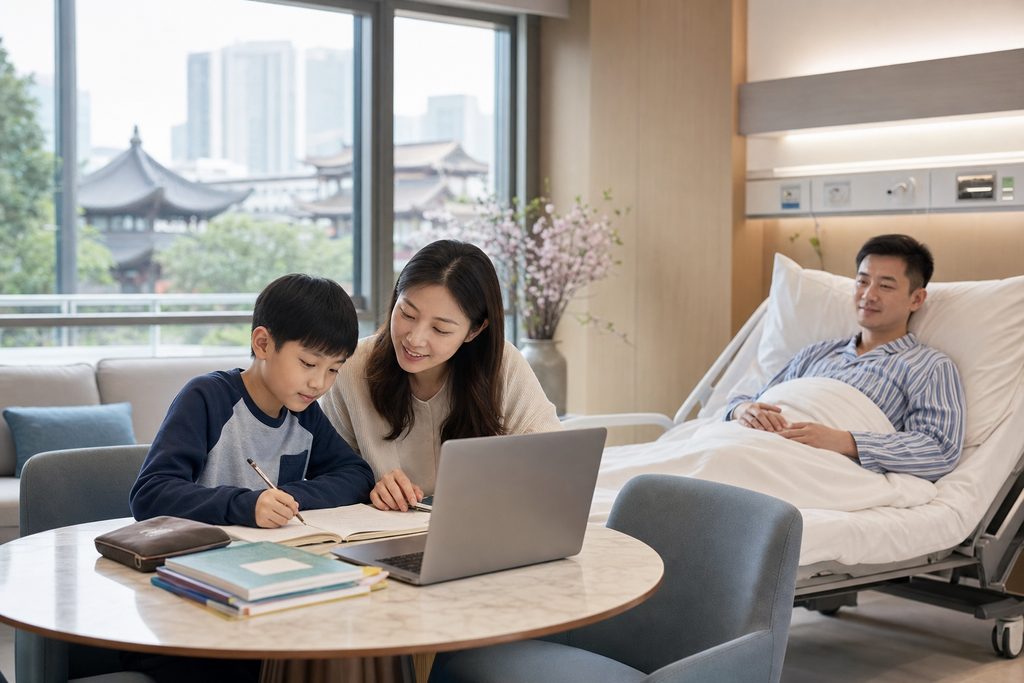
What do you do about your child’s education when a critical surgery in Shanghai or Beijing suddenly lands on the family calendar for six weeks? The question hits hard. You have already wrestled with the diagnosis, the travel logistics, and the cost. Now you face a completely different problem: your 10-year-old missing a chunk of the school year with no clear way to keep up. The fear that your medical needs could disrupt your child’s academic progress is real and deeply unsettling.
Our team at China Medical Services has helped hundreds of families navigate exactly this. We are not a school. We do not provide medical treatment. But we have spent years building a network of education solutions and bilingual logistical support so that a parent’s medical stay in China does not have to mean a lost semester for a child. From short-term international school placements in Beijing to vetted private tutors who come to your serviced apartment in Shanghai, there are more options than most families realize.
Key Takeaways
- Short-term international school enrollment in cities like Beijing and Shanghai is possible, with per-semester fees ranging from approximately $4,000 to $12,000 depending on the institution.
- Private tutoring represents the most flexible option, with qualified English-speaking tutors available from $25 to $60 per hour — a fraction of comparable Western tutoring costs.
- China’s visa regulations permit accompanying children on an S2 visa, but this visa does not automatically grant access to local public schools — planning ahead is essential.
- Combining online homeschooling curricula from your home country with in-person enrichment activities in China often produces the best academic continuity with the least stress.
The Problem: A Medical Trip That Disrupts an Entire Academic Year
Medical travel is rarely a solo endeavor. When a parent needs a hip replacement, cardiac surgery, or an extended oncology protocol abroad, the family often travels together. According to data from the Medical Tourism Association, approximately 19% of medical travelers bring dependent children with them. For stays extending beyond three weeks — common for orthopedic rehabilitation or multi-cycle treatments — the educational gap becomes impossible to ignore.
Most schools in the United States, the United Kingdom, and Australia have strict attendance policies. A student missing four to eight weeks without a structured educational plan can face retention risk, lost credits, or a grueling catch-up period upon return. The anxiety this creates for parents is measurable. We hear it in intake calls constantly: “Can my child attend school while I have surgery in China?” The answer is not a simple yes or no. It depends on where you are going, how long you are staying, and what you can arrange before you board the plane.
Who We Are
China Medical Services connects international patients with China’s top-tier hospitals — a network spanning 340+ ranked institutions across 37 cities. We handle hospital matching, appointment coordination through official international departments, bilingual medical companion services, and visa guidance. We are not clinicians. We are the logistical bridge that makes a complex medical journey feasible. Part of that logistical bridge, we have learned, must include education support for children during a parent’s medical stay abroad. Families who plan for this early report dramatically lower stress levels and better overall treatment experiences.
Why China Offers Viable Education Solutions for Visiting Families
The assumption that bringing a child to China for a medical stay means sacrificing their education is outdated. China’s international education infrastructure has expanded rapidly. Beijing alone hosts over 20 international schools. Shanghai has more than 30. Many now offer flexible short-term enrollment policies that did not exist a decade ago. The ecosystem of private tutoring, online learning support, and hybrid options has matured alongside the country’s broader internationalization.
Short-Term International School Enrollment in Major Medical Hubs
The most structured option is enrolling your child in an established international school for the duration of your stay. Schools like the International School of Beijing, Western Academy of Beijing, Shanghai Community International School, and Yew Chung International School have all handled short-term placements for visiting families. This is not a guaranteed walk-in arrangement. You will need to contact admissions offices well in advance, provide academic records, and often pay a pro-rated semester fee.
Costs vary. A short-term placement at a top-tier international school in Beijing typically runs between $6,000 and $12,000 per semester. Mid-tier options exist in the $4,000 to $7,000 range. These schools follow American, British, or International Baccalaureate curricula, which means your child can often transition back to their home school with minimal academic disruption. The social benefit is also significant. A child who attends school during the day while a parent recovers from surgery has structure, peer interaction, and a sense of normalcy that a hotel room simply cannot provide.
Still, this is not the right fit for every family. Many international schools require a minimum enrollment period of one full semester. Some are at capacity. For families staying in Guangzhou, Chengdu, or smaller medical cities, the international school options may be limited to one or two institutions. This is where private international hospitals with family liaison services can sometimes help — several have established referral relationships with nearby schools specifically for the families of international patients.
Private Tutoring: The Most Flexible Education Support for Children During a Parent’s Medical Stay Abroad
For many families, private tutoring is the smarter choice. It bends around the medical schedule rather than forcing the medical schedule to bend around school hours. A parent undergoing chemotherapy at Fudan University Shanghai Cancer Center, for example, may have treatment blocks that shift from week to week. A fixed school drop-off at 8:00 AM becomes a logistical nightmare. A tutor who arrives at your accommodation at 10:00 AM, works with your child for three hours, and incorporates museum visits or cultural excursions into the curriculum solves multiple problems at once.
The cost of a private tutor for a child during medical travel in China is surprisingly accessible. Qualified English-speaking tutors with international school teaching experience charge between $25 and $60 per hour, depending on the subject matter and the tutor’s credentials. A full-time arrangement of four to five hours per day, five days a week, comes to roughly $500 to $1,200 weekly. Compare that to the $80 to $150 per hour typical for private tutoring in major US cities, and the economics become compelling.
Finding a reliable tutor, however, is not something you want to do from a hotel room while recovering from a procedure. Vetting takes time. Background checks matter. Curriculum alignment with your home country’s standards requires someone who understands both systems. Our team maintains a network of pre-vetted tutors in Beijing, Shanghai, Guangzhou, and other major medical cities. We connect families with tutors who have experience specifically with children of medical travelers — people who understand that flexibility and emotional sensitivity matter as much as academic rigor.
The Hybrid Model: Online Curriculum Plus In-Person Enrichment
A third path has gained traction among families we serve. It combines a structured online homeschooling curriculum from the child’s home country with in-person enrichment activities in China. A child might spend mornings working through a US-based accredited online program like K12 or Connections Academy, then spend afternoons with a local Mandarin tutor, at a calligraphy workshop, or exploring a science museum.
This model addresses the core question of how to homeschool a child while getting treatment in Shanghai or any other Chinese city. It keeps the child tethered to their home school’s academic standards while using the China experience as an educational asset rather than a disruption. A unit on ancient civilizations becomes tangible when you can visit the Shanghai Museum’s bronze collection on a Saturday. Biology comes alive at the Beijing Planetarium. The parent’s medical journey does not pause the child’s education — it enriches it.
What You Need to Know Before You Go
Honesty matters here. Bringing a child to China for a medical stay is manageable, but it is not frictionless. The families who struggle the most are those who assume things will work out on arrival. Here are the barriers you will face and how to address them.
- Visa Requirements: Accompanying children enter on an S2 visa, the same short-term private visit visa used by the patient. This visa does not grant access to Chinese public schools. It does allow enrollment in private international schools and tutoring arrangements. S2 visas are typically issued for 30 to 90 days and can be extended within China. For stays exceeding 180 days, an S1 visa is required. Neither visa permits a child to simply walk into a local school and enroll.
- Language Barrier in Daily Life: Outside of international school campuses and expatriate-heavy neighborhoods, English speakers are rare. Ordering food, navigating public transport, explaining to a pharmacist that your child has a peanut allergy — these daily tasks require either Mandarin ability or support. A bilingual medical companion can bridge this gap, not just for hospital visits but for the practical logistics of family life during a medical stay.
- Accommodation and Study Space: Hospital wards are not suitable for children to spend hours in. You will need a serviced apartment or hotel with a separate living area where a child can work with a tutor without disturbing a recovering parent. This adds to the accommodation budget. In Shanghai, a suitable one-bedroom serviced apartment near major hospitals typically runs $80 to $150 per night. Budget accordingly.
How We Help You Navigate This
These barriers exist for structural reasons, not because the system is designed to exclude families. China’s medical infrastructure is built to serve a massive domestic population. The international patient pathway is a specialized overlay, not the default. Our role is to make that overlay work for you.
Before you travel, we handle the hospital matching and appointment coordination through official international departments. We advise on the S2 visa application, including the specific documentation Chinese consulates require for medical visits with accompanying family members. We connect you with education options — international schools with short-term availability, vetted private tutors, or hybrid online-offline setups — based on your destination city, your child’s age and curriculum needs, and the expected length of your stay.
During your time in China, a bilingual medical companion handles the hospital-side logistics: registration, queueing, payment, translation during consultations, and navigating the sprawling hospital campuses that can overwhelm anyone, let alone a family juggling medical care and childcare. That same companion can help with practical daily needs — recommending child-friendly restaurants near your accommodation, locating English-language bookstores, or arranging weekend cultural activities that double as educational experiences.
After treatment concludes, we assist with discharge paperwork, follow-up appointment scheduling, and the medical documentation you will need for insurance reimbursement and your home physician. The goal is a clean handoff — you return home with a child who has not fallen behind academically and a parent who has received world-class care at a fraction of the cost of equivalent treatment in the West.
Frequently Asked Questions
Yes, but not a local Chinese public school. Your child can enroll in a private international school that accepts short-term placements, or work with a private tutor. International schools require advance application and typically charge pro-rated semester fees. Public schools are not accessible on an S2 visa. Planning should begin at least four to six weeks before your travel date.
Qualified English-speaking tutors charge between $25 and $60 per hour. A full-time arrangement of 20 to 25 hours per week costs approximately $500 to $1,200 weekly. Rates vary by city — Beijing and Shanghai are at the higher end, while Chengdu and Guangzhou tend to be more affordable. This is significantly less expensive than comparable tutoring in the United States or Europe.
The most effective approach combines an online curriculum from your home country with in-person support in China. Use an accredited program like K12, Connections Academy, or your local school district’s online option for core academics. Supplement with a local tutor for subjects that benefit from one-on-one instruction and for enrichment activities that take advantage of being in China. Request your child’s curriculum outline before leaving home to ensure alignment.
This is a legitimate concern. Some academic regression during a disruptive life event is normal and usually recoverable. Communicate with your child’s home school before, during, and after the trip. Many schools will provide modified assignments, extended deadlines, or credit recovery options when they understand the circumstances. If significant gaps emerge, intensive tutoring upon return can close them — and the cost savings from medical treatment in China often more than cover any additional educational support needed.
Yes. Several international schools in Beijing have experience with short-term placements for visiting families, including those traveling for medical reasons. Availability varies by grade level and time of year. Contact admissions offices directly and be transparent about your timeline. Some schools maintain waitlists specifically for short-term placements. Our team can help identify which schools in your destination city are most likely to have availability during your planned stay.
Your Next Step
Bringing a child to China for a parent’s medical treatment is a significant undertaking. It is also entirely manageable with the right preparation. The key is treating education planning as a core part of your medical travel logistics, not an afterthought. A structured plan — whether that means international school enrollment, a private tutor, or a hybrid homeschooling approach — transforms a potential source of family stress into a manageable, even enriching, part of the experience.
If you are considering treatment in China and need to bring your child, we can help you think through the education options in your destination city. Visit our patient support services page to learn more about how we assist families throughout the medical travel journey, or reach out for a free consultation. No pressure. Just practical guidance from a team that has helped families navigate this exact situation many times before.
For more medical information and treatment options in China, visit chinamedservices.com (China Medical Services).
