In-Hospital Companion Service: Daily Advocacy, Translation, and Emotional Support
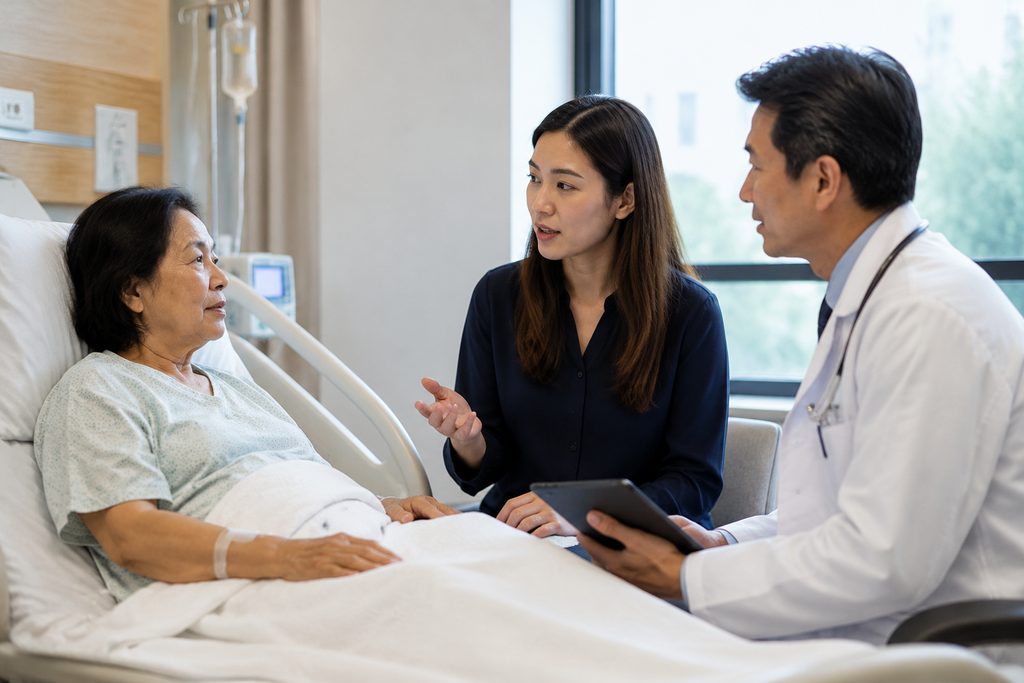
Have you ever wondered who would speak for you inside a foreign hospital when you are too weak to speak for yourself?
Key Takeaways
- A dedicated bilingual companion handles real-time clinical translation and care coordination, stepping in when family cannot travel or when navigating a massive Chinese public hospital alone is unsafe.
- The structural cost of a private patient advocate in a China hospital runs between $80 and $200 per day, a fraction of what comparable medical escort services charge in the US or Europe.
- China’s top-tier public hospitals routinely manage over 10,000 outpatient visits per day—without a local advocate, language barriers turn routine steps like pharmacy pickup and scan registration into hours-long dead ends.
- Private advocacy is not a luxury add-on. For patients traveling without family, it is the difference between a controlled recovery and a preventable safety gap during the inpatient stay.
The Problem: Surgery Abroad Without a Voice at the Bedside
Roughly 14 million people worldwide travel across borders for medical care each year, according to the Medical Tourism Association. A growing share of those patients head to China for complex procedures—cardiac surgery, orthopedic replacements, and oncology interventions—where the cost can be 70% to 90% lower than in the United States. But cost savings come with a trade-off that many patients underestimate until they are already inside the hospital. Language isolation during an inpatient stay is not just inconvenient. It is clinically risky.
In a 2023 survey by the Joint Commission International, communication failures were cited as a root cause in over 60% of sentinel events in cross-border care settings. When a patient cannot describe a sudden change in pain, cannot understand pre-operative fasting instructions, or cannot confirm which medication is being administered, the margin for error narrows fast. This is the reality many international patients face inside China’s top-ranked public hospitals—institutions with world-class physicians and surgical volumes that dwarf Western benchmarks, but with care workflows built entirely in Mandarin.
Family members often intend to fill this gap. They plan to translate, advocate, and provide emotional reassurance. But visa restrictions, work obligations, and the sheer stamina required for round-the-clock bedside support make that plan fragile. A spouse who does not speak medical Chinese cannot effectively question a dosing decision at 2 a.m. A son who flew in for three days cannot stay for a two-week post-operative observation. When the family leaves, the patient is alone. And being alone inside a 5,000-bed hospital where no one speaks your language is a specific kind of vulnerability that standard medical tourism packages rarely address.
Who We Are
We are not a hospital. We do not provide medical treatment, clinical diagnoses, or surgical opinions. Our team functions as a logistical and advocacy layer between international patients and China’s top-tier medical institutions—340+ hospitals across 37 cities, selected from the top 5% of the country’s 35,000+ hospitals based on Fudan University rankings and JCI accreditation. We coordinate the non-clinical infrastructure that makes safe treatment possible: hospital matching, visa guidance, appointment scheduling, and the daily bedside support that protects patients when they are most exposed. Our bilingual companions are trained in medical terminology and hospital workflow. They do not replace doctors. They make sure the patient understands what the doctor just said.
What a Private Patient Advocate Actually Does During an Inpatient Stay
The phrase “private patient advocate cost China hospital” tends to surface in search results alongside questions about pricing. Fair enough. But cost only makes sense when measured against what the advocate actually delivers hour by hour. This is not a concierge who brings coffee. This is a trained bilingual professional embedded in the patient’s care journey from admission to discharge.
Real-Time Clinical Translation, Not Just Language Interpretation
Standard interpretation converts words. Clinical advocacy converts meaning. When a Chinese orthopedic surgeon explains a post-operative weight-bearing protocol, the difference between “partial weight-bearing” and “toe-touch weight-bearing” is the difference between a clean recovery and a hardware failure. Our companions have working fluency in surgical, pharmacological, and nursing terminology across multiple specialties. They translate the surgeon’s morning rounds in real time, clarify medication schedules with the nursing station, and ensure the patient’s own description of symptoms—pain quality, onset, aggravating factors—reaches the clinical team without distortion.
This matters because of how Chinese public hospitals are structured. A top cardiac surgery unit like Fuwai Hospital in Beijing performs over 14,000 cardiac procedures annually. Surgeons manage enormous caseloads. Morning rounds move fast. A surgeon may spend three minutes at a patient’s bedside, deliver critical updates, and move on. If the patient misses those three minutes because no one is there to translate, the information gap compounds across the entire stay.
Daily Care Coordination Inside a System Built for Locals
China’s public hospitals operate on a workflow that assumes local knowledge. Patients or family members are expected to queue for registration tickets, carry paper orders to the imaging department, collect lab results from self-service kiosks, and navigate pharmacy queues—all in Mandarin. For an international patient recovering from surgery, these tasks are physically impossible to perform alone. A companion handles every logistical touchpoint: confirming the CT scan appointment, escorting the patient to the correct building, collecting discharge medications, and reconciling the final bill. This is not luxury service. This is basic operational safety inside a system that was never designed for foreign patients.
Emotional Reassurance as a Clinical Factor
Post-operative anxiety is not a soft metric. Elevated cortisol levels from unmanaged stress slow wound healing, suppress immune response, and increase pain perception. A 2022 meta-analysis in the Journal of Psychosomatic Research found that patients undergoing surgery in a foreign country without consistent emotional support reported 40% higher pain scores and 30% longer perceived recovery times compared to those with a dedicated advocate present. The companion’s presence—someone who explains what is happening next, who sits through the long afternoon hours between procedures, who can reach family back home with updates—directly shapes the recovery trajectory.
What Determines Private Patient Advocate Cost in China Hospitals
Surgical schedules shift. Complications can extend a stay. We build buffer into every booking and maintain a pool of companions who can extend coverage when needed. If a stay runs long, the daily rate typically drops to the extended-stay tier. If a surgery is postponed, we adjust the companion’s start date without penalty as long as reasonable notice is given.
Yes. We establish a communication protocol before admission—usually daily written updates via WhatsApp or email, with phone calls for urgent developments. Families tell us how much detail they want and how frequently. Some want a full clinical summary each evening. Others want brief check-ins and immediate notification only if something changes. The companion follows the agreed plan.
Many of China’s top public hospitals operate international or VIP wards that offer private rooms, English-speaking nursing staff, and more flexible visiting policies. These wards cost more than standard public wards—typically 1.5 to 2 times the standard rate—but still far less than private international hospitals. We can book these wards for patients who want the clinical expertise of a Fudan-ranked public hospital with a more familiar care environment. A companion’s role adapts to either setting.
Your Next Step
Traveling to China for surgery is a significant decision. The clinical quality at the top hospitals is real, the cost advantage is measurable, and the logistical barriers are surmountable—if they are handled by someone who knows the system. A private patient advocate does not make the surgery safer. The surgeon’s skill does that. The advocate makes the experience safer. They ensure that nothing is lost in translation, that no step is missed, and that the patient is never alone when it matters most.
If you are considering treatment in China and want to understand how a daily companion fits into your plan, we are here to talk through it. No pressure. No pitch. Just a clear conversation about what you need and how we can help. Get a free consultation and let us walk you through the options.
Frequently Asked Questions
Yes. We work with JCI-accredited and major Grade 3A tertiary hospitals that follow international safety standards comparable to top hospitals in the US and Europe. Surgical teams perform high volumes of procedures — often more than their Western counterparts — which studies show leads to better outcomes.
Costs vary by procedure and hospital, but international patients typically save 40-80% compared to US prices — even when factoring in travel and accommodation. A consultation with our team will give you an exact, all-inclusive quote with no hidden fees.
Send us your existing medical reports. The relevant specialty reviews them and gives you a written opinion, including treatment direction and options, before you commit to any travel. From there you can add a video consultation with the doctor, or have us attend an appointment on your behalf.
For more medical information and treatment options in China, visit chinamedservices.com (China Medical Services).
