Hubei Cancer Hospital Radiation Oncology: A Guide for International Patients
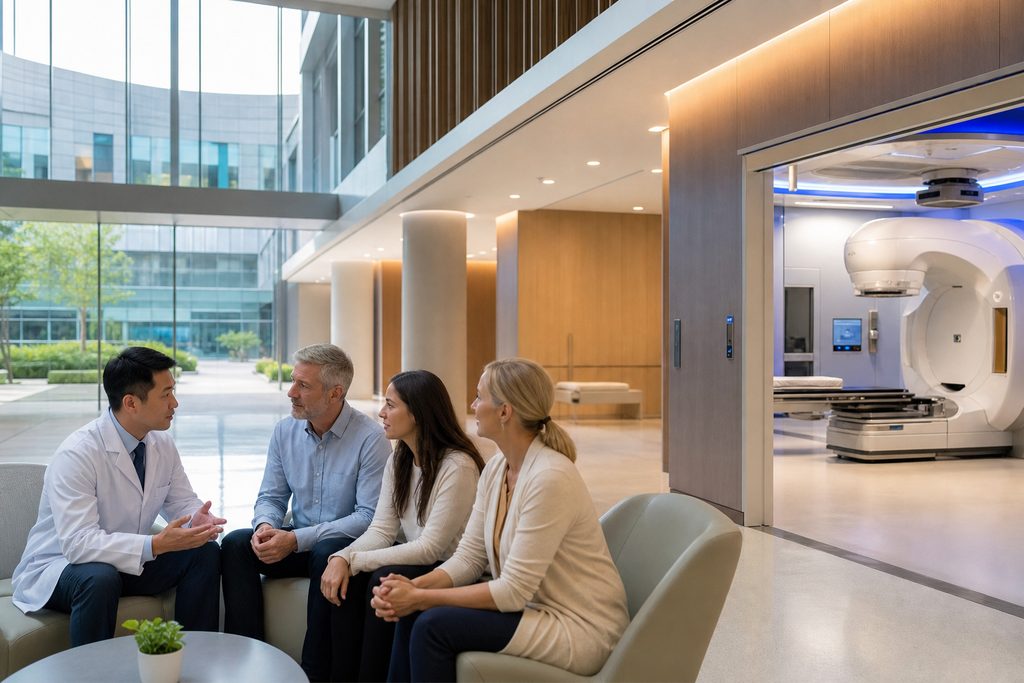
Have you ever wondered whether a top-tier Chinese cancer center could treat you as safely and effectively as one back home — at a fraction of the cost? The Hubei Cancer Hospital radiation oncology price typically ranges from $8,000 to $25,000 for a full standard course, depending on technique and complexity. That compares to $40,000–$120,000 in the United States or Western Europe for equivalent protocols.
But cost is only one variable. This article breaks down what the hospital actually offers, who should consider it, how the process works for foreigners, and what you need to know before booking a flight to Wuhan.
Hubei Cancer Hospital Radiation Oncology: The Short Answer
Hubei Cancer Hospital, located in Wuhan, is one of the largest dedicated oncology centers in central China. Its radiation oncology department runs modern linear accelerators and offers intensity-modulated radiation therapy (IMRT), volumetric modulated arc therapy (VMAT), stereotactic body radiation therapy (SBRT), and image-guided radiation therapy (IGRT). For international patients, the hospital treats a meaningful number of overseas cases each year, primarily from Southeast Asia, the Middle East, and Eastern Europe.
The short answer: yes, international patients can access radiation oncology here. The process is not instant. You need medical records review first, then a treatment plan, then travel logistics. Expect 2–4 weeks from first contact to sitting in the treatment room.
Who This Is Right For — and Who It Isn’t
Radiation oncology at Hubei Cancer Hospital suits a specific profile. It is not a universal solution.
Typically a good candidate:
- Diagnosed with a solid tumor where radiation is a standard component — head and neck, cervical, esophageal, lung, rectal, or prostate cancer
- Has complete pathology reports, imaging (CT/MRI/PET), and treatment history in English or Chinese
- Wants to reduce treatment cost by 60–80% without sacrificing modern technology
- Is medically stable enough to travel and stay in Wuhan for 4–7 weeks
- Has a local oncologist at home willing to coordinate follow-up after treatment
Who should not pursue this:
- Patients requiring emergency radiation for spinal cord compression or airway obstruction — travel time is a real risk
- Those mid-course in a radiation protocol at home; switching centers mid-treatment is rarely advisable
- Patients needing concurrent chemotherapy with unfamiliar regimens that cannot be safely replicated
- Anyone without a clear diagnosis or incomplete pathology — no reputable center will treat blind
- Patients whose cancer requires a clinical trial unavailable in China, or a highly specialized pediatric protocol
Being honest about who should stay home is what keeps the rest of this guide credible.
The Options, Compared
You are not choosing between “China” and “nowhere.” You are choosing between treatment settings with real trade-offs. Here is how Hubei Cancer Hospital stacks up against other paths.
| Factor | Hubei Cancer Hospital (Wuhan) | Private International Hospital (Shanghai/Beijing) | US/EU Academic Center |
|---|---|---|---|
| Radiation course cost | $8,000–$25,000 | $30,000–$60,000 | $40,000–$120,000+ |
| Technology available | IMRT, VMAT, SBRT, IGRT | IMRT, VMAT, SBRT, proton (limited) | All, including proton and carbon ion |
| English-speaking staff | Limited; interpreter needed | Full English service | Native English |
| Wait time to start | 1–3 weeks after records review | 1–2 weeks | 2–8 weeks (varies by system) |
| Insurance billing | Pre-pay, then claim reimbursement | Direct billing common | In-network billing |
| Daily patient volume | Very high | Low | Moderate to high |
If your priority is maximum cost savings with solid technology, Hubei Cancer Hospital wins. If you need seamless English communication and insurance-direct billing, a private international hospital in Shanghai or Beijing fits better. If you need proton therapy or a specific clinical trial, stay in the US, Europe, or Japan.
What “Radiation Oncology at Hubei Cancer Hospital” Actually Means
Here is what a typical treatment course looks like, day to day. You will not be handed a single “package.” Radiation oncology is delivered in fractions.
A standard curative course runs 25–35 fractions, delivered once daily, five days per week. That means 5–7 weeks in Wuhan. SBRT for early-stage lung or oligometastatic disease uses 3–8 fractions and can finish in 1–2 weeks. Your radiation oncologist determines the fractionation schedule based on tumor type, stage, and prior treatment.
The workflow is structured. First, a simulation session maps your body and creates immobilization devices. Then the physics team designs your plan. Then quality assurance checks run before the first fraction. After that, daily treatments take 10–20 minutes on the table, with weekly imaging to verify positioning.
You will have a designated radiation oncologist, a physicist behind the scenes, and radiation therapists who operate the machine daily. The hospital’s radiation oncology department handles a high volume of cases — that repetition is what builds technical skill. But it also means appointments are efficient, not leisurely.
What It Costs — and What Drives the Variance
The Hubei Cancer Hospital radiation oncology price is not a single number. It depends on technique, number of fractions, and whether you need additional imaging or hospitalization.
| Item | Typical Range (USD) |
|---|---|
| Simulation and treatment planning | $800–$1,500 |
| IMRT/VMAT course (25–35 fractions) | $8,000–$18,000 |
| SBRT course (3–8 fractions) | $10,000–$25,000 |
| IGRT add-on per course | $1,000–$2,500 |
| Diagnostic imaging (CT/MRI/PET if needed) | $400–$2,000 |
| Hospitalization (if required, per day) | $150–$500 |
What is not included: international flights, accommodation in Wuhan, daily meals, interpreter services, and any concurrent systemic therapy. A 6-week stay in a mid-range hotel near the hospital runs roughly $3,000–$6,000. Interpreter or bilingual companion support typically adds $300 per day if you need it for hospital visits.
Also note: Chinese public hospitals operate on a pre-payment model. You pay a deposit at admission, top up as treatment progresses, and settle the final balance before discharge. You then submit itemized receipts to your insurer for reimbursement. Most international insurers reimburse after the fact for treatment at Chinese public hospitals — verify this with your provider before committing.
Practical Considerations: Records, Visa, Language, and Follow-Up
Radiation oncology abroad is a logistics project. The medical part is difficult enough; the administrative part trips up more people.
Medical records. You need complete, translated documentation: pathology report, staging workup, imaging discs (DICOM format), prior surgery or chemotherapy summaries, and current medication list. Chinese oncologists will review these before accepting you for treatment. Incomplete records delay everything.
Visa. For medical treatment in China, the applicable visa category is S2, issued for short-term private affairs including medical treatment. Your accompanying family members also apply for S2. You will need a supporting letter from Hubei Cancer Hospital confirming your treatment arrangement. The M visa is for commercial and trade activities only — it does not apply to medical travel. Processing times vary by embassy, so start 4–6 weeks before your intended travel date. No one can guarantee visa approval; the hospital letter strengthens your application but does not override consular discretion.
Language. Hubei Cancer Hospital is a public institution. Frontline staff may have limited English. Expect to manage registration, payment, pharmacy pickup, and scheduling in Chinese or with an interpreter. This is not a criticism — it is the reality of a hospital serving a predominantly domestic patient base. If you arrive without language support, the process will be slower and more stressful. That is precisely where a bilingual medical companion earns their fee.
Follow-up after returning home. Radiation side effects peak weeks after treatment ends. You need a local oncologist who agrees to manage post-radiation care — skin reactions, fatigue, mucositis, or late effects. Before you leave Wuhan, request a complete treatment summary, radiation dose records, and imaging on disc. Your home oncologist will need these to continue your care safely.
Frequently Asked Questions
At accredited top-tier centers like Hubei Cancer Hospital, the technology and physics protocols match international standards. Linear accelerators are the same models used in Western hospitals — Varian and Elekta dominate the market. The real variable is communication and process navigation, not machine quality. A hospital that treats thousands of radiation patients annually has the technical repetition to deliver safe treatment. What it may lack is the hand-holding Western patients expect.
For a standard IMRT course of 30 fractions, expect $8,000–$15,000 in China versus $40,000–$80,000 in the United States. SBRT runs $10,000–$25,000 in China versus $60,000–$120,000 in the US. The gap narrows if you need proton therapy — China has fewer proton centers, and those that exist price closer to Western levels. The savings come from lower physician fees, lower facility overhead, and lower administrative costs.
You cannot simply “book” a radiation slot online. The process starts with a remote records review. You send your medical documents; the radiation oncology team evaluates whether they can treat you and proposes a plan. If both sides agree, you receive a treatment arrangement letter for your S2 visa application. You then travel to Wuhan for an in-person consultation, simulation, and treatment start. There is no shortcut that skips the records review. Anyone promising instant booking is not being honest about how Chinese public hospitals work.
Radiation oncology has known acute side effects — skin reactions, fatigue, esophagitis, mucositis — and the hospital manages these daily. More serious complications are rare but possible. Hubei Cancer Hospital is a full-service cancer center with emergency and inpatient capacity. But you are far from home, in a system where you may not speak the language. That is a genuine risk. Mitigate it by carrying comprehensive travel medical insurance that covers treatment complications, identifying a local contact person, and keeping your home oncologist informed throughout. Do not assume everything will go smoothly; plan for the possibility that you need extra support.
No. Unlike cosmetic surgery or check-up packages, cancer treatment is not sold as an all-inclusive “medical tourism package.” You are paying hospital charges directly, plus separate costs for flights, housing, food, and any coordination services you choose to hire. Some private facilitators market “cancer treatment packages,” but reputable public hospitals do not operate that way. The hospital bills for treatment delivered. Everything else is your responsibility to arrange. That is more work — but it is also more transparent.
Your Next Step
Radiation oncology at Hubei Cancer Hospital offers real technology at a genuinely lower price than Western centers. But the process demands preparation: complete records, an S2 visa, language support, and a home oncologist willing to manage follow-up. It is not for everyone, and it is not effortless.
We are China Medical Services, a coordination team connecting international patients with top-ranked Chinese hospitals. We are not a hospital, and we do not diagnose or treat. What we do is handle the logistics — hospital matching, records translation, appointment coordination, bilingual accompaniment, and visa guidance — so you can focus on treatment. If you are considering radiation oncology in Wuhan and want an honest assessment of whether it fits your case, request a free consultation through our patient coordination service. We will tell you straight if this path makes sense for you.
For more medical information and treatment options in China, visit chinamedservices.com (China Medical Services).
