IBD Treatment in China: Coordinated Care for Crohn’s and Ulcerative Colitis
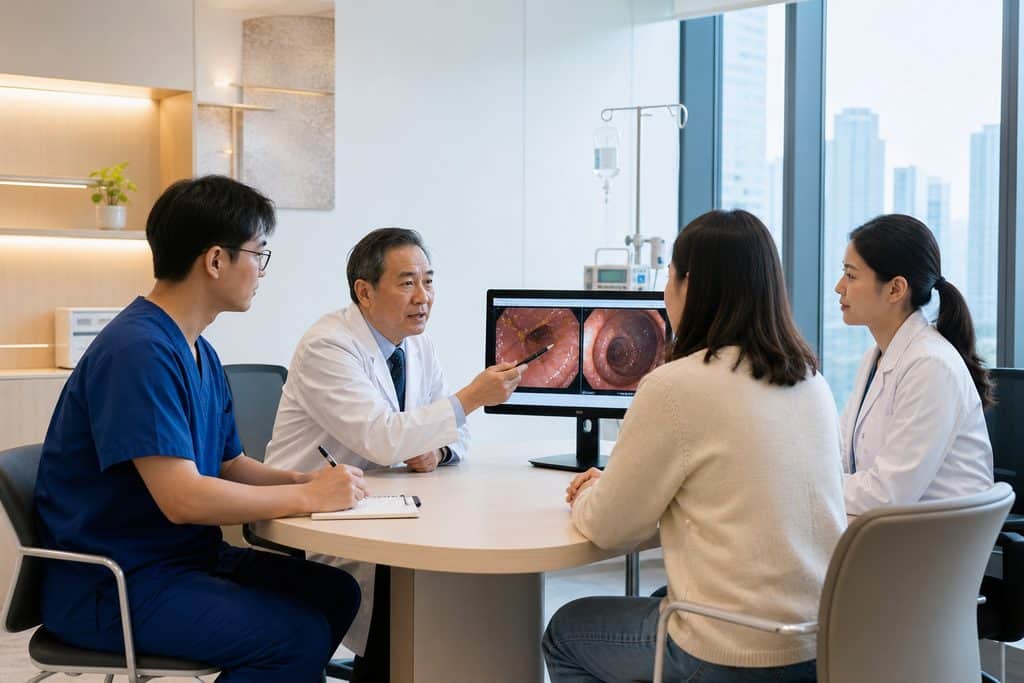
A patient in the United States faces an average annual cost of $23,000 to manage moderate-to-severe Crohn’s disease with biologics. In Shanghai, that same class of therapy often begins at $8,000 per year. The disparity is not a mark of lower quality. It reflects a structural difference in how healthcare is delivered and priced. For those navigating the exhausting cycle of flares, steroids, and step-up therapies, these numbers open a door that was not there before.
Key Takeaways
- Biologic therapy for Crohn’s disease in China typically costs 60-70% less than in the United States, with surgical intervention for ulcerative colitis averaging $12,000-18,000 compared to $60,000+ in Western private hospitals.
- China’s top gastroenterology centers, including those ranked in the Fudan University hospital specialty lists, manage inflammatory bowel disease patient volumes that rival or exceed major Western IBD centers.
- Navigating China’s hospital system independently as a non-Chinese speaker is genuinely difficult—appointments, payment systems, and inpatient coordination require Mandarin fluency that most international patients simply do not have.
- Coordinated care through a medical concierge service transforms a fragmented system into a seamless pathway, from visa documentation to post-discharge follow-up, without marking up hospital treatment fees.
The Problem: When Standard IBD Care Stops Working
Living with Crohn’s disease or ulcerative colitis means living with uncertainty. A flare can derail months of normal life. For patients who have cycled through 5-ASA drugs, immunomodulators, and a first biologic only to see their calprotectin levels spike again, the options narrow. Surgery becomes the next conversation. So does the question of cost.
The Crohn’s & Colitis Foundation reports that approximately 1 in 4 patients with ulcerative colitis will eventually require colectomy. In the United States, a laparoscopic colectomy with ileal pouch-anal anastomosis—the gold standard for UC—runs anywhere from $50,000 to $120,000 depending on the hospital and complications. Many insured patients still face $10,000+ out-of-pocket after deductibles and coinsurance. For the uninsured or underinsured, these numbers are simply catastrophic. And the wait times? A non-emergency IBD surgery in Canada or the UK can stretch 6 to 12 months while the disease continues to damage the intestinal tract.
That is the moment some patients start searching for alternatives. Not because they want medical tourism. Because they need a path forward that does not bankrupt them or leave them waiting until their colon perforates.
Who We Are
We are not a hospital. We do not provide medical treatment, prescribe medications, or offer clinical diagnoses. Our team functions as your logistical architects—we bridge the gap between you and China’s top-tier gastroenterology and colorectal surgery departments. We handle hospital matching, appointment coordination, bilingual medical companion services, visa documentation support, and accommodation logistics. Our database includes over 340 top-ranked hospitals across 37 cities, each vetted against Fudan University’s national hospital rankings and JCI accreditation standards. We are here so you can focus on getting better, not on figuring out how to pay a hospital bill in a system you do not understand.
How Is Inflammatory Bowel Disease Treated in China
Treatment protocols in China’s major academic medical centers align closely with guidelines from the European Crohn’s and Colitis Organisation (ECCO) and the American Gastroenterological Association (AGA). The difference is not in what is available. It is in how quickly you can access it and what you pay.
A newly diagnosed patient at Ruijin Hospital in Shanghai or Peking Union Medical College Hospital in Beijing will move through the same step-up paradigm familiar to any Western gastroenterologist: aminosalicylates for mild UC, corticosteroids for acute flares, immunomodulators like azathioprine for steroid-dependent disease, and biologic agents—primarily infliximab and adalimumab—for moderate-to-severe refractory cases. Vedolizumab and ustekinumab are also available through hospital international departments, though not every center stocks every agent. This is where pre-travel coordination matters enormously.
Clinical Volume and Procedural Experience
There is a well-documented relationship between hospital volume and surgical outcomes in IBD. A 2019 meta-analysis published in The Lancet Gastroenterology & Hepatology found that high-volume centers had significantly lower postoperative mortality and complication rates for complex colorectal procedures. China’s top gastroenterology departments operate at a scale that is hard to grasp until you see it. The Department of Gastroenterology at West China Hospital in Chengdu performs over 120,000 endoscopic procedures annually. The IBD center at the Sixth Affiliated Hospital of Sun Yat-sen University in Guangzhou—one of the country’s most recognized centers for colorectal surgery—manages thousands of Crohn’s and UC patients each year. These are not small boutique clinics. These are high-throughput academic centers where the surgical team may see more complex IBD cases in a month than a regional hospital in the West sees in a year.
That volume translates into procedural fluency. The surgeons know how to handle fistulizing Crohn’s. They have seen the difficult pelvic dissections. They have managed the postoperative biologic tapering protocols. For a patient considering a colectomy or strictureplasty abroad, that depth of experience matters.
Biologic Access and the Crohn’s Disease Treatment Cost China Advantage
Let us talk about the numbers directly. Infliximab biosimilars in China are priced substantially below their Western counterparts. A single infusion at a public hospital international department may cost $600-900, compared to $3,000-5,000 in the United States before insurance. A full year of maintenance therapy—eight infusions—often lands between $8,000 and $12,000. In the US, even with insurance, annual biologic costs routinely exceed $20,000.
The cost structure is not a reflection of inferior drugs. China’s National Medical Products Administration enforces rigorous biosimilar approval standards. The price difference stems from lower pharmaceutical pricing regulations, reduced hospital administrative overhead, and a healthcare labor market where physician and nursing salaries do not inflate procedure costs to Western levels. Patients who book IBD treatment in China through coordinated channels access the same class of therapy, administered in accredited hospital infusion centers, for a fraction of the financial burden.
Surgery for Ulcerative Colitis and Crohn’s: What the Numbers Show
What is the success rate of Crohn’s surgery abroad? The question is fair. No honest coordinator will quote a single percentage because outcomes depend on disease phenotype, nutritional status, smoking history, and surgeon experience. But the peer-reviewed literature offers benchmarks. A 2020 study in Diseases of the Colon & Rectum reported a 5-year surgical recurrence rate of approximately 25-30% after ileocolic resection for Crohn’s disease, with the rate dropping significantly when patients received prophylactic biologic therapy postoperatively. Chinese surgical centers that integrate postoperative biologic management show outcomes consistent with these international benchmarks.
For ulcerative colitis, the three-stage IPAA procedure—colectomy, pouch creation, and ileostomy takedown—is performed routinely at centers like Shanghai’s Zhongshan Hospital and Beijing’s Peking University Third Hospital. Total surgical costs for the complete three-stage process typically range from $15,000 to $22,000 across all three admissions. A single-stage subtotal colectomy for urgent cases starts around $10,000. These are not promotional figures. They represent the actual hospital charges we see for international patients coordinated through official hospital international departments.
What You Need to Know Before Going Alone
We need to be direct about this. China’s public hospital system is not built for walk-in international patients. The infrastructure is world-class. The administrative layer is not. Here is what you face if you attempt to navigate this independently:
- Language Barrier at Every Touchpoint: Hospital registration counters, payment windows, pharmacy pick-up stations, and nursing units operate almost exclusively in Mandarin. Even in Shanghai and Beijing, English-speaking staff are concentrated in international departments—not in the general outpatient halls where initial registration happens. A single miscommunication about your surgical history or drug allergies carries real clinical risk.
- Payment and Registration Systems: Public hospitals require upfront deposit payments before admission. The deposit window may not accept international credit cards. WeChat Pay and Alipay dominate. Without a Chinese bank account or a local intermediary, you can spend hours trying to pay a bill that should take five minutes. And if your deposit runs low mid-admission? Treatment pauses until the balance is restored. This is not negligence—it is how the system works for everyone.
- Medical Records and Diagnostic Continuity: Chinese hospitals will want to repeat key diagnostics—colonoscopy, imaging, histopathology—before committing to a surgical plan. This is standard practice and clinically defensible. But coordinating those appointments, obtaining translated reports, and ensuring your home gastroenterologist receives the documentation requires a bilingual clinical coordinator who understands both medical terminology and hospital workflow.
How We Help You Navigate This
These barriers exist for structural reasons. They are not designed to exclude international patients—they simply reflect a system built for a domestic population of 1.4 billion. Our role is to create a parallel pathway through that system.
Before you travel, we collect and translate your complete medical records—colonoscopy reports, histopathology, imaging studies, current medication list, and surgical history. We present your case to the international department of the hospital best matched to your condition. If you need a best hospital for ulcerative colitis in Shanghai, we look at Fudan specialty rankings, surgical volume data, and the availability of your required biologic agent. We do not guess. We verify.
Once the hospital accepts your case, we coordinate your S2 visa documentation—the correct visa category for medical treatment in China. We arrange your appointment schedule, your bilingual medical companion for every hospital visit, and your accommodation near the hospital. During your admission, our companion handles deposit payments, communicates with nursing staff, translates doctor rounds, and ensures you understand every step of your care plan. After discharge, we coordinate follow-up appointments and medication procurement before you fly home.
This is not concierge medicine in the luxury-hotel sense. This is practical, operational support that prevents a complex medical journey from becoming a logistical nightmare.
Frequently Asked Questions
Yes—with an important distinction. Original biologic agents like Remicade (infliximab) and Humira (adalimumab) are available at major international hospital departments. China also produces rigorously regulated biosimilars that have demonstrated pharmacokinetic equivalence in clinical trials. Your treating physician will discuss which option is appropriate. We can confirm drug availability at your target hospital before you commit to travel.
This is one of the strongest arguments for using a coordinated pathway rather than traveling independently. The hospitals we work with know you are coming. Your records are already in their system. If your condition deteriorates and you require urgent intervention, you are not starting from zero in an emergency room at 2 a.m. with no translator. You are admitted through an established channel with a clinical team that has already reviewed your history. Our companion is reachable to facilitate communication immediately.
IBD medical tourism packages in China exist, but we caution against anything that looks like a one-click online purchase. Inflammatory bowel disease is too variable for a fixed-price bundle. A Crohn’s patient with a simple ileocolic stricture needs a different recovery plan than a UC patient undergoing a three-stage pouch procedure. What we offer is modular coordination—hospital care, accommodation, and companion services arranged around your specific treatment plan, not a generic itinerary.
We reference the Fudan University Hospital Specialty Reputation Rankings, which evaluate China’s top gastroenterology and colorectal surgery departments annually. Hospitals ranked among the top 10 in these specialties—such as Peking Union Medical College Hospital, Ruijin Hospital, and Nanfang Hospital—maintain dedicated IBD centers with multidisciplinary teams including gastroenterologists, colorectal surgeons, radiologists, and pathologists. We connect you with hospitals that have demonstrable expertise, not just a general gastroenterology department.
Your Next Step
Inflammatory bowel disease does not pause while you weigh your options. The biologics, the surgery, the recovery—these things move on the disease’s timeline, not yours. China’s top medical centers offer a pathway to treatment that is clinically credible and financially accessible in ways that many Western healthcare systems simply cannot match.
If you want to understand what a coordinated treatment plan would look like for your specific diagnosis—which hospital, what timeline, what costs—we are here to walk you through it. Visit our patient coordination page to start a free consultation. No pressure. No commitment. Just a clear, honest conversation about what is possible.
For more medical information and treatment options in China, visit chinamedservices.com (China Medical Services).
