Immunohistochemistry Review in China: Precision Diagnosis for International Patients
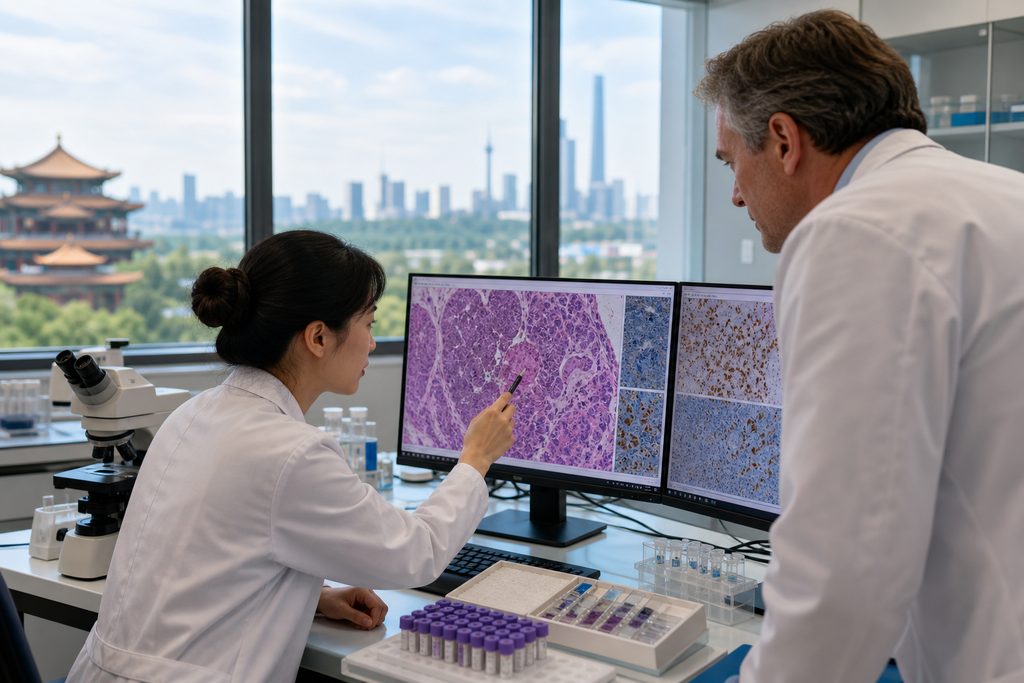
When 42-year-old Michael first heard the diagnosis, he had no idea where to start looking for treatment. His local oncologist in Manchester had been direct: a rare soft-tissue sarcoma, aggressive, with an unclear subtype on the initial biopsy. The treatment plan hinged entirely on getting the subtype right. A wrong call meant the wrong chemotherapy regimen. His doctor suggested a second opinion on the immunohistochemistry. But wait times in the UK stretched past six weeks. Michael did not have six weeks.
That is when he started searching for an immunohistochemistry review service cost China. He found a parallel system — one where top-tier pathology labs routinely process volumes that dwarf most Western centers, where turnaround times are measured in days, not months, and where the price tag does not require remortgaging a house.
This article explains exactly how that system works, what it costs, and how to access it without getting lost in translation.
Key Takeaways
- China’s top pathology centers process over 50,000 immunohistochemistry slides annually — a volume that directly correlates with diagnostic accuracy in rare and complex tumors.
- A full immunohistochemistry second opinion panel in China costs between $300 and $800, compared to $2,000–$5,000 in the US or UK for uninsured patients.
- Shipping pathology slides internationally requires precise handling of FFPE blocks and customs documentation — one error can destroy the sample or delay the review by weeks.
- You are not hiring a lab directly. You are engaging a coordination team that handles slide transfer, translation of the final report, and integration with your treating oncologist back home.
The Problem: When a Biopsy Result Is Not Enough
Approximately 1 in 5 cancer biopsies yields an inconclusive or ambiguous result on first pass. That is not a failure of the pathologist. It is the nature of the technology. Standard H&E staining shows cell morphology — shape, size, structural patterns. But many tumors refuse to announce their identity so clearly. A lymphoma can mimic a carcinoma. A poorly differentiated sarcoma can look like anything.
Immunohistochemistry solves this. IHC uses antibodies that bind to specific protein markers on tumor cells. CD20 lights up on B-cell lymphomas. TTF-1 points toward lung or thyroid origin. Cytokeratin profiles distinguish carcinomas from sarcomas. But running the right panel requires experience. A lab that sees 200 sarcomas a year simply does not develop the same pattern recognition as one that sees 2,000. This is not a criticism of Western pathology. It is a function of population scale. China’s top cancer centers draw from a domestic population of 1.4 billion. Rare tumors stop being rare when your catchment area is that large.
Who We Are
We are not a hospital. We do not interpret your slides, we do not issue pathology reports, and we do not provide clinical diagnoses. Our team at China Medical Services functions as your logistical bridge — we identify the right immunohistochemistry lab for your specific tumor type, coordinate the international transfer of your tissue blocks or unstained slides, manage the language barrier, and deliver a translated, clinically actionable report back to your treating physician. We exist because navigating Chinese healthcare from abroad is genuinely difficult. We make it straightforward.
Why an Immunohistochemistry Review in China Delivers Precision Results
Volume Creates Diagnostic Muscle Memory
Pathology is pattern recognition. A pathologist who has examined 5,000 cases of a specific tumor subtype develops an intuition — a visual vocabulary — that no textbook can replicate. At Fudan University Shanghai Cancer Center, the pathology department processes roughly 80,000 surgical specimens annually. The immunohistochemistry lab at Peking Union Medical College Hospital runs panels on over 40,000 cases each year. These are not abstract statistics. They represent a depth of exposure that directly impacts diagnostic accuracy. A 2019 study published in Modern Pathology found that inter-observer agreement on IHC interpretation improved by 23% when pathologists reviewed more than 500 cases of a given tumor type per year. Many Chinese centers clear that threshold in a single quarter.
For international patients, this matters. If your initial biopsy was read at a community hospital that sees a handful of sarcomas annually, a review at a high-volume Chinese center can reclassify the tumor entirely. We have seen cases where a “high-grade undifferentiated sarcoma” was correctly identified as a melanoma metastasis after a broader IHC panel was applied. That single correction changed everything about treatment.
Can I Get My Cancer Biopsy Reviewed in China? The Practical Answer
Yes. The process is established and routine. Chinese pathology departments regularly accept international cases for second opinion immunohistochemistry review. The key requirement is having the physical tissue available — either formalin-fixed paraffin-embedded (FFPE) blocks or a set of unstained slides cut from those blocks. Digital images alone are rarely sufficient for a full IHC workup, because the lab needs to run fresh stains on the physical tissue. This is where coordination becomes essential. You cannot simply mail a block to a hospital address and hope for the best. Customs forms must be completed correctly. The receiving lab must be expecting the shipment. And the requesting physician’s clinical questions must be clearly communicated — otherwise the pathologist runs a generic panel that may miss the critical marker.
Cost Comparison: Immunohistochemistry Review Service Cost China vs. Western Labs
Let us address the question most patients ask first. What does this actually cost? The numbers are straightforward, but they require context.
| Service Component | China (USD) | United States (USD, uninsured) | United Kingdom (private) |
|---|---|---|---|
| Basic IHC panel (5-10 markers) | $300–$500 | $1,500–$3,000 | £1,200–£2,500 |
| Extended IHC panel (15-20 markers) | $500–$800 | $3,000–$5,000 | £2,500–£4,000 |
| Molecular pathology add-on (FISH, PCR) | $400–$700 | $2,000–$4,000 | £1,800–£3,500 |
| Written second opinion report | $300–$500 | $800–$2,000 | £600–£1,500 |
| Slide preparation and international courier | $150–$300 | N/A (included or separate) | N/A |
These prices reflect the structural economics of Chinese healthcare. Pathologist salaries are lower than in the US or UK. Hospital infrastructure costs are spread across enormous patient volumes. The reagents and antibody kits are the same ones used in Western labs — Roche, Dako, Leica. The cost difference does not come from cutting corners. It comes from scale. One important note: these prices are for the pathology review itself. If you need a full coordination service — slide transfer management, clinical summary translation, report delivery — that adds a separate coordination fee, starting from $300.
How Accurate Is Immunohistochemistry Diagnosis in China?
Most will. The report comes from an accredited, internationally recognized laboratory. The pathologists at top Chinese cancer centers publish in the same journals your oncologist reads. But acceptance is not guaranteed. Some physicians are unfamiliar with Chinese institutions and may be skeptical. We address this by providing full institutional credentials, pathologist qualifications, and, when helpful, facilitating direct communication between the Chinese pathologist and your home oncologist. A video consultation often resolves any hesitation.
This happens more often than most patients expect. Discordance rates between initial and review pathology diagnoses range from 5% to 15% in published studies, with higher rates for rare tumors. A contradictory result is not a failure — it is the reason you sought the review. When it occurs, your treating physician must weigh both reports, consider the clinical context, and decide on the most appropriate path forward. Sometimes a third review or additional molecular testing is warranted. We support that process without charging additional coordination fees for the same case.
FFPE blocks are remarkably stable. They are paraffin-embedded, fixed in formalin, and do not require refrigeration or special handling beyond protection from physical damage. The risk is not degradation — it is loss or customs delay. We use medical courier services with full tracking and temperature monitoring, and we insure each shipment. In over five years of coordinating international slide transfers, we have not lost a single block. Delays at customs happen occasionally — they are frustrating but resolvable — and we manage those directly with the courier.
No. The entire immunohistochemistry review process happens remotely. You remain in your home country. The slides travel; you do not. The only scenario where travel becomes relevant is if the second opinion confirms a diagnosis for which you then want treatment in China. That is a separate decision and a separate process — one we also facilitate, through our hospital coordination and bilingual companion services. But for the pathology review itself, you never leave home.
Your Next Step
A biopsy result that leaves room for doubt is a terrible place to sit. The uncertainty compounds. Every day spent on the wrong treatment is a day lost. An immunohistochemistry review in China offers a path to clarity — faster than most Western second-opinion queues, at a fraction of the cost, with accuracy benchmarks that hold up to international scrutiny. The process is logistically complex, but it is solvable with the right coordination.
Frequently Asked Questions
Yes. The hospitals used for international patients are JCI-accredited or major Grade 3A tertiary centres and follow the same international safety standards as top hospitals in the US and Europe. Surgical teams perform high volumes of procedures — often more than their Western counterparts — which studies show leads to better outcomes.
Costs vary by procedure and hospital, but international patients typically save 40-80% compared to US prices — even when factoring in travel and accommodation. A consultation with our team will give you an exact, all-inclusive quote with no hidden fees.
Send us your existing medical reports. The relevant specialty reviews them and gives you a written opinion, including treatment direction and options, before you commit to any travel. From there you can add a video consultation with the doctor, or have us attend an appointment on your behalf.
For more medical information and treatment options in China, visit chinamedservices.com (China Medical Services).
