Inpatient Companion: Middle East Care in China’s Top Hospitals
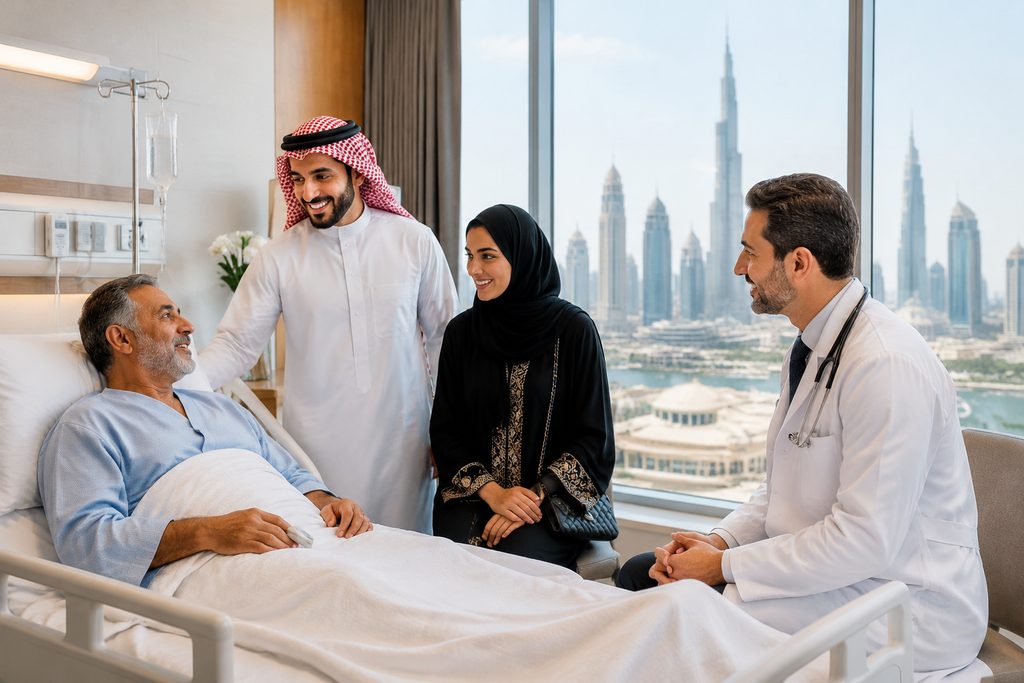
According to 2023 data from China’s National Health Commission, over 700,000 international inpatients received care in Chinese hospitals, with Middle Eastern patients representing one of the fastest-growing groups. The cancer treatment cost China hospitals quote typically runs 60–80% below equivalent US pricing, but the numbers only tell part of the story. What actually determines whether a treatment journey succeeds is the layer of human coordination around the clinical care itself — the person who stands at the registration window, translates the surgeon’s pre-op briefing, and makes sure the right scan gets to the right department before the right doctor sits down to review it.
That role, in practical terms, is the inpatient companion. Not a nurse. Not a physician. A bilingual coordinator who walks the patient and family through every non-clinical step of an inpatient stay in a Chinese hospital. For families traveling from Riyadh, Dubai, Doha, or Jeddah, this single resource changes the entire experience.
Inpatient Companion Services for Middle East Patients: The Short Answer
An inpatient companion in China is a bilingual professional who manages the daily logistics of your hospital stay — registration, queueing, payment, translation during ward rounds, communication with nurses, meal coordination, and discharge paperwork. For Middle East patients, the companion also bridges cultural gaps: prayer space locations, halal meal arrangements, family visiting protocols, and gender-specific care preferences where hospitals can accommodate them.
The caveat: a companion does not change medical outcomes. What changes is the patient’s ability to follow instructions, ask the right questions, and avoid costly misunderstandings. In a system where a single missed queue number can cost half a day, that operational layer matters enormously.
Who This Is Right For — and Who It Isn’t
A dedicated inpatient companion makes the most sense for patients who meet several of these criteria:
- Traveling without fluent Mandarin or a Chinese-speaking family member
- Planning a stay longer than five days, where daily logistics compound
- Navigating a complex diagnosis requiring multiple departments
- Accompanying an elderly parent or a child
- Coming from a cultural background where family presence at the bedside is expected but hospital rules differ
Who should not rely on a companion? Patients who already have a Chinese-speaking relative willing to stay on-site full-time. Or those using a private international hospital like United Family or Jiahui, where English-speaking staff handle most coordination internally. And patients whose condition is stable enough for outpatient follow-up only — a companion is overkill for a single consultation.
The Options, Compared
The table below contrasts the three main paths a Middle East patient can take when seeking inpatient care in China.
| Path | Daily Cost (USD) | Language Support | Best For |
|---|---|---|---|
| Public hospital, no companion | $0 (self-managed) | Minimal; Chinese only at most counters | Fluent Mandarin speakers |
| Public hospital + bilingual companion | $300–400 | Full-time English/Arabic translation | Most international inpatients |
| Private international hospital (e.g., United Family) | $800–1,500 (room and care) | Built-in English staff | Those prioritizing Western-style amenities |
The middle column — public hospital plus companion — delivers the clinical strength of China’s top-ranked institutions at a fraction of private international pricing. A patient at Fuwai Hospital for cardiac surgery, for instance, gets one of the world’s highest-volume heart surgery programs. The companion handles everything around that clinical core.
What an Inpatient Companion Actually Does, Hour by Hour
This is the section that separates a real service description from a vague promise. Here is what a typical inpatient day looks like with a companion on-site.
6:30–8:00 AM. The companion arrives before morning rounds. They confirm the day’s schedule with the nursing station, check whether any new orders were posted overnight, and brief the patient on which doctors will visit and when.
8:00–9:30 AM. Morning rounds. The companion stands beside the bed, translates the attending physician’s assessment, and relays the patient’s questions back — sleep quality, pain level, appetite, medication side effects. They write down every instruction.
9:30–11:30 AM. Tests and procedures. If the patient needs a CT, MRI, or blood draw in another building, the companion navigates the route, handles the queue, and ensures the results are routed back to the correct ward. In a hospital with 10,000 daily outpatient visits, this navigation alone saves hours.
11:30 AM–1:00 PM. Meal coordination. The companion confirms dietary restrictions with the nutrition department, arranges halal options where available, and coordinates family meal logistics.
1:00–4:00 PM. Family liaison. The companion updates family members via WhatsApp or WeChat, arranges visiting hours, and coordinates with the hospital’s international department on any billing or documentation issues.
4:00–6:00 PM. Discharge or next-day preparation. Medication reconciliation, prescription pickup, follow-up appointment scheduling, and translation of discharge instructions.
That is a single day. Multiply it across a ten-day post-operative stay, and the value becomes obvious.
How Medical Tourism Works in China for Middle East Patients
The pathway for a patient coming from the Gulf region follows a predictable sequence. Understanding it prevents wasted trips.
Step one: remote evaluation. The patient sends existing medical records — imaging, lab reports, physician notes — to a Chinese hospital’s international department or a coordination service. A written second opinion typically costs $300–500. A video consultation with a top specialist ranges from $500–800. These fees are often credited toward later on-site coordination.
Step two: hospital selection and appointment confirmation. This is where most patients need guidance. The right hospital for cardiac surgery is not necessarily the right hospital for oncology. China’s Fudan University hospital rankings list top institutions by specialty, and our specialty-specific hospital rankings break down the top ten departments across 45 clinical areas.
Step three: visa and travel. Medical travelers use an S2 visa, with the treating hospital providing an invitation letter and supporting documentation. Family members accompanying the patient apply for their own S2 visas under the same process. Processing times vary by embassy, so allow at least three to four weeks.
Step four: arrival and admission. The companion meets the patient at the airport, coordinates the $200 round-trip transfer, and handles admission paperwork. Public hospitals require prepayment; the companion manages this through the hospital’s international department.
Step five: inpatient stay with daily companion support. As described above.
Step six: discharge and follow-up. The companion translates discharge instructions, arranges medication pickup, and schedules any needed follow-up before the patient returns home. Remote follow-up via video consultation is increasingly common.
Cancer Treatment Cost China: What Middle East Patients Actually Pay
The primary reason many Middle East families look east is cost. Here are representative figures, always subject to hospital and case complexity.
| Treatment | China (USD) | United States (USD) | Savings |
|---|---|---|---|
| Lung cancer lobectomy | $15,000–25,000 | $80,000–120,000 | 75–80% |
| Breast cancer mastectomy + reconstruction | $12,000–20,000 | $60,000–100,000 | 70–80% |
| Colorectal cancer resection | $14,000–22,000 | $70,000–110,000 | 75–80% |
| Chemotherapy (per cycle) | $1,500–4,000 | $8,000–20,000 | 70–80% |
| Radiation therapy (full course) | $8,000–15,000 | $40,000–80,000 | 75–80% |
These figures cover the hospital’s clinical charges only. They do not include the companion fee ($300–400 per day), accommodation for family members, or international travel. Even with those added, total costs typically land at 40–50% of US equivalents.
Why the gap? Lower labor costs, higher patient volumes that amortize equipment investment, and a public hospital system that operates on thinner margins than US private systems. The clinical quality at top-ranked institutions — Fudan-ranked, JCI-accredited — is not the source of the savings.
JCI Accredited Hospitals in Beijing for International Patients
For Middle East patients who want an additional layer of international quality assurance, JCI accreditation matters. JCI — Joint Commission International — audits hospitals against US-derived standards for patient safety, medication management, and infection control.
Beijing hosts several JCI-accredited facilities that serve international inpatients. United Family Beijing is the most established, with full English-language service and direct billing arrangements with many international insurers. Peking Union Medical College Hospital‘s international department, while not fully JCI-accredited across all units, operates to comparable standards and ranks among China’s most prestigious institutions. Other options include Beijing Friendship Hospital‘s international wing and several specialty centers.
For a broader look at top-ranked public institutions, our Beijing hospital guide lists Fudan-ranked facilities by specialty.
The practical takeaway: JCI accreditation signals a baseline of international-standard safety. But many of China’s most clinically advanced public hospitals — Fuwai for cardiac surgery, Zhongshan in Shanghai for liver disease — have not pursued JCI because their domestic reputation already fills every bed. Accreditation and clinical excellence do not always overlap perfectly.
Practical Considerations: Records, Visas, Payment, and Follow-Up
Medical records. Chinese hospitals require translated copies of all relevant records before a remote evaluation. Expect to provide imaging in DICOM format, not just printed films. A coordination service typically handles translation as part of the case management fee.
Visa timing. The S2 visa for medical treatment requires an invitation letter from the treating hospital. Processing takes two to four weeks at most Gulf embassies. Do not book flights until the visa is approved.
Payment. Public hospitals require prepayment, often 50–100% of the estimated treatment cost, deposited at admission. International bank transfers can take three to five business days. Private international hospitals accept major credit cards and often bill insurers directly.
Language. Even in hospitals with international departments, the ward nursing staff, radiology technicians, and pharmacy counters operate primarily in Chinese. The companion is the bridge across every one of those touchpoints.
Follow-up after returning home. Most Chinese hospitals now offer video follow-up consultations. The treating team reviews post-discharge imaging and lab work remotely. Medication refills can be coordinated through the hospital’s international pharmacy, though shipping regulations vary by country.
Frequently Asked Questions
China has highly skilled transplant surgeons and several internationally recognized transplant centers, particularly for liver and kidney procedures. However, organ transplantation involves strict legal and ethical frameworks, and foreign patients face specific eligibility requirements. Any patient considering this path must work directly with a hospital’s transplant program to understand current regulations. We do not facilitate or guarantee access to donor organs.
No. Chinese public hospitals require in-person evaluation before any transplant surgery can be scheduled. A remote consultation can determine preliminary eligibility and provide a written opinion, but admission and surgery dates are only confirmed after the patient arrives and completes the hospital’s own assessment protocol. Any service claiming to sell a guaranteed transplant package should be treated with extreme caution.
Chinese hospitals have formal complaint and patient-advocacy channels, but they operate in Chinese. Your companion escalates concerns through the hospital’s international department, documents every interaction, and can involve your home country’s consulate if needed. For clinical disputes, a second opinion from another Chinese hospital or a return to your home country’s system is always an option. The companion’s role is to make sure you understand what is happening at every step, not to guarantee a specific outcome.
For a two-week inpatient stay, budget $4,200–5,600 for a full-time companion, $1,500–3,000 for family accommodation near the hospital, $200 for airport transfers, and $500–1,000 for incidentals. Total non-clinical costs typically run $6,000–10,000 for a two-week stay. That is on top of the treatment charges shown in the tables above.
Your Next Step
The decision to pursue inpatient care in China is not one to make from a brochure. It starts with a clear-eyed look at your medical records, your treatment goals, and the real numbers. We are not a hospital, and we do not diagnose or treat. We are a coordination team that connects international patients with China’s top-ranked institutions and provides the on-the-ground support that makes a complex journey manageable. If you want to understand what this would look like for your specific case, request a free consultation and our team will walk you through the options — no pressure, no obligation, just straight answers.
The core message is simple: China’s top hospitals offer world-class clinical care at a fraction of Western prices, but the system was built for Chinese-speaking patients. A bilingual inpatient companion is the bridge that makes it accessible to everyone else.
For more medical information and treatment options in China, visit chinamedservices.com (China Medical Services).
