Joint Replacement Cost in China: 2026 Prices, Top Hospitals & How to Plan
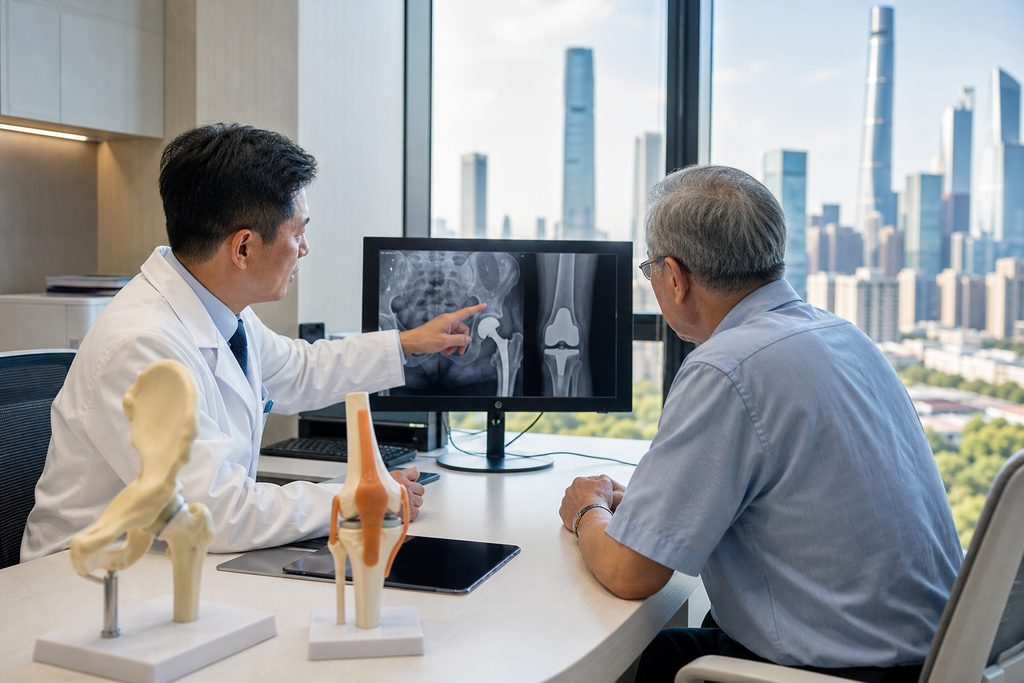
While patients in Canada wait a median of 28.6 weeks for orthopedic surgery, surgeons at Beijing Jishuitan Hospital routinely perform more than 300 joint replacements every month — with clinical outcomes that match or exceed Western benchmarks. In the United States, a single knee replacement averages $35,000 to $57,000 before insurance. In China, the same procedure at a top-tier public hospital typically lands between $8,000 and $18,000, all-in. That gap is why “joint replacement cost China” has become one of the most searched phrases among international patients exploring surgery abroad.
But price alone is a poor reason to travel 7,000 miles for surgery. What matters is whether the hospital, the surgeon, and the follow-up care meet the standard you would accept at home. This guide walks through real numbers, honest limitations, and the practical steps for booking knee or hip replacement surgery in China as a foreign patient.
Joint Replacement Cost in China: The Short Answer
A total knee replacement in China costs roughly $8,000 to $18,000 at a top-ranked public hospital, and $20,000 to $35,000 at a private international hospital. A total hip replacement runs $9,000 to $20,000 in the public system. Those figures include the implant, surgeon fees, hospital stay, anesthesia, and basic rehabilitation — but they vary by hospital and case complexity.
The caveat: “China” is not one price. A tier-3A public hospital in Beijing or Shanghai charges more than a provincial hospital, and a JCI-accredited private facility can cost three times the public rate. The implant you choose — domestic versus imported ceramic or titanium — swings the total by thousands of dollars on its own.
Who This Is Right For — and Who It Isn’t
Medical travel for joint replacement is not for everyone. Being clear about that up front saves people from expensive mistakes.
Typically a good fit:
- Patients with osteoarthritis or avascular necrosis who have exhausted conservative treatment and need a primary (first-time) total knee or hip replacement.
- People facing long public waitlists at home — 6 to 12 months is common in several single-payer systems.
- Self-paying patients or those with international insurance that reimburses overseas treatment.
- Patients willing to spend 2 to 3 weeks in China for surgery plus early rehabilitation.
- Those who can arrange a companion or hire bilingual support, since most public hospital staff do not speak English.
Probably not a good fit:
- Anyone with active infection, uncontrolled diabetes, severe cardiac disease, or a BMI that makes anesthesia high-risk — these are contraindications that any responsible surgeon will screen for.
- Complex revision surgery, where continuity with your original surgeon matters enormously.
- Patients who cannot tolerate a long flight (10+ hours) within weeks of major surgery.
- Anyone expecting a Western-style “concierge” experience at public hospital prices. Those two things do not coexist.
The Options, Compared
Here is how the main pathways stack up on the numbers that actually drive decisions.
| Pathway | Typical Total Cost | Wait Time | English Support | Insurance Billing |
|---|---|---|---|---|
| China — top public hospital (tier-3A) | $8,000–$18,000 | Days to 3 weeks | Limited; interpreter needed | Pay upfront, reimburse later |
| China — private international hospital | $20,000–$35,000 | 1–2 weeks | Full English service | Direct billing common |
| United States | $35,000–$57,000 | 3–8 weeks | Native | Insurance-dependent |
| United Kingdom (private) | £12,000–£16,000 (~$15,000–$20,000) | 2–6 weeks | Native | Self-pay or private plan |
| Canada (public system) | $0 out of pocket | Median 28.6 weeks+ | Native | Covered |
| Thailand / India | $10,000–$16,000 | 1–3 weeks | Full English service | Varies |
Which column matters most? If your priority is raw cost and you can bring a translator, a Chinese public hospital wins decisively. If you want English-speaking staff and direct insurance billing, look at the private international hospitals. And if you have full coverage at home with a tolerable wait, the case for traveling is weaker.
Why China’s Top Orthopedic Hospitals Are Worth Considering
Volume matters in joint replacement. Surgeons who perform hundreds of procedures a year tend to have lower complication rates and faster operative times — that relationship is well established in orthopedic literature.
China’s top hospitals operate at a scale few Western centers match. Beijing Jishuitan Hospital, the country’s best-known orthopedic specialty center, handles an enormous annual caseload. Shanghai’s major teaching hospitals — including Ruijin and Zhongshan, both affiliated with Fudan University — run high-volume joint replacement programs with modern navigation and robotic-assist systems.
For foreigners, the practical question is often location. If you are searching for the best orthopedic hospitals in Shanghai for foreigners, the shortlist typically includes the international departments of the major Fudan-affiliated hospitals plus JCI-accredited private facilities like United Family and Jiahui. Beijing offers the deepest orthopedic bench, with Jishuitan as the anchor.
You can browse ranked options by city on our top hospitals directory, which groups facilities by the Fudan Hospital Rankings tiers and by city.
What Actually Drives the Price Up or Down
Two patients can have the same diagnosis and pay wildly different totals. Here is what moves the number.
- Implant choice. A domestic implant might add $1,500 to the bill; a premium imported ceramic-on-ceramic system can add $5,000 or more.
- Hospital tier. Public tier-3A versus private international is the single biggest swing — often a 2x to 3x difference.
- Unilateral versus bilateral. Both knees at once costs more but avoids a second recovery period.
- Length of stay. Standard is 5 to 10 days. Complications extend it.
- Rehabilitation. Inpatient rehab adds cost; outpatient or home programs cost less.
- International department surcharge. Using a hospital’s VIP or international channel typically runs 1.5 to 2 times the standard rate — but you get English-speaking staff and faster scheduling.
What is usually not included in quoted figures: flights, accommodation, meals, interpreter services, and follow-up after you return home. Budget those separately.
How Foreigners Actually Book Knee or Hip Replacement in China
This is where most people get confused, because the Chinese public hospital system does not work like booking a clinic in the US or Europe.
You cannot reserve a standard public outpatient slot from overseas. Registration happens on the day, in person, by queue. And crucially, surgery is scheduled only after an in-person consultation with the surgeon — no exceptions at public hospitals.
So how do you book knee replacement surgery in China from abroad? There are three realistic routes:
- International or VIP department. Most top hospitals have one. They accept advance scheduling, provide English-speaking staff, and charge 1.5–2x the standard rate. This is the most common path for foreigners.
- Private international hospital. Full English service, direct insurance billing, Western-style care. Higher cost, smoother experience.
- Remote evaluation first, then travel. You send imaging and records, a Chinese orthopedic specialist reviews them, and you get a written opinion plus a treatment plan before you fly. This is the model we use at China Medical Services, and it prevents the worst outcome — flying 7,000 miles to be told you are not a surgical candidate.
That third route is worth emphasizing. A written second opinion from a top-hospital specialist typically costs $300–$500. A video consultation runs $100–$800 depending on the tier. Compare that to the cost of a wasted trip.
Safety, Records, and the Visa Question
Is hip replacement surgery safe in China? For primary, uncomplicated cases at a top-tier hospital, the published complication rates are broadly comparable to Western centers. China performs hundreds of thousands of joint replacements annually, and its leading orthopedic departments follow international protocols.
But “safe” depends heavily on case selection. A high-volume center with proper pre-operative screening is safer than a low-volume hospital that accepts everyone. This is why remote evaluation matters — it filters out cases that should not travel.
On documentation, you will need your imaging (X-ray, MRI), prior operative notes if any, medication list, and recent bloodwork. Get these translated into Chinese by a qualified service; machine translation of medical records is not adequate.
For the visa: foreign patients traveling to China for medical treatment apply for an S2 visa with a medical-treatment annotation. Stays beyond 180 days use the S1 category. Accompanying family members apply for S2 as well. Note that the M visa is strictly for commercial and trade activities and has nothing to do with medical treatment. Requirements shift, so confirm current rules with the nearest Chinese embassy or consulate and bring supporting documents from the receiving hospital.
Payment: public hospitals require prepayment, with insurance reimbursement handled afterward in your home country. Private international hospitals often bill insurers directly. Bring a payment method that works in China — international credit cards are accepted at international departments but not everywhere in the public system.
Frequently Asked Questions
A total knee replacement at a top Chinese public hospital typically runs $8,000 to $18,000, versus $35,000 to $57,000 in the US. Private international hospitals in China land around $20,000 to $35,000 — still often below US pricing, with more English-language support.
Not at standard public hospitals — an in-person consultation is required before surgery is scheduled. You can, however, arrange a remote written second opinion or video consultation first, then travel once a plan is confirmed. International and VIP departments offer more flexibility on advance scheduling.
This is a real risk and should be planned for. Ask your Chinese surgeon for a complete operative report and imaging in English before discharge, and arrange a follow-up appointment with an orthopedic surgeon at home before you leave. Most post-operative issues in the first year — infection, loosening, stiffness — are managed locally, but your home surgeon needs the full record.
No. Packages exist, but they vary widely in quality and often bundle services you do not need. A more transparent approach is to pay for specific services — hospital coordination, interpretation, airport transfer — as separate line items. That way you know what you are buying.
Your Next Step
The core message is simple: joint replacement in China can cost a fraction of Western prices at genuinely world-class hospitals, but only if you match the right facility to your case and plan the logistics properly. The savings are real. So are the complications of going in unprepared.
We are China Medical Services — a coordination service, not a hospital. We do not diagnose or treat anyone. What we do is connect international patients with the right Chinese specialists, arrange remote second opinions and video consultations, and handle the on-the-ground logistics once you decide to travel. If you would like to understand your options before making any commitment, you can start with a free consultation. No pressure, no obligation — just a clearer picture of what is possible.
This article is for general information only and is not medical advice. Treatment decisions should always be made with a qualified physician who has reviewed your individual case.
For more medical information and treatment options in China, visit chinamedservices.com (China Medical Services).
