Joint Ultrasound in China: How to Book and What It Really Costs
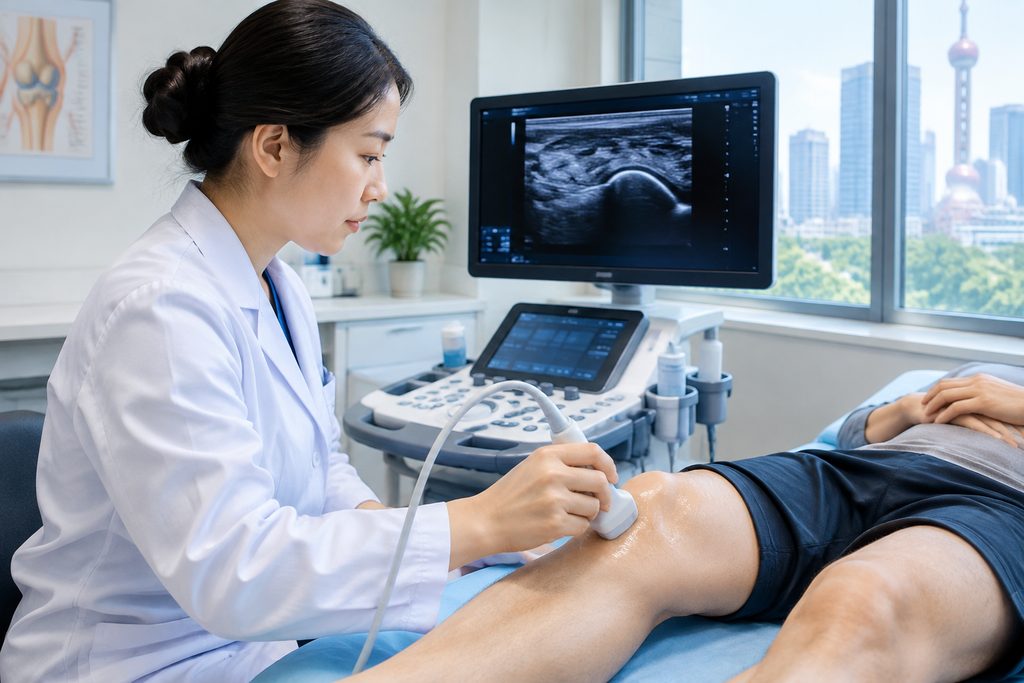
Key Takeaways
- Joint ultrasound cost China-wide typically falls between $80 and $350 at public tertiary hospitals — a fraction of the $500–$1,500 a musculoskeletal scan often runs in the United States.
- Ultrasound is the fastest, safest imaging option for joints: no radiation, no contrast dye, and results printed the same day at most large hospitals.
- The honest barrier is not price or quality — it is access. Walk-in registration, Chinese-language queues, and same-day appointment limits frustrate foreign patients who arrive unprepared.
- Booking through an official international department, or with a coordinator who understands the system, turns a two-day ordeal into a single morning.
Could a 15-minute scan in Shanghai cost you less than your insurance co-pay back home — and still be read by a radiologist who performs thousands of musculoskeletal studies a year?
The short answer is yes. Joint ultrasound in China is one of the few medical services where the price gap with the West is enormous and the quality gap is essentially zero. A scan of a knee, shoulder, wrist, or ankle at a major Chinese public hospital generally runs between $80 and $350, depending on the hospital tier and how many joints are imaged. The same study at a US outpatient imaging center frequently bills $500 to $1,500 before insurance adjustments.
What trips people up is not the scan itself. It is everything around it — getting registered, finding the right department, and understanding a hospital that may see 10,000 outpatients in a single day. This guide walks through the real numbers, the safety record, and exactly how to book joint ultrasound in China without wasting a day in the wrong queue.
The Problem: Great Imaging, Confusing Access
Roughly one in four adults worldwide lives with chronic joint pain, according to the CDC’s arthritis surveillance data, and imaging is usually the first real diagnostic step. In the US and UK, that step is often gated by referrals and waiting lists. A routine musculoskeletal ultrasound through the NHS can take several weeks; in some US markets, scheduling an outpatient scan means a referral, a prior authorization, and a bill that arrives three months later.
China inverts the problem. Capacity is enormous — a single top-tier hospital may run dozens of ultrasound rooms across multiple shifts — but the front door is built for Chinese-speaking walk-in patients. Public hospitals generally do not allow foreigners to pre-book a standard outpatient slot from overseas. You show up, you register on-site, you queue.
That is the friction point. A patient flying in from Dubai or Toronto with a swollen knee does not want to spend day one decoding a registration hall. The scan is easy. The system is not.
Why China Delivers Strong Results for Joint Imaging
Volume That Builds Real Expertise
Chinese radiologists at major hospitals read musculoskeletal ultrasound at a pace Western counterparts rarely match. A senior sonographer at a large tertiary center may perform 40 to 80 joint scans in a single day. That repetition matters — subtle findings like small effusions, early synovitis, or partial tendon tears are far easier to catch when you see them weekly rather than monthly.
The equipment is not the bottleneck either. Top hospitals in Beijing, Shanghai, and Guangzhou run current-generation machines from GE, Philips, Canon, and Mindray, with high-frequency linear probes suited to superficial joints like fingers, wrists, and ankles.
Speed and Same-Day Reporting
Here is a structural difference worth understanding. At most large Chinese hospitals, an ultrasound report is issued within hours, often within the same visit. You walk in, get scanned, and leave with printed findings and images. Compare that to the multi-day turnaround common in many Western outpatient systems.
For a traveler, that compression is everything. It means a scan on Monday morning and a specialist consultation Monday afternoon — a sequence that might take three separate appointments at home.
Cost Without a Quality Trade-Off
Why is it cheaper? Not because anything is cut. Chinese public hospital pricing is set administratively, physician salaries are lower in absolute terms, and patient volume spreads fixed equipment costs across far more studies. A hospital doing 500 ultrasounds a day amortizes a $150,000 machine very differently than a clinic doing 20.
That is the whole story. Same probes, same physics, same diagnostic criteria — different economics.
| Service | Typical Cost in China (USD) | Typical Cost in US (USD) |
|---|---|---|
| Single joint ultrasound (public tertiary hospital) | $80 – $180 | $500 – $900 |
| Multi-joint scan (2–3 joints) | $150 – $350 | $900 – $1,500 |
| International/VIP department scan | $200 – $400 | — |
| Private international hospital scan | $300 – $600 | — |
| Same-day specialist consultation | $30 – $120 | $250 – $500 |
Prices vary by hospital and case complexity, and the figures above are reference ranges rather than quotes. A scan ordered as part of a broader workup, or one requiring dynamic stress views, may sit at the higher end.
How to Book Joint Ultrasound in China: The Step-by-Step Path
Two routes exist, and they behave very differently.
Route one — walk-in at a public hospital. You arrive at the outpatient building, present your passport at the registration desk, pay the registration fee (usually under $10), and join the queue for the relevant department. For ultrasound specifically, many hospitals allow direct scheduling once you have a registration slip. Expect to spend two to four hours on-site. Bring a Chinese-speaking companion or a translation app; signage is largely in Chinese.
Route two — international department or VIP channel. Most large tertiary hospitals operate a separate international medical department with English-speaking staff, appointment scheduling, and shorter waits. The price is roughly 1.5 to 2 times the standard rate. For a scan costing $120, you might pay $220. In exchange, you get a booked time slot, an English-speaking coordinator, and a much calmer experience.
If you want to book joint ultrasound appointment Beijing-style at a top hospital like Peking Union Medical College Hospital, the international department route is realistic. The walk-in route is possible but slow. For Shanghai, hospitals such as Ruijin and Zhongshan run similar international services, and the private international hospitals — United Family, Jiahui, Parkway — offer fully English-language booking with direct insurance billing.
A third option sits between the two: using a coordinator who handles registration, department selection, and on-site navigation. That is the practical answer for most foreign patients who cannot pre-book remotely and do not want to gamble on a walk-in.
Is Joint Ultrasound in China Safe — and Who Should Skip It?
On the safety question, the evidence is unremarkable in the best way. Diagnostic ultrasound uses no ionizing radiation and no contrast agent in standard musculoskeletal protocols. The World Health Organization classifies diagnostic ultrasound as a non-ionizing modality with no established adverse effects at diagnostic intensities. The main risks are procedural, not physical: miscommunication about which joint, incomplete scanning, or a report you cannot read.
So is joint ultrasound in China safe? Clinically, yes — provided you are scanned at a licensed hospital and the report is interpreted by a qualified physician. The variables that matter are the facility and the communication, not the country.
Who should think twice?
- Patients who need ultrasound-guided intervention, such as a steroid injection or aspiration, should confirm the hospital performs the procedure and that a physician — not only a sonographer — will be present.
- Anyone whose symptoms suggest something beyond a joint — unexplained weight loss, night sweats, fever — needs a broader workup, not a single scan.
- Patients who cannot travel or tolerate a long hospital day may find a local scan plus a remote second opinion more sensible.
And one honest caveat: a scan is a picture, not a diagnosis. If your case is complex — a suspected ligament reconstruction, an unclear mass, a failed prior surgery — the imaging should feed into a specialist consultation, not stand alone.
Practical Considerations: Records, Payment, and Follow-Up
Bring your prior imaging. If you have an MRI, X-ray, or earlier ultrasound from home, bring the discs and the written reports. Chinese radiologists routinely compare new findings against prior studies, and having them on hand shortens the visit considerably.
Visa category. For medical travel to China, the applicable short-stay category is the S2 visa, issued for medical treatment and private affairs, subject to the latest embassy or consulate requirements and supporting hospital documents. Accompanying family members apply under the same category. Stays exceeding 180 days fall under S1. The M visa is for commercial and trade activities and is not the medical route — a distinction worth getting right before you apply.
Payment. Public hospitals require upfront payment; international cards are accepted at international departments but not always at standard cashier windows, so carry a card that works on Chinese networks or arrange payment through your coordinator. Private international hospitals typically bill insurers directly. If you plan to claim reimbursement at home, request an itemized receipt and an English-language report — both are usually available on request.
Follow-up after you leave. Ask for digital copies of the images and the report before departure. If your treating physician at home needs clarification, a written second opinion from the Chinese hospital’s specialty team can be arranged remotely — you send the reports, the department reviews them, and you receive written analysis and treatment direction. That service typically runs $300–$500, and any such fee is credited in full toward on-the-ground coordination if you later travel to China within 90 days.
For a broader look at how the hospital system is organized, the directory of top-ranked Chinese hospitals by city is a useful starting point, and the specialty rankings by department help narrow down which hospital actually leads in orthopedics or rheumatology.
Frequently Asked Questions
Standard public hospital outpatient slots generally cannot be reserved from overseas — registration happens on-site. International departments and private international hospitals do accept advance booking, often by email or through a coordinator. If you need a confirmed time slot before you fly, the international department route is the realistic one.
Expect $80–$350 at public tertiary hospitals and $300–$600 at private international facilities. In the US, the same study commonly bills $500–$1,500. Prices vary by hospital and case complexity, and multi-joint scans cost more than single-joint studies.
Most joint ultrasound findings are manageable — effusion, tendinopathy, bursitis, early arthritis. If something unexpected appears, the hospital will typically refer you to the relevant specialty the same day or the next. For complex findings, a multidisciplinary review can be arranged, and you should not make treatment decisions based on imaging alone.
Yes, any medical visit requires an appropriate visa. For short medical stays, S2 is the applicable category, subject to current embassy or consulate requirements and supporting hospital documentation. Approval is never guaranteed, and requirements change — verify with the embassy before applying.
Your Next Step
Joint ultrasound in China is fast, affordable, and technically solid — the only real obstacle is navigating a system designed for local patients. Knowing which route fits your timeline is most of the battle.
We are China Medical Services, a coordination team that connects international patients with 340+ top-ranked hospitals across 37 cities. We are not a hospital and we do not diagnose or treat anyone — we handle hospital matching, appointment coordination, bilingual accompaniment, and visa guidance so you can focus on your health. If you would like to talk through your situation, start with a free consultation — no pressure, no obligation, just a clear picture of your options.
This article is for general information only and does not constitute medical advice. Always consult a qualified physician about your individual condition before making treatment decisions.
For more medical information and treatment options in China, visit chinamedservices.com (China Medical Services).
