Knee Replacement Rehab in China: Physiotherapy Protocol from Day One to Walking
Key Takeaways
- Top Chinese orthopedic centers mobilize patients within 4-6 hours post-surgery; studies show this early mobilization cuts the risk of deep vein thrombosis by nearly 50%.
- A total knee replacement in China costs between $12,000 and $18,000, roughly one-fifth of the US price, while adhering to protocols that match or exceed Western recovery timelines.
- Navigating a public hospital alone is a genuine barrier. Language gaps and registration systems can stall your rehab before it starts unless you have a local coordinator.
- You should understand that “fast-track” recovery is a structured, multi-week commitment—not a passive experience. The protocol demands your active participation from hour zero.
The Problem: A Great Surgery Sabotaged by Generic Recovery
You have probably heard the statistic: approximately 790,000 total knee replacements are performed annually in the United States. What gets less attention is the rehabilitation failure rate. Studies suggest that up to 30% of patients show negligible functional improvement one year after surgery. The culprit is rarely the surgeon’s skill. It is the gap between a technically perfect implant and a poorly executed physiotherapy protocol. When insurance limits you to a handful of generic physical therapy sessions, you are left fighting stiffness and muscle atrophy alone. You end up with a new knee that never truly learns to walk again.
This is a structural problem, not a personal one. In many Western systems, the transition from acute hospital care to outpatient physio is fragmented. You get handed a sheet of paper with stick-figure exercises. You wait weeks for an appointment. By then, scar tissue has already set in. The window for optimal recovery closes fast. For patients who traveled abroad specifically for the knee replacement rehab cost China advantage, the expectation is different. They are not just buying a cheaper implant. They are buying a system that refuses to let that implant fail.
Who We Are
We are not a hospital. We do not perform surgeries or prescribe treatment plans. Our role is to act as your logistical architects. We connect you to a network of 340+ top-ranked hospitals across 37 cities in China. These are institutions ranked in the top 5% of China’s 35,000+ hospitals, evaluated by the Fudan University ranking system and JCI accreditation standards. We handle the friction—the visa guidance, the bilingual medical companions, the appointment coordination—so that your clinical team can focus purely on your recovery protocol. We bridge the gap between you and a system built for volume-driven excellence.
Why China’s Rehab Model Delivers Faster Mobilization
Western patients often assume that lower costs signal corner-cutting. The reality is structural. Chinese orthopedic centers operate on a high-volume, protocol-driven model that creates a unique environment for recovery. The sheer repetition of a procedure refines not just the surgery, but the entire perioperative workflow. This translates into a physiotherapy protocol that begins aggressively early because the system is designed to support it logistically.
Clinical Volume Drives Protocol Precision
A senior orthopedic surgeon at a top-tier Chinese hospital often completes 300 to 500 knee replacements annually. Compare that to the average US surgeon, who performs roughly 65 per year. This volume is not just a vanity metric. It forces the creation of strict, standardized pathways. There is no guesswork about when to remove the drain or how to manage pain for early flexion. The physiotherapy protocol after knee replacement day 1 is not a suggestion here—it is a hospital-wide rhythm. When a physio team sees ten new knees every morning, they recognize the subtle difference between safe discomfort and dangerous pain instantly. That recognition gets you standing up hours earlier.
Integrated Inpatient Rehab Infrastructure
In many Western hospitals, physiotherapy is a consulting service that visits the ward. In major Chinese joint replacement centers, the rehabilitation department is structurally embedded within the orthopedic floor. The equipment is on-site. The therapists are assigned exclusively to post-op joints. This means the Continuous Passive Motion (CPM) machine is applied immediately. Ice compression systems are cycled with military precision. You don’t wait for a therapist to finish a session on a different floor. The system is built to answer the question how soon can I walk after total knee replacement in China with a concrete number: most patients stand with a walker within 4 to 6 hours, and independent walking often begins between day 2 and day 5.
The Economic Logic of Early Discharge
Let’s address the cost directly. The knee replacement rehab cost China is structurally lower because of labor economics and hospital efficiency, not inferior materials. A total knee package, including the implant, hospital stay, and initial inpatient rehabilitation, ranges from $12,000 to $20,000. In the US, that figure can easily exceed $50,000. The incentive model is also different. Chinese hospitals are not incentivized to keep you in a bed for extra billing days. The goal is a safe, rapid discharge. This aligns the hospital’s financial model perfectly with your recovery goal: get you walking, functional, and out the door safely. It is a fast-track medical tourism knee surgery fast track recovery abroad model that only works because the post-acute care is so intensive while you are still an inpatient.
What Is the Physiotherapy Protocol After Knee Replacement Day 1?
Let’s walk through the timeline. This is what you can expect when you book knee replacement rehabilitation package China through a top-tier center. The protocol is aggressive but graded. It respects tissue healing while refusing to let the joint stiffen.
Day 0: The First Four Hours
You wake up. The spinal anesthetic is still wearing off. A CPM machine may already be cradling your leg, gently flexing and extending the joint without muscular effort. This is passive motion. It prevents adhesions. The nursing team checks your neurovascular status. Ice is applied. And then, within 4 hours, the physio arrives. They don’t ask if you feel ready. They assess your vital signs. If stable, you sit on the edge of the bed. Your feet touch the floor. This is not walking. This is a neurological declaration of intent.
Day 1: Standing and Weight-Bearing
This is the day that defines the protocol. The drain is usually removed early. The bulky dressing is changed. The physiotherapy protocol after knee replacement day 1 demands that you stand. You will use a walker. You will put as much weight on that leg as you can tolerate. Full weight-bearing is not only allowed; it is required. The implant is mechanically stable. The threat is not the prosthesis breaking—it is the muscle shutting down. You might take ten steps. The focus is on gait pattern. Heel-to-toe. No limping. The therapist’s hands are on your gait belt, but their eyes are on your knee extension.
Day 2 to Day 3: Gait Training and Stair Climbing
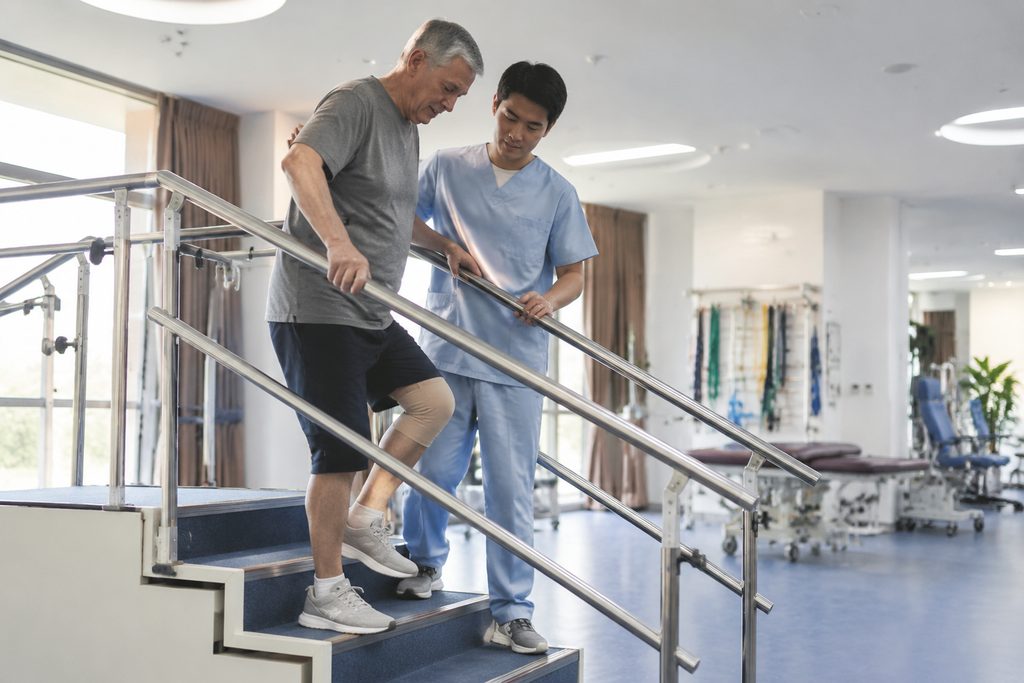
By day two, the CPM machine is used for hours at a time, pushing flexion to 90 degrees. The exercises escalate. Active quadriceps sets. Straight leg raises. You are walking longer corridors. In many Chinese protocols, stair climbing is introduced on day three. This surprises Western patients. But the logic is sound: if you can climb a step, you can function at home. The therapist teaches you the “up with the good, down with the bad” pattern. You are still swollen. It still hurts. But the motion is preserving your range.
Day 4 to Discharge (Day 7-10): Independence
You are now walking with a single crutch or a stick. The goal is 100 degrees of active flexion. You are doing standing heel raises. You are practicing getting in and out of a simulated car. Discharge does not mean the end. It means you have graduated from the acute phase. The question how soon can I walk after total knee replacement in China is now answered: you are walking. But the work is not finished.
What You Need to Know Before Going Alone
The protocol sounds effective. And it is. But accessing it as an independent international patient is where the system breaks down. We need to be brutally honest about the barriers.
- Visa Requirements: Medical treatment in China requires an S2 visa, which is specifically annotated for medical purposes. This requires an invitation letter from the hospital. Public hospitals do not issue these casually. You need a confirmed booking and a local contact. Showing up with an M (business) visa is not an option—it is the wrong category and can lead to denial of entry.
- Hospital Registration and Language: Top public hospitals handle over 10,000 outpatient visits daily. The registration kiosks are in Mandarin. The queue tickets are in Mandarin. The physiotherapist’s instructions during your first painful walk will be in Mandarin. Without a bilingual medical companion, you cannot execute this protocol. You will not understand the subtle cues for muscle activation.
- Payment Systems: Public hospitals require a prepaid deposit, often via WeChat, Alipay, or a Chinese bank card. International credit cards are frequently declined at the cashier counter. You can be standing in a hospital with a $20,000 budget and no way to pay the admission deposit.
How We Help You Navigate This
These barriers exist for structural reasons. They are not designed to exclude you, but they do. Our entire service model is built to dismantle them. We start with the visa invitation letter, sourced through the hospital’s official international department. We coordinate the appointment so that you are not competing with the general queue. A bilingual medical companion is with you on day one, translating the physiotherapist’s commands in real time: “Lock your knee. Do not lean. Squeeze your thigh.” These are not just translations. They are the difference between a correct gait and a compensatory limp that lasts for years.
We also handle the payment logistics, ensuring your deposit is processed without a mobile payment app. Our coordination fee starts from $300, and our bilingual companion service starts from $200 per day. If you begin with a remote consultation, that fee is credited in full toward any on-the-ground coordination within 90 days. We are not selling access to a specific surgeon. We are providing case management that makes the protocol possible.
If you are looking for the best knee surgery rehabilitation hospital Shanghai, our database includes top-ranked orthopedics departments. Shanghai is home to 18 of the Fudan Top 100 hospitals. We connect you to centers where the volume of joint replacements ensures that the physio team has seen your exact case hundreds of times. You can explore our database of top-ranked hospitals to understand the landscape. We also maintain a list of private international hospitals for patients who prefer a fully English-speaking environment with direct insurance billing, though the cost structure there differs.
Frequently Asked Questions
The protocol is tailored to the individual’s bone quality and cardiovascular status, not just their chronological age. The clinical team adjusts weight-bearing status based on intraoperative findings. An 80-year-old with good bone density will follow the same early mobilization principles as a 60-year-old, but the progression might be slower. The principle of early movement, however, is non-negotiable because the risk of pneumonia and thrombosis from bed rest is far greater than the risk of controlled loading.
This is a common concern. If the flexion goal is not met due to excessive swelling or pain, the discharge is not canceled. The hospital will arrange for a manipulation under anesthesia (MUA) if the window for stiffness is closing, or they will extend your inpatient rehabilitation package. Our coordination team ensures that the discharge criteria are clinically driven, not financially driven. We handle the negotiation with the international department to extend the stay if medically justified.
You will receive a detailed discharge summary in English, including operative notes, implant stickers, and a phased outpatient rehabilitation protocol. This document is designed for a Western physiotherapist to follow. It specifies the exact range of motion milestones and strengthening exercises for weeks 3 through 12. We bridge the handover so you don’t experience a gap in care. The hard part—the acute pain and the initial neuromuscular re-education—is done. Your local physio simply continues the established trajectory.
Technically, yes. Practically, it is extremely difficult. You would need to navigate a Mandarin-only website, secure an S2 visa invitation independently, and hope that a bilingual physiotherapist is available on your ward. In a public hospital, the default is a Mandarin-speaking team. If you miscommunicate a pain level or misunderstand a post-op instruction, the protocol fails. The question is not whether it is possible, but whether you want to risk a $15,000 investment on a language barrier.
Your Next Step
Recovery from a total knee replacement is a race against scar tissue. The first two weeks determine the arc of your mobility for the next decade. China’s top orthopedic centers have refined a protocol that wins that race with a combination of high-volume expertise and aggressive early mobilization. The financial savings are significant, but the functional outcome is the real prize.
If you want to understand how this protocol applies to your specific condition, or if you want to see a tailored estimate for the knee replacement rehab cost China, we are here to provide that clarity. There is no pressure and no commitment required. You can start with a simple, no-obligation discussion about your needs through our free consultation page. We listen to your history, and we map out the logistics. The decision to move forward is entirely yours.
Disclaimer: This article is for informational purposes only and does not constitute medical advice. Always consult a qualified orthopedic surgeon for a personal assessment. Prices stated are estimates in USD and vary by hospital, implant choice, and case complexity.
For more medical information and treatment options in China, visit chinamedservices.com (China Medical Services).
