Knee Replacement Surgery Service China: Coordinating Total and Partial Knee Arthroplasty
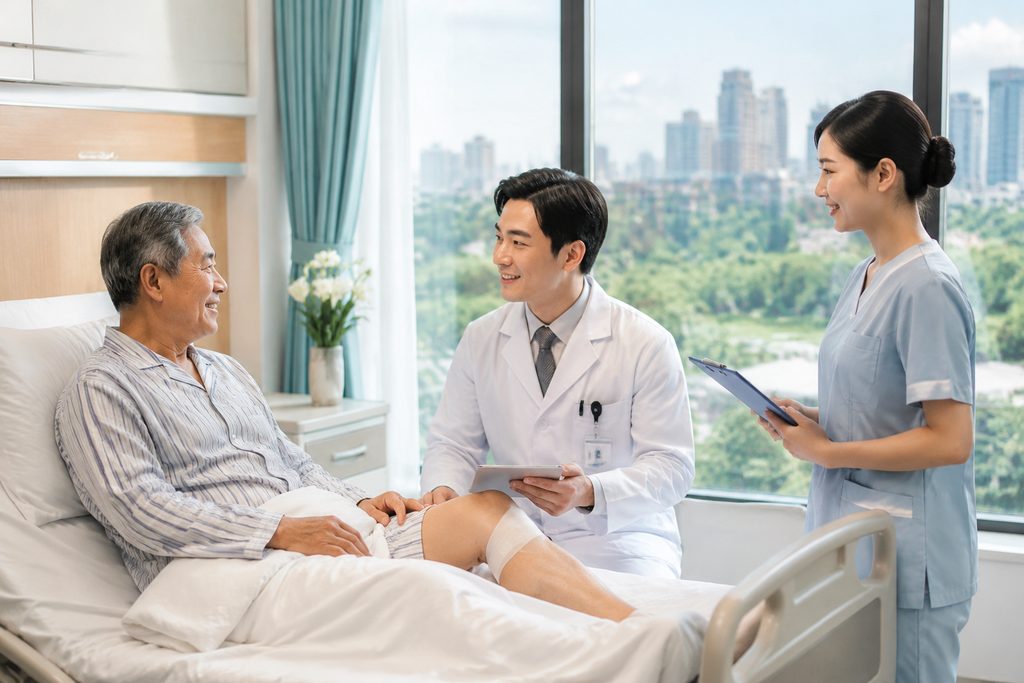
You have probably heard that traveling abroad for a knee replacement involves a trade-off. The assumption is that a lower knee replacement surgery cost China means accepting a lower standard of care, outdated implants, or a risky, unregulated environment. The data tells a completely different story. The top 5% of China’s 35,000+ hospitals operate at a volume and efficiency that fundamentally changes the risk profile of the procedure itself. We are not talking about a discount alternative. We are talking about specialized orthopedic centers where surgeons perform more knee arthroplasties in a month than many Western surgeons do in a year. The question is not whether the quality is there. The question is whether you can successfully navigate the system to access it. That is where most independent travelers hit a wall.
Key Takeaways
- Total knee replacement in a top-tier Chinese hospital costs $12,000 to $25,000, compared to $35,000 to $70,000 in the US, with no evidence of inferior clinical outcomes at high-volume centers.
- Surgeons at Fudan-ranked orthopedic hospitals routinely log 300-500 cases annually, a caseload linked in multiple studies to lower complication rates and shorter operative times.
- Public hospital outpatient departments cannot be booked from overseas; surgical scheduling requires an in-person consultation first, making a local coordinator essential for avoiding weeks of dead time.
- Partial knee arthroplasty is not a “mini” version of total knee replacement; it is a distinct procedure with a narrower eligibility window, and choosing the wrong candidate leads to early revision.
The Problem: When a Bad Knee Dictates Your Life
Approximately 1 in 4 adults over 55 will develop symptomatic knee osteoarthritis severe enough to limit daily mobility, according to data from the Centers for Disease Control and Prevention. You stop taking the stairs. You brace against the shopping cart. You plan your day around how far you will have to walk from the parking lot. The joint space narrows, the cartilage thins to nothing, and the bone-on-bone friction turns every step into a calculation. At some point, conservative measures stop working. Cortisone injections become a temporary patch. The orthopedist mentions arthroplasty, and you face two immediate realities: a wait time that can stretch 6 to 18 months in publicly funded systems, and a price tag that, in the US private system, hits $35,000 to $70,000 for a single knee.
For someone without comprehensive insurance, or for someone whose deductible makes the surgery financially devastating, those numbers are paralyzing. So you wait. And while you wait, the quadriceps atrophy, gait compensations stress the opposite hip, and overall cardiovascular fitness declines because walking hurts. The cost of delay is real, and it compounds.
Who We Are
We are not a hospital, and we do not provide medical treatment, surgical advice, or clinical diagnoses. Our team functions as a logistical bridge between international patients and China’s top-tier orthopedic centers. We handle hospital matching based on your specific imaging and medical history, appointment coordination through official international departments, bilingual medical companion services on the ground, and the visa guidance required to get you here. We do not promise outcomes. We do promise that the administrative chaos that derails most independent medical travelers will be managed before you ever board a flight. Our database covers 340+ top-ranked hospitals across 37 cities, filtered by Fudan University rankings and JCI accreditation status.
Why Coordinated Knee Replacement in China Delivers Results
Clinical Volume and the Surgeon’s Learning Curve
The relationship between surgical volume and patient outcomes in total knee arthroplasty is well documented. A 2019 study in The Journal of Arthroplasty found that surgeons performing over 100 cases annually had significantly lower rates of 90-day complications, including deep infection and readmission, compared to low-volume surgeons. At a major orthopedic center in Beijing or Shanghai, a senior joint replacement surgeon completes 300 to 500 knee arthroplasties per year. The average US orthopedic surgeon performs approximately 65. This is not a marginal difference. It represents a deep, procedural familiarity that reveals itself in operative efficiency: shorter tourniquet times, less soft tissue trauma, and a refined ability to handle intraoperative surprises without hesitation.
For a patient, that translates into less time under anesthesia, reduced blood loss, and a lower probability of the kind of technical error that leads to early implant loosening. The surgeon has simply seen more variations of the same anatomy.
Implant Technology and the Partial Knee Decision
Many patients arrive asking one specific question: is partial knee replacement better than total? The answer is not a simple yes or no. A unicompartmental knee arthroplasty preserves the anterior cruciate ligament and the healthy compartments of the knee. Recovery is faster. The joint feels more natural. But the eligibility window is narrow. You need intact ligaments, a correctable deformity, and disease confined to a single compartment. If the surgeon selects a patient with early inflammatory changes in the lateral compartment, that partial knee will fail within a few years.
Chinese orthopedic centers have been early and aggressive adopters of robotic-assisted partial knee replacement, using systems like Mako and NAVIO for precise implant positioning. The technology reduces outliers in component alignment, which is one of the leading causes of early failure in manual partial knee procedures. A top-ranked hospital in Shanghai performing 200 partial knee cases annually will have refined its patient selection protocols to a point where the 10-year survivorship of the implant approaches 95%. The key is matching your specific arthritis pattern to a center that does high volume in both partial and total procedures, so the recommendation is not biased by what the surgeon happens to prefer.
The Structural Cost Advantage
The knee replacement surgery cost China is not lower because corners are cut. It is lower because of structural economic factors that have nothing to do with quality. Labor costs for surgical teams, nursing staff, and rehabilitation therapists are a fraction of Western equivalents. Hospital construction and operational overhead are lower. Implant costs are reduced because Chinese hospitals purchase in enormous volumes and negotiate aggressively with both domestic and international manufacturers. A titanium alloy femoral component from a major US manufacturer costs the same to produce regardless of where it is implanted, but the hospital’s negotiated price per unit in a 3,000-bed Shanghai institution is substantially lower than at a 200-bed community hospital in Ohio.
You are not paying for a less capable surgeon. You are paying a market rate in a different economic environment. A total knee arthroplasty at a JCI accredited orthopedic hospital Beijing or Shanghai runs $12,000 to $25,000, including implant, hospital stay, and standard rehabilitation. That is roughly one-fifth of the US cash price. The gap is structural, not qualitative.
What You Need to Know Before Going Alone
The clinical infrastructure exists. The challenge is access. An international patient attempting to coordinate surgery independently will encounter several hard barriers:
- Visa Complexity: Medical treatment in China requires an S2 visa with a specific annotation for medical purposes. You need an invitation letter from the hospital, a confirmed treatment plan, and documentation that can withstand scrutiny at the consulate. An M visa is for commercial trade and will be rejected if presented for hospital admission. Getting the paperwork right without a local contact is the first point of failure.
- Outpatient Gatekeeping: Public hospital outpatient departments do not accept international reservations. You cannot email a surgeon and book a surgery date. You must physically present at the clinic, register, queue, and be seen. Only after the face-to-face consultation can a surgical slot be scheduled. This means an uncoordinated trip involves arriving in China with no guarantee of when or if you will be seen by the right specialist.
- Language and Navigation: A top-tier Chinese hospital may see 10,000 outpatient visits per day. Signage, registration terminals, payment counters, and pharmacy instructions are overwhelmingly in Mandarin. A single missed step in the registration process can cost an entire day. Without a bilingual medical companion, the friction is constant and exhausting.
How We Help You Navigate This
These barriers are real, but they are also solvable with the right coordination layer. Our process begins before you travel, with a review of your imaging and medical history. We match your case to the orthopedic department best suited to your specific pathology, whether that means a high-volume total knee surgeon at a Fudan-ranked public hospital or a JCI-accredited private international hospital with direct insurance billing.
We obtain the official invitation letter required for your S2 visa application and guide you through the documentation. Once you land, a bilingual medical companion meets you and handles every logistical touchpoint: registration, queue management, payment processing, translation during the surgeon consultation, and coordination of pre-operative testing. You are not wandering a 3,000-bed hospital campus trying to find the imaging department. You are moving through a pre-planned sequence with someone who knows exactly where to go and who to speak with.
After surgery, the companion coordinates your inpatient rehabilitation, discharge planning, and follow-up appointments. If you choose to recover in China before flying home, we can arrange extended accommodation and outpatient physiotherapy. The goal is a seamless clinical experience where the only thing you need to focus on is your recovery.
Frequently Asked Questions
Most patients are standing with assistance within 24 hours of surgery. Hospital stay typically ranges from 3 to 7 days for a total knee replacement, depending on the surgical approach and your pre-operative condition. Crutch walking continues for 2 to 4 weeks. Return to normal daily activities happens around 6 to 8 weeks, with full recovery and maximal strength taking up to 12 months. The timeline is similar to Western protocols because the surgical technique and rehabilitation principles are the same. The question of how long to recover from knee arthroplasty China depends more on your age, body mass index, and pre-surgical fitness than on the location of the hospital.
You cannot book a specific surgery date or a fixed-price package sight unseen. A surgeon must examine you, review your imaging, and determine the surgical plan before any date is set. What we coordinate is the appointment pathway that gets you to that consultation efficiently, without the wasted days and dead ends that come with navigating the system alone. Once the surgeon approves the procedure, the hospital will quote a surgical cost, and scheduling moves quickly from there. This is not a retail transaction. It is a clinical process with a necessary in-person step. Anyone offering to book knee surgery package China without a pre-operative consultation is selling something that does not exist in legitimate practice.
This is a question every medical traveler should ask. The surgeon will provide a complete operative report and discharge summary in English, including implant model numbers and serial stickers for your records. Your local orthopedist can manage routine follow-up and any late complications using this documentation. In the rare event of an early post-operative issue, we maintain communication channels with the surgical team and can facilitate a remote consultation. The implant used in a top Chinese hospital is the same globally recognized brand your local orthopedist already knows. There is no mystery hardware.
Joint Commission International accreditation is not a rubber stamp. It requires the same patient safety standards, infection control protocols, medication management systems, and credentialing processes that a JCI-accredited hospital in the US or Europe must meet. A JCI accredited orthopedic hospital Beijing or Shanghai has been audited against those standards and found compliant. That does not mean every Chinese hospital is at that level. It means the ones we work with are. The accreditation provides an external, verifiable benchmark that cuts through vague claims about quality.
Your Next Step
Knee arthritis does not improve with patience. It progresses. The decision to pursue surgery abroad is significant, and it deserves clear, honest information rather than marketing promises. If you are considering a knee replacement and want to understand whether a top-tier Chinese orthopedic center is the right fit for your specific case, we can help you evaluate that without pressure or obligation. Our consultation is free, and it starts with your imaging and your questions. From there, we build a plan that makes sense or we tell you honestly if it does not. Get in touch with our team when you are ready to explore the option.
For more medical information and treatment options in China, visit chinamedservices.com (China Medical Services).
