Limb Lengthening Surgery China: Ilizarov External Fixation for Complex Deformity Correction
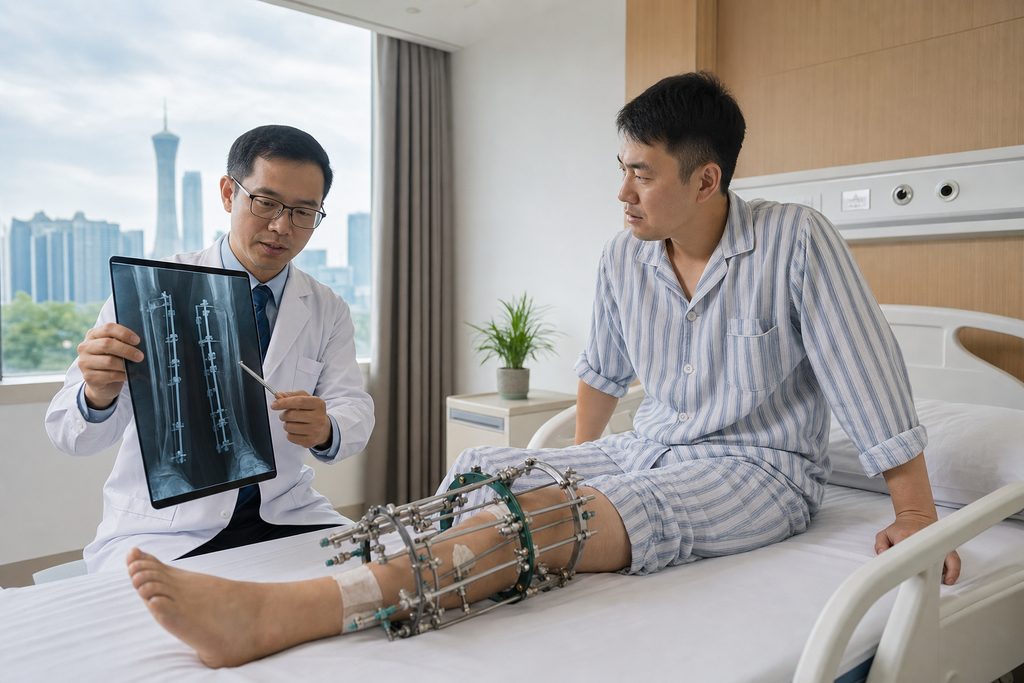
Limb lengthening is not a cosmetic shortcut. It is a meticulous, months-long orthopedic reconstruction process. For patients with congenital discrepancies, post-traumatic shortening, or severe rotational deformities, the Ilizarov external fixation method remains one of the most powerful tools in a surgeon’s hands. The device looks intimidating—a circular metal cage surrounding the limb, secured by tensioned wires that pass through bone and skin. But that cage is a biological scaffold. It tricks the body into regenerating its own bone tissue, millimeter by millimeter. The primary concern for most international patients considering this route is the limb lengthening surgery cost China, which often lands at a fraction of Western quotes without sacrificing the technical sophistication required for these complex corrections.
Key Takeaways
- China’s top orthopedic centers manage Ilizarov frames on a scale rarely seen in the West, with some units handling over 1,000 external fixation cases annually.
- The structural cost advantage is significant: total procedure and hospitalization fees often range from $15,000 to $35,000, compared to $80,000–$150,000 in the United States.
- Language and logistical barriers in public hospitals are severe; navigating a 10,000-patient-per-day facility without a bilingual medical companion is not a realistic plan for foreign visitors.
- Frame management after discharge is the real marathon. Success hinges on strict daily pin-site care and a structured physiotherapy protocol that continues for months after you return home.
The Problem: When Your Legs Do Not Match the Life You Want to Live
A leg length discrepancy (LLD) of more than 2 centimeters rewires how a person walks. The body compensates. The pelvis tilts. The spine curves. Over a decade, that compensation cascade grinds down the lumbar discs and hip cartilage on the overloaded side. Approximately 1 in 1,000 people live with a discrepancy significant enough to require surgical intervention. Some are born with it—congenital femoral deficiency or fibular hemimelia. Others are made: a femur fracture that heals short after a motorcycle accident, or a childhood bone infection that kills the growth plate. In the United States and Europe, the waiting lists for complex deformity correction can stretch six to nine months. The insurance pre-authorization battles can drag on even longer. And the out-of-pocket quote for a full Ilizarov frame application and distraction phase often lands north of $100,000. That number is not an exaggeration. It is the market reality when you add surgeon fees, hospital facility charges, and the cost of the hardware itself. For a patient in Dubai, London, or Los Angeles, that price tag does not just delay treatment. It cancels it.
Who We Are
We are not a hospital. We do not perform surgeries, interpret X-rays, or prescribe rehabilitation protocols. China Medical Services operates as a dedicated patient navigation team. We bridge the logistical gap between your diagnosis and the orthopedic surgical team best equipped to treat it. Our database covers 340+ top-ranked hospitals across 37 cities. We translate your medical records, coordinate video consultations with specialists, and deploy bilingual medical companions to guide you through every corridor, payment counter, and pharmacy queue. The clinical decisions belong to you and your surgeon. The logistics belong to us.
How Does the Ilizarov Method Correct Leg Deformities? The Frame That Builds Bone
The Ilizarov apparatus is not an implant. It is an external scaffold. Tensioned Kirschner wires pass through the bone and lock into circular rings. Threaded rods connect those rings. When the patient—or a caregiver—turns those rods four times a day, the frame pulls apart a surgical bone cut at a rate of roughly 1 millimeter per day. That gap does not fill with scar tissue. It fills with new, living bone. This process is called distraction osteogenesis. Gavriil Ilizarov, a Siberian orthopedic surgeon, discovered it in the 1950s while treating war veterans with infected non-unions. Today, the method remains the gold standard for correcting multi-planar deformities—cases where the bone is simultaneously too short, rotated inward, and bowed. An intramedullary nail can lengthen a straight bone. But only a circular external fixator can simultaneously lengthen, derotate, and angularly correct a complex tibial deformity over the course of four to six months.
Why Volume Matters: The Chinese Orthopedic Scale
A surgeon who applies ten Ilizarov frames a year works cautiously. A surgeon who applies two hundred works with an almost instinctual grasp of pin placement, frame biomechanics, and complication rescue. In China’s largest orthopedic trauma centers, external fixation is not an occasional salvage procedure. It is a core subspecialty. The department at Tianjin Hospital, for instance, is recognized internationally for its external fixation volume. Surgeons there routinely manage infected non-unions, congenital pseudarthrosis of the tibia, and massive bone defects from open fractures. When you search for the best Ilizarov external fixation hospital China, you are not looking for a facility that dabbles in the technique. You are looking for a team that has seen every possible frame configuration and every possible pin-tract complication. That depth of experience translates directly into shorter frame times and lower rates of regenerate deformity.
The Cost Equation: Why Limb Lengthening Surgery Cost China Reshapes the Decision
Let us address the numbers directly. In the United States, a complete Ilizarov limb lengthening and deformity correction—including the initial surgery, the hospital stay, the frame, and the removal procedure—can cost between $80,000 and $150,000. In the United Kingdom, private quotes often exceed £50,000. In China, the same procedure at a top-tier public hospital typically ranges from $15,000 to $35,000. That is the limb lengthening surgery cost China reality that drives patients to research flights to Shanghai or Beijing. Why the difference? It is not a discount on safety. It is structural. Chinese orthopedic surgeons are salaried. Hospital facility fees are regulated. The cost of the Ilizarov hardware itself, much of which is manufactured domestically to the same metallurgical standards, is far lower. You are not buying lower quality. You are buying a different economic model. A patient who needs bilateral femoral lengthening for achondroplasia might pay $25,000 in China versus $120,000 at home. That gap pays for flights, accommodation, and months of physiotherapy with room to spare.
| Procedure | China (USD, approx.) | United States (USD, approx.) |
|---|---|---|
| Ilizarov frame application + distraction phase (single segment) | $15,000 – $35,000 | $80,000 – $150,000 |
| Frame removal (day surgery) | $2,000 – $5,000 | $10,000 – $20,000 |
| Monthly physiotherapy (per session) | $30 – $60 | $100 – $250 |
| Bilingual medical companion (per day) | from $200 | N/A (domestic) |
These figures vary by hospital tier, case complexity, and whether you access care through the international VIP department or the standard public channel. A straightforward 4-centimeter tibial lengthening lands at the lower end. A multi-planar femoral correction with an infected non-union lands at the higher end. Always confirm a written quote before travel.
Is Limb Lengthening in China Safe for Complex Cases? What the Data Shows
Safety in limb lengthening is not a yes-or-no question. It is a risk-management question. Every frame carries the risk of pin-site infection, joint contracture, nerve stretch injury, and regenerate bone failure. The question is whether the surgical team has the experience to anticipate and intercept these complications before they derail the outcome. A 2019 study published in Clinical Orthopaedics and Related Research found that high-volume centers—those performing more than 50 limb lengthening procedures per year—reported significantly lower rates of major complications compared to low-volume centers. Many Chinese orthopedic departments clear that threshold several times over. The safety question—is limb lengthening in China safe for complex cases—should be reframed. The procedure itself carries inherent risks anywhere in the world. The variable is the team managing your frame. A department that performs 300 distraction osteogenesis cases annually has seen and solved problems that a low-volume Western surgeon might encounter only a handful of times in a career. That institutional memory matters.
There is another layer. Infection control protocols in Chinese public hospitals can feel different from what a Western patient expects. Wards are often shared. Nursing ratios are lower. This is not a secret. It is the reality of a high-volume public system. The international VIP departments at hospitals like Peking Union Medical College Hospital or Shanghai’s Huashan Hospital bridge this gap. They offer private rooms, dedicated nursing, and English-speaking coordinators. The cost is higher—roughly 1.5 to 2 times the standard rate—but the environment feels familiar. For a procedure as demanding as Ilizarov lengthening, where you will spend weeks in the hospital during the initial distraction phase, that environment is not a luxury. It is a clinical factor.
What You Need to Know Before Going Alone
The surgical plan is only half the battle. The operational reality of landing in a Chinese city and navigating a 3,000-bed hospital without language support is the other half. We want to be completely direct about what that looks like.
- Visa Requirements: Medical treatment in China requires an S2 visa, specifically annotated for medical purposes. You will need an official invitation letter from the hospital, a treatment plan, and proof of financial means. Your accompanying family member also applies for an S2. The M visa is for commercial business and will be rejected for medical travel. Getting the hospital to issue the correct invitation letter without a local contact can take weeks of back-and-forth.
- Hospital Navigation: A top-tier Chinese public hospital sees over 10,000 outpatient visits per day. Signage in English is inconsistent. The registration counter, the imaging department, and the inpatient admission office are often in separate buildings. You cannot simply walk in and find the orthopedic wing. Without a bilingual companion, you will lose hours—potentially days—just completing the administrative steps required before your surgeon ever sees you.
- Payment Reality: Public hospitals in China operate on a prepaid deposit system. You load funds onto your hospital account at admission. When the balance runs low, treatment pauses until you top it up. International credit cards are not universally accepted. WeChat Pay and Alipay dominate. A foreign patient without a Chinese bank account and local payment setup faces a genuine operational barrier at the cashier window.
How We Help You Navigate This
These barriers are structural, not malicious. The system was built for a domestic population of 1.4 billion, not for international walk-ins. Our role is to build a bridge over each one. The process starts before you book a flight. We collect your medical records, imaging files, and surgical history. Our team translates everything into clinical Chinese and submits it to the orthopedic departments best matched to your specific deformity. We do not send your femoral lengthening case to a spine surgeon. We target the departments that rank among China’s top 10 for orthopedics, as assessed by the Fudan University hospital rankings. Once a surgeon reviews your file and confirms that you are a surgical candidate, we coordinate a video consultation. The video consultation fee ranges from $100 to $800 depending on the specialist’s seniority. If you proceed to on-the-ground treatment, that consultation fee is credited in full toward the coordination service—a one-time credit applied within 90 days.
When you arrive, a bilingual medical companion meets you at the airport. They accompany you to every appointment: the initial physical examination, the preoperative imaging suite, the admission office. They handle the deposit payment, the pharmacy pickup, the discharge paperwork. They translate the surgeon’s frame-turning schedule into clear, written English instructions. They do not just interpret words. They interpret the system. That distinction matters when you are standing in a crowded hospital corridor, post-operative and exhausted, trying to understand why the pharmacy rejected your prescription slip. The companion fixes it. You focus on healing.
After discharge, the frame stays on for months. You will likely return home during the consolidation phase. We maintain a line to your surgical team. If you need a follow-up X-ray reviewed, we facilitate that. If a pin-site infection flares up and your local doctor is unfamiliar with Ilizarov wire care, we arrange a remote consult. The frame is removed in a short second procedure, which we coordinate as part of the full treatment plan. Some patients choose to return to China for removal. Others arrange it locally with guidance. Either path works. We make sure the instructions are crystal clear.
Frequently Asked Questions
The total cost for an Ilizarov-based limb lengthening and deformity correction at a top Chinese public hospital typically falls between $15,000 and $35,000 USD. That range usually covers the surgeon’s fee, anesthesia, the Ilizarov hardware, the initial hospital stay, and basic inpatient physiotherapy. It does not include international airfare, accommodation for family members, or the outpatient physiotherapy sessions you will need for months afterward. The final number swings significantly based on whether you are correcting a simple length discrepancy or a complex multi-planar deformity with prior infection. Always request a written, itemized treatment plan before committing.
The phrase “best hospital” is a trap if you apply it universally. The best hospital for a pediatric congenital deformity might not be the best for a post-traumatic adult non-union. We recommend starting with the Fudan University specialty rankings for orthopedics, which identify the top 10 departments in the country. From there, the decision narrows based on your specific diagnosis. A hospital with a dedicated bone transport program for large defect reconstruction differs from one focused on cosmetic stature lengthening. We handle this matching process as part of our initial consultation—reviewing your imaging and directing your file to the department whose case volume most closely aligns with your needs. You can explore our orthopedic specialty database to understand the landscape.
Yes, coordinated treatment packages exist, but they are built around your clinical timeline, not a fixed itinerary. A typical Shanghai-based package includes airport transfer, hospital admission coordination, bilingual companion support during all inpatient and outpatient visits, accommodation recommendations near the hospital, and scheduling of the frame removal procedure. The distraction phase—where you turn the frame daily—lasts roughly one month for a 3-centimeter lengthening. The consolidation phase, where the new bone hardens, lasts another two to three months. Some patients stay in China for the full duration. Others return home after distraction and come back for removal. Both models work. The package adapts to your choice. What you cannot do is book a precise surgery date before the surgeon has examined you in person. Chinese public hospital policy requires a face-to-face consultation before scheduling any major orthopedic procedure. We arrange that consultation and then lock in the surgery slot immediately afterward.
Pin-site infections are the most common complication of Ilizarov frames—occurring in anywhere from 10% to 50% of patients depending on the study and the definition of infection. Most are superficial and resolve with increased cleaning frequency and oral antibiotics. A deeper infection that tracks along the wire requires urgent attention. If this happens after you return home, we connect you directly with your surgical team in China for a remote assessment. They review photos and, if needed, coordinate with a local orthopedic surgeon near you. In rare cases where the frame must be removed or revised earlier than planned, we facilitate an emergency return. The key is not to ignore increasing pain, redness, or drainage. Early intervention almost always prevents frame loss.
This is the most important question to ask your surgeon—not the internet. The Ilizarov frame and the internal lengthening nail (such as the PRECICE system) serve different clinical scenarios. An internal nail is more comfortable. No metal rings. No pin sites. But it cannot correct rotational or angular deformities simultaneously. It lengthens in a straight line. If your femur is 4 centimeters short and also internally rotated by 20 degrees, an internal nail alone will not fix the rotation. The Ilizarov frame will. Also, in cases of poor bone quality, active infection, or very short segments where the nail would have insufficient purchase, the external fixator remains the only viable option. The frame is harder to live with but far more versatile. The decision should be driven entirely by your specific deformity parameters, not by a preference for comfort.
Your Next Step
The Ilizarov method is not an easy path. It demands patience, discipline, and a high tolerance for looking at metal wires where they exit your skin. But for a complex deformity that no internal device can fully address, it remains the definitive solution. The decision to travel to China for this procedure is fundamentally a decision about access—access to surgical teams who have built their careers around external fixation, and access to a cost structure that makes the treatment financially possible. If you have imaging and a clear diagnosis, we can put it in front of the right surgical eyes within days. The conversation starts there. No pressure. No pitch. Just a clear path forward.
Medical Disclaimer: This article is for informational purposes only and does not constitute medical advice. Limb lengthening surgery carries significant risks including infection, nerve injury, joint stiffness, and regenerate bone failure. Always consult a qualified orthopedic surgeon to discuss your individual case, imaging findings, and treatment options. China Medical Services does not provide clinical care or guarantee surgical outcomes.
For more medical information and treatment options in China, visit chinamedservices.com (China Medical Services).
