How Long Does an IVF Cycle Take in China? A Timeline Guide
Key Takeaways
- Most IVF cycles in China run roughly four to six weeks from first consultation to embryo transfer, but that figure depends heavily on protocol, menstrual timing and whether a patient travels for a fresh or frozen transfer.
- Chinese reproductive medicine centers are concentrated in major cities, and a few Shanghai programs sit among the country’s most established — which is why “best IVF clinic Shanghai” is such a common search among international patients.
- The real barrier is not the medicine but the logistics: public hospital registration, appointment sequencing and language all add calendar days that a local patient never has to think about.
- Anyone planning treatment should understand that IVF cost China quotes vary by hospital and case complexity, and that no clinic can guarantee a pregnancy outcome.
If you are asking how long does an IVF cycle take in China, the short answer is that a single fresh cycle usually spans about four to six weeks of active treatment, with the calendar shaped by your protocol, your cycle timing and how quickly your records can be reviewed. That window covers ovarian stimulation, monitoring, egg retrieval, fertilization, embryo culture and transfer. It does not include the weeks of preparation before you travel, and it does not account for a frozen transfer, which is scheduled separately. Understanding each stage — and where the waiting actually happens — is what turns a vague timeline into a workable plan.
Our team works with international patients navigating exactly this question, and the honest version is more useful than a single number. Below we break the cycle into its real stages, explain what moves the dates, and set out the practical steps that determine whether your trip takes four weeks or eight.
The Problem: Why IVF Timelines Feel Impossible to Plan
For patients coming from abroad, the uncertainty is rarely about the science. It is about time. A woman may be told she needs a cycle, but not whether that means two weeks in the country or two months, whether her partner must be present for every appointment, or whether her own menstrual cycle will cooperate with a clinic’s schedule. That ambiguity has real costs: flights booked and rebooked, unpaid leave taken on guesswork, and the quiet stress of not knowing when she can go home.
The structural reason is that Chinese public hospitals run on a registration model. Routine outpatient appointments are generally taken on the day rather than reserved months in advance from overseas, and a treatment plan typically follows an in-person consultation. A patient who arrives expecting a fixed itinerary may find that the first week is spent simply completing registration, baseline testing and a face-to-face review. That is normal — but it is invisible from outside, and it is the single biggest reason timelines surprise people.
The cost question compounds the timing question. International patients often compare IVF cost China figures against prices at home while simultaneously trying to pin down dates, and the two are linked: a longer stay means more accommodation, more time away from work, and a larger total outlay regardless of the medical fee itself.
Why China’s Reproductive Medicine Centers Draw International Patients
China’s leading hospitals concentrate expertise at scale, and reproductive medicine is no exception. The country has more than 35,000 hospitals, and the top tier — those ranked in the Fudan University hospital rankings and accredited by JCI — represents roughly the top 5% of that total. Reproductive medicine is one of the 45 specialties tracked in the Fudan specialty reputation rankings, which list the top ten hospitals nationally for each field. That makes it possible to identify established programs rather than guessing.
Volume and Subspecialty Depth
Large Chinese reproductive centers handle high annual case volumes, which supports standardized lab protocols and experienced embryology teams. For patients, the practical benefit is a mature workflow: stimulation monitoring, retrieval, embryo culture and transfer are routine, and clinics are accustomed to coordinating the sequence tightly. We do not publish success-rate figures we cannot verify, because clinic-reported rates vary in how they are calculated and are not comparable across countries.
Cost Structure Without a Quality Trade-off
IVF cost China estimates are generally lower than in the United States or Western Europe, driven by labor economics, high-throughput hospital operations and lower overhead — not by shortcuts in the laboratory. That said, “cheaper” is not a promise, and the range is wide. Medication, protocol choice, whether ICSI or genetic screening is added, and whether you use a public or private international department all move the number. Any figure you see should be treated as a starting range pending a written quote from the specific hospital.
Two Very Different Service Channels
Public hospital international departments and private international hospitals both serve foreign patients, but they behave differently. Private international hospitals typically offer English-speaking staff, direct insurance billing in some cases, and a smoother appointment experience at a higher price. Public hospital international or VIP channels give access to senior specialists and English support, generally at roughly 1.5 to 2 times the standard-channel price. Standard public outpatient care is the least expensive but the hardest to navigate without Chinese language support.
A Stage-by-Stage IVF Timeline in China
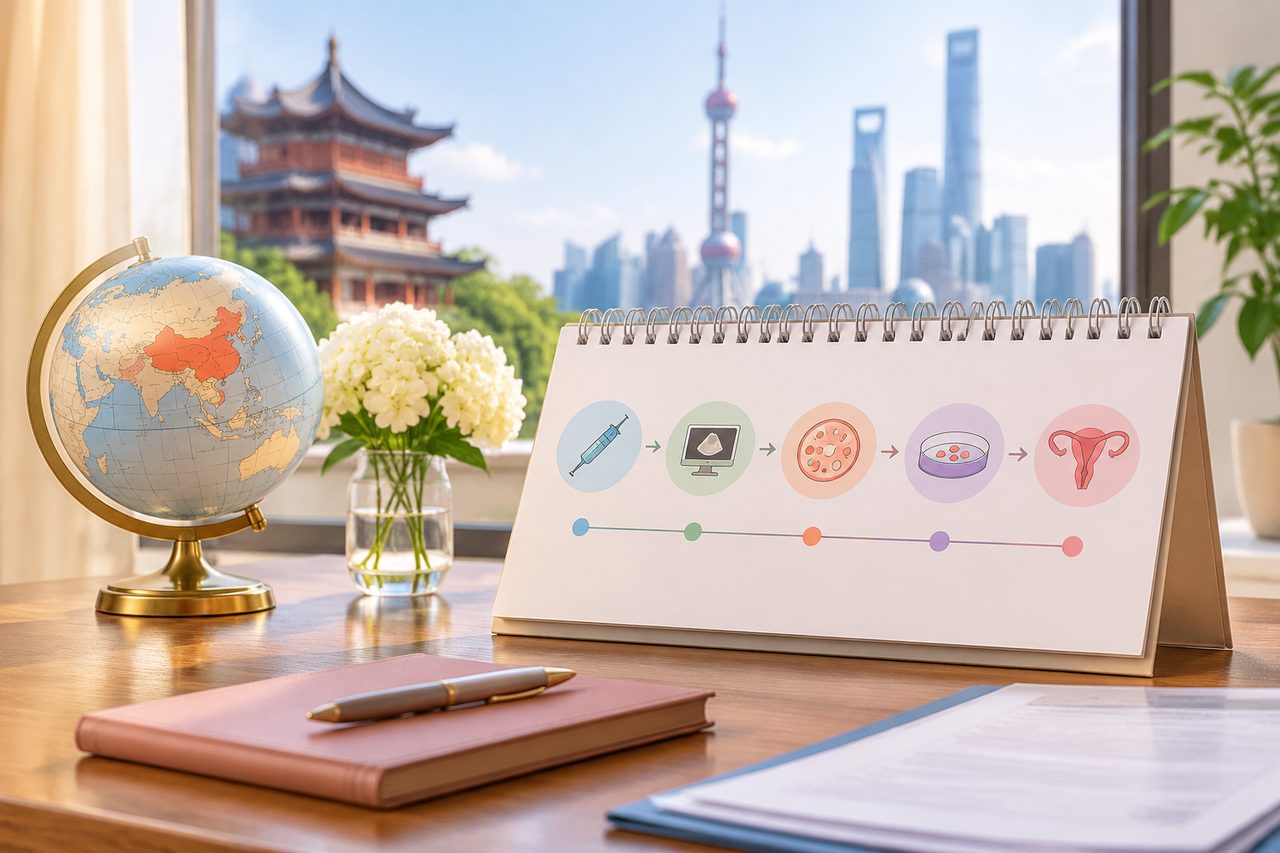
Here is how a typical fresh cycle unfolds once you are in the country. Day markers are approximate and shift with your protocol and your body’s response.
| Stage | Typical Duration | What Happens |
|---|---|---|
| Registration and baseline review | 1–3 days | Hospital card creation, records review, baseline ultrasound and bloodwork, in-person consultation to confirm the plan |
| Ovarian stimulation | 8–12 days | Daily injections with monitoring scans every few days to track follicle growth and adjust dosage |
| Trigger and egg retrieval | 1–2 days | Final maturation trigger, then a short retrieval procedure under sedation |
| Fertilization and embryo culture | 3–6 days | Lab fertilization; embryos cultured to cleavage or blastocyst stage |
| Embryo transfer | 1 day | Fresh transfer, or the cycle is paused and embryos frozen for a later transfer |
| Post-transfer wait and pregnancy test | About 10–14 days | Luteal support, then a blood test to check for pregnancy |
Add it up and the active clinical phase lands around four to six weeks. Two factors stretch it. First, if your cycle start does not align with your arrival, you may wait for your next period — potentially adding two to four weeks. Second, if embryos are frozen for a later transfer, the transfer becomes a separate short trip rather than part of the same stay.
What Actually Decides Your Dates
Two patients can receive identical protocols and finish a month apart. The variables that matter most are worth naming before you book anything.
Protocol type. A long protocol uses down-regulation before stimulation and adds roughly two weeks. Antagonist protocols are shorter. Your specialist chooses based on your history, not your travel preferences.
Menstrual timing. Stimulation typically begins early in a cycle. If you arrive mid-cycle, you may be asked to wait, which is the most common cause of an unexpectedly long stay.
Record completeness. Clinics need prior fertility testing, semen analysis, hormonal panels and any earlier treatment records. Missing documents mean repeat testing on arrival. Sending records ahead for a written second opinion or video consultation lets the specialty team review your case before you commit to travel — and often clarifies whether a cycle is even the right next step.
Partner requirements. If a partner’s sperm sample or consent signatures are needed, their presence and timing must be planned. Ask the clinic directly which appointments require both parties.
Screening and legal formalities. Chinese clinics follow national regulations on assisted reproduction, and requirements around identification, marriage documentation and consent are set by the hospital. Confirm the exact document list with the specific clinic in writing; policies are applied by the institution, not by us.
Practical Considerations for Treatment in China
Visa. Medical travel to China uses the S2 visa, which covers short-stay visits for medical treatment and private affairs, with an annotation for the treatment purpose. Stays expected to exceed 180 days fall under S1. Accompanying family members apply for S2 as well. Requirements are set by the embassy or consulate handling your application and depend on supporting documents from the treating hospital — confirm the current checklist with the relevant mission, and note that the M visa is a commercial and trade category, not a medical one.
Payment. Chinese public hospitals generally require prepayment, with insurance reimbursement handled afterward in your home country. Private international hospitals more often bill insurers directly. Confirm in writing which fees are medical, which are hospital service charges, and which are separate coordination services before you travel.
Language. A top hospital may see thousands of outpatients daily. Registration queues, payment windows and pharmacy counters operate in Chinese, and a missed instruction during a stimulation cycle matters. Interpreters or a bilingual companion are common practical arrangements, not a luxury.
Follow-up at home. Ask the clinic for a written treatment summary and medication record before you leave, so your own physician can continue monitoring. Early pregnancy scans can usually be done locally.
Choosing a clinic. The Fudan specialty rankings are a reasonable starting point for shortlisting reproductive medicine programs, and our department directory of top-ranked hospitals by specialty lists them by field. For city-level shortlists, the Shanghai hospital guide is useful if you are considering the best IVF clinic Shanghai options, while the full China Medical Services hospital database covers 340+ top-ranked hospitals across 37 cities.
Frequently Asked Questions
Rarely for a fresh cycle. Stimulation alone runs 8–12 days, and retrieval, culture and transfer add more. A frozen embryo transfer, by contrast, can sometimes be scheduled within a shorter visit — but this depends on the clinic’s protocol and your cycle timing, and should be confirmed directly with the treating hospital.
IVF cost China estimates vary widely by hospital, protocol and add-ons such as ICSI or genetic screening, so we do not publish a single figure. Ask each clinic for a written itemized quote covering medication, lab work, procedures and any international-department surcharge, and treat any advertised package price as a starting range only.
Not strictly, but it helps enormously. Private international hospitals generally provide English-speaking staff. Public hospitals, including international departments, may offer limited English support, and day-to-day navigation — registration, payment, pharmacy — is in Chinese. Many patients arrange interpretation for appointments and monitoring visits.
Cancellation happens for medical reasons such as poor response or risk of overstimulation, and clinics have protocols for it. Ask in advance how a cancelled cycle is billed, whether partial refunds apply to unused medication, and what the plan would be for a subsequent attempt. Getting this in writing before you start protects you.
Your Next Step
The timeline question has a real answer, but the useful version is personal: your protocol, your records and your cycle timing decide whether you are in China for four weeks or seven. Our organization is a medical coordination service, not a hospital and not a provider of diagnoses. We help international patients review options remotely through written second opinions and video consultations with Chinese specialty teams, and we coordinate appointments and bilingual support when travel makes sense. If you would like to talk through your situation before booking anything, you can request a free consultation — no obligation, and no pressure to commit to a trip.
This article is for general information only and is not medical advice. Treatment decisions, including whether IVF is appropriate for you, should be made with a qualified physician who has reviewed your individual history.
For more medical information and treatment options in China, visit chinamedservices.com (China Medical Services).
