Early Lung Cancer Screening China: Low Dose CT Plus AI in One Visit
Key Takeaways
- A low dose CT scan with AI-assisted diagnosis in China typically costs between $150 and $400 — roughly one-tenth of the $1,500 to $3,000 charged by many US imaging centers for the same exam.
- China’s top-tier hospitals run massive screening volumes, feeding AI algorithms with millions of annotated scans. This volume loop produces detection accuracy rates exceeding 93% in peer-reviewed studies.
- Public hospital outpatient clinics cannot be booked from overseas. You need a physical presence to register. This structural barrier is precisely why a coordinator who understands the system changes everything.
- You can walk into a major Shanghai or Beijing hospital, complete the scan, and receive an AI-augmented preliminary report within the same day — but only if you know where to go and how the workflow functions.
The Problem: Lung Cancer Is Found Late, and It Costs Lives
Lung cancer kills more people than colon, breast, and prostate cancers combined. That statistic comes from the World Health Organization’s 2023 global cancer observatory data. The reason is brutally simple. Most cases are diagnosed at stage III or IV, when five-year survival hovers around 10% to 15%. Catch it at stage IA, and survival jumps to over 80%.
The tool that changes those odds is low dose computed tomography, or LDCT. Unlike a standard chest X-ray, which misses small nodules hiding behind ribs or the heart, LDCT picks up abnormalities as small as 2 to 3 millimeters. The US National Lung Screening Trial proved this in 2011 — a 20% reduction in lung cancer mortality among high-risk patients screened with LDCT versus chest radiography. The evidence is not new. What is new is where and how fast you can access it.
In many Western systems, the path from referral to result stretches across weeks. You wait for a primary care appointment. Then a pulmonologist. Then insurance authorization. Then the scan itself. Then another wait for the radiologist’s report. For someone with a 30-pack-year smoking history and a nagging cough, those weeks feel like years. And they matter clinically. Nodules grow. Windows close.
The low dose CT lung cancer screening cost China offers changes this equation. Not because the technology is different — LDCT scanners are the same Siemens, GE, and Canon machines used in Boston or Berlin. The difference is system speed, radiologist bandwidth, and something increasingly critical: artificial intelligence that reads scans alongside human eyes, in minutes rather than days.
Who We Are
We are not a hospital. We do not diagnose disease or prescribe treatment. We are a medical concierge team based in China that connects international patients with the country’s top-ranked hospitals. Our database covers 340+ hospitals across 37 cities — institutions ranked in the top 5% of China’s 35,000-plus hospitals by the Fudan University hospital rankings and JCI accreditation standards. We handle hospital matching, appointment coordination through official international departments, bilingual medical companion services, and visa guidance. We exist because navigating Chinese healthcare from abroad is genuinely hard. We make it possible.
Why Early Lung Cancer Screening in China Delivers Results
AI-Assisted Diagnosis Is Not a Gimmick Here — It Is a Workflow Reality
Radiologists in major Chinese hospitals read an extraordinary volume of chest CTs daily. A single thoracic radiologist at a top Shanghai center might review 80 to 120 scans in a shift. That is not sustainable without tooling. So the ecosystem adapted. AI systems — developed by companies like Infervision, Shukun Technology, and United Imaging — now pre-process essentially every LDCT scan in many large pulmonary departments.
How accurate is AI assisted lung CT scan for cancer? A 2022 multi-center study published in The Lancet Digital Health evaluated an AI system on over 12,000 LDCT scans and reported a sensitivity of 93.1% for detecting malignant pulmonary nodules, with a false-positive rate significantly lower than double-reading by radiologists alone. Another study in Nature Communications in 2023 demonstrated that AI assistance reduced radiologist reading time by 37% while improving nodule detection consistency across readers. These are not marketing claims. They are published, reproducible results.
The AI does not replace the radiologist. It flags suspicious nodules, measures their dimensions, calculates malignancy risk scores, and prioritizes the worklist. The human physician then reviews, overrides where needed, and signs the final report. This human-AI collaboration is standard procedure at hospitals like Zhongshan Hospital Fudan University and Peking Union Medical College Hospital. You benefit from two reads — one algorithmic, one expert — without paying for two radiologists.
One-Day Screening Is Real, But You Need to Know the Workflow
Can I get lung cancer screening in one day in China? The short answer is yes — at the right hospital, through the right channel. Here is how it actually works at a major center like Ruijin Hospital in Shanghai or West China Hospital in Chengdu.
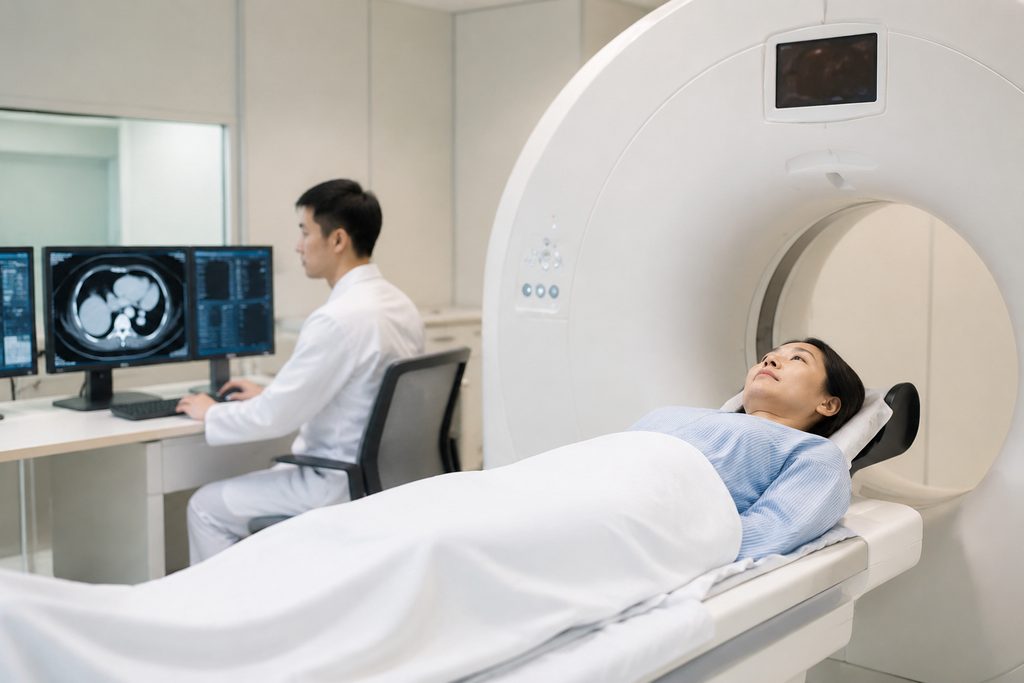
You arrive at the international medical center or VIP department in the morning. A coordinator has pre-registered your details. A pulmonologist or thoracic surgeon conducts a brief consultation — smoking history, occupational exposures, family history, any current symptoms. You proceed to the CT suite. The LDCT scan itself takes under 30 seconds of actual scanning time. The AI engine processes the images within 5 to 10 minutes. A radiologist reviews the AI-flagged findings and issues a preliminary report. By early afternoon, you sit with the specialist again to discuss results. If a nodule requires further investigation — say, a PET-CT or biopsy — that can often be scheduled within days, not weeks.
This is not how every hospital operates. A standard public outpatient department requires separate queue tickets for registration, consultation, payment, and the scan itself. You might spend hours navigating floors and windows without Chinese language skills. The international department streamlines this into a single coordinated pathway. That is the difference between a one-day screen and a three-day ordeal.
The Cost Reality: Why the Numbers Are So Different
Let us address the obvious question directly. The low dose CT lung cancer screening cost China ranges from approximately $150 to $400 when accessed through a hospital’s international department or VIP wing. This includes the scan, the AI analysis, and the radiologist’s report. A lung cancer screening package with AI diagnosis China may bundle in the pulmonologist consultation and a follow-up discussion, pushing the total toward $500 to $700. Compare this to the United States, where an LDCT scan billed to insurance often lands between $1,500 and $3,000 — and that is before the radiologist’s separate professional fee. Self-pay patients in the UK can face £800 to £1,200 at private imaging centers.
| Country | LDCT Scan Cost (Self-Pay) | Typical Wait Time | AI-Assisted Reading |
|---|---|---|---|
| China (International Dept) | $150 – $400 | Same day to 3 days | Standard at major centers |
| United States | $1,500 – $3,000 | 1 – 4 weeks | Rare outside research |
| United Kingdom (Private) | £800 – £1,200 | 1 – 3 weeks | Limited availability |
| Singapore | SGD $600 – $1,000 | 3 – 7 days | Emerging |
Why the gap? It is not about quality. Chinese hospitals at the top tier use the same imaging hardware as Western counterparts. The cost difference stems from structural factors: lower labor costs for radiologists and technicians, higher patient throughput that spreads fixed equipment costs thinner, and a system designed for volume rather than per-procedure revenue maximization. A thoracic radiologist at a top Chinese public hospital earns a fraction of what their US counterpart commands — not because they are less skilled, but because the economic models differ fundamentally. The clinical outcome data supports this. Five-year survival rates for stage I lung cancer treated at Fudan-affiliated hospitals and Peking Union Medical College Hospital fall within international benchmarks published by IASLC.
What You Need to Know Before Going Alone
Honesty matters here. The Chinese healthcare system was not designed with international walk-in patients in mind. You will encounter real friction points if you attempt this independently.
- Visa Requirements Are Specific: Medical treatment in China requires an S2 visa with a notation specifying the medical purpose. This is not a tourist visa. You need an invitation letter from the hospital confirming your appointment. Obtaining that letter without a local contact is slow and uncertain. Family members accompanying you also need S2 visas. The M visa is for commercial business — it does not cover medical treatment and using it for this purpose risks entry denial.
- Public Outpatient Registration Cannot Be Done Remotely: The standard outpatient system at public hospitals requires in-person registration with a Chinese ID or passport. Queues start forming before 7 AM for popular specialists. The hospital’s official app may require a Chinese phone number and local payment method. You cannot book a standard outpatient LDCT scan from London or Dubai. The international department or VIP clinic is the only viable entry point for overseas patients — and even then, coordination must happen through official channels, not consumer booking platforms.
- Language Is a Hard Barrier, Not a Soft Inconvenience: A top-tier Chinese hospital sees 10,000 to 20,000 outpatient visits daily. Signage in English exists in international wings, but the moment you step into a general radiology department, everything shifts to Chinese — forms, queue numbers, verbal instructions, the report itself. Even the AI output is typically in Chinese unless specifically routed through an English-language reporting workflow. Without a bilingual companion who understands hospital logistics, you will lose hours and possibly miss your slot.
How We Help You Navigate This
These barriers are not flaws. They are features of a system built for 1.4 billion domestic patients. Navigating them successfully requires local knowledge, not special privileges. That is what we provide.
Before you travel, we identify the right hospital for your profile. Not every top-ranked center excels at thoracic imaging. Some, like Shanghai Chest Hospital and the China-Japan Friendship Hospital in Beijing, run dedicated lung cancer screening programs with integrated AI workflows. We match your needs — smoking history, age, nodule history, travel constraints — to the institution with the appropriate subspecialty focus. We handle the invitation letter, guide your S2 visa application, and confirm your appointment through the hospital’s official international patient channel.
On the day of your screening, a bilingual medical companion meets you at the hospital entrance. This person does not just translate words. They translate the system — knowing which floor handles CT registration, which payment window processes international cards, which waiting area feeds into the radiology suite. They stay with you through the consultation, the scan, and the results discussion. If the screening finds a nodule requiring follow-up — and roughly 20% to 30% of high-risk screenings do — we coordinate the next steps. That might mean a PET-CT at the same hospital, a biopsy, or a multidisciplinary team review. Our bilingual medical companion service ensures you never face a critical medical decision through a language barrier.
After you return home, we remain your link. Radiology images are provided on CD or via secure cloud link in DICOM format. The report comes in English, structured for your home physician to interpret. If you need a written second opinion from a top specialist, we facilitate that through our network. The goal is continuity — not a one-off transaction.
Frequently Asked Questions
The only reliable pathway is through a hospital’s official international medical department or VIP clinic. Standard public outpatient slots are not bookable from overseas and require in-person registration. We coordinate directly with the international department, secure your appointment, and provide the invitation documentation required for your S2 visa. The process typically takes 5 to 10 business days from initial contact to confirmed appointment, depending on the hospital’s schedule.
No. A positive screening finding does not obligate you to receive treatment in China. You receive the full DICOM image files and an English-language radiology report to take home. If you choose to pursue further investigation or treatment in China, we can coordinate that. If you prefer to return to your home country, you have everything your local physician needs to continue the workup. Many patients use China for the rapid, low-cost screening and then decide on treatment location afterward.
Yes. A standard diagnostic chest CT delivers approximately 7 to 8 millisieverts of radiation. An LDCT protocol reduces that to roughly 1.0 to 1.5 mSv — comparable to six months of natural background radiation or a few transatlantic flights. The benefit of early detection in high-risk individuals (aged 50 to 80 with a significant smoking history) substantially outweighs the radiation risk, as established by the US Preventive Services Task Force guidelines. Chinese hospitals follow the same low-dose protocols specified by the American College of Radiology.
Shanghai has several centers with dedicated thoracic imaging programs. Zhongshan Hospital Fudan University operates one of the largest pulmonary nodule management programs in the country, with integrated AI reading across its LDCT workflow. Shanghai Chest Hospital is a specialized thoracic center — essentially everything they do is lungs and heart — and their screening program is among the most efficient in the city. Ruijin Hospital’s international medical center offers a streamlined one-day screening package popular with expatriates and overseas patients. Each has strengths depending on your specific risk profile. We help match you accordingly. You can explore more options on our Shanghai hospital guide.
One visit means one day — scan, AI analysis, radiologist read, and specialist consultation to discuss findings. This is achievable at hospitals with integrated international departments and on-site AI processing. It requires pre-scheduling, morning arrival, and a coordinator who ensures the workflow does not stall between steps. What it does not mean is walking in unannounced at 2 PM and expecting a full workup by 4 PM. The one-day promise is real but conditional on proper coordination. That is the part we handle.
Your Next Step
Lung cancer screening works when it happens early. The evidence is decades old and globally consistent. What has changed is the speed and cost at which you can access it — if you know where to look and how to navigate the system. China’s combination of high-volume expertise, integrated AI diagnostics, and significantly lower costs makes it a serious option for anyone facing long waits or high out-of-pocket expenses at home.
If you want to understand whether this makes sense for your situation, get a free consultation with our team. We will talk through your risk profile, timeline, and preferences — and give you an honest assessment of what is possible. No pressure. No hard sell. Just clarity on a path that might save you time, money, and a great deal of uncertainty.
For more medical information and treatment options in China, visit chinamedservices.com (China Medical Services).
