Medical Imaging Cloud Access Service China: DICOM Viewer for You and Your Home Doctor
Key Takeaways
- China’s top hospitals generate massive imaging datasets — a single large institution can perform over 4,000 CT scans daily — but accessing your own scans digitally as a foreign patient has historically been a paperwork nightmare.
- A medical imaging cloud service bridges the gap between a Chinese hospital’s PACS and your home doctor’s screen, using standard DICOM viewers that eliminate the need for physical discs or films.
- Hospital PACS networks in China are often firewalled from foreign IP addresses; trying to share images via a consumer cloud drive or email almost always fails due to file size and format incompatibility.
- You do not need to understand DICOM protocols. You need a coordinator who can pull the data legally, convert it, and deliver it to your physician abroad in a format they can actually use.
The Problem: Your Scans Are Locked in a System You Can’t Access
You flew home after a medical check-up in Shanghai. The CT scan was clear. Or so you were told. Three weeks later, your family doctor in London wants to see the original images — not just the written report. You call the hospital’s international department. Someone tells you to come back in person with a USB drive. Another person emails you five JPEG screenshots of a monitor. Neither option helps your doctor make a clinical decision.
This happens constantly. A 2023 survey of medical tourists published in the Journal of Medical Internet Research found that 41% of patients who underwent imaging abroad could not successfully transfer their full-resolution DICOM files to their home physician. The files were either compressed into non-diagnostic formats, lost in transit, or never released by the facility. What should be a routine data transfer becomes a source of clinical risk.
And the stakes are real. A radiologist reading a compressed JPEG instead of a full DICOM series misses subtle findings. Lung nodules under 4 mm disappear. Bone marrow edema vanishes. You are left with an incomplete picture and a nagging question: was that report accurate, or did the radiologist only see part of the data?
Who We Are
We are not a hospital. We do not read your scans, diagnose conditions, or prescribe treatment. China Medical Services operates as your logistical bridge — we coordinate the release, de-identification, cloud upload, and secure delivery of your medical imaging from hospitals across our network of 340+ top-ranked institutions in 37 Chinese cities. Our team handles the bureaucratic friction so your doctor gets diagnostic-quality DICOM files, not screenshots. That is the entire job.
How a Medical Imaging Cloud Service China Price Compares to the Cost of Doing Nothing
Let’s talk about the medical imaging cloud service China price honestly. The coordination fee for image retrieval, DICOM conversion, and secure cloud delivery typically starts from $300. The exact cost varies by hospital and the volume of studies requested. Some hospitals charge an internal administrative fee for data export; others do not. We quote you after confirming the facility’s specific requirements.
Compare that to the alternative. Repeating a CT scan in the United States costs $500 to $3,000 without contrast, depending on the facility. An MRI runs higher. Then there is the radiation exposure — a single abdominal CT delivers approximately 10 mSv, equivalent to roughly three years of natural background radiation. Avoiding an unnecessary repeat scan is not just about money. It is about clinical prudence.
But the real cost of doing nothing is diagnostic uncertainty. Your home doctor proceeds without the original images. A finding is missed. A treatment decision is made on incomplete data. That cost cannot be measured in dollars.
Why a Dedicated DICOM Transfer Pathway Delivers Results
Hospital PACS Networks Are Not Built for Foreign Access
Picture Archiving and Communication Systems — PACS — inside Chinese public hospitals operate on intranet environments. They are deliberately isolated from the public internet for cybersecurity reasons. A hospital’s PACS server might store millions of studies, but the system has no API endpoint that your doctor in Toronto can query. It was never designed for that.
Consumer file-sharing tools fail here. A single CT chest series with thin slices can exceed 1 GB. WeChat file transfers cap at 100 MB. Email attachments typically top out at 25 MB. Google Drive works — if the hospital IT staff are willing and able to upload to a foreign cloud service, which they generally are not. The gap is not technological. It is procedural.
Our team physically retrieves the DICOM data on-site, verifies the series are complete, de-identifies them according to HIPAA-equivalent standards, and uploads them to a HIPAA-compliant cloud viewer. Your home doctor receives a secure link. They open a browser. They scroll through your slices in real time. No software installation. No VPN. No frustration.
Your Home Doctor Needs a Real DICOM Viewer, Not a Gallery of Screenshots
A diagnostic DICOM file is not a picture. It is a data object containing hundreds or thousands of axial slices, each with spatial metadata that allows a radiologist to measure lesions, adjust window levels for lung versus bone versus soft tissue, and reconstruct coronal or sagittal planes. A JPEG of a single slice destroys all of that.
The best online DICOM viewer for international patients is one that requires zero technical effort from the receiving physician. We use browser-based viewers that load directly from a secure URL. The doctor can window, zoom, measure, and scroll through the entire series. They can download the full DICOM dataset if they prefer to import it into their local PACS. The key is that the viewer is a tool, not an obstacle. It works on a standard hospital workstation behind a firewall because it uses HTTPS and standard ports. No IT ticket required.
Medical Tourism Radiology Second Opinion China: Volume Drives Accuracy
There is another reason this matters beyond convenience. Chinese radiologists at top-tier centers read an extraordinary volume of studies. A thoracic radiologist at a major Shanghai hospital might interpret 80 to 120 chest CTs in a single shift. That repetitive exposure builds pattern recognition that is hard to replicate in lower-volume settings. When you request a medical tourism radiology second opinion China, you are tapping into that reading volume.
But the second opinion is only as good as the data it is based on. If the consulting radiologist receives degraded images, the opinion is compromised. The cloud transfer pathway ensures the second-opinion radiologist sees exactly what the original radiologist saw — every slice, every sequence, every pixel. That is the standard of care.
What You Need to Know Before Going Alone
Attempting to handle image transfer independently is possible. It is also slow, confusing, and prone to failure. Here is what you will face:
- In-person release requirements: Many Chinese public hospitals will only release DICOM data to the patient or a legally authorized representative who appears at the medical records office with identification. If you are already back in your home country, you cannot walk up to that counter. Someone must go for you.
- Format and media limitations: Some hospitals still burn DICOM data onto CD-ROMs or DVDs. Modern laptops no longer have optical drives. Even if you receive the disc, you must find a computer that can read it, extract the files without corrupting the directory structure, and upload them. The DICOMDIR index file is easily broken during casual file copying.
- Language and administrative friction: The medical records office staff speak Mandarin. The release form is in Chinese. The data export process may require a hospital administrator’s signature, which takes time and negotiation. Doing this remotely, across a 12-hour time zone difference, with no local contact, is not a phone call. It is a project.
How We Help You Navigate This
The process we follow is simple in concept, detailed in execution. You provide us with your hospital registration details and the dates of your imaging studies. We send a bilingual coordinator to the hospital’s medical records department. They request the DICOM export, verify the dataset on-site — checking series count, slice thickness, and completeness — and then upload the files through an encrypted channel to our cloud platform.
You receive a secure link. You forward it to your doctor. That is your entire involvement. The China hospital PACS access for foreign patients problem is solved by having a physical human being stand at the right counter, speak the right language, and know which data to request. Technology alone cannot replace that.
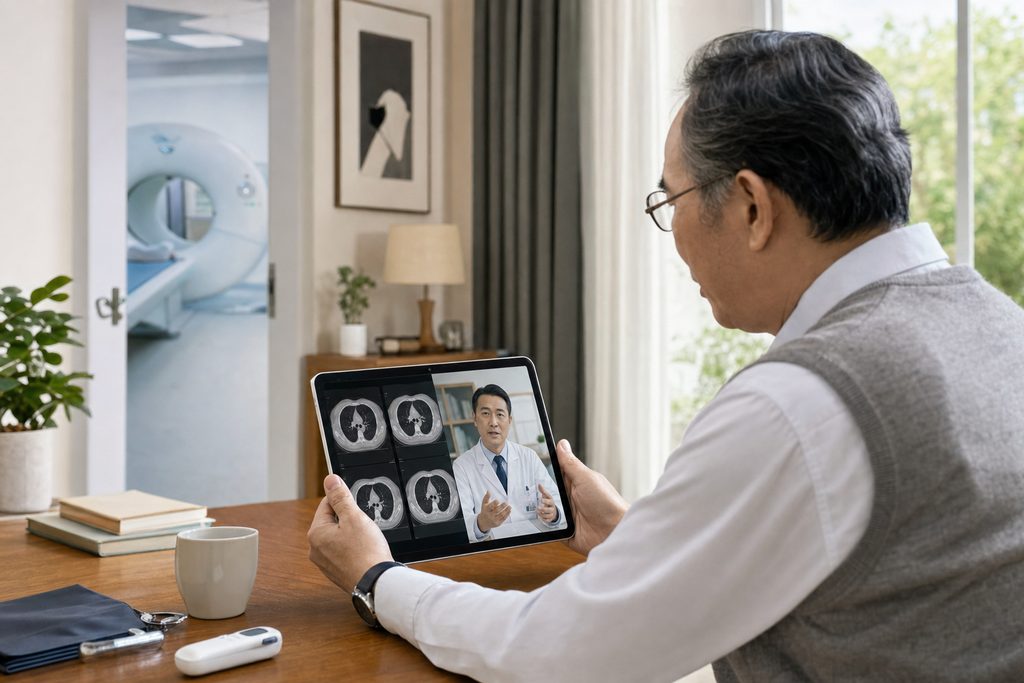
And if your home doctor asks: can my home doctor view my CT scan from China — the answer is yes. The viewer link works on any modern browser. No plugins. No downloads. Your doctor can view the scan during your next appointment, or share it with a radiologist for a formal second read. The data is yours. We just make it accessible.
Frequently Asked Questions
Most retrievals are completed within 3 to 7 business days. The timeline depends on the specific hospital’s medical records office hours and internal approval workflow. Some hospitals release images same-day. Others require 48-hour processing. We confirm the expected turnaround when you contact us.
We cover all hospitals within our network of 340+ top-ranked institutions across 37 cities. If your scans were performed at a hospital outside our direct network, we can still attempt retrieval, but the process may take longer and the outcome cannot be guaranteed. We will tell you honestly before you commit to anything.
Yes. All data is encrypted in transit using TLS 1.3 and encrypted at rest with AES-256. We de-identify studies before upload by stripping patient name and ID fields, replacing them with a study token that only you and your authorized physician can correlate. The cloud viewer platform is HIPAA-compliant and does not store data on consumer-grade infrastructure. Access links are single-use or time-limited per your preference.
The viewer requires only a web browser and an internet connection. It works on Chrome, Safari, Edge, and Firefox without plugins. If your doctor prefers to import the DICOM files into their own PACS, we can provide a direct download link for the full dataset. They will receive the DICOMDIR-structured folder exactly as it was exported from the hospital.
Coordination fees start from $300 for a single study retrieval from one hospital. The price increases if multiple hospitals or multiple study dates are involved, or if the hospital charges its own administrative export fee. We provide a fixed quote before any work begins. There are no surprise charges. The fee covers on-site retrieval, data verification, de-identification, cloud upload, and secure link delivery to you and your physician.
Your Next Step
Your CT or MRI contains information that belongs to you. Getting that data into your home doctor’s hands should not require another flight, another scan, or another dose of radiation. It requires someone on the ground who knows the system and can navigate it efficiently. That is what we do. If you need your imaging from a Chinese hospital, reach out for a free consultation — we will explain the process, confirm the feasibility, and give you a clear timeline and cost before you decide anything.
For more medical information and treatment options in China, visit chinamedservices.com (China Medical Services).
