Staying Safe While Healing: Private Security and Personal Protection Service for Medical Tourists in China
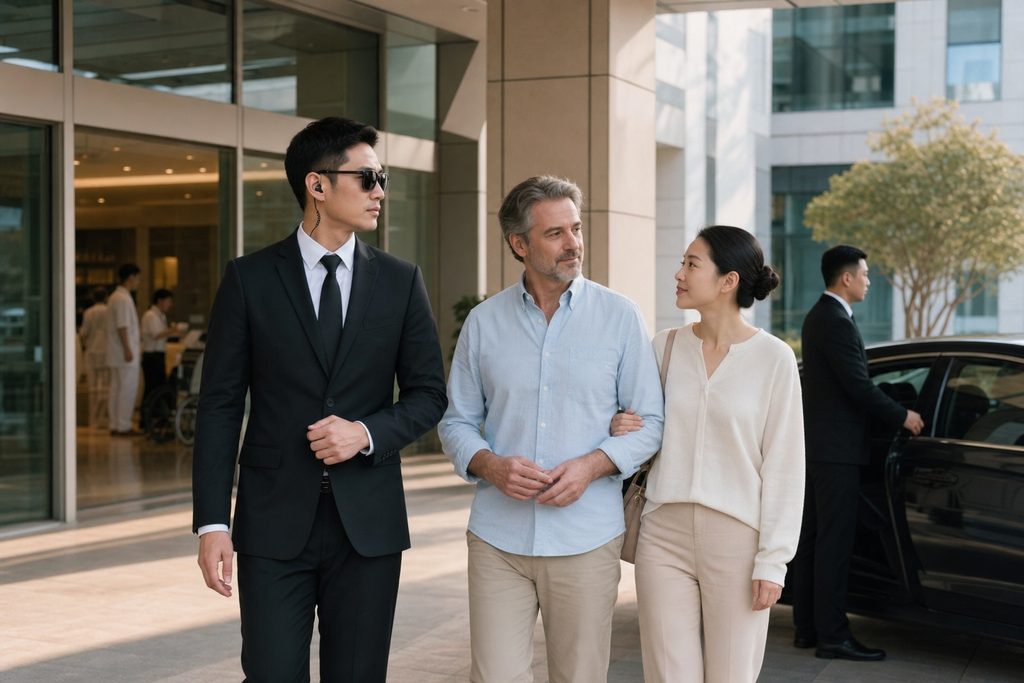
You have probably seen the headlines. A foreigner gets lost in a sprawling Chinese city. A patient feels vulnerable after a major surgery. The anxiety is real. You are considering a life-changing procedure thousands of miles from home, in a country where you don’t speak the language, and your mind naturally goes to the worst-case scenario. But here is what the data actually shows: China has a homicide rate of approximately 0.5 per 100,000 people, according to the United Nations Office on Drugs and Crime, compared to roughly 6.4 in the United States. The streets of Shanghai, Beijing, and Guangzhou are, by almost any statistical measure, significantly safer than most Western capitals. The question is not really about violent crime. The real question is about operational security — navigating a complex, unfamiliar environment without friction, without getting lost, and without the low-level hassles that drain your energy when you should be focused on recovery.
Key Takeaways
- China’s violent crime rate is a fraction of that in the US and Western Europe, making a dedicated bodyguard unnecessary for the vast majority of medical tourists.
- The true “security” risk for foreign patients is logistical: language barriers, getting lost in massive hospital complexes, and payment system failures — not physical danger.
- A bilingual medical companion solves 95% of the safety and navigation concerns at a fraction of the cost of a security detail, starting from $200 per day.
- Dedicated personal protection services do exist in major hubs like Shanghai and Beijing, but they are generally reserved for high-net-worth individuals with specific threat profiles, not typical patients.
The Problem: You Are Planning a High-Stakes Trip Into the Unknown
Planning a medical trip abroad is stressful enough. You are coordinating with surgeons, reviewing success rates, and calculating the cost savings of a cardiac bypass that runs $15,000 to $20,000 in a top Chinese hospital versus over $120,000 in the United States. But then a different kind of worry creeps in. What happens when you land at Pudong International Airport, groggy and disoriented? Who makes sure you get to the right hotel, the right hospital wing, the right check-in counter? If you are traveling alone, or if your companion is just as unfamiliar with China as you are, the vulnerability is not about being attacked. It is about being overwhelmed. A single-day outpatient volume at a hospital like West China Hospital in Chengdu can exceed 20,000 visits. That is the population of a small town, all funneling through one campus. Without a guide, you are not in danger. You are just lost.
This is not a theoretical problem. We have seen patients miss pre-operative consultations because they could not find the correct building in a complex that spans multiple city blocks. We have seen family members unable to purchase food or water because their foreign credit cards were declined by WeChat-only vendors. The fear is a fear of helplessness. And that fear makes people search for terms like “how safe is medical travel to China” or “hire personal protection for hospital stay Beijing.” They are looking for a shield. What they usually need is a bridge.
Who We Are
We are China Medical Services. We are not a hospital. We do not perform surgery, make diagnoses, or prescribe medication. We are a medical concierge organization that connects international patients with China’s top-tier hospitals — over 340 institutions across 37 cities, representing the top 5% of the country’s 35,000-plus medical facilities, as ranked by Fudan University and JCI accreditation. Our team handles the logistics: hospital matching, appointment coordination, visa guidance, and bilingual medical companionship. When a patient asks us about hiring a private security guard for medical tourists China, we listen carefully to what they are really afraid of. Then we build a plan that addresses that fear directly, without overselling services they don’t need.
Why a Bilingual Medical Companion Solves the Real Security Problem
The word “security” carries a lot of weight. It conjures images of earpieces, dark sunglasses, and physical intervention. But for a medical tourist, security is mostly about continuity of care and environmental control. Let us break down where the actual risks lie.
The Statistics: Violent Crime Is Not Your Primary Risk
China maintains one of the lowest violent crime rates globally. The 2023 Global Peace Index ranks China significantly higher in safety than many medical tourism competitors. Petty theft, like pickpocketing in crowded tourist areas, exists — just as it does in Barcelona or Paris. But inside hospital international wards, the environment is controlled. Access is restricted. The staff are vetted. The real friction points are mundane. A patient who cannot read a prescription label. A taxi driver who does not understand the destination. A payment terminal that rejects a Visa card. These are not threats you need a bodyguard for. These are threats you need a translator and logistical expert for.
How a Personal Bodyguard Service for Foreign Patients Shanghai Actually Operates
That said, dedicated close protection does exist. In Shanghai and Beijing, licensed security firms offer personal protection officers for corporate executives, celebrities, and high-net-worth families. These services typically cost between $500 and $1,500 per day, depending on the operative’s training level and whether a vehicle is included. The operatives are often former military or police. They handle physical security, route reconnaissance, and access control. If you are a public figure with a genuine concern about kidnapping or targeted harassment, this is a legitimate expense. For everyone else, a bilingual medical companion achieves the same operational outcome — safe, frictionless movement — without the intimidating optics or the price tag. A uniformed guard standing outside your hospital room can actually create anxiety where none existed before, alarming nursing staff and complicating the therapeutic environment.
Medical Tourism Security Packages China Prices: What You Are Really Buying
When you see “medical tourism security packages China prices” advertised, you are usually looking at a bundled service that combines airport pickup, dedicated transportation, and a personal escort. The escort is the key variable. A driver who speaks only Mandarin is not a security solution. A bilingual medical companion, on the other hand, acts as a force multiplier for your safety. They verify your hospital admission paperwork. They confirm that the pharmacy has dispensed the correct medication. They translate your allergy list to the nursing staff. These are the real safety interventions. Our companion service starts from $200 per day. A full VIP coordination package, which includes a dedicated vehicle, bilingual companion, and 24/7 hotline access, ranges from $5,000 to $8,000 for a complete treatment journey. That is comprehensive environmental security. It just does not come with a firearm or a threatening posture.
| Service Type | Daily Cost (USD) | Best For |
|---|---|---|
| Bilingual Medical Companion | from $200 | Navigation, translation, hospital liaison |
| Dedicated Driver + Vehicle | from $150 | Airport transfers, inter-city travel |
| Licensed Personal Bodyguard | $500–1,500 | High-profile individuals with specific threats |
| VIP End-to-End Coordination | $5,000–8,000 (full trip) | Comprehensive logistics for complex cases |
What You Need to Know Before Going Alone
If you decide to travel independently, without a companion or coordinator, you will hit walls. These are not insurmountable. But they are draining, and they can absolutely compromise your sense of safety.
- Language Barrier in Clinical Settings: Even in top-tier international departments, not every staff member speaks fluent English. A night-shift nurse might have only basic proficiency. Informed consent forms are in Chinese. Explaining a sudden onset of post-operative pain at 2 a.m. becomes a game of charades. This is a safety risk, plain and simple.
- Digital Ecosystem Lockout: China runs on apps like WeChat and Alipay. Hospital cafeterias, nearby pharmacies, and even some hospital payment counters now default to QR code transactions. Foreign credit cards are increasingly accepted at major hospital cashiers, but the small vendor selling bottled water outside your hotel? Probably not. Without a local payment method, you can find yourself functionally stranded.
- Navigational Scale: A hospital like Fuwai Hospital in Beijing performs over 14,000 cardiac surgeries a year. The campus is a maze of interconnected buildings. Your consultation might be in Building 1, your blood test in Building 3, and your CT scan across the street. A companion who knows the layout saves you hours of walking and the very real risk of missing a time-sensitive appointment slot.
How We Help You Navigate This
We start with a consultation. You tell us your procedure, your destination city, and your specific anxieties — including whether you have been searching for a private security guard for medical tourists China. We assess your actual risk profile. For a family traveling from the Middle East for a pediatric cardiac procedure at our top-ranked cardiac surgery department, the concern is usually about managing a sick child in a foreign city, not about physical attack. We assign a bilingual companion who meets them at the airport, handles the vehicle transfer, and stays with them through admission. The companion translates the surgical consent forms line by line. They confirm dietary restrictions with the hospital kitchen. They walk the parents to the nearest hotel and show them how to use the translation app on their phone. That is security. It is just not the kind that makes a threatening posture.
For a high-net-worth individual traveling to Shanghai for an elective procedure, the calculus might be different. Privacy is paramount. We coordinate with the hospital’s VIP wing to ensure a private room with controlled access. We arrange a dedicated vehicle with tinted windows and a driver who signs an NDA. If the patient’s corporate security team requires a local armed operative — a very rare request, requiring extensive government permitting — we can connect them with a licensed provider. But we are always honest: the vast majority of patients do not need this. What they need is a flawless logistical chain that prevents the small, stupid problems from snowballing into crises.
Our model is case management. We translate your medical records, coordinate through the hospital’s official international patient center, and provide the human bridge. Any consultation fees you pay — for a video second opinion, for example, which runs $300 to $500 with a top specialist — are credited in full toward our coordination service if you proceed with treatment within 90 days. We do not charge for access. We charge for the labor of making a complex system navigable.
Frequently Asked Questions
From a clinical standpoint, the top-tier hospitals we work with — those in the Fudan University Top 100 rankings or holding JCI accreditation — operate at international standards. Fuwai Hospital’s cardiac surgery volume is the highest in the world, and their outcomes are published in peer-reviewed journals. From a personal safety standpoint, China’s violent crime rate is exceptionally low. The primary risk to a foreign patient is not violence. It is miscommunication. A bilingual companion mitigates that risk effectively.
Yes, you can hire personal protection for a hospital stay in Beijing. Licensed security firms in the city offer close protection operatives. The daily rate typically starts at $500 and can climb significantly for armed operatives, though armed guards face extremely tight restrictions and are rarely permitted inside hospital grounds. For most patients, a dedicated bilingual companion providing escort and translation is a more practical and less expensive solution that achieves the same goal: ensuring you move safely and confidently through your medical journey.
The term is used loosely by different providers. Some include only airport pickup and a driver. Others bundle a personal escort, hotel security consultation, and 24/7 emergency hotline. Before you pay for a package, ask for a line-item breakdown. Specifically, ask whether the “security” personnel are licensed guards or logistical escorts. A driver is not a security operative. A translator is not a bodyguard. Understand what you are buying. Our VIP coordination packages are transparent: they cover logistics, transportation, and bilingual companionship, not armed protection.
China is, by most metrics, safer than many popular medical tourism destinations. The State Department’s travel advisories for China do not highlight violent crime as a primary concern for urban centers. The more relevant comparison is operational complexity. Medical travel to Thailand or Singapore is often simpler for English speakers because of wider English proficiency and more Westernized hospital systems. China’s barrier is navigational complexity, not danger. With a competent coordinator, that barrier disappears.
If you are a public figure, a corporate executive, or someone with a documented personal threat, we take that seriously. We will connect you with a vetted, licensed security firm in your destination city and coordinate with the hospital’s security director to establish a protocol. This is not a DIY situation. You need professional risk assessment. We can facilitate that conversation, but we do not provide armed protection ourselves. We are medical logisticians, not a private military company.
Your Next Step
The fear that drives someone to search for a private security guard is almost always legitimate. It is the fear of losing control in a vulnerable moment. The solution, however, is usually simpler and more elegant than a bodyguard. It is a person who speaks the language, knows the hospital layout, and can solve problems before they become emergencies. That is what we provide. If you are considering treatment in China and the question of personal safety is keeping you up at night, talk to us. We will build a plan that addresses the real risks, not the imagined ones. Start with a free consultation at our patient coordination page, and let us show you what secure medical travel actually looks like.
Medical Disclaimer: This article is for informational purposes only and does not constitute medical advice, security consultation, or a recommendation for treatment. Always consult with a qualified physician regarding any medical procedure, and a licensed security professional for any personal protection needs. Treatment costs vary by hospital and case complexity. China Medical Services does not provide armed security services.
For more medical information and treatment options in China, visit chinamedservices.com (China Medical Services).
