Top Myasthenia Gravis Hospital in Shanghai: Huashan Hospital’s Neurology Program
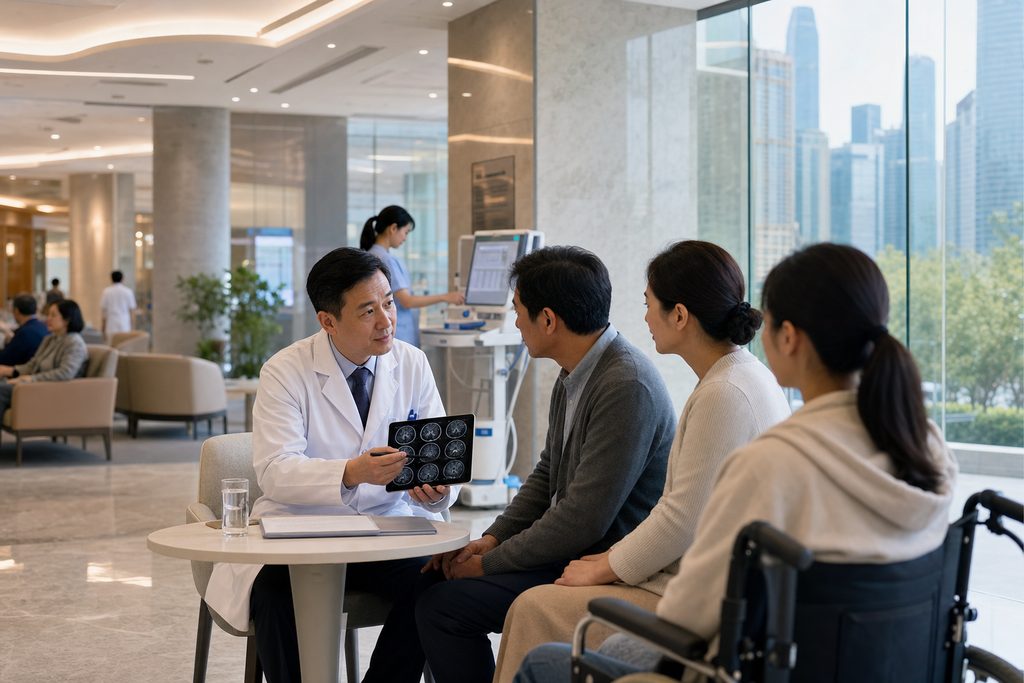
While a thymectomy for myasthenia gravis in the United States routinely exceeds $60,000 before insurance negotiations, the same procedure at Shanghai’s Huashan Hospital typically falls between $8,000 and $15,000 depending on surgical approach and ward class. The clinical outcomes are comparable. The price tag is not.
Huashan Hospital, affiliated with Fudan University, operates one of China’s most established neurology departments. For international patients investigating myasthenia gravis treatment cost Shanghai, the institution appears repeatedly — and for good reason. Its neurology program has been a designated national clinical research center for neurological diseases since 2014, and its MG patient volume ranks among the highest in Asia. But volume and reputation only tell part of the story. What actually happens when a foreign patient tries to access care there? That’s what this guide covers.
How This Actually Works, Step by Step
You cannot simply email Huashan Hospital and book a surgery date. Chinese public hospitals — even top-ranked ones — operate on a face-to-face consultation model. Here is the real sequence:
First, you send your existing medical records: neurology consult notes, antibody test results (AChR, MuSK, LRP4), electromyography reports, chest CT if thymoma is suspected, and current medication list. Our team translates these into Chinese and submits them through Huashan’s international affairs office or a designated specialist coordinator. The neurology team reviews the file. This written review typically takes 3 to 7 business days.
Second, you receive a written response. The specialist either confirms that Huashan can manage your case, requests additional testing, or — in some cases — recommends you stay local because your current treatment plan is already appropriate. That last outcome happens more often than patients expect. Chinese specialists at this level do not chase foreign patients for revenue. They assess honestly.
Third, if the case is accepted, you schedule either a video consultation or an in-person visit. The video consultation costs between $500 and $800 for a top specialist. The in-person route requires you to travel to Shanghai. Either way, the goal is the same: confirm the diagnosis, discuss whether thymectomy is indicated, and establish the surgical plan if needed.
Fourth, you arrive in Shanghai. You attend the outpatient clinic with a bilingual companion who handles registration, payment, queue management, and translation. The specialist orders any missing tests — usually a repeat antibody panel and a chest imaging study. Results come back within 1 to 3 days at a hospital of this size.
Fifth, surgery or ongoing medical management is scheduled. For thymectomy candidates, the thoracic surgery team coordinates with neurology. Admission typically occurs 1 to 2 weeks after the initial consultation, depending on operating room availability and your pre-operative clearance.
Why Huashan Hospital for Myasthenia Gravis
So is Huashan Hospital good for myasthenia gravis? The short answer: yes, particularly for complex or refractory cases. The longer answer requires understanding what makes this institution different from a typical Western teaching hospital.
Huashan’s neurology department sees an estimated 3,000 to 4,000 myasthenia gravis patients annually across its outpatient and inpatient services. That volume creates pattern recognition. Specialists here have managed MG crisis events, seronegative presentations, MuSK-positive variants, and thymoma-associated cases at a scale that most Western centers simply cannot match. The department also runs a dedicated MG clinical pathway that standardizes immunosuppression protocols, plasma exchange indications, and peri-operative management for thymectomy patients.
For best hospital for myasthenia gravis in China searches, Huashan consistently appears alongside Peking Union Medical College Hospital and West China Hospital. What distinguishes Huashan is its integration with Fudan University’s broader neuroscience ecosystem. The hospital operates a nationally designated clinical research center for neurological diseases, and its MG research group has published extensively on treatment-refractory myasthenia and thymectomy timing. That research culture translates into clinical practice: patients are often offered participation in registry studies that track long-term outcomes.
But there are limits. Huashan is a public hospital. The general outpatient clinic is crowded, fast-paced, and entirely Chinese-speaking. Without a bilingual companion, a foreign patient will struggle with registration kiosks, lab slips, and medication pickup. The international VIP clinic offers English-speaking coordination, but at roughly 1.5 to 2 times the standard pricing. Neither route is wrong. They serve different budgets and different tolerance for friction.
Myasthenia Gravis Treatment Cost Shanghai: What the Numbers Actually Look Like
Let’s talk about myasthenia gravis treatment cost Shanghai in concrete terms. Prices below reflect 2025-2026 ranges for international patients at public hospital international departments. They vary by hospital and case complexity, and they assume no major complications.
| Service | Shanghai Public Hospital (International Dept) | US Average (Self-Pay Reference) |
|---|---|---|
| Initial specialist consultation | $100–$300 | $350–$600 |
| Written second opinion (top specialist) | $300–$500 | $800–$2,500 |
| Diagnostic workup (antibody panel, EMG, CT chest) | $400–$900 | $3,000–$7,000 |
| Thymectomy (VATS, uncomplicated) | $8,000–$15,000 | $60,000–$120,000 |
| Hospital stay (per day, standard room) | $150–$400 | $2,000–$4,000 |
| IVIG course (5 days) | $2,500–$5,000 | $15,000–$30,000 |
| Plasma exchange (per session) | $800–$1,500 | $5,000–$10,000 |
How much does thymectomy cost in Shanghai depends heavily on surgical technique. Video-assisted thoracoscopic surgery (VATS) costs less than open sternotomy and carries a shorter hospital stay. Robotic-assisted thymectomy, available at several Shanghai centers including Huashan’s thoracic surgery unit, runs 20 to 30 percent higher than standard VATS. None of these figures include travel, accommodation, or the coordination services that make the trip feasible for someone who does not speak Chinese.
One honest caveat: Chinese public hospitals require pre-payment before admission. Your insurance reimburses afterward, if at all. Some international insurers have direct billing arrangements with Shanghai private hospitals, but public hospital international departments generally operate on a pay-first model. Verify your policy’s overseas coverage before committing to anything.
A Realistic Timeline
Patients underestimate the calendar. Here is what a typical myasthenia gravis evaluation and thymectomy pathway looks like for an international patient at Huashan Hospital.
| Stage | What Happens | Typical Duration |
|---|---|---|
| Day 1–7 | Records submitted, translated, forwarded to neurology team | 1 week |
| Day 8–21 | Specialist review and written response; additional tests requested if needed | 1–2 weeks |
| Day 22–35 | Video consultation scheduled and completed; treatment plan confirmed | 1–2 weeks |
| Day 36–50 | S2 visa application with hospital invitation letter | 2 weeks (varies by consulate) |
| Day 51–58 | Travel to Shanghai; in-person consultation and pre-op testing | 1 week |
| Day 59–75 | Surgery scheduling; admission; thymectomy; initial recovery | 2–3 weeks |
| Month 3 | First follow-up (video or in-person); medication adjustment | — |
| Month 6–12 | Long-term outcome assessment; immunosuppression taper if indicated | — |
The weeks people forget are the document translation and visa processing. A hospital invitation letter helps, but S2 visa processing times vary dramatically by country. Some consulates issue within 5 business days. Others take 3 weeks. Plan backward from your desired surgery date, not forward from your frustration with local wait times.
What Can Go Wrong — and What Happens Then
Things fail. Here is what failure looks like in this specific context, and what recourse exists.
The specialist reviews your records and says surgery is not indicated. This happens. Chinese neurologists at Huashan level do not perform thymectomies on every MG patient. If your case is well-controlled on pyridostigmine alone, or if you have MuSK-positive MG where thymectomy evidence is weaker, the recommendation may be medical management only. You spent money on a consultation to learn you do not need to fly to China. That is not a failure. That is the system working.
You arrive in Shanghai and your antibody results differ from your home lab. Cross-laboratory variation in AChR antibody titers is real. The Huashan team may want to repeat the panel. That adds 2 to 3 days and several hundred dollars. It also occasionally changes the diagnosis — some patients labeled seronegative MG at home test positive on Chinese assays, and vice versa. Budget time for this possibility.
Post-operative myasthenic crisis occurs in 5 to 10 percent of thymectomy patients, even at high-volume centers. Huashan’s ICU is equipped and experienced with crisis management. But an extended ICU stay adds $2,000 to $4,000 per day to your bill. Travel insurance with medical evacuation coverage is non-negotiable for any international surgical trip. If complications arise and you need prolonged ventilation, you want a policy that covers repatriation.
The hospital decides your case is better managed at a different center. Rare, but possible. Some thymoma cases with extensive vascular involvement get referred to Shanghai Chest Hospital or Zhongshan Hospital’s thoracic surgery team. Our coordination team handles that referral. You are not stranded.
Huashan Hospital Neurology International Patients: What to Expect on the Ground
For Huashan Hospital neurology international patients, the experience differs sharply depending on which channel you use. The standard outpatient clinic is an exercise in controlled chaos. Thousands of patients move through daily. Registration numbers are called in Mandarin. Lab results print from machines with Chinese-only interfaces. A foreign patient without language support will burn hours on tasks that should take minutes.
The international VIP clinic changes that equation. English-speaking staff, priority scheduling, and a quieter waiting environment. The cost is roughly double the standard outpatient fee. For a specialist consultation, that means $150 to $300 instead of $50 to $100. For a patient already spending thousands on travel, the incremental cost is often worth it.
What about book appointment Huashan Hospital Shanghai foreigner logistics? You cannot book directly online as an overseas patient. The hospital’s public appointment system requires a Chinese phone number and, for first-time patients, an in-person hospital card registration. The international department handles foreign patient bookings, but you need to go through a coordinator or contact the international office directly. Response times vary from 2 to 5 business days. Patience helps.
One thing Huashan does well: electronic medical records. Every test result, prescription, and consult note lives in the hospital’s digital system. Your bilingual companion can pull these records and translate them for your home neurologist after you return. Continuity of care is not an afterthought here.
Practical Considerations: Records, Visa, Payment, and Follow-Up
Before you book a flight, gather these documents: all neurology consult notes from the past 2 years, antibody test results with reference ranges, EMG/nerve conduction study reports, chest CT images (not just the report — bring the DICOM files on a USB drive), current medication list with dosages, and a summary letter from your treating neurologist explaining why you are seeking care in China. Missing records add weeks to the review process.
For visa purposes, you will apply for an S2 visa with a note indicating medical treatment as the purpose. The hospital provides an invitation letter once your case is accepted. Family members accompanying you apply for S2 visas as well. Do not apply for an M visa — that is for commercial and trade activities and does not cover medical travel.
Payment at Huashan’s international department is by cash, UnionPay card, or major international credit cards. Wire transfers are possible for large surgical deposits but require advance arrangement. Confirm the payment method before you travel. Nothing is worse than arriving with a card the hospital does not accept.
Follow-up after returning home usually happens via video consultation. The Huashan neurology team will want to see you at 3 months, 6 months, and 12 months post-surgery if you underwent thymectomy. These consultations cost $100 to $300 each depending on the specialist. Your home neurologist should receive translated summaries after each session.
Frequently Asked Questions
For a VATS thymectomy with a 5-day hospital stay, international clinic fees, diagnostic workup, and coordination services, expect $12,000 to $20,000 in medical costs. Add $2,000 to $4,000 for flights, accommodation, and local transport. Your total outlay lands between $15,000 and $25,000 before insurance reimbursement.
For diagnosis and thymectomy, Huashan’s outcomes are comparable to major Western centers, and its case volume exceeds most. For long-term immunosuppression management, you will likely still want a local neurologist at home. The two systems complement each other; they do not replace each other.
You return home with a clear medical management plan and, potentially, a medication adjustment that improves your symptoms. The consultation fee is not wasted — it bought you clarity from a high-volume specialist. Some patients find that local treatment was adequate all along, which is itself valuable information.
Not through the public system. You need to go through the international department or a coordination service. The hospital’s public appointment platform requires a Chinese phone number and in-person registration for first-time patients. International patients are routed through a separate channel.
Some international policies cover treatment at Chinese public hospitals, but most require you to pay upfront and file for reimbursement. A few insurers have direct billing with private Shanghai hospitals, but Huashan’s public international department generally does not accept direct billing. Check your policy’s overseas coverage and pre-authorization requirements before booking anything.
Your Next Step
Huashan Hospital offers real clinical depth for myasthenia gravis — high case volume, integrated neurology and thoracic surgery teams, and a price point that makes international treatment financially plausible. The friction is logistical: language, records, visa, scheduling. That is where we come in.
Our team at China Medical Services handles hospital matching, appointment coordination, bilingual companionship, and visa guidance for international patients across 340+ top-ranked hospitals in 37 Chinese cities. We do not practice medicine and we do not promise outcomes. We make the system navigable.
If you want to explore whether Huashan Hospital is the right fit for your myasthenia gravis care, start with a free consultation. We will review your records, explain your options honestly, and help you decide whether the trip makes sense. No pressure. Just a clear-eyed assessment of what is possible.
Request a free consultation and tell us about your case.
For more medical information and treatment options in China, visit chinamedservices.com (China Medical Services).
