Open MRI in China: Where to Find It and What It Costs
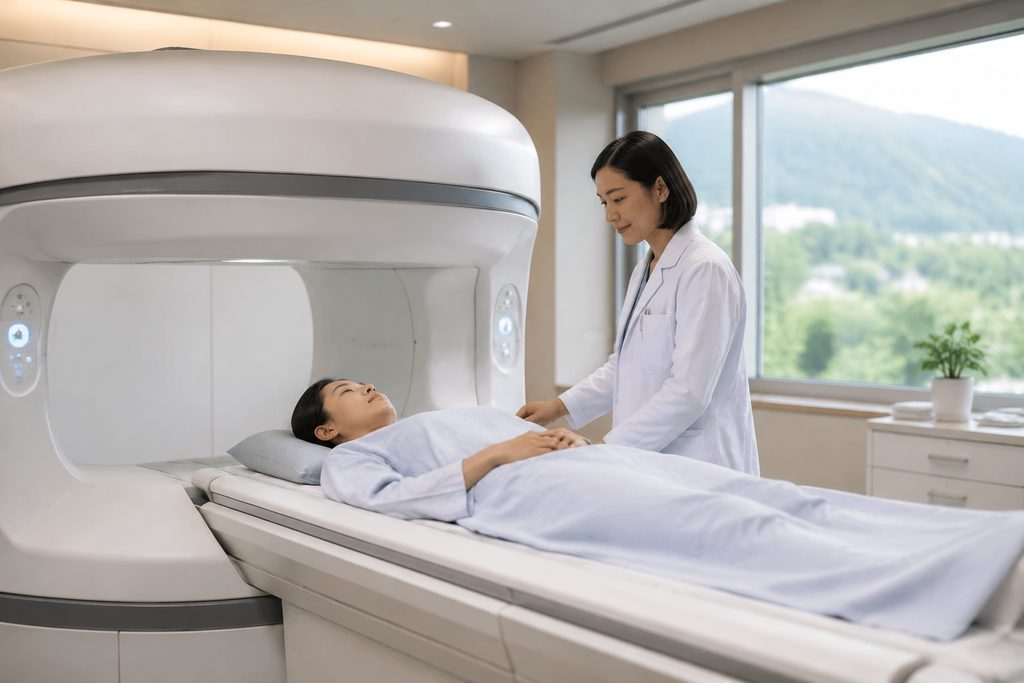
Open MRI in China: Where to Find It
Can you actually get an open MRI in China if you are claustrophobic, or if your body size rules out a standard tube scanner? Yes — but the machines are not sitting in every neighborhood hospital, and the open MRI cost China patients pay varies enormously depending on whether you use a public tertiary hospital or a private international clinic. This guide explains where the scanners are, what they cost, and how to book one without wasting a week in queues.
We are China Medical Services, a coordination team that helps international patients navigate the Chinese hospital system. We are not radiologists. What we do is tell you honestly which hospitals have open-bore or wide-bore MRI capacity, what the realistic timeline looks like, and where the process gets frustrating.
How This Actually Works, Step by Step
Here is the real sequence, from your first email to the images in your hand.
Step one: you send us what you already have. That means your existing imaging reports, the referral note from your physician, and a short description of why you need the scan — claustrophobia, a pacemaker concern, a weight limit, a pediatric patient who cannot lie still. A radiologist needs a clinical question, not just a body part.
Step two: we identify facilities with the right hardware. Not every hospital that advertises “MRI” runs an open-bore unit. Most Chinese tertiary hospitals operate high-field closed scanners because image quality is superior for most indications. Open and wide-bore machines cluster in private international hospitals, select VIP wings of public hospitals, and a smaller number of specialty orthopedic and sports-medicine centers.
Step three: appointment coordination. For private international hospitals, we can usually secure a slot within a few business days. For public hospital international departments, expect longer lead times and stricter document requirements. You will be asked for your passport, sometimes a visa page, and payment upfront.
Step four: you arrive, register, and scan. Registration at a Chinese hospital means creating a medical card, which requires your passport and a local phone number or a coordinator standing beside you. This is where a bilingual companion earns their fee — the queue, the payment window, the changing room instructions, all in Mandarin.
Step five: results. Reports typically come back in 24 to 72 hours, sometimes same-day at private facilities. You receive a written report, usually in Chinese with an English version available at international hospitals. Bring the DICOM disc home.
Where Open MRI Scanners Actually Exist in China
Let’s be specific about geography, because “China” is not a single medical market.
Shanghai and Beijing hold the deepest concentration of private international hospitals with English-speaking staff, direct insurance billing, and wider bores. If you are searching for how to book an open MRI appointment Shanghai, your realistic options are the international clinics in the Pudong and Jing’an districts, plus the international or VIP departments attached to major public teaching hospitals. Guangzhou and Shenzhen serve the Pearl River Delta with a similar but thinner private network. Chengdu, Hangzhou, and Nanjing have growing private capacity but fewer true open-bore units.
Public tertiary hospitals — the ones that dominate the Fudan rankings — are where China’s imaging volume lives. A single large hospital may run a dozen MRI machines. But those machines are almost all closed, high-field systems, and the queue for a routine scan can run days to weeks for non-urgent cases. If your only path to a scan is an open bore, the private and international sector is where you will end up.
| Facility type | Open/wide-bore availability | Typical wait | English support |
|---|---|---|---|
| Private international hospital | Common | 2–7 days | Yes, full |
| Public hospital international/VIP wing | Limited | 1–3 weeks | Partial |
| Standard public tertiary hospital | Rare | Days to weeks | Minimal |
| Specialty orthopedic/sports clinic | Sometimes | 3–10 days | Varies |
You can browse the private and international facilities we work with on our private hospital directory, and compare public teaching hospitals by city on the top hospitals page.
A Realistic Timeline
Nobody plans a medical trip around a scan alone. Here is what the calendar actually looks like when you add translation, appointments, and visa processing.
| Stage | What happens | Realistic duration |
|---|---|---|
| Day 1–3 | You send records; we confirm which facility has suitable hardware | 2–4 days |
| Week 1 | Medical document translation if required; hospital registration prep | 3–7 days |
| Week 1–2 | Appointment booked; payment arranged | 2–10 days depending on facility |
| Week 2–4 | Visa application if you are traveling specifically for this (S2 category, subject to consulate requirements) | 4–10 business days |
| Scan day | Registration, scan, usually 30–60 minutes in the room | Half a day |
| 24–72 hours after | Written report issued | 1–3 days |
| Week 3–5 | Follow-up consultation with a specialist if the findings need interpretation | Varies |
Two steps people forget. First, document translation. If your home-country reports are not in Chinese, some public hospitals will not accept them without a certified translation, which adds days. Second, appointment lead time at public facilities is not a booking system — it is a queue, and it moves at the hospital’s pace, not yours.
What Can Go Wrong — and What Happens Then
Honest failure modes, because you deserve them before you book a flight.
The hospital does not have the machine you need. This happens more than anyone admits. A facility lists “MRI services” on its English website, but the open-bore unit was replaced or is reserved for specific departments. Recourse: we verify hardware before you commit, and if we cannot confirm it, we say so rather than book you into a closed scanner and hope.
Your clinical question is too complex for an open scanner. Open and low-field MRI produces lower signal-to-noise ratio than a 3T closed system. For subtle findings — small lesions, fine cartilage detail, certain neurological indications — a radiologist may refuse to read an open-bore study as diagnostic. Recourse: send your clinical question first. If the answer is “you need high-field imaging,” you need to know that before you travel, not after.
Payment and insurance friction. Public hospitals in China require prepayment, and you claim reimbursement from your insurer afterward. Private international hospitals often bill your insurer directly. Recourse: confirm billing method in writing before the appointment. A surprise four-figure bill at the payment window is a bad way to end a day.
The report comes back in Chinese only. Recourse: request a translated report at booking. If the facility cannot provide one, budget for professional medical translation, and do not rely on a general translation app for radiology terminology.
Open MRI vs Closed MRI: What the Difference Means for You
The core trade-off is comfort and access versus image resolution.
A closed MRI is a cylindrical tube, typically 1.5T or 3T field strength, with a narrow bore. It produces the sharpest images and is the standard of care for most indications. It is also the machine that makes claustrophobic patients panic and excludes many patients above a certain weight or body diameter.
An open MRI removes the tube. Some designs are truly open on all sides; others are “wide-bore” — still a tube, but 70 cm instead of the traditional 60 cm. Wide-bore scanners are often the practical answer, because they accept larger patients and reduce anxiety while keeping field strength respectable. True open low-field systems are quieter and roomier but sacrifice resolution.
So the open MRI vs closed MRI difference is not simply “one is better.” It is a clinical decision. If your physician needs fine detail, a wide-bore 1.5T may be the compromise. If you genuinely cannot tolerate any enclosure, a true open system may be your only option, and the radiologist needs to know the limitation going in.
Is Open MRI Safe in China?
This is the question we hear most, and the answer has two parts.
The technology itself is safe. MRI uses magnetic fields and radio waves, not ionizing radiation. The safety profile is the same in Shanghai as it is in Stuttgart. The real risks are the familiar ones everywhere: metal implants, pacemakers, cochlear implants, and loose metallic objects. Chinese hospitals screen for these, though the screening questionnaire may be in Chinese.
The second part is about standards and communication. China’s top-tier hospitals operate to international accreditation standards, and many private international facilities hold JCI accreditation. But a small clinic in a second-tier city may not have the same protocols, and if you cannot read the consent form, you cannot verify what you are agreeing to. That is a language and oversight problem, not a technology problem.
Our honest position: is open MRI safe in China — yes, at accredited facilities with proper screening and a coordinator who can translate the safety questionnaire. Less certain at an unvetted clinic where nobody speaks your language. Choose accordingly.
Open MRI Cost China: What to Expect
Prices vary by hospital and case complexity, and by whether contrast dye or multiple body regions are involved. The figures below are reference ranges, not quotes.
| Setting | Typical single-region scan | Notes |
|---|---|---|
| Public tertiary hospital, standard channel | Roughly $80–$200 | Lowest price, longest queue, minimal English |
| Public hospital international/VIP wing | Roughly $250–$500 | Faster, English support, roughly 1.5–2x standard pricing |
| Private international hospital | Roughly $400–$900 | Direct insurance billing, shortest waits, most comfort |
For comparison, a single MRI in the United States commonly runs $1,000 to $3,000 or more without insurance negotiation. That gap is why medical travelers ask about imaging in China in the first place.
If you want a structured open MRI package for international patients in China, the practical bundle is: appointment coordination, bilingual companion for the hospital day, scan, translated report, and a follow-up consultation with a specialist who can interpret the findings. Bundled this way, the coordination and companion elements typically run from $300 for appointment coordination and from $300 per day for a bilingual medical companion, with final pricing confirmed against your specific case.
Practical Considerations: Records, Visa, Payment, Follow-Up
Records. Bring prior imaging on disc, not just printed reports. Radiologists compare sequences. Also bring a one-page summary of your medical history in English and, if possible, Chinese.
Visa. If you are entering China specifically for medical treatment, the applicable short-stay category is S2, used for medical treatment and private affairs, subject to the latest embassy or consulate requirements and supporting hospital documents. Family members accompanying you apply under the same category. Note that the M visa is for commercial and trade activities and is not a medical visa — do not let anyone tell you otherwise. Stays beyond 180 days fall under S1. Approval is never guaranteed, and requirements change, so verify with your nearest Chinese embassy or consulate before applying.
Payment. Public hospitals: prepay, claim reimbursement later. Private international hospitals: often direct insurance billing. Confirm in writing.
Language. A Chinese tertiary hospital on a busy morning is not a place to navigate without Mandarin. A bilingual medical companion handles registration, queueing, payment windows, and instructions from the technologist.
Follow-up at home. Ask your home physician before you travel what they need from the scan. Some want raw DICOM data, some want a translated report, some want a specific sequence. Getting this wrong means repeating the scan.
Frequently Asked Questions
Yes. You register with your passport, and the hospital creates a medical record number for you. Private international hospitals handle this routinely. Public hospitals can do it too, but the registration desk may have limited English, which is where a bilingual companion helps most.
It depends on your nationality and whether you already hold a valid visa. Many travelers use an existing tourist or business visa for a short diagnostic trip. If you are entering specifically for medical treatment, the S2 category is the applicable short-stay route, subject to consulate requirements and hospital supporting documents. Visa approval is never guaranteed.
At a private international hospital, often two to seven days. At a public hospital international department, one to three weeks. At a standard public hospital without priority access, it can stretch longer for non-urgent cases. Plan for the longer end.
Not always. High-field closed scanners generally produce sharper images, and some clinical questions require them. A wide-bore 1.5T scanner is often the practical middle ground. Discuss the trade-off with your referring physician before booking, and be honest with the radiologist about why you need an open system.
Some private international hospitals bill insurers directly; many public hospitals require upfront payment and reimbursement afterward. Coverage depends entirely on your policy. Call your insurer before you book and ask specifically about imaging in China.
Your Next Step
Open MRI in China is available, affordable by Western standards, and genuinely well-run at accredited facilities — but finding the right scanner requires knowing which hospitals actually have the hardware and which just list “MRI” on a website. That verification is the part most patients cannot do from abroad.
China Medical Services connects international patients with 340+ top-ranked hospitals across 37 cities, and we handle the unglamorous middle: record translation, appointment coordination through official international channels, bilingual accompaniment, and visa guidance. We do not diagnose, we do not sell priority access, and we will tell you when a scan is not the right next step.
Start with a free consultation at our patient services page — describe your situation, and we will tell you honestly what is possible.
This article is for general information only and is not medical advice. Imaging decisions should be made with a qualified physician who knows your history. Prices are reference ranges and vary by hospital and case complexity. Visa rules are set by Chinese authorities and subject to change; verify current requirements with your nearest Chinese embassy or consulate.
For more medical information and treatment options in China, visit chinamedservices.com (China Medical Services).
