Pakistan Patient Medical Service China: Full Support From Islamabad, Lahore & Karachi
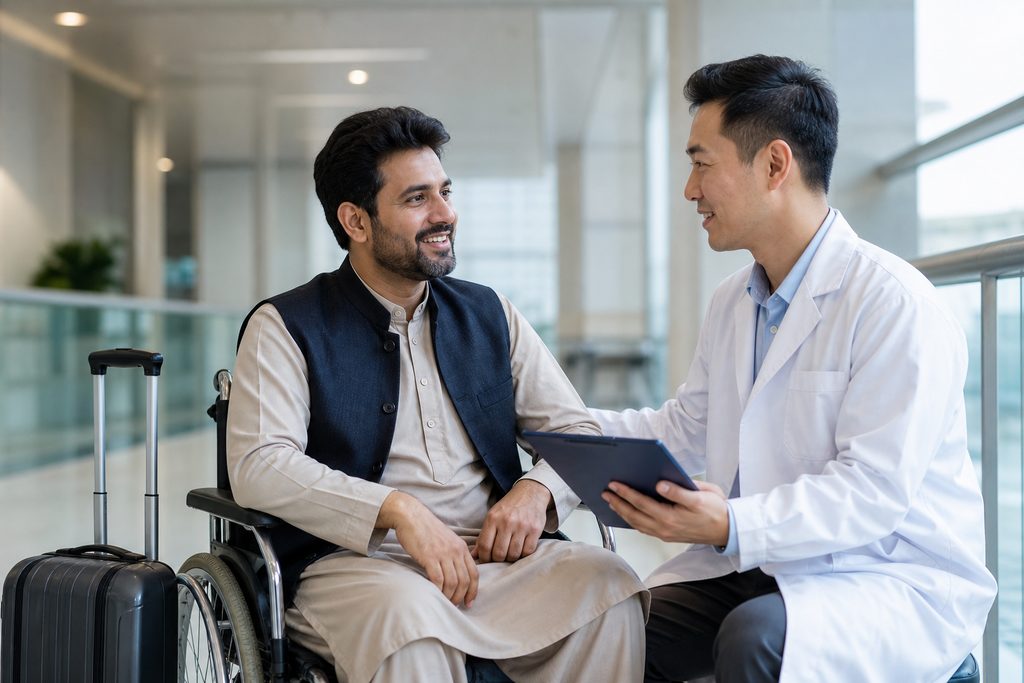
What if the biggest barrier to world-class surgery wasn’t the procedure itself, but simply knowing where to start?
Our team fields calls every week from families in Islamabad, Lahore, and Karachi facing the same impossible equation. A diagnosis lands. The local specialist recommends a complex cardiac repair, a liver transplant, or a delicate spine surgery. The quoted wait time stretches past six months. Or the family wants a second opinion from a surgical team that handles thousands of cases annually, not dozens. And then the real questions begin. Which hospital in China actually specializes in this? How do you even get a medical visa from Pakistan? What is the realistic China hospital package cost from Pakistan when you factor in flights, accommodation, and the procedure itself?
These are not abstract questions. They are logistical nightmares when tackled alone. They are also entirely solvable.
Key Takeaways
- China’s top-tier hospitals handle surgical volumes that dwarf Western centers — Fuwai Hospital alone performs over 14,000 cardiac surgeries annually, creating a depth of clinical experience that directly impacts outcomes.
- A full treatment journey from Pakistan involves three distinct layers: pre-travel medical coordination, on-ground bilingual support, and post-operative recovery logistics — not just a hospital booking.
- The S2 medical visa is the correct category for Pakistani patients; applying with the wrong documentation or visa type causes delays that can derail a treatment timeline entirely.
- Package costs vary dramatically by hospital tier and case complexity — a liver transplant at a public top-tier center operates on a different cost structure than a private international hospital, and understanding this difference before traveling is essential.
The Problem: When Waiting Is Not an Option
Pakistan’s healthcare system delivers capable frontline care. But for complex tertiary procedures — organ transplants, advanced oncology protocols, complex congenital cardiac repairs — the gap between need and capacity is real. A 2023 study published in the Pakistan Journal of Medical Sciences noted that the country performs approximately 300-400 liver transplants annually across all centers, while the estimated need exceeds 5,000. That gap represents families who must either wait indefinitely or seek care abroad.
The math is unforgiving. A liver transplant surgery price China 2024 ranges significantly based on the hospital tier and case complexity, but the structural advantage is clear: China’s top transplant centers run multiple operating rooms daily, not weekly. That volume translates to surgical teams that have seen rare complications and know how to manage them. For a family in Karachi weighing options, the question shifts from “can we afford to go” to “can we afford to wait.”
Spine surgery patients face a parallel dilemma. Complex multi-level fusions or revision surgeries require a surgeon who does these procedures as a routine, not an exception. The best cancer treatment hospitals in China for Pakistani patients offer something else entirely: access to clinical trials and immunotherapy protocols that may not be available regionally. These are not marginal differences. They are treatment-defining.
Who We Are
We are not a hospital. We do not provide medical treatment, make clinical diagnoses, or recommend specific surgeons over others. What we do is build the bridge. Our team connects patients from Islamabad, Lahore, Karachi, and beyond with China’s top-tier medical institutions — 340+ top-ranked hospitals across 37 cities, representing the top 5% of China’s 35,000+ hospitals as ranked by the Fudan University hospital rankings and JCI accreditation standards. We handle the architecture of a medical journey: hospital matching based on your actual diagnosis, appointment coordination through official international departments, bilingual medical companion services on the ground, and visa guidance that ensures your application is complete before you approach the embassy. Think of us as your Pakistani patient coordinator China medical tourism logistics team — we solve the “how” so you can focus on the “what matters.”
Why China Delivers Results for Pakistani Patients
Clinical Volume Creates Specialist Depth
There is a well-documented correlation in medical literature between surgical volume and patient outcomes. A surgeon who performs 300 knee replacements a year simply encounters and manages complications differently than one who performs 50. China’s top orthopedic centers operate at a scale that is hard to comprehend until you see it. A senior spine surgeon at a major Shanghai hospital might complete 400-500 complex spinal procedures annually. The average spine surgeon in a Western country performs roughly 80-100. This is not a statement about individual skill. It is about system design. China’s top hospitals are high-throughput centers where rare presentations become familiar patterns.
For Pakistani patients considering spine surgery abroad with full travel support, this matters enormously. Revision spine surgery — fixing a previous failed procedure — is one of the most technically demanding operations in orthopedics. You want a team that has seen your exact complication before, multiple times, and has a rehearsed surgical plan for it.
Technology Adoption at Scale
China’s hospital infrastructure investment over the past decade has been staggering. Robotic surgical systems, intraoperative MRI suites, proton therapy centers for cancer — these are not scattered across a few flagship institutions. They are deployed systematically across the top-tier hospital network. For a Pakistani cancer patient, this means access to radiation oncology protocols that spare healthy tissue with precision that older linear accelerators cannot match.
The best cancer treatment hospitals in China for Pakistani patients are not a single institution. They are a network of specialized centers — some ranked among China’s top 10 for oncology by the Fudan specialist reputation rankings — each with deep expertise in specific cancer types. One hospital might lead in hematological malignancies. Another in thoracic oncology. Matching the hospital to the diagnosis, not the brand name, is where most independent patients get lost.
The Cost Equation: Structural, Not Compromised
Let us address the obvious question directly. The China hospital package cost from Pakistan is lower than equivalent care in the United States, United Kingdom, or private facilities in the Gulf — often by a factor of 5 to 10. A cardiac bypass procedure that costs $120,000+ in the US might run $12,000-20,000 at a top Chinese public hospital’s international department. A liver transplant surgery price China 2024 at a public top-tier center typically falls in a range that is a fraction of Western private-sector pricing.
Does lower cost mean lower quality? No. It means different cost structures. Chinese surgeon salaries, hospital operating costs, and pharmaceutical pricing operate on a different economic base than Western health systems. The clinical protocols — sterile technique, surgical standards, ICU monitoring — are internationally benchmarked. Many top Chinese hospitals hold JCI accreditation, the same international quality standard applied to hospitals in Singapore, the UAE, and the United States. The value proposition is real, but it requires understanding that you are accessing care through a different economic model, not a discounted version of Western medicine.
What You Need to Know Before Going Alone
Honesty matters here. The barriers to accessing Chinese healthcare as a Pakistani patient are real and can derail a treatment plan if underestimated.
- Visa Complexity: The correct visa category is the S2 visa, endorsed for medical treatment purposes. This is not a tourist visa. The Chinese embassy in Islamabad requires a formal invitation letter from the treating hospital, medical records substantiating the need for treatment, and proof of financial means. Applying without the hospital invitation letter — or worse, applying for an M business visa hoping to sort out treatment later — will result in rejection or, at minimum, significant delays. Family members accompanying the patient also apply for S2 visas. How to get medical visa for China from Pakistan starts with having a confirmed hospital acceptance, not the other way around.
- Hospital Access Reality: Chinese public hospitals do not allow overseas patients to remotely book a general outpatient appointment and then arrive expecting surgery. The standard pathway requires an in-person consultation first. The surgeon must examine you, review your imaging, and confirm the treatment plan before scheduling a procedure. The only way to lock in a surgical slot and specialist before traveling is through the hospital’s official international department or VIP channel — which involves higher consultation fees but guarantees English-speaking coordination and pre-arranged scheduling. Independent patients who arrive hoping to figure it out on the ground face language barriers and wait times they did not anticipate.
- Payment Systems: Chinese public hospitals operate on a prepayment model. You deposit funds at admission, and treatment proceeds against that balance. International insurance is typically reimbursed after the fact, not directly billed at public hospitals. Private international hospitals — United Family, Jiahui, Raffles — do offer direct insurance billing and English-speaking staff, but their procedure costs are higher. Understanding which hospital type fits your financial and clinical needs before you travel is critical.
- Language and Navigation: A top Chinese public hospital might see 10,000 outpatient visits in a single day. Signage is increasingly bilingual in major cities, but the operational staff — the people at registration windows, the pharmacy counters, the imaging department scheduling desks — speak Mandarin. Without a bilingual medical companion, a simple task like collecting lab results or scheduling a follow-up CT scan becomes an exercise in frustration. This is not a minor inconvenience. It directly affects the pace and quality of your care journey.
How We Help You Navigate This
These barriers are not random. They exist because China’s hospital system was built to serve a domestic population of 1.4 billion, and the international patient infrastructure is layered on top, not baked into the foundation. Our job is to make that layer work for you.
The process starts before you book a flight. You share your medical records and diagnostic imaging with our team. We translate them into clinical Chinese — not just language translation, but formatting them to match what Chinese specialists expect to see. We match your case to the right hospital and department, drawing on our database of 340+ institutions and the Fudan specialist reputation rankings across 45 clinical departments. If your case requires a written second opinion from a top-tier specialist before you commit to travel, we facilitate that through official hospital channels. The fee for that service — typically $300-500 — is credited in full toward any on-ground coordination service if you proceed to treatment within 90 days.
Once a hospital accepts your case, we coordinate the official invitation letter that anchors your S2 visa application. We guide you through the documentation package, but we do not submit visa applications — that step belongs to you and the Chinese embassy. What we provide is a complete, embassy-ready document set that minimizes the risk of rejection or requests for additional information.
On the ground in China, a bilingual medical companion meets you at the airport. This person is not a doctor. They are your logistical partner — handling hospital registration, queuing for appointments, translating during consultations, picking up medications, scheduling follow-up imaging, and navigating the thousand small administrative steps that a hospital stay generates. For patients arriving from Islamabad, Lahore, or Karachi, this is the difference between a stressful, disorienting experience and a focused recovery. The companion handles the system. You handle getting better.
Post-discharge, we coordinate follow-up consultations, medication refills, and any required rehabilitation appointments. If your treatment plan requires a return visit in six months, we pre-schedule it before you leave. The goal is continuity — a treatment journey that feels like a single coherent plan, not a series of disconnected episodes.
Frequently Asked Questions
The China hospital package cost from Pakistan varies too widely for a single number. A cardiac bypass at a top public hospital’s international department typically falls in the $12,000-20,000 range. A liver transplant surgery price China 2024 at a public center ranges higher, often $40,000-70,000 depending on the hospital and whether a living donor is involved. A complex multi-level spine surgery might run $15,000-30,000. These figures cover the hospital procedure, not flights, accommodation, or our coordination fees. Private international hospitals charge more — sometimes double — but offer direct insurance billing and a fully English-speaking environment. We provide a detailed cost estimate only after reviewing your medical records and confirming the treating hospital’s current pricing.
No. The S2 medical visa requires a formal invitation letter from a Chinese hospital confirming they have accepted you for treatment. This is non-negotiable. The embassy will also require medical records substantiating the need for treatment in China and proof of sufficient funds. How to get medical visa for China from Pakistan is a process that starts with hospital acceptance, not with the visa application. Attempting to enter on a tourist visa and then seeking treatment violates visa conditions and risks denial of care or legal complications.
China’s liver transplant programs are among the highest-volume in the world. The surgical teams operate frequently, and the donor allocation systems are distinct from Pakistan’s. However, living donor transplants — where a family member donates a portion of their liver — require both donor and recipient to travel and undergo extensive compatibility testing in China. The process is medically complex and emotionally demanding. We coordinate the full donor-recipient workup through the hospital’s transplant coordination team, but we are transparent about the timeline: this is not a one-week process. Plan for an extended stay. The liver transplant surgery price China 2024 at a top public center reflects the procedure itself; donor evaluation, post-operative immunosuppressant medications, and extended accommodation add to the total cost.
The best cancer treatment hospitals in China for Pakistani patients depend entirely on the cancer type. China’s Fudan University hospital rankings publish specialist reputation rankings for 45 clinical departments, including oncology subspecialties. A hospital ranked in China’s top 10 for thoracic oncology may not be the right choice for a hematological malignancy. Our matching process starts with your pathology report and imaging, not with a hospital’s general reputation. We identify the departments with demonstrated expertise in your specific diagnosis and present you with options, including the trade-offs between public top-tier centers and private international hospitals.
Chinese top-tier hospitals carry medical liability insurance and have established protocols for managing adverse events. As your Pakistani patient coordinator China medical tourism logistics partner, our role is to ensure communication lines stay open. Your bilingual companion remains with you, translating discussions between you and the medical team, ensuring you understand what is happening and what options are available. We do not intervene clinically — that is the hospital’s responsibility — but we ensure you are never alone in a system where you do not speak the language. If a second opinion within the same hospital or a transfer to another facility becomes necessary, we facilitate those conversations through official channels.
Your Next Step
Traveling abroad for major surgery is not a decision anyone makes lightly. The logistics are real. The language barrier is real. The financial commitment is real. But so is the alternative — waiting, hoping, and watching a treatable condition progress because the local system cannot move fast enough.
China’s top hospitals offer something specific: high-volume surgical expertise, advanced technology, and a cost structure that makes world-class care financially accessible for Pakistani families. The path from Islamabad, Lahore, or Karachi to a hospital bed in Beijing, Shanghai, or Guangzhou runs through a series of logistical checkpoints. Our team handles those checkpoints. You handle the decision. If you are ready to explore what a coordinated treatment journey looks like for your specific diagnosis, we are here to walk you through it — no pressure, no hard sell, just clear information and a plan.
Medical Disclaimer: This article is for informational purposes only and does not constitute medical advice, diagnosis, or treatment recommendations. All treatment decisions should be made in consultation with qualified medical professionals. China Medical Services does not provide clinical care or guarantee specific medical outcomes.
For more medical information and treatment options in China, visit chinamedservices.com (China Medical Services).
