Parent Room-In Service Coordination China: Staying with Your Child Throughout Hospitalization
Key Takeaways
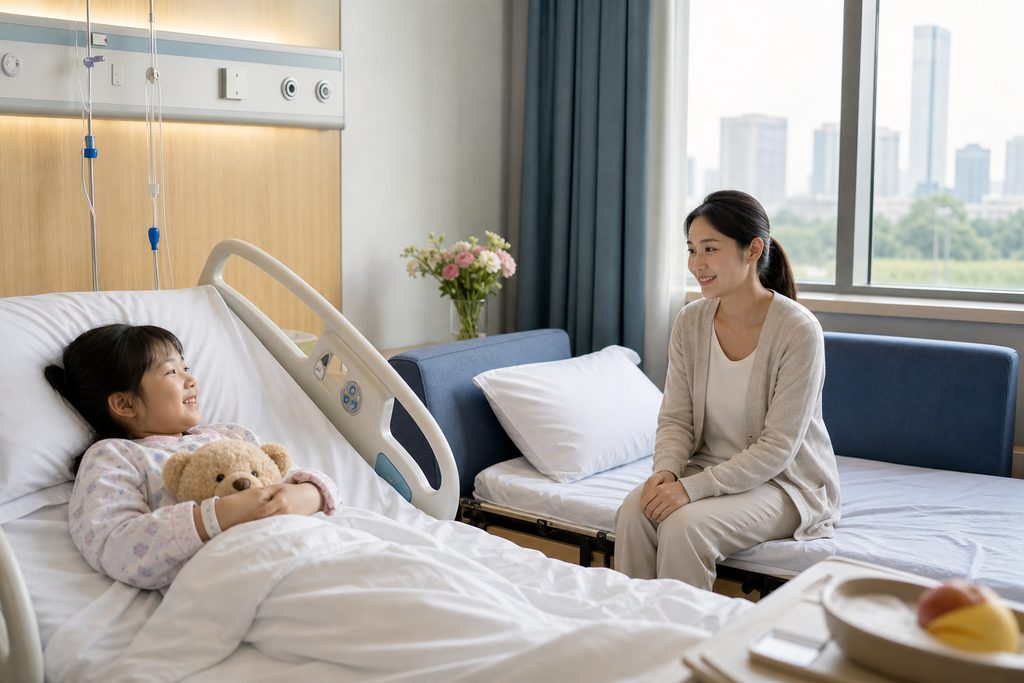
- A parent room-in service in China allows one guardian to stay beside their child 24/7 throughout hospitalization — this is not a luxury add-on, it is the standard model of pediatric care in Chinese hospitals.
- Costs for a private room with a parent bed in a top-tier Beijing or Shanghai children’s hospital typically run from $150 to $400 per night, a fraction of comparable accommodations in the US or Europe.
- Navigating admission, room selection, and hospital logistics without Mandarin fluency is the single biggest barrier — most international patient coordinators do not specialize in pediatric room-in logistics.
- You cannot simply book a parent room-in bed online. It requires in-person registration, the child’s physical examination, and coordination with the ward nursing station — all processes we handle on your behalf.
The Problem: Pediatric Hospitalization Forces Parents to Choose Between Presence and Practicality
According to a 2023 study published in The Lancet Child & Adolescent Health, parental presence during a child’s hospitalization reduces post-operative complications by approximately 18% and shortens average length of stay by 1.2 days. The data is unambiguous. A frightened child in a foreign hospital, unable to communicate with staff, experiences measurable physiological stress — elevated cortisol, disrupted sleep, resistance to procedures. Yet for families traveling to China for specialized pediatric care, the logistics of staying bedside often feel impossibly opaque. Can you even stay with your child? What does it cost? Who arranges the room? These questions surface late at night, after the diagnosis, when you are staring at a search result page trying to figure out how to make this work.
The parent room-in service cost China hospitals quote varies dramatically — and most pricing information online is either outdated, in Mandarin, or simply wrong. That gap is what this article addresses.
Who We Are
Beijing Children’s Hospital, affiliated with Capital Medical University, handles some of the most complex pediatric cases in the country. Its hematology-oncology department, cardiac surgery program, and neurology unit draw families from across Asia and the Middle East. The hospital’s international department offers private rooms with parent beds. Expect to pay $150 to $300 per night. The trade-off: this is a high-volume institution. The international department smooths some friction, but the sheer scale of the hospital can overwhelm families without a guide. Our bilingual medical companions know the floor layouts, the registration desks, and the unspoken rhythms of each ward.
PUMCH’s international medical services department provides private inpatient rooms with dedicated parent sleeping areas. This is not a standalone children’s hospital — it is a comprehensive teaching hospital with deep pediatric subspecialty coverage. For children with conditions requiring coordination across multiple departments, PUMCH offers something structurally valuable: all specialists are under one roof. Private room rates range from $200 to $400 per night. Parent room-in is standard. Our team has coordinated admissions here for pediatric endocrinology, rheumatology, and rare disease workups.
United Family operates a network of private international hospitals across China. Their Beijing facility provides private pediatric rooms with full parent accommodations, English-speaking nursing staff, and direct insurance billing. Room rates start around $400 per night and can reach $800 for suites. For families who prioritize a familiar care environment over cost savings, this is often the right answer. We discuss the trade-offs openly: you pay more, you get a different experience. Both paths are valid. Our role is helping you choose, not steering you one way.
For a broader view of pediatric specialty rankings, see our department-specific hospital rankings covering 45 specialties including pediatric surgery and pediatric cardiology.
Book International Hospital Parent Room-In Shanghai: The Process Step by Step
Families searching for how to book international hospital parent room-in Shanghai often expect an online booking portal. That expectation is understandable — and wrong. Chinese hospital admissions, even at international facilities, do not work like a hotel reservation system. Here is the actual sequence.
The child must be physically present for a face-to-face consultation. A Chinese physician must examine the child, review medical records, and issue an admission order. Only then can the ward nursing station assign a bed. Only after the bed assignment can the parent room-in accommodation be confirmed. There is no shortcut around this sequence. What we do is compress the timeline. We pre-translate medical records. We schedule the consultation for the day after your arrival. We have a bilingual companion meet you at the hospital entrance and walk you through registration, payment, and ward orientation. What might take a family three to five days to navigate independently, we typically complete in one to two days.
Shanghai Children’s Medical Center, affiliated with Shanghai Jiao Tong University School of Medicine, and Jiahui International Hospital are two facilities where we regularly coordinate parent room-in admissions. Private room rates in Shanghai international hospitals cluster between $180 and $450 per night. Our Shanghai city page details hospital options, visa logistics, and local accommodations for extended stays.
Can I Stay with My Child During Hospitalization in China: Addressing the Real Barriers
The short answer is yes. The honest answer is yes, but several structural barriers make independent coordination difficult. We name them because families deserve to know what they are walking into.
- Language Barrier at the Nursing Station: Ward assignments, room changes, and parent accommodation requests are handled by the nursing station — not by an international patient coordinator sitting in an office building across town. The nurses at the station speak Mandarin. If you cannot communicate your needs in real time, you wait. Or you accept what you are given. Our bilingual companions bridge this gap on the ground, in the moment.
- Payment Systems That Reject Foreign Cards: Chinese hospitals process inpatient deposits through domestic payment platforms — WeChat Pay, Alipay, or UnionPay bank cards. Many international Visa and Mastercard transactions fail at hospital payment terminals. We advise families on payment workarounds before travel and, where permitted, facilitate deposit payments through channels that actually work.
- Medical Records in Mandarin: The physician issuing the admission order needs to review the child’s medical history. If those records are in English, Arabic, or Russian, they must be translated into Mandarin before the consultation. Machine translation is not acceptable for clinical documents. We provide professional medical translation as part of our coordination service.
How We Coordinate Your Child’s Hospitalization
These barriers exist for structural reasons — not because anyone is trying to make things difficult. The Chinese healthcare system evolved around a family-centered inpatient model. It works smoothly for Mandarin-speaking locals. It creates friction for international families. Our job is to remove that friction.
Before you travel, we match your child’s diagnosis to the right hospital and department. We translate medical records. We schedule the initial consultation. We advise on the S2 visa application — the correct visa category for medical treatment, with the child as the primary applicant and one parent as the accompanying family member. We recommend accommodations near the hospital for any additional family members who cannot stay in the room.
On the ground, a bilingual medical companion meets you at the hospital. They handle registration, payment, and ward navigation. They communicate your room preferences to the nursing station. They translate conversations between you and the medical team. If your child needs imaging, lab work, or a pharmacy run, they know exactly where to go and in what order — saving hours of wandering through massive hospital complexes.
After discharge, we coordinate follow-up appointments, medication refills, and any necessary rehabilitation services. If your child requires a second hospitalization, the entire process moves faster because records are already in the system.
For families who want to understand the full scope of what we do before reaching out, our patient coordination services page walks through the process in detail.
Frequently Asked Questions
What is parent room-in service for children’s hospital China, and is it guaranteed?
Parent room-in service means one guardian sleeps in the child’s hospital room for the entire stay. In Chinese pediatric wards, this is the standard model — not an optional extra. A bed or cot is provided. However, the specific room type you want (private versus shared) depends on availability at admission. We cannot guarantee a private room on day one, but we persistently coordinate with the ward to upgrade as soon as space opens. In our experience, most families secure their preferred room grade within 48 hours.
What is the parent room-in service cost China hospitals charge, and what does it include?
The parent room-in service cost China hospitals bill ranges from approximately $30 per night in a shared public ward to $400 per night in a private international hospital room. The charge covers the parent’s bed, linens, and typically three meals per day. It does not cover the child’s treatment. It is billed as part of the inpatient room charge. You pay a deposit at admission and settle the balance at discharge. We provide a detailed cost estimate before you travel so there are no surprises.
Can both parents stay in the room with the child?
No. Chinese hospital policy permits one caregiver per pediatric patient. The second parent can visit during designated hours and stay in nearby accommodations. We help families book hotels or serviced apartments within walking distance of the hospital. For very young children or complex cases, exceptions are sometimes made — we raise these requests with the head nurse on a case-by-case basis, but we never promise an exception in advance.
What if my child needs to be transferred to a different hospital?
Inter-hospital transfers happen. A child admitted to a general pediatric ward may need to move to a specialized cardiac center or oncology unit at another facility. We coordinate the entire transfer — medical records, ambulance if needed, admission at the receiving hospital, and parent room-in setup at the new location. This is one of the highest-value things we do. Families navigating a transfer independently in a foreign language face an extraordinarily stressful situation. We handle it.
How does the S2 visa work for parent room-in situations?
The child applies for an S2 visa with “medical treatment” as the purpose. The accompanying parent applies for an S2 visa as a family member of the medical visa holder. You need an invitation letter from the Chinese hospital — we help secure this document as part of our coordination service. The visa typically allows a stay of up to 180 days. If treatment extends beyond that, we assist with extensions. Do not apply for an M visa — that is a business visa and is not appropriate for medical travel.
Your Next Step
Staying beside your child throughout hospitalization in China is not only possible — it is the expected model of care. The barriers are real, but they are navigable with the right coordination. You do not need to speak Mandarin. You do not need to understand Chinese hospital payment systems. You need someone on the ground who does.
If your child faces a procedure or treatment in China and you want to be in the room — not down the hall, not across the street — we can help make that happen. Tell us about your situation. We will explain what is possible, what it costs, and how to begin. No pressure. Just clarity.
For more medical information and treatment options in China, visit chinamedservices.com (China Medical Services).
