Pediatric Oncology Tumor Board China: Multi-Specialist Planning for Your Child
Key Takeaways
- A pediatric oncology tumor board brings together 8-15 specialists — oncologists, surgeons, radiologists, pathologists — to design one unified treatment plan, reducing the risk of fragmented care.
- China’s top children’s cancer centers manage case volumes that often exceed major Western hospitals by a factor of three to five, building deep clinical experience with rare and common pediatric malignancies alike.
- Language barriers and hospital navigation are real. Without a bilingual coordinator, even registering for an outpatient visit can take hours. This is not a system built for independent international patients.
- The total cost for a pediatric tumor board consultation and coordinated treatment plan in China typically runs from $1,500 to $2,000 — a fraction of what the same multidisciplinary process costs in the United States, where fees can exceed $10,000 before a single treatment begins.
What a Pediatric Oncology Tumor Board Actually Is
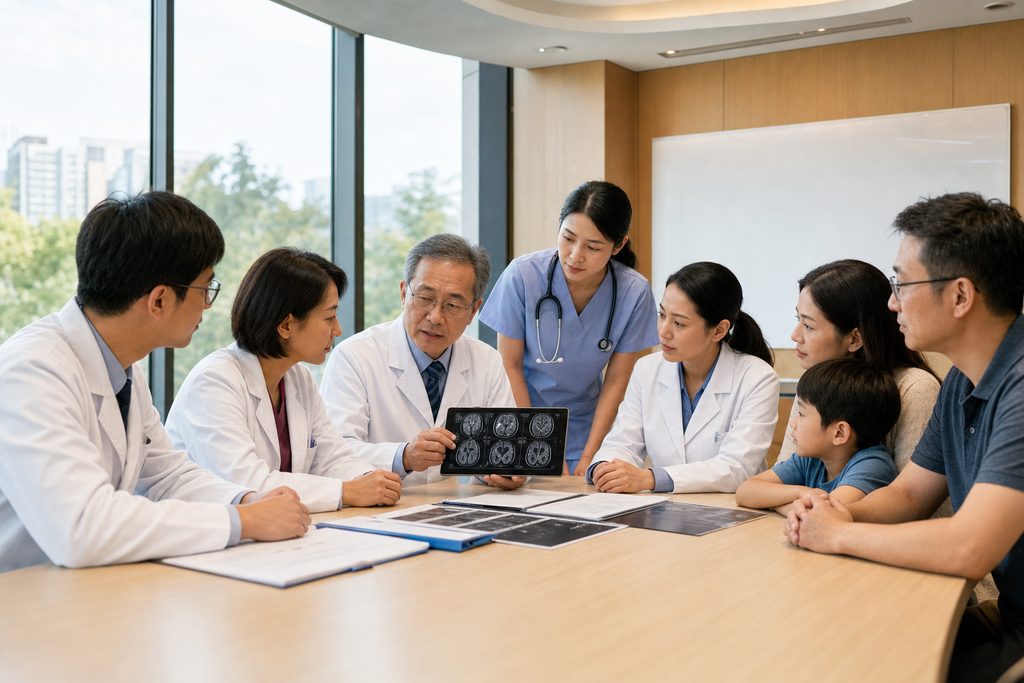
Your child has been diagnosed. You have seen one oncologist. Then another. Maybe a surgeon. Each gives you a slightly different version of what should happen next. It is exhausting. And terrifying. A pediatric oncology tumor board cuts through that noise. It is not a single doctor making a call. It is a room of specialists — pediatric oncologists, radiation oncologists, surgical oncologists, pathologists, radiologists, geneticists, and sometimes psychologists or palliative care experts — reviewing your child’s case together. All at once. They argue. They compare imaging. They examine pathology slides. And they emerge with one plan. Not three plans. One.
This approach matters enormously for childhood cancers. Pediatric malignancies are biologically different from adult cancers. A neuroblastoma behaves nothing like a lung carcinoma. Treatment protocols differ. Dosing differs. The long-term survivorship considerations — growth, fertility, cognitive development — differ. A general tumor board that handles adult cases will miss these nuances. You need a dedicated pediatric team.
Our team at China Medical Services has coordinated pediatric tumor board reviews for families from over a dozen countries. We do not treat your child. We are not doctors. We are the people who make sure the right specialists are in the same room, your child’s records are translated and complete, and you understand every word of the discussion.
The Problem: Fragmented Care When Your Child Cannot Afford Fragmentation
Childhood cancer is uncommon. That is the good news and the bad news. Approximately 1 in 285 children in the United States will be diagnosed with cancer before age 20, according to the American Childhood Cancer Organization. Because cases are relatively rare outside of major academic centers, many families find themselves shuttling between providers who do not communicate well. A surgeon at one hospital recommends immediate resection. An oncologist at another prefers neoadjuvant chemotherapy first. Nobody is coordinating. And the clock is ticking.
This is where the pediatric oncology tumor board cost China conversation becomes relevant. In the US healthcare system, a formal multidisciplinary tumor board review at a major cancer center can cost $5,000 to $12,000 in professional fees alone. Insurance may cover part of it. Or it may not. For international families without US insurance, the price is often prohibitive. Meanwhile, wait times for a coordinated pediatric oncology consultation at top US centers can stretch to four or six weeks. Some families do not have four weeks.
China offers a structurally different option. The country’s top-tier children’s hospitals run tumor boards weekly. Some run them daily for complex cases. The volume is staggering. Shanghai Children’s Medical Center and Beijing Children’s Hospital each manage thousands of new pediatric cancer cases annually. That volume translates into pattern recognition — specialists who have seen your child’s rare tumor subtype multiple times, not just once in a career.
Who We Are
We are not a hospital. We do not provide medical treatment, make clinical diagnoses, or recommend specific therapies. We are your logistical architects — a team of bilingual case managers who bridge the gap between your family and China’s top-tier pediatric oncology expertise. We translate medical records, coordinate with hospital international departments, schedule tumor board reviews, arrange bilingual companions for every appointment, and handle the visa guidance and accommodation logistics that make treatment abroad possible. Our database covers 340+ top-ranked hospitals across 37 cities. We know which centers have dedicated pediatric oncology tumor boards, which run them in English, and which have experience treating international children. That knowledge comes from years of doing this work, not from a brochure.
Why a Pediatric Tumor Board in China Delivers Results
Clinical Volume Builds Expertise That Rare Cases Demand
Here is a number that matters: a top Chinese pediatric oncology center may treat 400 to 600 new childhood cancer cases per year. By comparison, many respected US children’s hospitals outside the top five cancer centers treat 100 to 200 new cases annually. For common diagnoses like acute lymphoblastic leukemia, the protocols are well-established everywhere. But for a rare sarcoma or an atypical teratoid rhabdoid tumor, volume matters enormously. A specialist who sees twenty cases of a rare tumor builds a different level of judgment than one who sees two.
Chinese pediatric oncologists also publish extensively. A search of PubMed for pediatric oncology research originating from Shanghai, Beijing, and Guangzhou shows thousands of indexed papers over the past decade. These are not isolated practitioners. They participate in global clinical trial networks and contribute to protocols used worldwide. When you ask about the child cancer specialist team Shanghai price, you are not just buying a meeting. You are buying access to clinicians whose experience base is built on caseloads that most Western centers cannot match.
Structural Efficiency That Cuts Wait Times
American and European hospitals schedule tumor boards around academic calendars, administrative meetings, and individual surgeon availability. It can take two to three weeks just to get all the required specialists on the same calendar. In China’s top public hospitals, tumor boards are institutionalized. They happen on fixed schedules — every Tuesday afternoon, every Thursday morning — and attendance is mandatory for department leads. If a case is urgent, an ad hoc board can be convened within 48 hours.
This is not magic. It is a system designed for throughput. Chinese public hospitals serve enormous populations. They have to be efficient. For an international family, that efficiency means a pediatric oncology tumor board cost China that reflects operational speed, not inflated professional fees. The board review itself typically costs $1,500 to $2,000 through a hospital’s international department. That includes record translation, multi-specialist review, and a written treatment plan in English.
Cost Advantage Without Quality Compromise
Let us address the elephant in the room. Many Western families hear “medical treatment in China” and think “cheaper must mean worse.” That assumption is wrong. The cost difference exists for structural reasons, not quality reasons. Chinese specialist physicians earn salaries that are high by local standards but far lower than US physician compensation. Hospital infrastructure, while modern and well-equipped, is amortized across massive patient volumes. Malpractice insurance costs are a fraction of what US doctors pay. None of these factors reflect clinical capability.
To put numbers on it: a comprehensive pediatric oncology tumor board review with a written multi-specialist treatment plan in China costs $1,500 to $2,000. The same multidisciplinary review at a major US cancer center often runs $8,000 to $15,000 in professional fees before any treatment begins. The actual cancer treatment — chemotherapy, surgery, radiation — costs 70% to 90% less in China than in the United States. A course of pediatric chemotherapy that runs $100,000 in the US might cost $15,000 to $25,000 at a top Chinese hospital. These are real numbers that change what is possible for families facing catastrophic medical costs.
How Does a Pediatric Tumor Board Work in China
The process is straightforward but requires local coordination. First, your child’s complete medical records — pathology reports, imaging studies on CD or cloud link, surgical notes, genetic testing results — are translated into Chinese by a medical translator. This step is critical. A mistranslated pathology term can derail the entire discussion. Our team handles this with translators who specialize in oncology terminology.
Next, the records are submitted to the hospital’s international department, which schedules the case for the next available tumor board. The board convenes. Radiologists review the scans on high-resolution monitors. Pathologists present the slides. Surgeons discuss resectability. Oncologists weigh chemotherapy and targeted therapy options. A pediatrician addresses supportive care needs. The discussion lasts 20 to 45 minutes per case. Within 48 hours, the family receives a written summary in English — the unified treatment recommendation, with staging, proposed protocol, and expected timeline.
If the family decides to proceed with treatment in China, the hospital’s international department coordinates admission, surgery scheduling, and chemotherapy cycles. If the family prefers to take the plan back to their home country for implementation, that is entirely their choice. The tumor board opinion belongs to them. There is no obligation to treat in China.
This answers the question how does pediatric tumor board work in China — it works through institutionalized multidisciplinary review, not ad hoc phone calls between colleagues. The structure is built into the hospital’s operations.
Is China Good for Childhood Cancer Treatment
Parents ask this with fear in their voices. They have read headlines about food safety and air quality. They wonder if the medical care is legitimate. The honest answer: at China’s top-tier pediatric cancer centers, the care is excellent and outcomes are comparable to Western benchmarks. But — and this is crucial — you must be at a top-tier center. Not a provincial hospital. Not a small private clinic. The institutions that appear on the Fudan Hospital Ranking’s pediatric oncology specialty list. These are the hospitals that run rigorous tumor boards, follow international protocols, and publish in peer-reviewed journals.
Survival rates for common childhood cancers at these centers tell the story. For acute lymphoblastic leukemia, five-year survival at Shanghai Children’s Medical Center exceeds 85%, in line with outcomes from St. Jude Children’s Research Hospital and major European centers. For Wilms tumor and retinoblastoma, outcomes are similarly strong. The gap, where it exists, is in access to the very newest targeted therapies and immunotherapies — CAR T-cell therapy for pediatric ALL is available in China, but the range of approved indications may be narrower than in the US. A good tumor board will tell you honestly what is available and what is not.
So is China good for childhood cancer treatment? At the right hospital, with the right coordination, yes. It is not a universal yes. It depends entirely on the institution and the specific diagnosis. That is why the tumor board review matters so much — it gives you a clear-eyed assessment before you commit to travel.
What You Need to Know Before Going Alone
Some families try to arrange this independently. We understand the instinct to save money. But going alone into China’s hospital system with a sick child and no Mandarin is brutally difficult. Here is what you face:
- Visa Requirements: Medical treatment in China requires an S2 visa with a notation specifying the medical purpose. The application requires an invitation letter from the treating hospital, proof of appointment, and documentation of the patient’s condition. Hospitals will not issue invitation letters without a confirmed consultation. You cannot get the visa without the letter. You cannot get the letter without local coordination. It is a closed loop. Parents and accompanying family members also need S2 visas. M visas are for business — they will be rejected for medical travel.
- Hospital Registration Systems: Chinese public hospitals do not accept online appointments from overseas patients for standard outpatient clinics. You cannot book a specialist visit from abroad through a website. Registration happens on the day, in person, often through a mobile app that requires a Chinese phone number and ID. The international department is the only pathway for pre-arranged care, and not every hospital has one that handles pediatric oncology.
- Medical Records and Language: Your child’s records must be professionally translated into Chinese. Google Translate will not suffice for a pathology report. One wrong word — confusing “blastoma” for “carcinoma” — and the tumor board is reviewing the wrong diagnosis. Bilingual companions are essential for every appointment, every scan, every discussion of results.
How We Help You Navigate This
These barriers are real. They exist for structural reasons, not malice. Chinese hospitals serve a billion-plus domestic population first. International patients are a tiny fraction of their volume. The systems are not built for you. That is why we exist.
We start with a free consultation. You tell us about your child’s diagnosis, what records you have, and what you need — a tumor board review, a second opinion, or full treatment coordination. We identify the hospitals with the strongest pediatric oncology programs for that specific diagnosis. We contact the international departments, confirm tumor board availability, and get a timeline. We handle record translation. We guide you through the S2 visa process, providing the invitation letter and appointment confirmation you need. When you arrive, a bilingual medical companion meets you at the airport, accompanies you to every appointment, translates every conversation, and ensures you understand every recommendation.
The international child cancer treatment package Beijing or Shanghai typically includes the tumor board review, treatment coordination, inpatient admission support, and ongoing bilingual accompaniment throughout treatment. Costs vary by hospital and case complexity, but a full coordination package for a course of pediatric cancer treatment generally runs from $5,000 to $8,000 in service fees, separate from hospital charges. Any consultation fee paid — including the tumor board review — is credited in full toward the coordination service if you proceed with treatment within 90 days. That means the initial consultation effectively costs nothing if you move forward.
To book pediatric oncology consultation China, the process begins with a conversation. We need to understand the diagnosis, the records available, and the family’s timeline before we can recommend a specific hospital or provide a firm cost estimate. There is no online shopping cart for this. Every case is different.
Frequently Asked Questions
A multidisciplinary pediatric tumor board review through a top-tier Chinese hospital’s international department typically costs between $1,500 and $2,000. This includes medical record translation, multi-specialist review, and a written treatment plan in English. The fee is credited in full toward any subsequent treatment coordination service if you proceed within 90 days. Hospital treatment costs are separate and vary significantly by diagnosis and protocol.
Yes. The tumor board opinion and treatment plan belong to you. Many families use it to inform treatment decisions with their home-country oncologists. There is no obligation to receive treatment in China. The written plan includes staging, proposed protocols, drug names and dosages, surgical recommendations, and expected timelines — all in English, formatted to be shared with your local medical team.
This happens occasionally, particularly with the newest CAR T-cell constructs or targeted therapies approved only in the US or Europe. A reputable tumor board will tell you honestly if the recommended treatment is unavailable locally. They will then propose the best available alternative in China or recommend treatment abroad. The board’s job is to give the best medical advice, not to sell Chinese hospital services. We have seen boards recommend that families pursue treatment in the US or Europe when that was clearly the better option.
With complete medical records ready for translation, the process typically takes 10 to 14 days. Record translation takes two to three business days. Scheduling the tumor board depends on the hospital’s fixed schedule — usually within a week of submission. The written report follows within 48 hours of the board meeting. Urgent cases can be expedited; we have seen the entire process compressed into five days when the clinical situation demanded speed.
Many do, especially at the major international departments in Shanghai and Beijing. Tumor board discussions are conducted in Chinese, but the international department provides English-language summaries and will arrange for an English-speaking oncologist to discuss the findings with the family. Our bilingual medical companions are present throughout to ensure nothing is lost in translation. You will never be in a room where you cannot understand what is being said about your child.
Your Next Step
A childhood cancer diagnosis fractures your world. The last thing you need is to navigate a foreign healthcare system alone while carrying that weight. A pediatric oncology tumor board in China offers something rare: a room full of specialists focused entirely on your child’s case, producing one unified plan, at a cost that does not exhaust your family’s resources. The expertise is real. The outcomes are documented. The path exists. You just need someone who knows the way.
If you want to understand whether a Chinese pediatric tumor board makes sense for your child’s specific diagnosis, start with a conversation. There is no cost for that. No commitment. Just honest answers about what is possible. Reach out to our team and tell us about your child. We will take it from there.
For more medical information and treatment options in China, visit chinamedservices.com (China Medical Services).
