Pediatric Radiology Second Opinion China: Fast Subspecialist Imaging Review for Your Child
Key Takeaways
- A written second opinion from a Chinese pediatric radiology subspecialist typically costs $300–500, a fraction of what a comparable review costs in the US or UK.
- China’s top children’s hospitals handle imaging volumes that dwarf most Western centers — a pediatric neuroradiologist at a major Shanghai or Beijing hospital may read over 15,000 pediatric brain MRIs annually.
- Language barriers and hospital bureaucracy make going it alone nearly impossible. You need someone on the ground who speaks the system’s language.
- A second opinion is not a prescription. It is a detailed imaging report that you take back to your home physician for clinical decisions.
The Problem: Your Child’s Scan Deserves a Second Pair of Eyes, but the Wait Is Agonizing
You are holding a CD with your child’s brain MRI on it. Or a CT of their abdomen. The radiologist’s report is filled with words like “cannot exclude” and “clinical correlation recommended.” You have questions. Big ones. But the next available pediatric radiology subspecialist appointment in your home country is four months away. You lie awake at night wondering if that tiny shadow on the scan is growing while you wait.
This is not an abstract fear. A 2023 study published in Pediatric Radiology found that discrepancies between general radiologists and pediatric subspecialists occur in approximately 30% of pediatric imaging cases, with roughly 15% classified as clinically significant — meaning they could change the treatment plan. Your child’s case deserves that second look. But the system is stacked against speed.
The American College of Radiology reports a worsening shortage of pediatric radiologists across North America. Many community hospitals have zero dedicated pediatric imagers on staff. Your child’s scan was likely read by a general radiologist who splits their day between adult strokes, geriatric fractures, and the occasional pediatric case. That is not incompetence. It is a bandwidth problem. And it leaves gaps.
Who We Are
In many Western healthcare systems, a “pediatric radiologist” covers everything — neuro, body, musculoskeletal, cardiac. At China’s major children’s hospitals, subspecialization runs deep. You will find dedicated pediatric neuroradiologists who read only brain and spine cases. Pediatric chest imagers who focus exclusively on congenital lung lesions and airway disorders. Pediatric musculoskeletal radiologists who have seen more cases of Langerhans cell histiocytosis in a year than most generalists see in a career.
This matters when you are searching for a children’s imaging specialist review online China-based option. You are not getting a general read. You are getting a focused expert who lives and breathes one narrow slice of pediatric imaging. If your child has a posterior fossa tumor, you want the neuroradiologist who has characterized over 1,000 of them — not the general pediatric radiologist who sees five per year.
The Cost Advantage Is Structural, Not a Quality Trade-Off
Let us address the elephant in the room directly. A pediatric radiology second opinion cost China falls in the $300–500 range for a written report from a top-tier subspecialist. A comparable second opinion from a major US academic center typically runs $1,500–3,000. In the UK, private pediatric radiology reviews start around £800–1,200.
Why the difference? It is not about quality. Chinese radiologists at Fudan-ranked hospitals train in internationally recognized programs, many with fellowships in North America or Europe. The cost gap exists because of structural economics — lower labor costs, higher patient volumes that spread fixed costs, and hospital systems designed for throughput efficiency. You are paying for expertise, not marble lobbies.
Is pediatric teleradiology from China reliable? This question deserves a straight answer. The imaging review itself is as reliable as the radiologist performing it. The key variable is not geography — it is credentialing. Our network includes only radiologists practicing at hospitals ranked in the Fudan University Hospital Rankings, specifically those in the pediatric specialty top 10. These are institutions where diagnostic standards are audited, peer review is mandatory, and misdiagnosis rates are tracked. The reliability question is really a credentialing question. And that is where a good intermediary earns its keep.
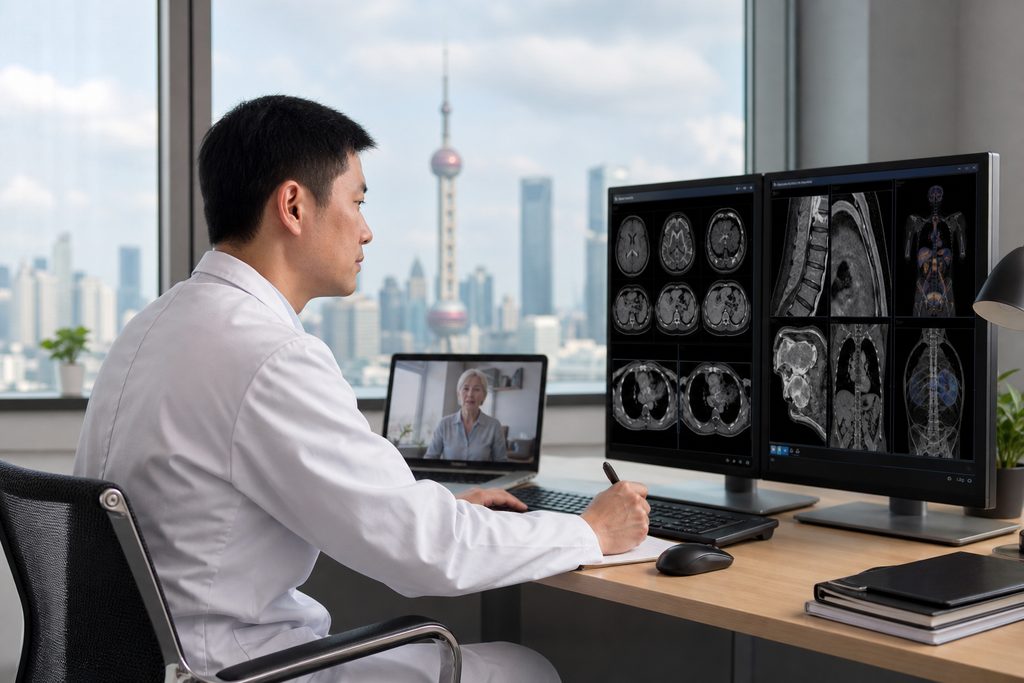
How the Process Works: From Your Desktop to a Subspecialist’s Workstation
Getting a second opinion on your child’s imaging from China is not complicated — if you know the right doors to knock on. Here is what the workflow looks like when handled properly.
First, you upload the DICOM files. Not JPEGs. Not screenshots from the patient portal. The full-resolution DICOM dataset from the CD or USB drive the imaging center gave you. This is non-negotiable. A radiologist cannot make a meaningful assessment from compressed images. Our team provides secure upload instructions and verifies file integrity before anything moves forward.
Second, we translate and prepare your child’s clinical summary. This is not Google Translate. A bilingual case manager with medical terminology training compiles the relevant history — age, symptoms, prior diagnoses, specific clinical questions you want answered — into a structured document that the Chinese radiologist can read alongside the images. Context matters. A small cerebellar lesion means something different in a child with known neurofibromatosis type 1 than in a previously healthy child.
Third, the case is routed to the appropriate subspecialist. If you need to send your child’s CT scan for expert review China price inquiry turns into an actual case, we match the scan type to the right reader. Chest CT goes to a pediatric thoracic imager. Brain MRI with spectroscopy goes to a neuroradiologist with neuro-oncology focus. This matching step is where generalist platforms fail and specialist networks deliver.
The written report comes back in English. It addresses your specific clinical questions. It notes any discrepancies with the original read. It suggests additional sequences or imaging modalities if indicated. And it carries the name and institutional affiliation of the reviewing radiologist — full accountability, no anonymous reads.
What You Need to Know Before Going Alone
Trying to arrange this yourself — emailing hospital international departments, navigating Chinese hospital websites, sending files through unsecured channels — is a recipe for frustration. Here is what stands in your way.
- Hospital gatekeeping: China’s top public hospitals do not accept direct overseas imaging review requests from individuals. Their international departments handle inbound inquiries, but response times are measured in weeks, not days. Many inquiries go unanswered. The system is not built for direct consumer access.
- Language and medical terminology: Even if you reach someone, explaining that your child has a “suspected dysembryoplastic neuroepithelial tumor in the left temporal lobe” requires precise medical translation. A single mistranslated term can send the case to the wrong subspecialist — or worse, lead to a misinterpretation.
- Payment and data security: Chinese hospitals do not accept foreign credit cards for remote services. Wire transfers are slow and opaque. And emailing DICOM files through unencrypted channels violates data protection principles that any responsible parent should care about.
How We Help You Navigate This
These barriers are real. They exist for structural reasons, not malice. And each one has a workaround — if you have the right team.
We pre-vet the hospitals and radiologists. We handle the secure file transfer through encrypted channels that meet international data protection standards. We translate your child’s clinical history with medical precision. We route the case to the correct subspecialist based on the imaging modality and clinical question — not based on whoever happens to be available. And we deliver the English-language report to your inbox, typically within 5–7 business days.
If you later decide to travel to China for in-person consultation or treatment, the second opinion fee is credited in full toward our on-the-ground coordination service. That is a one-time credit, applied to the coordination fee only — never to hospital treatment charges. It means you are not paying twice for expertise.
For families researching how to get a second opinion on my child’s MRI from China, the path exists. It requires navigating credentialing, language, payment, and data security. We handle those four things so you can focus on the one thing that matters: understanding your child’s imaging results and making informed decisions.
Frequently Asked Questions
How do I know the reviewing radiologist is genuinely qualified?
Every radiologist in our network practices at a hospital ranked in the Fudan University Hospital Rankings for pediatrics. These are institutions where diagnostic accuracy is audited and peer review is mandatory. The final report includes the radiologist’s full name and hospital affiliation. You can verify their credentials independently. We encourage it.
What if the Chinese second opinion contradicts my local radiologist’s report?
This happens in roughly 15–30% of cases, depending on the complexity of the imaging and the subspecialty gap between the original reader and the reviewing expert. A discrepancy is not a verdict — it is information. You take both reports to your child’s treating physician and discuss the differences. Sometimes the second opinion catches something the first reader missed. Sometimes it confirms the original read and gives you peace of mind. Either outcome has value.
Can I get a video consultation with the radiologist instead of just a written report?
Yes. A video consultation with the reviewing radiologist, conducted through a bilingual interpreter, costs $500–800. This allows you to ask follow-up questions and hear the findings explained in plain language. Many parents find this more reassuring than a written report alone. The video session is recorded and you receive the recording afterward.
What is the turnaround time — and what if I need it faster?
Standard turnaround is 5–7 business days from the time we receive complete, usable DICOM files and the translated clinical summary. Rush processing — 48–72 hours — is available for an additional $150. We do not promise same-day reads. A careful subspecialist review takes time, and rushing it serves no one.
Is my child’s medical data secure when sent to China?
We transfer all imaging files through end-to-end encrypted channels that comply with GDPR and HIPAA-equivalent standards. Files are stored on secure servers with access limited to the case manager and the reviewing radiologist. After the report is delivered, imaging data is deleted from our systems within 90 days unless you request otherwise. We take data protection seriously — because we are parents too.
Your Next Step
A second opinion on your child’s imaging is not an admission of doubt in your current medical team. It is a responsible step in a high-stakes situation. China’s pediatric radiology subspecialists offer world-class expertise at a cost that makes a second look accessible — not a luxury reserved for those who can afford the $3,000 academic center review. The key is working with someone who can open the right doors and ensure the process runs cleanly from upload to report delivery. If you are ready to move forward, our team is here to walk you through it — no pressure, no rush, just clear answers and a clear path.
Contact our team for a free consultation about your child’s case. We will help you understand your options, including which subspecialist is the right match for the imaging study you have in hand.
For more medical information and treatment options in China, visit chinamedservices.com (China Medical Services).
