Peking University Stomatology Beijing: China’s Top Center for Dental Implants & Oral Surgery
When 42-year-old Sarah from London started losing bone in her jaw after a failed bridge, her UK dentist laid out the options. A full-arch restoration with six implants per jaw. The quote stopped her cold: £28,000 for one arch. She needed two. That was a new car sitting in her mouth, and her insurance would cover none of it. Somebody at a dinner party mentioned China. She laughed. Then she Googled it at 2 a.m.
She found Peking University Stomatology Hospital in Beijing. The name kept surfacing in research journals, international conference proceedings, and patient forums. Not as a budget alternative. As the place where complex cases get solved when local options run dry.
That search brought her to us.
Key Takeaways
- Peking University Stomatology Hospital is consistently ranked China’s #1 dental institution, performing over 1.1 million outpatient visits and 55,000+ inpatient surgeries annually across its branches.
- Full-mouth dental implant restorations in China typically cost 60–75% less than comparable treatment in the US or UK, with the Peking University Stomatology dental implant cost reflecting its position as the nation’s premier teaching hospital.
- International patients cannot simply walk in and book surgery. The hospital’s public outpatient system requires in-person registration and a face-to-face consultation before any surgical scheduling — a process that is nearly impossible to navigate without Mandarin fluency.
- Working through the hospital’s official International VIP channel is the only reliable path for overseas patients to secure pre-arranged consultations and surgery dates with senior specialists.
The Problem: Advanced Dental Restoration Costs Are Breaking Patients in the West
Dental implants have become the gold standard for tooth replacement. The American Academy of Implant Dentistry reports that approximately 3 million Americans have implants, with that number growing by 500,000 each year. The clinical success rate hovers around 95–98% over 10 years. The problem is not the technology. It is the price tag.
A single implant in the United States runs $3,000 to $6,000, including the abutment and crown. A full-arch restoration using the All-on-4 or All-on-6 technique lands between $24,000 and $50,000 per jaw. In the UK, the figures are comparable: £2,000–£4,000 per implant, with full-mouth cases easily crossing £50,000. Dental tourism to Hungary, Thailand, and Mexico has exploded precisely because these numbers are unsustainable for most households.
But here is what gets lost in the cost conversation. Complex oral surgery — the kind involving zygomatic implants, extensive bone grafting, or reconstruction after tumor resection — requires more than a competitive price. It demands a surgical team that sees these cases daily. Not monthly. Daily.
That is where volume becomes a quality metric.
Who We Are
We are not a hospital. We do not provide dental treatment, clinical diagnoses, or medical advice of any kind. China Medical Services is a medical concierge organization that connects international patients with China’s top-tier hospitals — 340+ institutions across 37 cities, all ranked in the top 5% of China’s 35,000+ hospitals by the Fudan University hospital rankings and JCI accreditation standards. We handle the logistics: hospital matching, appointment coordination through official International VIP channels, bilingual medical companion services, visa guidance, and travel support. Think of us as your local fixers in a system that was never designed for foreign patients. We bridge that gap.
Why Peking University Stomatology Hospital Delivers Results
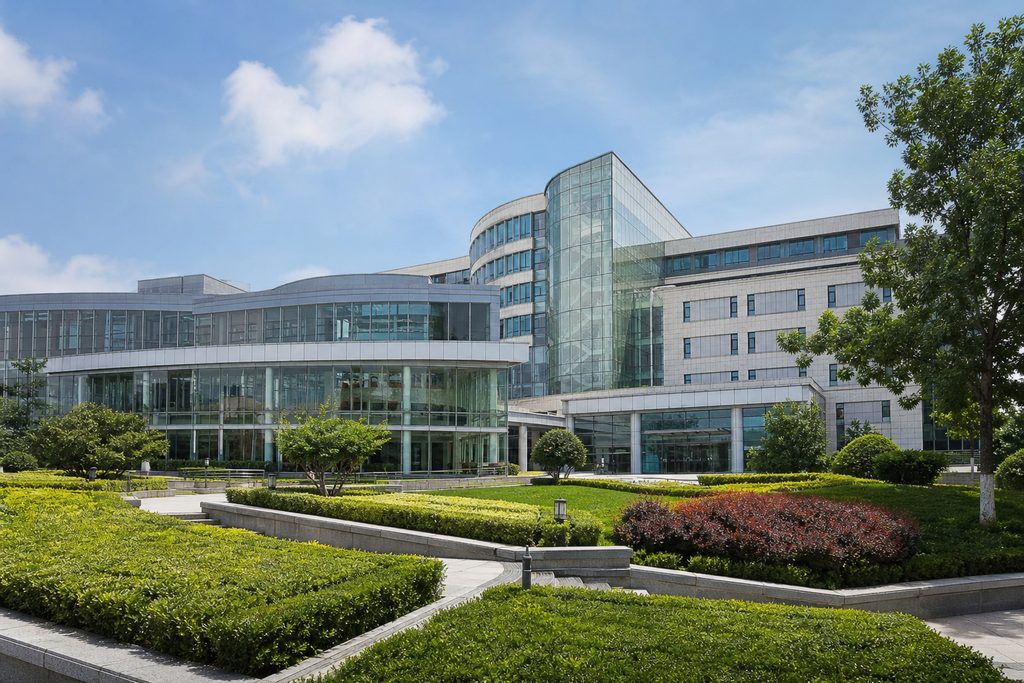
Peking University Stomatology Hospital — often referred to by its Chinese acronym PKUSS — is not just another dental school clinic. It is the national center for dental and maxillofacial surgery in China, a designation that carries weight in a country of 1.4 billion people. Founded in 1941, the hospital now operates multiple branches across Beijing, with its main campus in Haidian District serving as both a teaching hospital for Peking University’s School of Stomatology and a tertiary referral center for the most complex oral and maxillofacial cases in the country.
The numbers tell the story. The hospital handles over 1.1 million outpatient visits annually and performs more than 55,000 inpatient surgeries. Its dental implant department alone places thousands of fixtures each year, drawing patients from across China and increasingly from abroad. For context, a busy private implant clinic in the US might place 500–1,000 implants per year. The scale difference is not marginal. It is structural.
Clinical Volume Drives Surgical Precision
There is a well-documented relationship between surgical volume and patient outcomes. A 2017 study published in the Journal of Oral and Maxillofacial Surgery found that surgeons performing more than 50 implant placements annually had significantly lower complication rates than lower-volume practitioners. At PKUSS, senior implant surgeons place hundreds of implants per year. Some have placed tens of thousands over their careers.
This matters most in difficult cases. Patients with severe bone atrophy requiring sinus lifts, ridge splits, or zygomatic implants. Patients who have failed previous implant attempts. Patients undergoing full-mouth rehabilitation after years of periodontal disease. These are not straightforward cases. They demand intraoperative judgment that only comes from repetition. When you ask is Peking University Stomatology good for oral surgery, the answer is embedded in the case logs: the hospital’s oral and maxillofacial surgery department is one of the busiest in the world, handling trauma reconstruction, tumor resection with free flap repair, orthognathic surgery, and temporomandibular joint disorders at volumes unmatched outside of a handful of global centers.
Technology Infrastructure at Scale
PKUSS operates its own digital dentistry center equipped with intraoral scanners, cone-beam computed tomography (CBCT), computer-aided design and manufacturing (CAD/CAM) systems, and 3D printing capabilities for surgical guides and provisional restorations. What distinguishes the setup is not the equipment list — many Western clinics have similar tools. It is the integration across departments.
A patient needing full-arch implants moves through a coordinated workflow: CBCT imaging and intraoral scanning on day one, virtual implant planning with the prosthodontist and surgeon reviewing the case together, 3D-printed surgical guides fabricated in-house, and immediate-load provisional prostheses delivered within 24–48 hours of implant placement. The hospital’s in-house dental laboratory — one of the largest in Asia — eliminates the multi-week outsourcing delays common in smaller practices.
Cost Structure: Why Peking University Stomatology Dental Implant Cost Is Lower
Let us address the obvious question directly. The Peking University Stomatology dental implant cost is substantially lower than Western equivalents, and the reasons are structural rather than qualitative. Labor costs for highly skilled dental technicians and surgical staff in China are lower than in the US or Europe. Hospital overhead is distributed across enormous patient volumes. Implant components — many manufactured by the same global suppliers (Straumann, Nobel Biocare, Dentsply Sirona) used in Western clinics — are priced competitively in the Chinese market due to bulk procurement and local distribution networks.
Here is what international patients can expect to pay through the hospital’s International VIP channel:
| Procedure | Estimated Cost (USD) at PKUSS International VIP | Comparison: US Average |
|---|---|---|
| Single implant (including abutment + crown) | $1,200 – $2,500 | $3,000 – $6,000 |
| All-on-4 full-arch restoration (per jaw) | $8,000 – $14,000 | $24,000 – $50,000 |
| All-on-6 full-arch restoration (per jaw) | $10,000 – $16,000 | $28,000 – $55,000 |
| Zygomatic implant (per implant, complex atrophy cases) | $3,000 – $5,000 | $8,000 – $15,000 |
| Sinus lift bone graft (per side) | $800 – $1,500 | $2,500 – $5,000 |
These are reference ranges — not fixed quotes. Every case differs. Bone quality, implant brand selection, the need for adjunctive procedures, and the treating surgeon’s seniority all influence the final figure. The Peking University dental hospital international patient price is quoted after a clinical review of your CT scans and medical history, never before. Anyone promising an exact price sight unseen is not being honest with you.
When patients ask how much are full mouth dental implants in China, the honest answer is: $16,000 to $32,000 for both arches at a top-tier teaching hospital, compared to $48,000 to $100,000 in the United States. The savings are real. But they come with logistical complexity that must be managed carefully.
What You Need to Know Before Going Alone
We tell every prospective patient the same thing: the clinical care at PKUSS is world-class. The administrative experience, if you attempt it solo, is not. The hospital was built to serve China’s domestic population, and its systems reflect that reality.
- Language Barrier: English proficiency among clinical staff varies. Senior surgeons often read and publish in English-language journals, but the nursing staff, registration desks, billing counters, and pharmacy windows operate exclusively in Mandarin. Informed consent forms, post-operative instructions, and medication labels are in Chinese. Misunderstanding a post-surgical care instruction is not a minor inconvenience — it is a clinical risk.
- Registration and Scheduling: The hospital’s public outpatient system does not accept advance bookings from overseas. You show up at 6 a.m., queue for a registration ticket, and hope the specialist you need is available that day. Even then, you are booking a consultation — not a surgery date. Surgery scheduling happens only after the face-to-face consultation, and it may be weeks or months out depending on the surgeon’s calendar.
- Payment and Insurance: The hospital requires prepayment for surgical procedures. International insurance with direct billing arrangements is rarely accepted in the public system. You pay upfront and seek reimbursement later. WeChat Pay and Alipay dominate — international credit cards are not reliably accepted at every payment counter.
- Visa Requirements: Medical treatment in China requires an S2 visa (short-term, up to 180 days) or an S1 visa (long-term, over 180 days). Accompanying family members also need S2 visas. An M visa — the business visa — is not valid for medical treatment. The application requires an invitation letter from the treating hospital, which PKUSS can provide, but only after confirming your treatment plan.
Important: Attempting to book oral surgery at Peking University Stomatology Beijing without Mandarin fluency and local logistical support is not merely difficult — it is likely to fail. We have seen patients arrive in Beijing with no appointment, no translator, and no plan, only to discover they cannot even register for a consultation. The hospital is not set up to hand-hold international patients through its public system. That is not a criticism. It is a structural fact.
How We Help You Navigate This
Our role is to convert a chaotic, language-barrier-laden process into a structured, predictable treatment journey. We do this through the hospital’s official International VIP channel — not a backdoor, not a workaround, but the legitimate pathway the hospital itself has created for overseas patients.
Here is how it works in practice. Before you ever board a plane, we collect your dental records, panoramic X-rays, CBCT scans, and a detailed treatment summary from your home dentist. Our bilingual case managers translate these documents into clinical Chinese and submit them to the International VIP department at PKUSS. The hospital’s implant team reviews your case and provides a preliminary treatment plan with a cost estimate. This takes 5–10 business days.
If you decide to proceed, we coordinate a confirmed consultation date with a senior implant surgeon — not a junior resident, not a rotating fellow. The surgeon who reviews your case is the surgeon who will operate. We arrange your S2 visa invitation letter, recommend accommodations within walking distance of the hospital, and schedule airport transfers.
On the day of your consultation, a bilingual medical companion meets you at the hospital entrance. This person handles registration, guides you to the correct department, translates your conversation with the surgeon in real time, and ensures you understand every aspect of the proposed treatment plan — risks, alternatives, recovery timeline, and costs. Nothing is lost in translation because nothing is left to chance.
If surgery is scheduled, your companion remains with you through admission, pre-operative preparation, the procedure day, and post-operative discharge instructions. We handle pharmacy runs, follow-up appointment scheduling, and communication with the hospital’s billing department. When you return home, we facilitate remote follow-up consultations with your surgeon via video call — a service included in our coordination package. Should you need a written second opinion or remote video consultation before committing to travel, we arrange that too, with fees starting from $300 for a standard international department consultation and ranging to $800 for a top-specialist video session. Any consultation fees are fully credited toward on-the-ground coordination if you proceed to treatment within 90 days.
Frequently Asked Questions
PKUSS employs multiple senior implant surgeons with international training backgrounds and decades of experience. Rather than naming individual doctors — which would be misleading since the best dental implant surgeon Beijing China depends entirely on your specific clinical needs — we match patients to the surgeon whose subspecialty aligns with their case. Zygomatic implants, for instance, require a different skill set than straightforward single-tooth replacements. Our case managers review your records and recommend the appropriate specialist within the PKUSS faculty. The hospital’s implant department includes professors who train the next generation of Chinese oral surgeons and who regularly present at international conferences. You are not getting a general dentist who took a weekend implant course. You are getting a career implant surgeon at a national teaching hospital.
Plan for two trips. The first trip typically requires 10–14 days: initial consultation, pre-operative imaging, implant placement surgery, and delivery of immediate-load provisional teeth. You return home to heal for 4–6 months while osseointegration occurs. The second trip lasts 7–10 days for final impressions and delivery of the definitive prosthesis. Some patients combine the initial consultation and surgery into one trip if their case is straightforward and the surgeon’s schedule permits. Complex cases involving bone grafting or zygomatic implants may require a longer first stay. We coordinate all scheduling with the hospital before you book flights.
PKUSS provides a warranty on implant fixtures (typically covering manufacturer defects) and a guarantee period on prosthetic work. If a complication arises — implant failure, prosthetic fracture, peri-implantitis — we facilitate a remote video consultation with your surgeon to assess the situation. Minor prosthetic issues can often be addressed by a local dentist following instructions from the PKUSS team. If revision surgery is required, we coordinate your return to Beijing and work with the hospital to prioritize your case. We cannot eliminate surgical risk — no honest provider would claim that — but we ensure you are not abandoned once you leave China. Our relationship with the hospital’s International VIP department means you have a direct line back to your surgical team.
The implant systems used at PKUSS — Straumann, Nobel Biocare, Dentsply Sirona, and leading domestic brands approved by the China National Medical Products Administration — are the same global manufacturers supplying clinics in the US, UK, and Europe. The hospital’s in-house dental laboratory uses CAD/CAM milling and sintering systems from German and Swiss manufacturers. The difference is not in the hardware. It is in the surgical volume and the cost structure. You are receiving implant components with international regulatory approval, placed by surgeons who do this all day, every day, at a price that reflects Chinese rather than Western healthcare economics.
Your Next Step
Peking University Stomatology Hospital represents a genuine option for patients facing prohibitive dental restoration costs at home — not a discount clinic, but China’s premier academic dental center with surgical volumes that few Western institutions can match. The Peking University Stomatology dental implant cost makes complex oral rehabilitation financially accessible without compromising on the quality of surgical care or prosthetic materials. But accessing that care requires navigating a system that was not designed for foreign patients. That is what we do.
If you are considering dental implant treatment in China, start with a conversation — not a commitment. Send us your records. We will translate them, submit them to the PKUSS International VIP team, and return with a preliminary assessment and cost estimate. From there, you decide whether to move forward. There is no pressure and no obligation. Just clarity in a process that is otherwise opaque. Request your free consultation today and let us show you what is possible.
For more medical information and treatment options in China, visit chinamedservices.com (China Medical Services).
