Pituitary Tumor Surgery in China: Inside Shanghai Huashan Hospital’s Neuro-Endoscopy Complex
Key Takeaways
- Shanghai Huashan Hospital performs over 3,000 neuro-endoscopic procedures annually, making it one of the highest-volume pituitary surgery centers globally.
- The total pituitary tumor surgery cost at Shanghai Huashan Hospital typically runs $18,000–$28,000 USD for international patients, roughly one-fifth the US price.
- You cannot simply email the hospital and book a surgery date. The process requires an in-person consultation first, unless you go through the hospital’s international VIP channel.
- Recovery protocols and surgical techniques at Huashan mirror leading Western centers. The difference is volume, cost, and the logistical complexity of navigating a Chinese hospital from abroad.
The Problem: A Brain Tumor Diagnosis Triggers Two Fears, Not One
Roughly 1 in 1,000 adults develops a clinically significant pituitary adenoma. The moment the MRI lights up, you face a double terror: the thing inside your skull, and the bill coming your way. In the United States, an uncomplicated endoscopic transsphenoidal pituitary resection costs between $70,000 and $120,000. Even with solid insurance, the out-of-pocket portion can gut a family’s savings. Wait times in Canada or the UK stretch past six months. You sit with a tumor compressing your optic chiasm while a scheduler tells you the next available slot is in autumn.
That waiting period is not neutral. Pituitary adenomas that press on the optic nerve cause progressive vision loss. Functioning tumors flood the body with excess hormones — cortisol in Cushing’s disease, growth hormone in acromegaly. Time matters. And the brutal truth is that many healthcare systems make you wait anyway.
So patients start searching. They type phrases like “pituitary tumor surgery cost Shanghai Huashan Hospital” into Google at 2 a.m. They wonder if crossing the Pacific for brain surgery is reckless or brilliant. The answer is neither. It is a calculated option that demands clear information. That is what this article provides.
Who We Are
We are China Medical Services. We are not a hospital. We do not perform surgery, interpret MRIs, or prescribe medication. Our team functions as your logistical backbone — we connect international patients with the right specialists inside China’s top-tier hospital system and handle every non-clinical barrier that stands between you and treatment. Think of us as the bilingual, medically literate operational crew you need when you decide to access care 7,000 miles from home.
Why Shanghai Huashan Hospital’s Neuro-Endoscopy Center Delivers Results
Surgical Volume That Reshapes Surgeon Skill
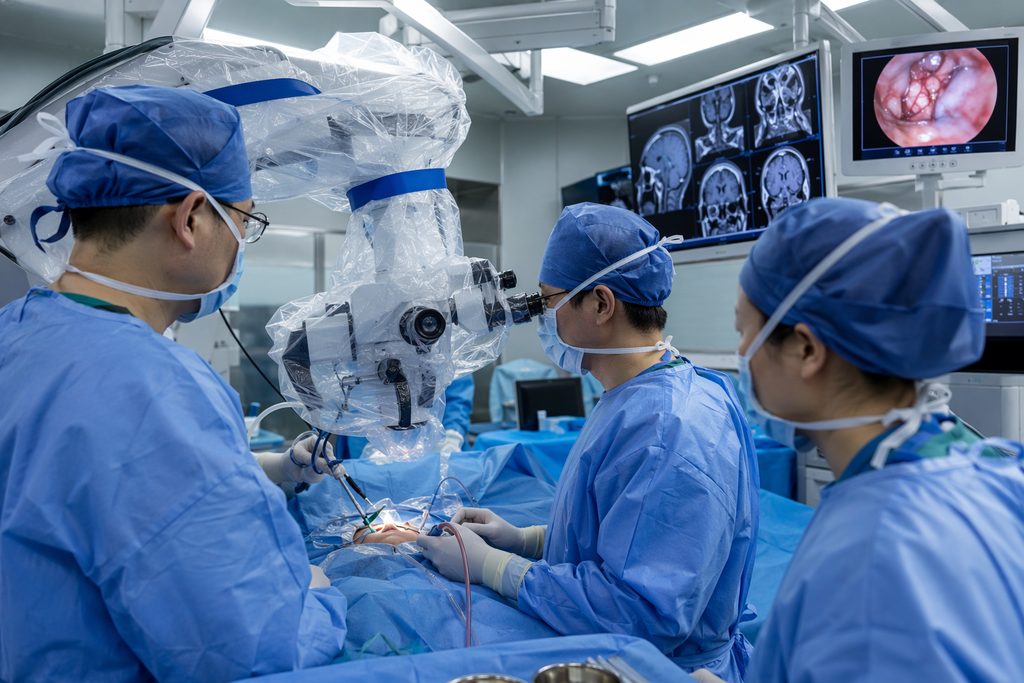
Huashan Hospital’s Department of Neurosurgery runs one of the busiest pituitary surgery programs on the planet. The neuro-endoscopy center logs well over 3,000 endoscopic skull base procedures each year. A dedicated pituitary team might complete 15 to 20 transsphenoidal resections in a single week. Compare that to a competent US academic center where the same team does perhaps 50 to 80 pituitary cases annually. Volume compounds. A surgeon who has done 3,000 endoscopic pituitary resections sees anatomical variations — the tricky carotid loops, the suprasellar extensions, the scarred re-operations — that a lower-volume surgeon encounters only sporadically. This is not speculation. Studies in Neurosurgery and Journal of Neurosurgery consistently link higher surgeon volume to lower complication rates and better gross-total resection rates in pituitary surgery.
The center uses rigid endoscopes with 0-degree and angled lenses, intraoperative MRI in select complex cases, and neuronavigation as standard. The technique is the same endoscopic transsphenoidal approach used at UCSF or Mass General. The hardware is Siemens and Storz. The difference is repetition.
How Is Endoscopic Pituitary Surgery Performed in China at This Scale
The workflow at Huashan’s neuro-endoscopy center is refined to an operational cadence that smaller centers cannot replicate. A patient arrives. Preoperative workup — high-resolution pituitary protocol MRI, full endocrinological panel, neuro-ophthalmological exam with formal visual field testing — happens in 48 to 72 hours. The surgery itself runs 90 to 180 minutes depending on tumor size and invasiveness. The ENT surgeon opens the corridor through the nostril. The neurosurgeon resects the tumor. A small abdominal fat graft or nasal septal flap closes the defect if CSF leakage risk is present. Postoperative monitoring in a dedicated neurosurgical ICU runs 24 hours. Most patients transfer to the ward the next morning. Nasal packing comes out within 48 hours. Discharge typically happens on postoperative day 4 or 5 for uncomplicated cases.
This is not a stripped-down, accelerated protocol that compromises safety. It is the same timeline you would get at a high-volume US pituitary center. The difference is that Huashan does it 60 times a month, not 6.
The Structural Reason Costs Stay Low
Let us address the obvious question directly. If the technique and technology are equivalent, why does the pituitary tumor surgery cost at Shanghai Huashan Hospital land at $18,000–$28,000 while the same procedure in the US runs $70,000–$120,000? The answer is structural, not qualitative. Chinese hospital charges are set by provincial pricing bureaus, not negotiated between insurers and hospital systems. Labor costs for nurses, anesthesiologists, and support staff are lower. Hospital administrative overhead is leaner. There is no multi-layered insurance billing apparatus inflating line-item charges. The neurosurgeon’s professional fee, the OR time, the anesthesia, the implantable materials — each component reflects a cost base that has not been distorted by the American payer-provider arms race.
Lower price does not signal lower quality here. It signals a different economic structure. The clinical outcomes data — tumor resection rates, CSF leak rates, new anterior pituitary deficiency rates — published by Huashan’s neurosurgery department in peer-reviewed Chinese and international journals are consistent with benchmarks from high-volume Western centers. The best neurosurgeon for pituitary adenoma China has to offer is not one individual but a team of subspecialized attendings who operate exclusively on the sella. That degree of focus is rare anywhere.
What You Need to Know Before Going Alone
Accessing this level of care independently is genuinely difficult. Not impossible. But difficult enough that we need to be honest about the friction points.
- Visa Requirements: Medical treatment in China requires an S2 visa with a notation specifying the treatment purpose. Your accompanying family member also needs an S2. The invitation letter must come from the hospital — specifically from the international medical department of Huashan Hospital. Getting that letter as an individual patient, without a local contact, involves phone calls during Shanghai business hours, documents in Chinese, and patience. The M visa is for business. It does not apply here.
- Payment Systems: Huashan’s international wing accepts payment upfront. Wire transfers, major credit cards, or UnionPay. The hospital does not bill foreign insurance directly. You pay, you get itemized receipts and translated medical records, and you seek reimbursement from your insurer afterward. A deposit of roughly 50% to 70% of the estimated surgical package is required before admission. This is standard. It is also jarring if you are used to post-treatment billing.
- Medical Records and Language: Your existing MRI discs, endocrinology reports, and ophthalmology notes need professional translation into Chinese. Google Translate will not cut it for a surgical team deciding whether a tumor invades the cavernous sinus. The hospital’s international department staff speaks English, but the ward nurses and OR circulators largely do not. Communication during the 23 hours a day you are not with the international coordinator requires a bridge.
How We Help You Navigate This
These barriers are real. They are also solvable. Our team handles the pre-arrival heavy lifting. We collect your medical records, have them professionally translated by medical translators, and submit them to Huashan’s international department for surgical review. We coordinate the invitation letter for your S2 visa. We schedule your initial consultation — which, under the international VIP pathway, can be arranged before you board the plane, though the surgeon will still need to examine you in person before finalizing the surgical plan.
On the ground in Shanghai, a bilingual medical companion meets you at the airport, accompanies you to every appointment, translates during the surgical consent discussion, and stays with you through discharge. They handle registration, payment queues, pharmacy runs, and the hundred small frictions that exhaust a postoperative patient in a foreign country. After discharge, we arrange follow-up video consultations with the Huashan team and coordinate the transfer of your Chinese medical records back to your home physician. The goal is continuity, not a one-off surgery in a vacuum.
What Is Recovery Time After Pituitary Tumor Removal Shanghai
Recovery follows a predictable arc. Hospital stay: 4 to 7 days for most endoscopic cases. Nasal breathing improves over 2 to 3 weeks. Sinus crusting and mild bloody drainage persist for roughly a month — this is normal and expected. Strenuous activity, heavy lifting, and air travel with significant cabin pressure changes are restricted for 4 to 6 weeks to protect the skull base repair. Most international patients stay in Shanghai for 10 to 14 days post-discharge for a wound check and a postoperative MRI before flying home. Hormonal axis testing happens at 6 weeks and again at 3 months. If the tumor was hormone-secreting, remission is assessed biochemically, not just radiographically. The team at Huashan provides a detailed postoperative endocrinology roadmap. Your home endocrinologist executes it.
One nuance that surprises patients: you will need nasal saline irrigations several times daily for weeks. The hospital provides the rinse bottles and instructions. It is tedious. It is also the single most important thing you can do to prevent synechiae and chronic sinusitis after surgery. Do not skip it.
Book Pituitary Tumor Surgery Huashan Hospital International Patient: The Real Pathway
You cannot book surgery at Huashan the way you book a hotel room. The sequence is: medical records review → provisional acceptance by the surgical team → in-person consultation → preoperative workup → surgery scheduling. This is not bureaucratic obstruction. It is the same sequence a Chinese national follows. The difference for international patients is that the coordination layer — the records submission, the scheduling, the visa support — runs through the hospital’s international medical center or through a service like ours.
The Shanghai Huashan neuro-endoscopy center package price abroad typically bundles the surgeon’s fee, anesthesiologist fee, operating room charges, standard endoscopic equipment, hospitalization in a private or semi-private international ward room, and routine postoperative medications. Implants like a dural sealant or a nasoseptal flap repair are usually included for standard cases. Complex reconstructions involving lumbar drains or extended approaches for large macroadenomas push the cost toward the upper end of the $18,000–$28,000 range. Every case is quoted individually after the surgeon reviews the MRI. There is no one-size-fits-all sticker price.
Frequently Asked Questions
You can express a preference. The international department will forward your case to the pituitary team and the most appropriate attending surgeon will be assigned based on tumor complexity and availability. Huashan’s pituitary division is staffed by multiple senior neurosurgeons who operate exclusively on sellar and skull base pathology. You are not getting a general neurosurgeon who does an occasional pituitary case. You are getting a subspecialist. The specific name matters less than the volume and focus of the entire team.
Huashan Hospital is a tertiary academic medical center with a dedicated neurosurgical ICU, interventional neuroradiology suite, and 24-hour in-house neurosurgery attending coverage. The complication rate for endoscopic pituitary surgery at high-volume centers — including Huashan — is low. CSF leak occurs in roughly 2% to 5% of cases. New hormonal deficiency in about 5% to 10%. Carotid artery injury is exceedingly rare, well under 1%. The hospital has the resources to manage complications should they occur. Your postoperative monitoring protocol includes strict fluid balance tracking, daily sodium checks, and neurological exams at regular intervals. The team looks for problems before they escalate.
Yes. Huashan’s pathology department issues reports in a standardized format consistent with WHO classification of pituitary tumors. The international department provides certified English translations of all operative notes, pathology reports, and discharge summaries. Your home endocrinologist will receive a complete packet. The lab reference ranges for hormonal assays differ slightly from Western labs, but the clinical interpretation is straightforward. We recommend sending the records to your home physician before you leave Shanghai so any questions can be clarified while you still have direct access to the surgical team.
Huashan’s neurosurgeons will specify the exact MRI protocol — 3T pituitary protocol with dynamic contrast, thin-slice coronal and sagittal sequences. You take this prescription to your local imaging center. The images are uploaded to a secure portal or sent on a disc. We facilitate the transfer back to Huashan for review. A video consultation is then scheduled to discuss the findings. This cycle typically repeats at 3 months, 6 months, and annually for several years depending on tumor pathology.
Your Next Step
A pituitary tumor diagnosis forces decisions under pressure. The option to access one of the world’s highest-volume neuro-endoscopy centers at a fraction of Western costs is real. It is also logistically demanding. Understanding the pituitary tumor surgery cost at Shanghai Huashan Hospital is only the starting point. The harder part is executing the journey — records, visa, consultation, surgery, recovery, and follow-up — without losing weeks to confusion and language barriers.
If you want to explore whether Huashan’s neuro-endoscopy center is a fit for your specific case, our team can walk you through the process with no obligation. We review your MRI and medical history, present your case to the international department, and give you a transparent surgical quote and timeline. Start with a free consultation to understand your options before committing to anything. No pressure. Just clarity.
For more medical information and treatment options in China, visit chinamedservices.com (China Medical Services).
