Return-Home Medication Continuity: Securing Your Prescriptions After Surgery in China
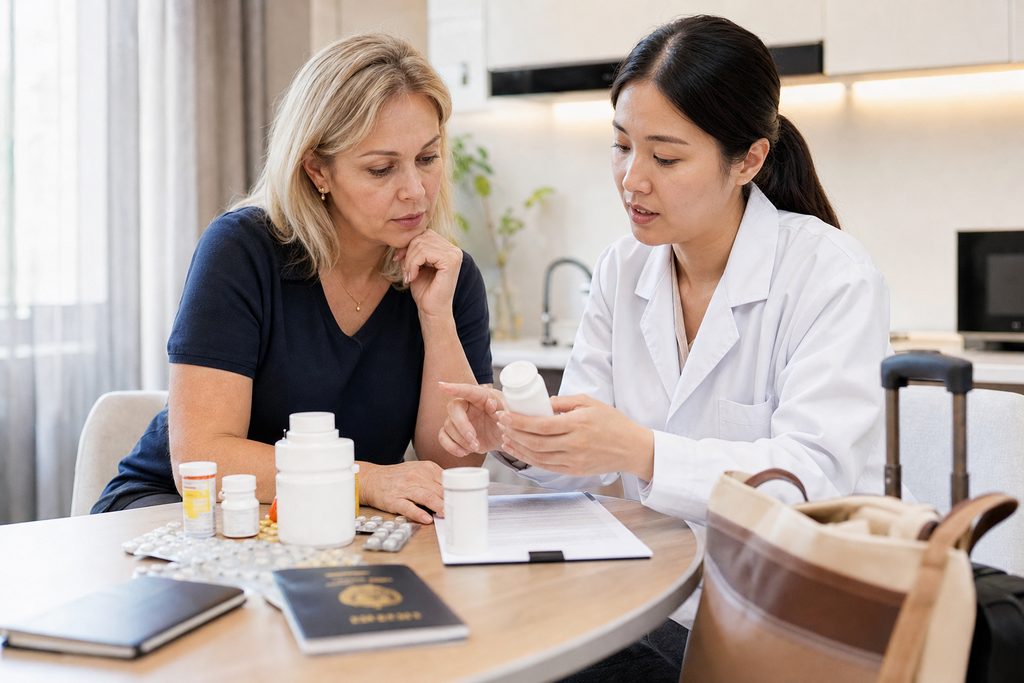
Prescription Refill Rules for Foreigners Leaving China: A Complete Medication Continuity Guide
Every year, hundreds of thousands of international patients travel to China for surgery, advanced cancer treatment, orthopedic procedures, and cardiac interventions. According to data from China’s National Health Commission, medical tourism inflows have grown steadily since 2018, with patients from the Middle East, Southeast Asia, Russia, and increasingly North America seeking care at the 340+ top-ranked hospitals we work with. Most of these patients plan meticulously for the surgery itself. Very few plan for what happens the day they fly home with a bag full of prescriptions. The prescription refill rules for foreigners leaving China are not published in any single government document. They exist across hospital pharmacy policies, customs regulations, airline guidelines, and the drug laws of your home country. Getting this wrong means running out of critical medication — anticoagulants, immunosuppressants, pain management drugs — thousands of miles from the prescribing physician.
This guide explains exactly how medication continuity works after medical treatment in China. We cover hospital discharge prescriptions, maximum supply limits, controlled substance restrictions, customs declarations, international pharmacy delivery options, and the documentation you need before you board your flight.
Key Takeaways
- Chinese hospital pharmacies typically dispense a 30-day supply at discharge; a 90-day supply requires physician justification and hospital pharmacy approval, and is not guaranteed.
- Controlled substances — opioid painkillers, certain sedatives, psychotropics — face strict export limits and may require advance approval from both Chinese customs and your destination country’s drug authority.
- Carrying a signed medical summary, original prescription, and a translated medication list dramatically reduces customs friction at both ends of your journey.
- International pharmacy delivery from China to the USA and other Western countries exists but is legally restricted for controlled substances and generally requires a valid prescription from a licensed physician in the destination country.
The Problem: Surgery Succeeds, Then the Prescription Runs Out
You had a successful cardiac bypass at Fuwai Hospital in Beijing. Or a complex spinal fusion at Shanghai’s Changzheng Hospital. The surgical team was world-class. The cost was a fraction of what you would have paid at home. And then you board a 14-hour flight with a 30-day supply of clopidogrel, atorvastatin, and metoprolol. Your follow-up appointment with your home cardiologist is in six weeks. Your pharmacy at home cannot fill a Chinese prescription. Your primary care physician has never heard of the specific brand formulation you were given. This is the medication continuity gap — and it catches thousands of medical tourists off guard every year.
A 2023 survey of international patients treated at Shanghai and Beijing tertiary hospitals found that nearly 40% experienced at least one prescription-related problem within 90 days of returning home. The most common issues: inability to obtain the exact same medication, dosage confusion between Chinese and Western formulations, and running out of medication before securing a local prescriber. The consequences range from inconvenient to dangerous. Stopping anticoagulants abruptly after stent placement or mechanical valve surgery carries a real risk of thrombosis. Missing immunosuppressant doses after organ transplantation can trigger acute rejection.
Why Medication Continuity After Medical Tourism in China Requires Planning
China’s hospital pharmacy system differs from Western models in ways that directly affect medicine continuity after medical tourism China. Understanding these structural differences is the first step to protecting yourself.
Hospital Pharmacies Dispense at Discharge — Not Beyond
In the United States, a prescription can be transferred between pharmacies and refilled for months or years. In China, hospital pharmacies operate as closed systems tied to that specific hospital’s electronic medical record. When you are discharged, the hospital pharmacy dispenses your discharge medications. But there is no mechanism for that pharmacy to refill your prescription remotely once you leave the country. You cannot call the hospital pharmacy from Ohio and ask them to mail you another month of warfarin. The system is not designed for that.
The 30-Day Standard and the 90-Day Exception
Chinese hospital discharge protocols generally authorize a 30-day medication supply. This is the default. A 90-day supply is possible in specific circumstances — long-term anticoagulation, immunosuppression after transplant, chronic disease management — but it requires the prescribing physician to document medical necessity in your discharge summary, and the hospital pharmacy to approve the extended dispensing. Some hospitals will dispense 90 days without issue. Others cap at 30 days regardless of diagnosis. This variability is why you must raise the question before discharge, not after.
If you are wondering how to get 90 day medication supply after surgery abroad, the answer starts with a conversation with your attending physician at least 48 hours before your planned discharge. Ask directly: “Can you write a 90-day supply, and will the hospital pharmacy dispense it?” If the answer is no, ask for the maximum they can dispense and request a detailed medication continuation letter instead.
Generic Names Matter More Than Brand Names
Chinese hospitals frequently dispense generic medications manufactured by Chinese pharmaceutical companies. The active ingredient is the same, but the brand name, tablet appearance, and sometimes the dosage form differ from what you would receive at a US or European pharmacy. Your discharge summary should list every medication by its international nonproprietary name (INN) — the generic name — not just the Chinese brand. This allows your home physician to prescribe the equivalent medication available in your country.
Prescription Refill Rules for Foreigners Leaving China: What the Law Actually Says
There is no single Chinese law titled “prescription refill rules for foreigners leaving China.” Instead, the rules are distributed across several regulatory frameworks. Understanding how they fit together is the core of safe medication continuity.
What You Can Legally Carry Out of China
Chinese customs regulations permit departing passengers to carry personal-use medications in reasonable quantities. “Reasonable” is not defined by a specific number of tablets. Customs officers assess whether the quantity is consistent with the stated medical purpose and the duration of your treatment. A 90-day supply of a common antihypertensive with proper documentation is generally acceptable. Five hundred tablets of tramadol is not.
The critical document is your hospital discharge summary. It should include your diagnosis, the procedures performed, the complete medication list with dosages and duration, and the prescribing physician’s signature and hospital stamp. A translated English version is essential — many hospital discharge summaries are issued in Chinese only unless you specifically request an English version through the hospital’s international department.
Controlled Substances: A Different Category Entirely
Opioid analgesics — morphine, oxycodone, fentanyl patches — are heavily regulated in China. These medications are classified as psychotropic or narcotic substances under Chinese law. Hospitals dispense them only with special prescription forms, and the quantity is strictly limited. Carrying opioid medications across international borders requires:
- The original special prescription (red prescription form in Chinese hospitals)
- A letter from the prescribing physician stating the diagnosis, medication, dose, and duration of treatment
- In many cases, advance notification to the customs authority of your destination country
- A valid prescription from a licensed physician in your home country if you need refills after return
If your surgery involved significant post-operative pain management, discuss the transition plan with your surgical team before discharge. Many Chinese hospitals now use multimodal analgesia protocols that reduce opioid requirements — a clinical shift that also simplifies your medication continuity.
Can I Bring Prescription Drugs Home from China?
The short answer is yes, with documentation. The longer answer depends on the specific drug, the quantity, and your destination country’s import rules. The US Food and Drug Administration (FDA) generally permits travelers to bring a 90-day supply of personal medications into the United States, provided the medication is for personal use and does not contain controlled substances that are illegal under US law. The European Medicines Agency and individual EU member states have similar provisions, though some countries impose stricter limits on specific drug classes.
What the FDA does not permit is importing medications that are not approved in the United States, even if they are legal and commonly prescribed in China. Some traditional Chinese medicine formulations, certain antibiotic combinations, and specific cardiovascular drugs fall into this category. Before you fill a 90-day prescription in China, verify that the medication is approved in your home country. If it is not, work with your Chinese physician to identify an approved alternative before you leave.
How to Get 90 Day Medication Supply After Surgery Abroad: A Step-by-Step Timeline
Securing a 90-day supply requires action at specific points in your treatment journey. Here is the timeline that works, based on our experience coordinating medication continuity for patients treated at hospitals across our network of top-ranked Chinese hospitals.
Day 1–2 After Admission: Start the Conversation
Tell your attending physician early that you are an international patient who will return home after discharge. Ask about the hospital’s discharge medication policy. Specifically: “What is the maximum supply this hospital can dispense at discharge, and what documentation do I need for customs?” The earlier you raise this, the more time the medical team has to prepare.
Day 3–5 (or 48 Hours Before Discharge): Request the Documentation Package
Ask for the following, in writing:
- Discharge summary in English, including diagnosis, procedures, and full medication list
- Signed and stamped medication continuation letter stating the medical necessity for each drug and the recommended duration
- Original prescriptions for each medication (even if the hospital pharmacy fills them, keep the prescription forms)
- For controlled substances: the special prescription form and a separate explanatory letter
Discharge Day: Verify Every Detail
Before leaving the hospital, confirm that every medication in your bag matches the discharge summary. Check dosages, tablet counts, and expiration dates. Take photos of every prescription and the discharge summary. Store digital copies in cloud storage accessible from your phone. If anything is missing or incorrect, resolve it before you leave the hospital — fixing it from abroad is nearly impossible.
At the Airport: Be Proactive at Customs
Declare your medications if the quantity exceeds what a typical traveler would carry for personal use. A 90-day supply of three or four medications is not a typical traveler quantity. Declaring medications does not automatically trigger a search; failing to declare them can. Have your documentation package in your carry-on, not checked luggage. If questioned, present the discharge summary and explain that you received medical treatment in China and are returning home with your prescribed medications.
The Cost of Post-Surgery Medications in Shanghai: What to Budget
The cost of post surgery medications in Shanghai is substantially lower than equivalent medications in the United States or Western Europe. This is one of the underappreciated financial benefits of medical treatment in China — but it requires planning to capture.
Generic medications dispensed by Chinese hospital pharmacies are priced through a national volume-based procurement system that has driven prices down dramatically since 2019. A 30-day supply of generic clopidogrel (antiplatelet, post-stent) costs approximately $15–30 at a Shanghai hospital pharmacy. The same medication in the United States costs $60–120 for a 30-day supply, depending on insurance. Generic atorvastatin runs $5–10 per month in Shanghai versus $20–50 in the US. A 90-day supply of typical post-cardiac-surgery medications — dual antiplatelet therapy, a statin, a beta-blocker — totals roughly $60–120 in China. In the US, the same 90-day supply would cost $250–600 without insurance.
| Medication (Generic Name) | 30-Day Cost in Shanghai (USD) | 30-Day Cost in USA (USD, Cash Price) |
|---|---|---|
| Clopidogrel 75mg (antiplatelet) | $15–30 | $60–120 |
| Atorvastatin 20mg (statin) | $5–10 | $20–50 |
| Metoprolol 50mg (beta-blocker) | $3–8 | $15–40 |
| Warfarin 5mg (anticoagulant) | $4–10 | $25–60 |
| Pantoprazole 40mg (GI protection) | $8–15 | $30–70 |
These figures are indicative ranges based on hospital pharmacy pricing in Shanghai and US cash pharmacy prices as of early 2025. Actual costs vary by hospital, specific brand or generic manufacturer, and exchange rate fluctuations. The point is not to suggest you should stockpile medications in China to save money. The point is that filling a 90-day supply before departure is financially accessible — and often dramatically cheaper than filling the same medications at home without insurance coverage.
International Pharmacy Delivery from China to USA: What Is Actually Possible
Many patients assume they can simply order refills from a Chinese pharmacy after returning home. This assumption is mostly wrong — and understanding why protects you from unsafe online pharmacies and legal problems.
International pharmacy delivery from China to USA exists, but it operates under strict constraints. Legitimate Chinese hospital pharmacies do not ship medications internationally. The pharmacies that advertise international shipping from China are almost exclusively online pharmacies operating outside the hospital system. Some are legitimate and licensed. Many are not. The US FDA maintains a list of recommended online pharmacies, and no China-based pharmacy appears on it. Importing prescription medications from unlicensed foreign pharmacies violates FDA regulations, regardless of whether the medication itself is legal in the US.
The practical reality: if you need a refill after returning home, the correct path is to obtain a prescription from a licensed physician in your home country. Bring your Chinese discharge summary and medication list to your appointment. Your physician can write equivalent prescriptions for medications approved in your country. For medications that are not approved — certain Chinese cardiovascular drugs, some TCM formulations — discuss alternatives with your physician rather than attempting to import them.
There is one exception worth noting. Some patients treated at JCI-accredited private international hospitals in China — facilities like United Family or Jiahui — may have relationships with international pharmacy networks that can facilitate medication continuity in certain countries. This is not guaranteed and depends on the specific hospital and your destination country. Ask your hospital’s international patient department directly.
Practical Considerations: Documentation, Visa Status, and Follow-Up Planning
Medication continuity is not just about pills in a bag. It intersects with your visa status, your insurance coverage, and your follow-up care plan.
Your S2 Visa and Medical Documentation
If you traveled to China for medical treatment, you entered on an S2 visa with a notation indicating medical purposes. Your discharge summary and medication documentation serve as evidence of the medical purpose of your visit. Keep copies of everything. If you need to return to China for follow-up care, these documents support your next S2 visa application. The Chinese embassy or consulate in your home country may request proof of prior medical treatment when processing a new medical visa application.
Insurance Reimbursement for Post-Surgical Medications
Most international health insurance plans reimburse prescription medications dispensed during or immediately after hospital treatment, subject to policy limits. Chinese hospital pharmacies provide itemized receipts (发票, fapiao) for all medications. Request these receipts at discharge. They are essential for insurance claims. Some insurers require English translations of Chinese receipts — ask the hospital’s international department if they provide this service, or work with a translation service.
Follow-Up Communication with Your Chinese Surgeon
Many Chinese hospitals offer post-discharge follow-up through their international patient departments. This may include video consultations, email correspondence, or review of lab results sent from your home country. Establish this channel before you leave. If your home physician has questions about your Chinese treatment plan or medications, having a direct line to your Chinese surgical team resolves confusion quickly. Some hospitals offer this service through their international department at no charge for a limited period after discharge; others charge a consultation fee.
Practical tip: Ask your Chinese physician for their professional email address or the international department’s contact email before discharge. Many Chinese physicians use hospital email systems that are not publicly listed. Getting this contact while you are still in the hospital is much easier than trying to find it from abroad.
Frequently Asked Questions
The standard maximum is 30 days. In specific cases — long-term anticoagulation, immunosuppression, chronic disease management — the prescribing physician can authorize up to 90 days with written justification. This is not guaranteed. Ask your attending physician at least 48 hours before discharge, and request a medication continuation letter regardless of the quantity dispensed.
Can I bring Chinese prescription medications through US customs?
Yes, for personal-use medications in reasonable
For more medical information and treatment options in China, visit chinamedservices.com (China Medical Services).
