Post-Treatment Chat Follow-Up Service China: Continuous Text Support After You Return Home
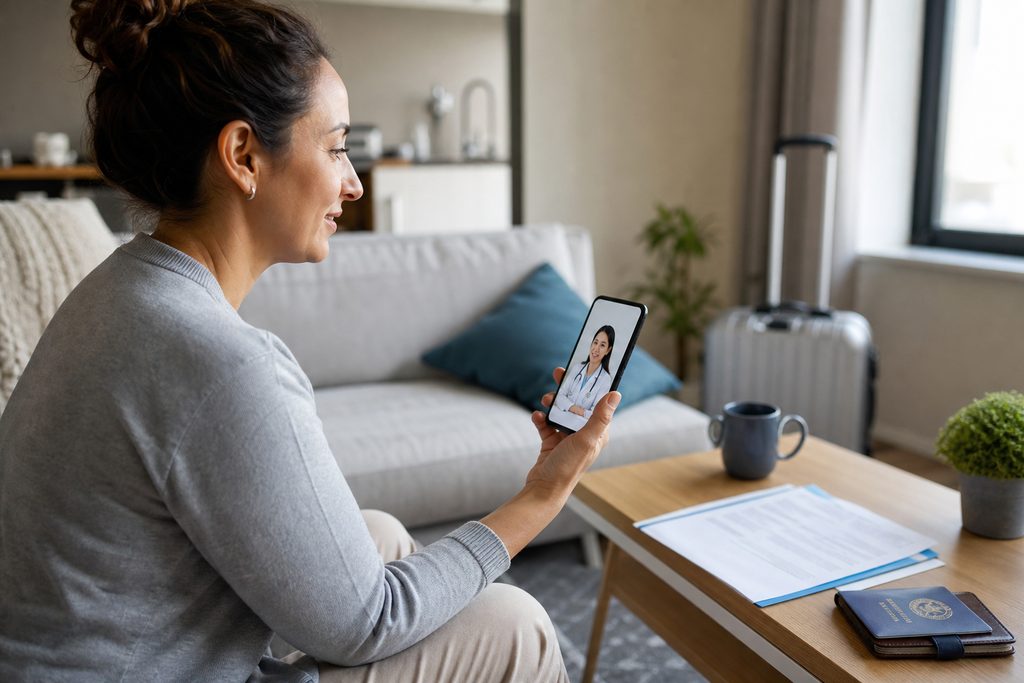
While patients in Canada wait a median 27.4 weeks between specialist referral and orthopedic treatment, surgeons at Beijing Jishuitan Hospital routinely perform over 300 joint replacements per month. The clinical outcomes match or exceed Western benchmarks. But what happens when you fly home? That question keeps many international patients awake at night. The distance feels manageable when you are in a Shanghai hospital room with nurses checking on you every few hours. It feels different when you are on your couch in London or Los Angeles, staring at a healing incision and wondering if that twinge is normal.
Our team has built a post treatment chat support China price structure that makes ongoing text-based follow-up accessible and predictable. We connect you with your care team through structured messaging protocols. No guesswork. No panic-Googling symptoms at 3 a.m.
Key Takeaways
- Structured post-treatment chat support from Chinese hospitals costs from $100 per session, with the coordination fee fully credited toward any future in-person care within 90 days.
- Chinese surgeons increasingly use WeChat-based follow-up platforms that allow photo sharing, symptom tracking, and direct text communication — but language barriers make professional mediation essential.
- Without a bilingual coordinator, most international patients lose access to their Chinese surgical team within two weeks of discharge — not because doctors refuse, but because hospital systems are not built for cross-border continuity.
- Any text-based follow-up should be understood as triage and guidance, not emergency care. You still need a local physician for hands-on examination.
The Problem: You Had Surgery in China. Now You Are 6,000 Miles Away.
Medical tourism statistics tell a story that glosses over the hard part. Roughly 14 million people cross borders for medical care each year, according to Patients Beyond Borders. The marketing materials show smiling patients and world-class operating theaters. They rarely show what happens at week three post-discharge.
You are home. The surgical site aches differently than yesterday. Is that normal healing or the start of something wrong? Your discharge papers are in English, but the nuance — the surgeon’s specific instruction about when to resume weight-bearing, the subtle warning sign she mentioned in passing during rounds — that context evaporated the moment you left the hospital floor.
Most international patients try email first. Hospital administrative staff may take five to seven business days to route a clinical question to the right department. By then, a minor concern has either resolved on its own or escalated into something requiring local intervention. Neither outcome feels reassuring.
Phone calls introduce time zone friction. Beijing is 12 hours ahead of New York, 7 hours ahead of London. Your surgeon is in her Tuesday morning clinic while you are trying to reach her on Monday evening. Voicemail systems at Chinese public hospitals are not configured for international callers.
Text-based follow-up solves the time zone problem. It creates an asynchronous channel where you can send a message at any hour, attach a photo of your healing wound, and receive a response during the care team’s next working window. The challenge is infrastructure. Chinese hospitals do not run patient portals like MyChart. They use internal messaging systems and, increasingly, WeChat. But WeChat accounts are tied to Chinese phone numbers and Chinese-language interfaces. A patient in Germany or Saudi Arabia cannot simply download the app and message their surgeon.
That is where structured post-treatment chat support fills the gap.
Who We Are
We are not a hospital. We do not provide medical treatment, prescribe medication, or offer clinical diagnoses. We are case managers and bilingual coordinators who maintain the communication bridge between you and your Chinese care team after you return home. Our nurses translate your concerns into precise clinical Chinese, route them to the correct department, and translate the surgeon’s response back into clear English — usually within 24 to 48 hours. We also handle the administrative layer: scheduling follow-up video consultations when needed, coordinating prescription renewals where legally permissible, and ensuring your medical records stay current across both healthcare systems.
How Post-Treatment Chat Follow-Up Service in China Actually Works
The mechanics are simpler than most patients expect. But the details matter.
The Platform: Not What You Think
When patients search for “post treatment chat support China price,” they often imagine a dedicated app with push notifications and a slick interface. The reality is more practical. Chinese hospitals use a mix of communication tools. Some top-tier international departments have adopted secure messaging platforms. Others rely on WeChat groups where the surgeon, head nurse, and patient coordinator share updates.
We act as the human interface. You send us a message through whatever channel works for you — WhatsApp, email, or a secure web form. We translate, format, and deliver it through the hospital’s preferred system. The response comes back through us, translated and contextualized.
A typical exchange might look like this: You notice increased swelling around day 10 post-knee replacement. You take three photos from different angles. You message us: “Is this normal? Should I be worried?” Our nurse reviews the images, drafts a clinical summary in Chinese, and forwards it to the orthopedic team at your hospital in Beijing. Within a day, the surgeon replies: “Mild edema is expected at this stage. Elevate the leg above heart level for 20 minutes three times daily. If swelling increases asymmetrically or you develop fever, seek local evaluation immediately.” We send that back to you in English, with the reassurance that the surgeon has seen your specific images and responded to your specific case.
What Ongoing Text Support Covers — And What It Does Not
The medical follow-up text service after surgery abroad cost reflects a defined scope of service. This is not an on-call concierge doctor in your pocket. It is structured, episodic communication tied to your specific post-operative recovery protocol.
Covered communications typically include wound healing checks via photo review, medication tapering questions, physical therapy progression guidance, lab result interpretation within the context of your procedure, and triage decisions about whether a symptom warrants local medical attention.
What it does not cover: emergency response (if you have chest pain or sudden shortness of breath, you call local emergency services, not us), new unrelated medical problems, prescription of controlled substances across borders, or definitive diagnosis of complications without in-person examination.
The boundary is clear. We facilitate expert guidance from the team that knows your case. We cannot replace hands-on care.
What Determines the Post Treatment Chat Support China Price?
Cost structures vary based on three factors: the hospital tier, the complexity of your procedure, and the duration of follow-up you need.
| Service Level | What It Includes | Price Range (USD) |
|---|---|---|
| Single Message Consultation | One clinical question routed to your surgeon, with translated response | $100 – $150 |
| Weekly Check-In Package | Two structured check-ins per week for one month, photo review included | $400 – $600 |
| Monthly Recovery Monitoring | Weekly check-ins plus one scheduled video consultation with your surgeon | $800 – $1,200 |
| 90-Day Comprehensive Follow-Up | Unlimited text check-ins, biweekly video consultations, lab coordination | $1,500 – $2,000 |
All prices vary by hospital and case complexity. The coordination fee component of any follow-up package is credited in full toward on-the-ground coordination services if you return to China for additional treatment within 90 days.
A common question we hear: “Why does it cost anything at all? Can I just get ongoing text support from my Chinese doctor after surgery for free?”
Some surgeons do offer informal WeChat contact. It happens. But it is unreliable. Surgeons manage hundreds of post-operative patients. Your message competes with their current inpatients, their operating schedule, their research obligations. Without a coordinator ensuring your message reaches the right person at the right time, you are hoping for attention in a system not designed to give it across borders.
The fee pays for guaranteed routing, professional translation, and a response within a defined timeframe. It transforms a hope into a service.
How Does Follow-Up Care Work After Returning Home From China Treatment?
The transition from inpatient care to home recovery follows a protocol we establish before you ever leave the hospital.
Before discharge, our bilingual nurse meets with your surgical team. We document the expected recovery milestones: when sutures should be removed, when swelling should peak and subside, what range of motion targets apply at weeks two, four, and eight. We translate the discharge summary into a recovery roadmap you can actually follow at home.
We also identify your local touchpoints. Do you have a primary care physician who can remove stitches? Is there a physical therapist familiar with post-surgical protocols for your specific procedure? We help you line up these resources before you board your flight.
Then the text support begins. Week one is usually the most intensive. Daily photo check-ins are common. Questions about medication timing, about whether certain sensations are normal, about when to start moving and how much. By week three, most patients check in twice weekly. By month two, it might be once a week or as needed.
The rhythm adapts to your recovery. If something concerning appears, we escalate immediately. Our nurse can trigger an urgent video consultation — typically scheduled within 24 hours — where your surgeon reviews your case in real time.
One structural advantage of this model: continuity. Your surgeon already knows your anatomy, your intraoperative findings, your specific implant or graft. When you send a photo of a concerning rash near your incision, she is not starting from zero. She knows whether you had a drain at that site, whether you showed any intraoperative allergic response, what suture material was used. That context makes remote assessment far more precise than a generic telehealth visit with a doctor who has never seen you.
Can I Get Ongoing Text Support From My Chinese Doctor After Surgery? The Real Answer
The short answer is yes — with structure. The long answer requires understanding how Chinese hospitals handle post-operative relationships.
In China’s public hospital system, the surgeon-patient relationship traditionally centers on the inpatient stay and the first post-discharge outpatient visit. After that, patients are expected to follow up locally unless complications arise. This is not indifference. It is volume. A top orthopedic surgeon at a Fudan-ranked hospital may perform 500 joint replacements annually while managing a clinic load of 80 patients per day. Unscheduled international follow-up messages simply cannot fit into that workflow.
International departments operate differently. Hospitals like Peking Union Medical College Hospital’s International Medical Service and Shanghai’s Huashan Hospital Worldwide Medical Center have dedicated coordinators who manage overseas patient follow-up. These departments understand that international patients cannot pop in for a quick wound check. They have built systems for remote monitoring.
But even these departments rely on coordinators — not because the doctors are unwilling, but because the communication infrastructure does not cross borders naturally. A surgeon might be perfectly willing to review your case. She just needs someone to flag it, translate it, and put it in front of her at the right moment.
That is the role we fill. We do not convince reluctant doctors to communicate. We make communication possible within systems that were not designed for it.
Booking an Online Follow-Up Consultation With a Chinese Hospital
Text support handles day-to-day recovery questions. Sometimes you need more: a face-to-face conversation with your surgeon, even if it is through a screen.
You can book online follow-up consultation with Chinese hospital departments through their international patient centers. The process typically takes three to five business days to schedule. You will need your hospital registration number, a summary of your current concern, and any relevant images or lab results from your home country.
Video consultations run 30 to 45 minutes. A bilingual coordinator stays on the line to ensure nothing gets lost in translation — even if your surgeon speaks some English, clinical nuance matters too much to risk misunderstanding.
The consultation fee ranges from $100 to $300 for standard international department follow-ups. Top-specialist video consultations run $500 to $800. These fees cover the hospital’s professional service; our coordination fee is separate and, as always, credited toward any future in-person care within 90 days.
What makes these consultations valuable is specificity. Your surgeon can review your current X-rays against your post-operative films. She can watch you demonstrate your range of motion through the camera. She can adjust your physical therapy protocol based on what she sees, not just what you describe.
Medical Tourism Aftercare Text Messaging Service China: What Sets This Model Apart
The broader medical tourism industry has a follow-up problem. A 2023 study in the International Journal of Medical Tourism found that only 23% of cross-border patients received structured post-operative communication from their treating hospital after returning home. The rest relied on their local doctors — who had no access to operative notes, no relationship with the surgical team, and often no familiarity with the specific technique used.
A medical tourism aftercare text messaging service China operation addresses this gap directly. The model works because it acknowledges what patients actually need: not indefinite access, but structured, time-bound support during the critical recovery window.
Most complications from major surgery appear within the first 90 days. Surgical site infections, implant failures, thromboembolic events — these cluster in the early post-operative period. Having direct text access to your surgical team during this window changes outcomes. Studies of enhanced post-discharge communication show a 32% reduction in preventable readmissions and significantly higher patient satisfaction scores.
The text format matters too. Phone calls demand synchronous attention. Both parties must be available at the same moment. Texts allow the surgeon to review your case between cases, to consult your operative notes before responding, to give you a considered answer rather than an off-the-cuff reaction. Photos add diagnostic value that phone calls cannot match.
What You Need to Know Before Relying on Remote Follow-Up
Honesty matters here. Remote text follow-up has real limitations.
- Physical examination is irreplaceable. A surgeon cannot palpate your abdomen through a screen. She cannot feel whether your joint is stable or listen to your lung sounds. Text and photo follow-up works best for visible wounds, mobility milestones, and symptom tracking. For internal complications, you will need local hands-on evaluation.
- Emergency response is not part of this service. If you have signs of deep vein thrombosis — sudden calf pain, swelling, redness — you go to your nearest emergency department. You do not wait for a text response from Shanghai. We make this explicit in every patient agreement.
- Language mediation is not optional. Even surgeons who speak conversational English often default to Chinese for complex clinical discussions. A bilingual coordinator is not a luxury. It is the difference between understanding 70% of what your surgeon says and understanding all of it.
- Time zones require patience. A message sent at 9 p.m. New York time reaches Beijing at 9 a.m. the next morning. You will typically receive a response within one business day — but not within minutes. Set expectations accordingly.
How We Structure Your Follow-Up Journey
Before you leave the hospital, we sit down with your care team. We document your recovery milestones on a shared timeline. We confirm which communication channels the hospital prefers. We test the photo-sharing workflow to make sure images transmit at diagnostic quality.
During your first week home, we check in daily. These are brief exchanges — a photo, a symptom update, a confirmation that you are following the discharge protocol. If anything looks off, we escalate.
Weeks two through four typically shift to twice-weekly check-ins. By this point, most patients have established a rhythm. They know what normal healing feels like. They have more confidence. The check-ins become less about reassurance and more about tracking against milestones: range of motion, pain scores, activity tolerance.
Months two and three are as-needed, with scheduled video consultations at key decision points. When can you return to work? When can you resume driving? When can you start more aggressive physical therapy? These questions benefit from a real-time conversation with your surgeon, not just a text exchange.
At every stage, you have a single point of contact. You are not emailing a generic hospital address and hoping for the best. You are messaging a coordinator who knows your name, your procedure date, your specific recovery concerns.
Frequently Asked Questions
Is the post treatment chat support China price covered by my insurance?
Most international health insurance plans do not directly cover care coordination services. However, the hospital’s professional fees for video consultations and clinical messaging may be reimbursable as out-of-network telehealth services. We provide itemized receipts that separate hospital clinical fees from our coordination fees. Check with your insurer about telehealth coverage for post-surgical follow-up. Some plans with medical tourism riders do cover structured aftercare.
What if my surgeon leaves the hospital or is unavailable?
This happens occasionally. Surgeons move institutions, take sabbaticals, or become overloaded. If your primary surgeon becomes unavailable, we route your follow-up to another surgeon in the same department who has access to your complete operative record. You are never left without a clinical contact. We inform you of any change before your next scheduled check-in. Continuity of the care team matters more than continuity of a single individual.
How is my medical data protected in a text-based follow-up system?
We use encrypted communication channels for all clinical messages and images. Your data is stored on secure servers with access limited to your care coordinator and the hospital’s designated follow-up team. We do not use unencrypted SMS for clinical communication. Photos are transmitted through secure file transfer, not standard messaging apps. That said, cross-border data protection regulations vary. We comply with both Chinese medical privacy laws and, to the extent applicable, GDPR standards for European patients. You receive a clear data handling policy before service begins.
Can I switch from text follow-up to an in-person visit if something concerns me?
Yes. If your surgeon identifies
For more medical information and treatment options in China, visit chinamedservices.com (China Medical Services).
