Prostate Cancer Specialist in Shanghai: Renji Hospital Expertise and Costs
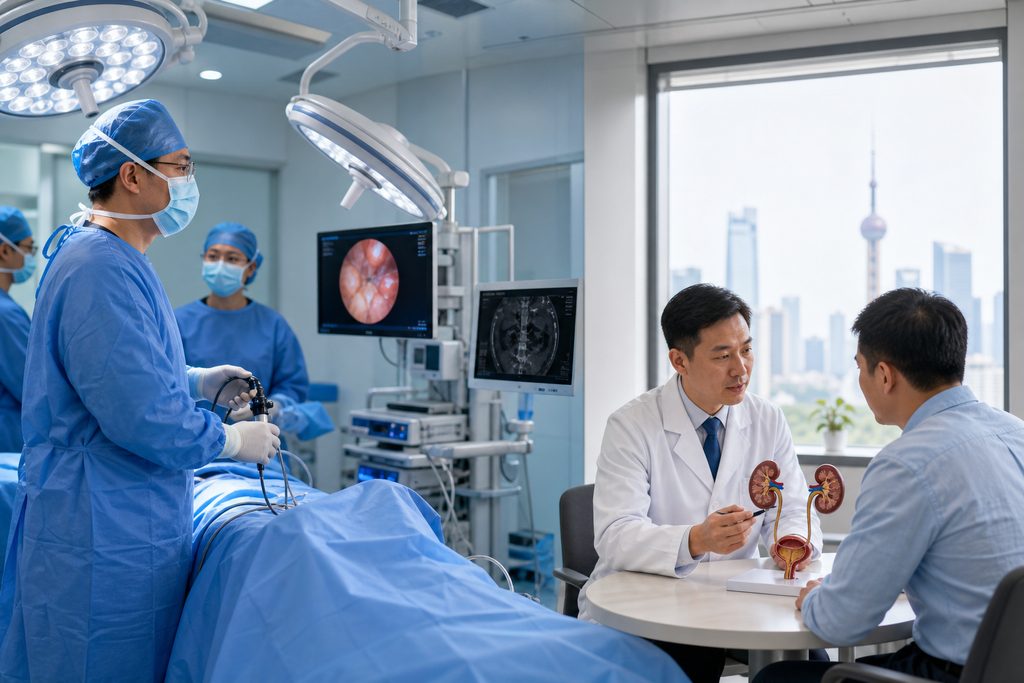
You’ve probably heard that traveling to China for cancer care means gambling with quality. The data tells a different story. Renji Hospital in Shanghai performs over 4,000 robotic-assisted urological surgeries annually, a caseload that places it among the highest-volume prostate cancer centers on earth. For international patients weighing prostate cancer treatment cost Shanghai against six-figure bills at home, the arithmetic demands attention.
Key Takeaways
- Renji Hospital’s Department of Urology is ranked among China’s top 3 nationally in the Fudan University specialist reputation rankings, with a robotic surgery program exceeding 4,000 cases per year.
- Radical prostatectomy at a top Shanghai public hospital typically runs $12,000–$20,000, compared to $40,000–$70,000 in the United States and $25,000–$45,000 in Western Europe.
- Public hospital outpatient clinics in China cannot be pre-booked from overseas through standard channels — international patients need the hospital’s VIP/international department or a coordination service to secure advance appointments.
- You will need an S2 visa for medical treatment in China, not an M visa. M visas are strictly for commercial and trade activities.
The Problem: Prostate Cancer Costs Are Crushing Western Patients
Prostate cancer is the second most common cancer in men worldwide. The American Cancer Society projects approximately 299,010 new cases in the United States in 2024 alone. For the estimated 1 in 8 American men who will face this diagnosis, the financial burden often rivals the emotional one.
A robotic-assisted radical prostatectomy in the US typically costs between $40,000 and $70,000 before insurance. Even with coverage, out-of-pocket maximums frequently land between $8,000 and $15,000. In the UK, NHS wait times for prostate cancer surgery have stretched past the 62-day target in many trusts, with some patients waiting 4 to 6 months from diagnosis to treatment. In Canada, the median wait from referral to radical prostatectomy exceeds 100 days in several provinces.
What happens when men delay treatment to save money or wait in a queue? Prostate cancer that remains localized has a 5-year survival rate above 99%. Once it metastasizes, that figure drops to roughly 34%. Time is not a luxury. Cost is not either. The tension between these two realities drives thousands of patients to consider alternatives abroad.
Why Renji Hospital Delivers Results for Prostate Cancer
Clinical Volume That Western Centers Rarely Match
Renji Hospital, affiliated with Shanghai Jiao Tong University School of Medicine, houses one of the largest urology departments in Asia. The department manages over 300 inpatient beds and performs more than 12,000 urological surgeries annually. Its robotic surgery program, launched in 2007, has completed over 4,000 da Vinci procedures — a volume that places it among the top five robotic urology centers globally.
Why does volume matter for prostate cancer? The learning curve for robotic prostatectomy is steep. Studies published in European Urology and The Journal of Urology consistently show that surgeons performing more than 100 robotic prostatectomies annually achieve significantly lower positive surgical margin rates and better functional outcomes than low-volume surgeons. A surgeon at Renji’s main campus may complete 200 to 400 robotic prostatectomies per year. The average American urologist performs fewer than 50.
That gap translates into measurable differences. Lower positive margin rates mean less chance of cancer recurrence. Better nerve-sparing technique means higher rates of continence and erectile function preservation. High volume is not a marketing slogan — it is a clinical variable with direct consequences.
Technology Without the Wait
Renji operates multiple da Vinci Xi and Si surgical systems, along with advanced imaging platforms including mpMRI fusion biopsy and PSMA PET-CT. A patient who needs a multiparametric MRI before biopsy can typically schedule it within days, not weeks. The hospital’s pathology department processes prostate biopsies with same-week turnaround in most cases.
Compare this to the United States, where scheduling a PSMA PET-CT can take 2 to 4 weeks in many regions. In the UK, access to pre-biopsy mpMRI improved after the 2019 NICE guideline update, but follow-up capacity remains strained. China’s top-tier hospitals run on a different operational rhythm. Outpatient volumes at Renji exceed 10,000 patients per day across its campuses. The system is built for throughput.
That efficiency has a downside: the standard outpatient experience is crowded, fast-paced, and entirely Chinese-speaking. Navigating it without language support or local knowledge is not realistic for most international patients. The hospital’s international department exists precisely for this reason — it provides English-speaking coordination, priority scheduling, and a calmer clinical environment at a premium of roughly 1.5 to 2 times standard public pricing.
Cost Advantage Without Quality Compromise
The most frequent question we hear from Western patients is blunt: “Is it cheaper because it’s worse?” The structural answer is no. Chinese hospital costs are lower for reasons that have nothing to do with clinical quality.
Labor economics explain most of the gap. A senior urological surgeon in Shanghai earns a fraction of what an American or British counterpart earns, despite comparable training and higher annual case volumes. Hospital construction costs, administrative overhead, and malpractice insurance premiums are all substantially lower in China. The da Vinci robot costs the same to buy and maintain — but it runs 12 hours a day, 6 days a week at Renji, amortizing that fixed cost across far more patients.
| Procedure | Shanghai (Top Public Hospital) | United States | United Kingdom (Private) |
|---|---|---|---|
| Robotic Radical Prostatectomy | $12,000–$20,000 | $40,000–$70,000 | $28,000–$45,000 |
| Open Radical Prostatectomy | $8,000–$14,000 | $25,000–$40,000 | $18,000–$30,000 |
| mpMRI + Fusion Biopsy | $1,500–$2,500 | $4,000–$7,000 | $3,000–$5,500 |
| PSMA PET-CT Scan | $800–$1,500 | $5,000–$8,000 | $2,500–$4,000 |
| Radiation Therapy (IMRT, 35–40 fractions) | $6,000–$10,000 | $30,000–$60,000 | $20,000–$35,000 |
Prices vary by hospital and case complexity. The figures above reflect typical charges at Shanghai’s top-tier public hospitals through their international departments. Private international hospitals in Shanghai, such as Jiahui and United Family, charge 30–50% more but offer Western-style amenities and direct insurance billing.
How to Book Prostate Cancer Treatment at Renji Hospital
The single biggest misconception international patients have is that they can email Renji Hospital, request an appointment with a named specialist, and show up the following week. That is not how Chinese public hospitals work.
Standard outpatient registration at Renji is same-day, in-person, and Chinese-language only. You cannot pre-book a standard clinic slot from overseas. Surgery is scheduled only after an in-person consultation with the treating surgeon. There is no exception to this rule in the public system.
The international department changes the equation. Through this channel, patients can secure advance appointments with senior urologists, receive English-language coordination, and access expedited imaging and biopsy scheduling. The cost premium is real — expect to pay 1.5 to 2 times standard public rates — but the alternative for a non-Chinese-speaking patient is effectively unworkable.
A practical pathway looks like this:
Week 1: Submit existing medical records — pathology reports, PSA history, MRI images and reports, any prior biopsy results. A written second opinion from a Renji urologist costs $300–$500 and provides a preliminary treatment recommendation. This step alone can save an unnecessary trip.
Week 2: If surgery or radiation appears appropriate, schedule a video consultation with a Renji specialist. Expect to pay $500–$800 for a top-specialist video session. This conversation clarifies whether the patient is a surgical candidate and what additional testing is needed.
Week 3–4: Travel to Shanghai on an S2 visa. The hospital’s international department issues an invitation letter and treatment confirmation document, which you submit with your visa application. Processing typically takes 1 to 3 weeks depending on your home country’s Chinese consulate.
Week 4–5: In-person consultation, repeat imaging if needed, and surgical scheduling. For robotic prostatectomy, most international patients are admitted within 1 to 2 weeks of completing pre-operative workup. Hospital stay averages 5 to 7 days. Total time in Shanghai: 2 to 4 weeks including recovery before flying home.
Choosing the Right Specialist: What the Rankings Actually Mean
Searching for the “best prostate cancer doctor China” is a natural instinct. It is also the wrong question. In China’s top-tier hospital system, individual surgeons are less important than the department they work in. The Fudan University hospital rankings — China’s most authoritative hospital evaluation — rank departments, not individual doctors. Renji’s Department of Urology has held a top-3 national position in the Fudan specialist reputation rankings for over a decade.
What does that mean for you? It means the department’s senior surgeons all operate at a level that would be considered high-volume and high-expertise by any international standard. The specific surgeon assigned to your case will be determined by scheduling, complexity, and availability — not by your ability to name-drop a particular doctor.
That said, there are meaningful distinctions within the department. Some surgeons focus on nerve-sparing robotic prostatectomy for younger patients with localized disease. Others specialize in salvage prostatectomy after failed radiation, or in cytoreductive surgery for oligometastatic disease. A good coordination process starts with your specific clinical situation and matches you to the appropriate subspecialist — not the other way around.
Is Renji Hospital good for prostate cancer? The evidence says yes, with an important caveat. Renji is an excellent choice for surgical treatment of localized and locally advanced prostate cancer. Its robotic program is world-class. For patients requiring complex multidisciplinary care — for example, metastatic disease requiring systemic therapy plus radiation plus possible surgery — a hospital like Fudan University Shanghai Cancer Center or Peking Union Medical College Hospital may offer broader oncology integration. The right hospital depends on your stage, your Gleason score, and your treatment goals.
For a broader view of China’s top urology and oncology departments, see our specialist department rankings and our Shanghai hospital guide.
Practical Considerations: Visa, Payment, and Follow-Up
Getting treated at Renji Hospital requires more than booking a flight. The logistics matter.
Visa: Foreign nationals traveling to China for medical treatment apply for an S2 visa, not an M visa. The S2 category covers short-term private affairs including medical treatment, with stays up to 180 days. If your treatment and recovery will exceed 180 days, you need an S1 visa. Family members accompanying you also apply for S2 visas. The hospital provides supporting documentation — an invitation letter, treatment confirmation, and admission details — which you submit with your application. Approval is not guaranteed and processing times vary by consulate. Start the visa process immediately after confirming your treatment plan.
Payment: Chinese public hospitals require pre-payment. Expect to deposit the estimated full cost of surgery before admission. International departments accept wire transfers and major credit cards. Private international hospitals in Shanghai may offer direct insurance billing; public hospital international departments generally do not. You pay upfront and seek reimbursement from your insurer afterward. Check with your insurance provider before committing — some policies exclude treatment at non-designated overseas facilities.
Records and Documentation: Bring everything. Pathology slides, not just reports. DICOM files of MRI and PET scans, not just printed images. PSA history with dates. Any prior treatment records including radiation plans if applicable. The quality of the second opinion you receive depends entirely on the completeness of what you submit.
Language: Renji’s international department provides English-speaking coordination staff. Ward nurses on the international floor generally speak basic medical English. Outside that floor, assume no English is spoken. For navigating registration, payment, pharmacy, and imaging departments, a bilingual companion is not a luxury — it is the difference between a 30-minute errand and a 3-hour ordeal. Our patient coordination services exist for exactly this reason.
Follow-Up After Returning Home: Prostate cancer follow-up is lifelong. PSA testing every 3 to 6 months for the first two years, then every 6 to 12 months. The good news: PSA testing is inexpensive and available everywhere. The challenge: your home urologist needs complete operative notes and pathology reports from Renji, translated into English. Request these before you leave Shanghai. The international department provides English-language discharge summaries and pathology reports as standard practice. Take digital copies. Your local urologist will need them to interpret your follow-up PSA trajectory correctly.
Frequently Asked Questions
Yes, but only through the hospital’s international department or a coordination service. Standard outpatient clinics cannot be pre-booked from abroad. The international department accepts advance appointments with English-language support, at a cost premium of roughly 1.5 to 2 times standard public rates.
A robotic radical prostatectomy at a top public hospital in Shanghai typically costs $12,000 to $20,000 through the international department. Open surgery runs $8,000 to $14,000. Radiation therapy costs $6,000 to $10,000 for a full course. These figures exclude travel, accommodation, and coordination fees. Prices vary by hospital and case complexity.
Renji Hospital is a tertiary referral center with full intensive care, interventional radiology, and 24-hour surgical backup. Complication rates for robotic prostatectomy at high-volume Chinese centers are comparable to those reported in Western academic hospitals. That said, no surgery is risk-free. You should discuss specific complication rates — urinary incontinence, erectile dysfunction, anastomotic leak — directly with your surgeon before consenting. If a complication requires extended care, your cost exposure increases. Travel insurance with medical coverage is strongly recommended.
Most Western insurers do not have direct billing arrangements with Chinese public hospitals. You will pay upfront and submit for reimbursement. Whether your policy reimburses depends on its terms — some exclude overseas treatment entirely, others cover it at out-of-network rates. Contact your insurer before committing. Private international hospitals in Shanghai, such as Jiahui or United Family, offer direct billing with many international insurers but charge 30–50% more for the same procedures.
For surgical treatment of prostate cancer, Renji is arguably the strongest choice in Shanghai and among the strongest in China. Its urology department’s robotic volume and Fudan ranking are exceptional. For advanced or metastatic disease requiring integrated medical oncology, Fudan University Shanghai Cancer Center may be more appropriate. The right choice depends on your specific clinical situation, not on a single hospital’s reputation.
Your Next Step
The decision to pursue prostate cancer treatment abroad is never easy. The cost savings are real, the clinical quality at Renji is demonstrable, and the logistical hurdles are manageable with proper planning. We help international patients navigate Chinese healthcare — from hospital matching and appointment coordination to bilingual companionship and visa guidance. We are not a hospital and we do not provide diagnoses or treatment recommendations. If you want to understand whether Renji Hospital is the right fit for your case, start with a free consultation. Send your records, ask hard questions, and make an informed decision. That is what this process should be.
For more medical information and treatment options in China, visit chinamedservices.com (China Medical Services).
