Proton Therapy in China: How International Patients Access Advanced Cancer Care
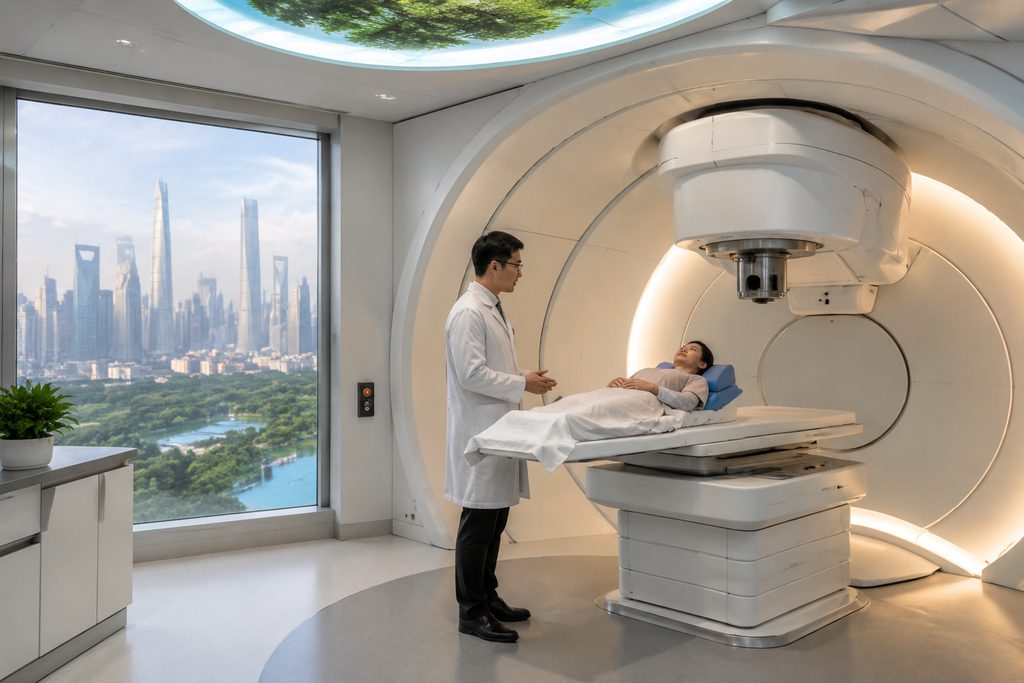
What if the most advanced radiation available to you wasn’t in your home country, but halfway around the world—and cost a fraction of what you’d pay at home?
That’s not a hypothetical for many cancer patients. It’s a real calculation. And more of them are landing on the same answer: China.
Key Takeaways
- China operates 7 of the world’s roughly 120 operational proton and heavy ion centers, with several more under construction, making it one of the fastest-growing destinations for this technology.
- The proton therapy cost in China typically ranges from $30,000 to $70,000 for a full course, compared to $150,000–$200,000+ in the United States—a structural cost difference, not a quality compromise.
- International patients cannot simply walk into a Chinese proton center. Access requires navigating a specific pathway: S2 medical visa, hospital international department registration, and pre-approval of medical records before travel.
- Language barriers and administrative complexity are real. Most centers do not have English-speaking front desks. Having a bilingual coordinator who understands both the clinical terminology and the hospital’s internal workflow is the difference between a smooth process and weeks of frustration.
The Problem: When Standard Radiation Isn’t Precise Enough
Roughly two-thirds of all cancer patients will receive radiation therapy at some point in their treatment journey, according to data from the American Society for Radiation Oncology. Standard photon-based radiation—what most hospitals offer—works. But it has a fundamental physical limitation: the beam deposits energy along its entire path through the body, not just at the tumor. For a child with a brain tumor, that means radiation to healthy developing tissue. For an adult with a liver tumor nestled against the spinal cord, it means a very narrow therapeutic window.
Proton therapy changes the physics. Protons are heavy charged particles that release the bulk of their energy at a precise depth—the Bragg peak—and then stop. No exit dose. Heavy ion therapy, using carbon ions, takes this further with a sharper Bragg peak and higher biological effectiveness against radiation-resistant tumors. The clinical advantage is not theoretical. A 2020 meta-analysis published in JAMA Oncology reviewed nearly 600 studies and found that proton therapy was associated with a significant reduction in acute toxic effects compared to photon therapy across multiple cancer types. For certain indications—uveal melanoma, chordoma, pediatric central nervous system tumors—proton and heavy ion therapy have become the standard of care, not just an option.
But access is the bottleneck. The United States has around 45 operational proton centers. Wait times can stretch for weeks. Insurance denials are common. And for international patients without US insurance, the out-of-pocket cost is prohibitive. Europe has centers concentrated in a handful of countries. Most of the world’s population lives nowhere near a proton facility. That’s the gap China’s rapid build-out is starting to fill.
Who We Are
We are not a hospital. We do not provide medical treatment, interpret scans, or make clinical recommendations. Our team at China Medical Services acts as your logistical architects—we bridge the gap between you and China’s top-tier proton and heavy ion centers. We handle medical record translation, hospital matching based on your specific diagnosis, appointment coordination through official international department channels, S2 visa guidance, and bilingual on-the-ground support. Think of us as the people who make sure your medical records arrive on the right desk, in the right language, before you ever board a plane.
Why China’s Proton and Heavy Ion Network Delivers Results
Clinical Volume and Specialized Expertise
The Shanghai Proton and Heavy Ion Center (SPHIC), which opened in 2015 as China’s first such facility, has treated over 6,000 patients. That’s not a large number compared to a general hospital—but for a single-indication particle therapy center, it represents one of the larger clinical datasets globally. The center’s published five-year survival data for stage II non-small cell lung cancer treated with carbon ions sits at 81.8%, comparable to surgical outcomes in operable patients. For adenoid cystic carcinoma, a rare head and neck tumor notoriously resistant to standard radiation, heavy ion therapy has shown local control rates above 80% at three years in SPHIC’s published cohorts.
What does this mean for you? It means the team evaluating your case has likely seen your tumor type before. Particle therapy is not a general skill—it’s a subspecialty. Centers doing high volumes of specific indications develop pattern recognition that smaller programs cannot match. And China’s centers, treating patients from across Asia and increasingly from the Middle East, Europe, and North America, are accumulating that experience rapidly.
Access to Both Proton and Heavy Ion Under One Roof
Most proton centers worldwide offer one modality: protons. The best heavy ion therapy hospital Shanghai has to offer—SPHIC—is one of only a handful of facilities globally that houses both proton and carbon ion beams in the same center. This matters clinically. Different tumors respond differently to different particles. A sarcoma that is relatively radioresistant to protons might be significantly more vulnerable to carbon ions. Having both options means the treatment decision is driven by tumor biology, not by which machine happens to be available. Other centers, like the Gansu Wuwei Heavy Ion Center and the Lanzhou Heavy Ion Center, focus specifically on carbon ions, offering another access point for patients who need that particular modality.
For patients wondering can international patients get heavy ion treatment in Beijing, the answer has recently changed. The Beijing Proton Therapy Center began clinical operations, and while heavy ion capability is not yet available in the capital, proton therapy is. For carbon ions, patients currently travel to Shanghai or Gansu. Our team tracks these capacity expansions in real time—a center that is not accepting international patients today might be doing so next quarter.
The Cost Structure: Why Prices Are Lower Without Cutting Corners
Let’s address the obvious question directly. The proton therapy cost China averages between $30,000 and $70,000 for a complete treatment course, depending on the number of fractions and the complexity of the treatment plan. In the United States, the same course typically runs $150,000 to over $200,000. That’s not a 10% or 20% difference—it’s a structural price gap of 60% to 80%.
Why? Not because Chinese centers use inferior equipment. SPHIC uses a synchrotron accelerator system from Siemens. The newer centers use technology from IBA and Varian—the same vendors supplying proton centers in the US and Europe. The cost difference comes from three structural factors: lower labor costs for physicists, dosimetrists, and support staff; higher patient throughput per machine (Chinese centers often operate extended hours); and a healthcare pricing environment that is not built on the US insurance reimbursement model. A treatment planning session that might cost $5,000 in the US might cost $800 in Shanghai. The physics is identical. The economics are not.
| Cost Component | China (USD) | United States (USD) |
|---|---|---|
| Full proton therapy course (30 fractions) | $35,000–$70,000 | $150,000–$220,000 |
| Heavy ion (carbon) therapy course | $45,000–$80,000 | Limited US availability; $180,000+ where offered |
| Treatment planning and physics | $1,500–$3,000 | $5,000–$10,000 |
| Consultation and imaging review | $500–$1,200 | $2,000–$5,000 |
All figures are estimates and vary by hospital, case complexity, and number of fractions. Final pricing is confirmed after medical record review.
How to Access Proton Beam Therapy in China as a Foreigner: The Real Pathway
Searching for how to access proton beam therapy in China as foreigner will return plenty of generic advice. Here is what actually happens on the ground.
Chinese proton and heavy ion centers are not walk-in facilities. They are not even typical hospital outpatient departments. Most operate through a centralized international patient office that requires medical records, imaging, and a referral summary before they will schedule a consultation. You cannot call the front desk and make an appointment in English. You cannot send an email and expect a response within a week without a local contact following up.
The pathway works like this. First, your case must be deemed appropriate for particle therapy. Not every tumor benefits. Proton and heavy ion centers will want to see your full medical history: pathology reports, recent CT and MRI scans (preferably within 30 days), surgical notes if applicable, and a summary of prior treatments. This package gets translated into clinical Chinese—not conversational Chinese, but precise medical terminology that a radiation oncologist can act on. Once reviewed, if your case is accepted, the center will propose a treatment schedule and a cost estimate.
Then comes the visa. Medical treatment in China requires an S2 visa, specifically annotated for medical purposes. Your accompanying family members also need S2 visas. The hospital’s international department will issue an invitation letter that you submit with your visa application. This is not a tourist visa. Showing up at the border with an L visa and explaining you are here for cancer treatment will not work—and could get you turned away.
What You Need to Know Before Going Alone
We have watched patients try to arrange this independently. Some succeed. Most lose weeks to administrative friction that a local coordinator could have resolved in hours. Here are the barriers you will face if you attempt to book proton therapy appointment China without support:
- Medical Record Requirements: Chinese proton centers require DICOM-format imaging on CD or via secure upload, not JPEGs attached to an email. Pathology slides may need to be re-read by the center’s own pathologists. Your records must be translated by someone who understands both oncology terminology and the specific format preferences of the receiving hospital. A general translation service will not know that “gross total resection” has a specific Chinese clinical equivalent that differs from a literal translation.
- Payment Systems: Chinese hospitals do not accept international credit cards at the cashier window. Payment is typically required upfront—a deposit of 50% to 100% of the estimated treatment cost—via wire transfer to the hospital’s corporate account. International wires take 3-5 business days and require exact beneficiary information in Chinese characters. Get one character wrong, and the funds bounce. Also, WeChat Pay and Alipay, which dominate daily transactions in China, are difficult for foreigners to set up with foreign credit cards and have transaction limits that will not cover a $50,000 hospital deposit.
- On-the-Ground Navigation: A top Chinese proton center might see 5,000 outpatients a day across all departments. Signage in English is limited. The registration desk for international patients is often in a separate building from the main outpatient hall. You need to know which building, which floor, which window—and you need to arrive before 8:00 AM with your passport and hospital-issued patient card. A bilingual medical companion who has walked that specific hospital’s hallways before will get you to the right place. Alone, you might spend your first morning in China lost in a sea of people.
How We Help You Navigate This
These barriers exist for structural reasons, not because anyone is trying to make things difficult. Chinese hospitals are designed to serve a massive domestic patient population efficiently. International patients are a small fraction of their volume, and the systems are not built around English-speaking workflows. Our job is to bridge that gap without asking the hospital to change how it operates.
Before you travel, we handle the entire medical record preparation: secure DICOM transfer, clinical translation by oncology-specialized translators, and submission to the international department of your target center. We confirm that your case has been reviewed and accepted before you book a flight. We coordinate the invitation letter for your S2 visa application and advise on the specific documentation your local Chinese consulate will require—which varies by country. We arrange a video consultation with the treating radiation oncologist if you want to speak with them before committing to travel. That consultation costs $500–$800, and if you proceed with treatment, that fee is credited in full toward our coordination service.
During treatment, our bilingual medical companion meets you at the hospital each day. They handle registration, queue for your scheduled time slot, translate conversations with your oncologist and physicists, and manage any administrative hiccups—a rescheduled fraction, an additional imaging request, a pharmacy pickup. You focus on resting and recovering. Your companion handles the friction.
After treatment concludes, we coordinate your follow-up imaging schedule, ensure you leave with a translated treatment summary and DICOM files of your radiation plan, and stay available for any post-treatment questions that arise once you are back home.
We also work with patients who are exploring proton and heavy ion treatment packages for international patients China. Some centers offer bundled pricing that includes treatment planning, all fractions, and follow-up imaging within a defined period. These packages are not advertised publicly—they are negotiated case by case through the international department. We help you understand what is included, what is excluded, and whether the package represents fair value for your specific treatment plan.
Frequently Asked Questions
The technology platforms are identical—Siemens, IBA, and Varian systems dominate globally, including in China. Clinical protocols at the major centers like SPHIC follow international standards and their published outcomes are comparable to Western centers for the indications they treat. The key variable is not the machine but the treatment planning team: the physicists and dosimetrists who design your specific radiation plan. Top Chinese centers have teams trained in the US, Japan, and Germany. Ask about the experience level of the team that will handle your case—not just the center’s overall volume.
Particle therapy has well-established indications—pediatric tumors, skull base chordomas and chondrosarcomas, uveal melanoma, certain sarcomas, and localized prostate cancer among them—and a much larger set of indications where the evidence is still maturing. A responsible center will tell you if your case is not a good fit. If you submit your records and the center declines, that is not a rejection of you—it is a clinical judgment that your tumor is better served by another modality. We would rather hear “no” from a center during the review phase than have a patient travel and discover the same answer in person. Our role includes helping you understand the reasoning and, if appropriate, connecting you with alternative treatment options at China’s top-ranked comprehensive cancer centers.
A typical proton or heavy ion course involves daily treatments, Monday through Friday, for 4 to 8 weeks depending on the total number of fractions prescribed. Some protocols are shorter—hypofractionated regimens for prostate cancer can be as few as 5 to 20 fractions over 1 to 4 weeks. You will need to arrive several days before treatment begins for simulation, immobilization device fabrication, and treatment planning. Plan for at least one week before your first fraction and a few days after your last for final imaging and discharge paperwork. Total stay: typically 5 to 10 weeks.
Yes. Your accompanying family member applies for an S2 visa alongside you, using the same hospital invitation letter. During treatment, your companion is welcome at the hospital. Our bilingual medical companion supports both of you—translating not just clinical conversations but also practical needs: where to find a pharmacy that stocks your medications, how to order food delivery to your accommodation, what to do if you need an after-hours doctor. We recommend booking accommodation within a 15-minute walk or short taxi ride of the treatment center. Daily commutes across a city like Shanghai during treatment are exhausting and unnecessary.
Your Next Step
Accessing proton or heavy ion therapy in China is more logistically complex than walking into your local hospital—but it is far more achievable than most patients assume. The centers exist. The technology is world-class. The cost is a fraction of what you would pay in the US. The missing piece is usually not clinical—it is coordination.
If you are considering particle therapy and want to understand whether a Chinese center is a realistic option for your specific diagnosis, we are here to help you find that answer. No pressure. No sales pitch. Just an honest assessment of your case, your options, and what the path forward would look like. Get a free consultation with our team, and we will walk you through it.
Medical Disclaimer: This article is for informational purposes only and does not constitute medical advice. Proton and heavy ion therapy are not appropriate for all cancer types or stages. Treatment decisions should be made in consultation with a qualified radiation oncologist who has reviewed your complete medical history and imaging. China Medical Services does not provide clinical care or make treatment recommendations. We facilitate access to hospitals and coordinate logistics for international patients.
For more medical information and treatment options in China, visit chinamedservices.com (China Medical Services).
