Your Proxy Consultation Report Explained: Getting Answers Without Flying to China
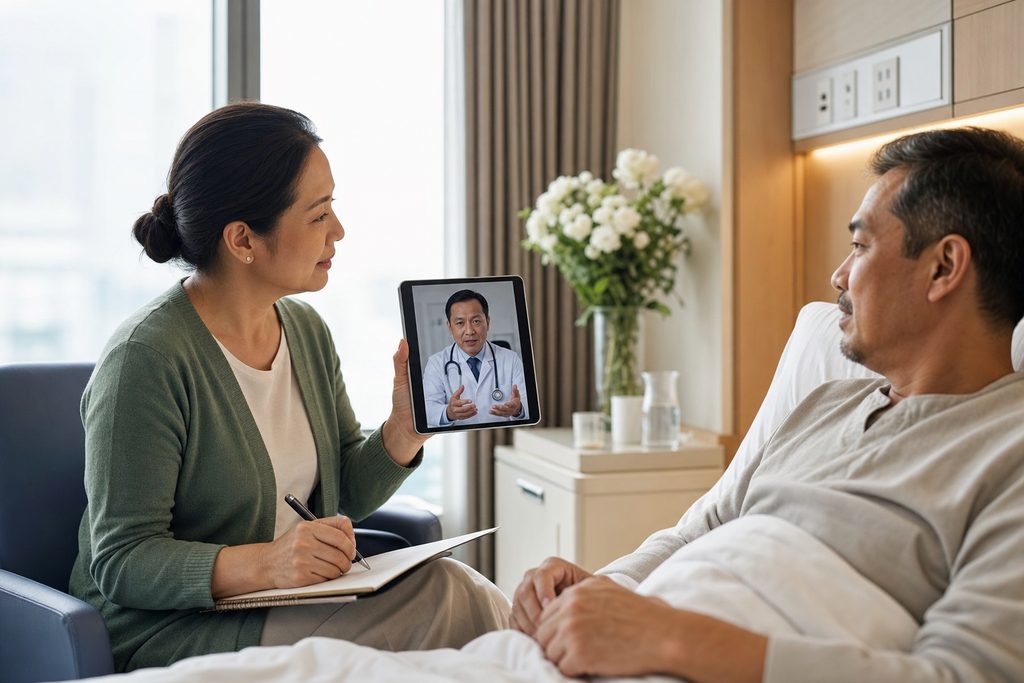
You have probably heard that getting a medical opinion from a top Chinese hospital means booking a flight, navigating a foreign city, and standing in lines you cannot read. That assumption is outdated. A proxy consultation lets a trained coordinator physically visit a hospital on your behalf, carrying your medical records, speaking directly with department staff, and returning a written report you can actually use. For international patients weighing cancer treatment cost China against options at home, this single service often answers the questions that matter most: Is my case treatable here? What would it cost? What happens next?
Key Takeaways
- A proxy consultation puts your existing medical records in front of a Chinese hospital department without requiring you to travel first — written reports typically cost $300–500 from top-tier specialists.
- The report is a clinical summary and directional recommendation, not a prescription or a binding treatment plan. It clarifies feasibility, suggested next steps, and estimated cost ranges.
- Language and hospital navigation are the biggest barriers. Chinese public hospitals see over 10,000 outpatient visits daily at major centers; a bilingual coordinator handles registration, queuing, and document submission for you.
- Any consultation fee can be credited in full toward on-the-ground coordination if you later decide to come to China for treatment — within 90 days.
The Problem: You Cannot Get a Straight Answer From 7,000 Miles Away
Cancer does not wait for visa processing times. A 2024 report from the American Cancer Society estimated over 2 million new cancer cases in the United States alone. Many patients face wait times of three to six weeks just to see an oncologist for an initial consultation. Now imagine adding international logistics to that timeline. You email a hospital in Shanghai or Beijing. No response. You call. The line connects to someone who speaks Mandarin. You try a web form. It asks for a Chinese phone number and national ID format.
The result is predictable: patients either abandon the idea of treatment in China altogether, or they book an expensive exploratory trip with no guarantee that any doctor will review their records. Neither outcome serves you. A proxy consultation exists to break this deadlock. Instead of you flying to China to ask questions, a trained medical coordinator goes to the hospital with your records and asks them for you.
Why a Proxy Consultation Works When Emails Fail
Public hospitals in China — including the 340+ top-ranked institutions we work with across 37 cities — are built around physical presence. Registration happens at machines or counters. Medical records are reviewed in person. Departments assign specialists based on same-day triage. Email inquiries from overseas rarely reach the right desk. A proxy visit inserts a human being into that system. The coordinator stands in the queue, speaks the language, submits your translated records, and collects the department’s written response.
Phone calls evaporate. A written second opinion from a top hospital specialist — priced from $300 to $500 — gives you something durable. You can share it with your local oncologist. You can translate it again if needed. You can compare it against another hospital’s response. The report typically includes: a summary of your submitted diagnosis, the reviewing department’s assessment, suggested treatment directions, and whether your case is suitable for treatment at that facility. It is for reference only. It is not a prescription. But it is specific enough to anchor real decisions.
Patients researching cancer treatment cost China often find vague ranges online. A proxy report narrows those ranges. The department can estimate the cost of surgery, chemotherapy cycles, or radiation based on your actual staging and records — not a generic brochure. Heart surgery in China, for comparison, typically runs $12,000 to $20,000 at top public hospitals versus $120,000 or more in the US. Cancer treatment varies more widely by protocol, but the same structural cost gap applies. Knowing your specific number before you travel changes the calculus entirely.
Practical tip: Before requesting a proxy consultation, gather every relevant record — pathology reports, imaging CDs, blood work, current medication list, and a one-page summary of your treatment history. Incomplete records are the number one reason a department defers a response.
What Your Proxy Consultation Report Actually Contains
Most patients imagine a single paragraph saying “yes, we can treat you” or “no, we cannot.” The reality is more useful. A well-executed proxy consultation produces a multi-section document. The first section confirms what was submitted and to which department. The second section records the department’s clinical response: whether your diagnosis is consistent with their review, what additional tests they would require, and what treatment approach they would consider. The third section addresses logistics: estimated costs, expected length of stay, and whether the hospital’s international department or VIP channel would be appropriate for your case.
Not every hospital responds the same way. Some departments write detailed clinical commentary. Others provide brief confirmations and request that you schedule a video consultation for deeper discussion. Both outcomes are valuable. The written report tells you whether this hospital is worth pursuing further. That is its core function.
Reading Between the Lines: How to Evaluate What Comes Back
A report that says “the patient’s condition is complex and requires further evaluation” is not a rejection. It is an invitation to submit more records or schedule a video call. A report that says “the department recommends surgical resection followed by adjuvant chemotherapy” gives you a concrete protocol to compare against your local oncologist’s plan. A report that lists estimated costs with specific line items — operating room fees, ward charges, medication — signals that the department took your case seriously.
And a report that is vague on every point? That usually means the records were insufficient or the wrong department was selected. This is where hospital matching matters. A patient with hepatocellular carcinoma should not be sent to a general oncology department if a specialized liver surgery center exists. Our team maintains a database of top-ranked departments across 45 specialties, including oncology, cardiac surgery, and orthopedics, so the match is deliberate rather than random.
Is It Safe to Have Surgery in China? What the Numbers Show
The question surfaces in nearly every conversation: is it safe to have surgery in China? The honest answer requires separating fear from data. China’s top hospitals are ranked by the Fudan University Hospital Management Institute, which evaluates clinical reputation and research output across 45 specialties. The top 100 hospitals on that list represent the top 5% of China’s 35,000+ hospitals. Many also hold JCI accreditation, the same international standard applied to hospitals in the US, Europe, and Singapore. You can review a list of JCI accredited hospitals in China on our site, alongside public institutions that meet comparable standards.
Volume is another factor. Fuwai Hospital in Beijing performs over 14,000 cardiac surgeries annually — the highest volume of any heart center globally. Surgeons who repeat a procedure thousands of times develop a level of proficiency that is difficult to match in lower-volume settings. That does not eliminate risk. No surgery anywhere is risk-free. But the structural conditions for safe surgery — experienced teams, modern equipment, rigorous protocols — exist at China’s top centers at a level comparable to leading Western hospitals.
How a Proxy Consultation Fits Into the Larger Medical Tourism Picture
Some patients search for how to book medical tourism package China and expect a bundled product: flight, hotel, hospital, surgery, recovery. That model exists, but it is not how serious medical travel works. Treatment plans depend on clinical findings. You cannot book a surgery package the way you book a vacation package — not responsibly. What you can do is sequence the steps: first a written second opinion or proxy consultation to confirm feasibility, then a video consultation with the specialist team, then travel for in-person evaluation and treatment.
This staged approach protects you from flying to China only to discover that the hospital cannot treat your specific condition, or that the cost is higher than expected, or that a different hospital would have been a better match. Each stage costs less than the next. Each stage de-risks the one after it. A proxy consultation is typically the cheapest and fastest first step — from $300 for hospital appointment coordination, with written second opinions from $300 to $500 depending on the hospital tier.
Important: A proxy consultation report is an informational document. It does not constitute a diagnosis, a treatment plan, or a prescription. It does not guarantee admission to any hospital. It clarifies what is possible and what it would cost. Any treatment decision should be made with your local physician and the Chinese hospital’s clinical team.
Practical Considerations: Records, Visas, and Payment
If you decide to pursue a proxy consultation, the documentation requirements are straightforward but strict. You need complete medical records translated into Chinese for most public hospital departments. Private international hospitals may accept English records, but public top-tier hospitals generally require Chinese translations. Your coordinator handles this translation as part of the service. You also need a signed authorization form allowing the coordinator to act on your behalf at the hospital. Without this, the hospital will not release any information.
Visa considerations come later, but it helps to understand them now. Foreigners traveling to China for medical treatment apply for an S2 visa, which covers short-term private affairs including medical treatment. Family members accompanying you also apply for S2. Stays exceeding 180 days require an S1 visa. The hospital’s international department can provide the supporting documents — an invitation letter and treatment confirmation — that the visa application requires. We guide patients through this process, but approval is always at the discretion of the Chinese embassy or consulate.
Payment for the proxy consultation itself is straightforward. Fees are quoted in USD, paid in advance, and any consultation fee is credited in full toward on-the-ground coordination if you proceed to treatment in China within 90 days. Hospital treatment charges are separate and are never included in coordination fees. Public hospitals require prepayment for services; private international hospitals often bill insurance directly. You should verify your insurance coverage before committing to any treatment plan.
Frequently Asked Questions
How long does a proxy consultation take?
Typically two to four weeks from the time we receive your complete translated records. The timeline varies by hospital: some departments respond within days, others take longer due to specialist availability and review queues. Incomplete records are the most common cause of delay.
What if the hospital says my case is not suitable for treatment?
That answer is valuable. It saves you the cost and stress of traveling to China for a treatment that would not happen. In many cases, we can route your records to a different hospital or department better matched to your condition. A negative response from one institution is not a dead end — it is a signal to adjust the match.
Can I use the report to get treatment at a different hospital?
Generally, no. The report reflects the reviewing department’s assessment at a specific hospital. Another hospital will want to conduct its own review of your records. However, the report can serve as supporting documentation that demonstrates your case has been professionally evaluated, which sometimes accelerates the intake process elsewhere.
Is a proxy consultation cheaper than a video consultation?
Often yes, for the simple reason that it does not require the specialist’s real-time availability. A written review can be completed between surgeries or during administrative hours. Video consultations with top specialists range from $500 to $800, while written second opinions start at $300. The right choice depends on whether you need interactive dialogue or a documented written assessment.
You have been searching for answers about cancer treatment cost China, hospital quality, and whether any of this is realistic without flying across the world first. The proxy consultation exists precisely because those answers are hard to get from a distance. It is not a guarantee of treatment. It is not a promise of outcomes. It is a professional, documented way to find out what a top Chinese hospital thinks about your case and what it would cost to pursue treatment there.
Our team at China Medical Services coordinates proxy consultations, written second opinions, and video consultations across 340+ top-ranked hospitals in 37 Chinese cities. We handle record translation, hospital registration, in-person submission, and report delivery. We are not a hospital and we do not provide diagnoses. If you want to know what a Chinese hospital would actually say about your case, request a free consultation through our patient services page and we will help you figure out the right first step.
For more medical information and treatment options in China, visit chinamedservices.com (China Medical Services).
