PSA Blood Test: What It Measures, Costs in China, and How to Get One
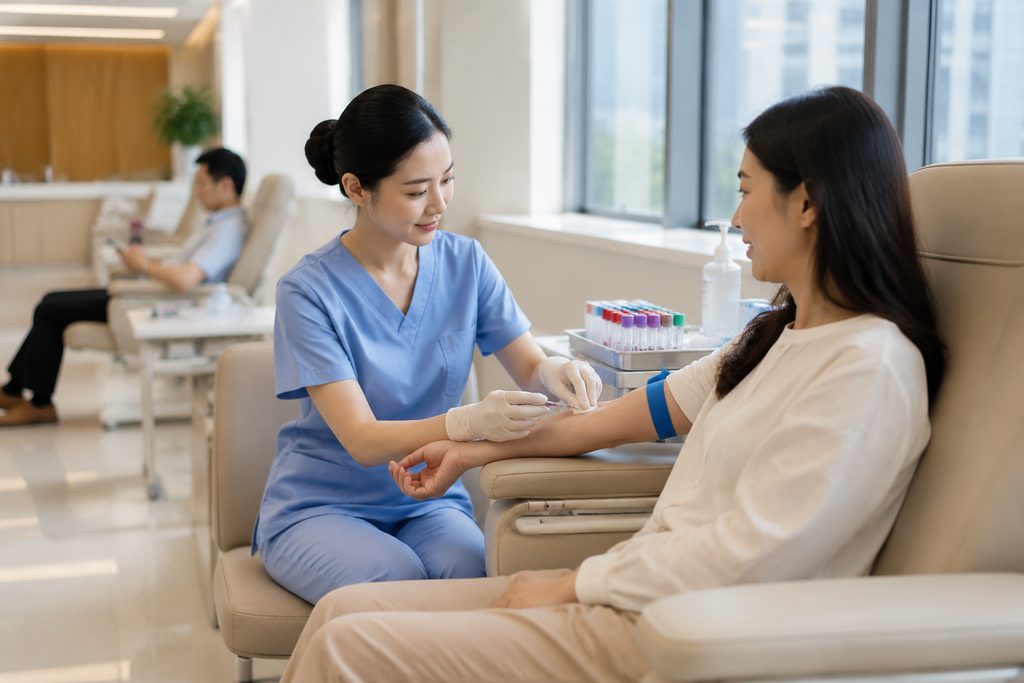
A PSA blood test measures the level of prostate-specific antigen in your bloodstream. That protein is produced by the prostate gland, and elevated levels can signal prostate cancer, an enlarged prostate, or an infection. It is a screening tool, not a diagnosis. For international patients weighing options, the PSA test cost China is often a fraction of what they would pay at home — typically between $30 and $120 at top-tier hospitals, depending on the facility and whether it is bundled with a consultation.
The test itself is simple. A nurse draws a small vial of blood from your arm. The laboratory measures PSA concentration in nanograms per milliliter. Results usually come back within 24 hours. But the context around that number matters enormously. Age, prostate size, recent sexual activity, urinary tract infections, and even bicycle riding can shift your PSA reading. A single elevated result rarely means cancer. Doctors look at trends over time, the PSA velocity, and the ratio of free to total PSA before ordering a biopsy.
That nuance is exactly why many patients seek a second opinion or a more affordable screening pathway abroad. China’s large public hospitals run these assays constantly — some process thousands of samples daily. The volume drives down cost without sacrificing accuracy. Modern immunoassay analyzers used in Shanghai and Beijing are the same Siemens, Roche, and Abbott platforms found in U.S. and European labs.
Our team at China Medical Services has helped patients coordinate PSA screening at hospitals across China’s top-ranked institutions, and the process is more straightforward than most people assume.
How This Actually Works, Step by Step
You do not need to fly to China just to get a PSA blood draw. The smart approach starts remotely.
Step 1: Send your existing records. If you have prior PSA results, ultrasound reports, or urology notes, our team translates and forwards them to a urology department for preliminary review. No travel required.
Step 2: Choose your testing pathway. You can book a standalone lab test at a hospital international department, or bundle the PSA test with a urologist consultation. Many patients choose the written second opinion route first — a specialist reviews your history and recommends exactly which tests make sense.
Step 3: Arrive and test. If you travel, the blood draw takes under 15 minutes. A bilingual companion can handle registration, payment, and navigation. Results typically return within one business day. Some hospitals offer same-day results for morning draws.
Step 4: Interpretation and next steps. A raw number without context is useless. If your result is elevated, the urologist will likely recommend a repeat test in 4–6 weeks, a free-to-total PSA ratio, or a multiparametric MRI before any biopsy decision. That staged approach prevents unnecessary procedures.
What Is a PSA Blood Test Used For — and What It Cannot Tell You
The question what is a PSA blood test used for deserves a precise answer. It has three legitimate clinical uses.
First, screening. In men aged 50–70 with average risk, PSA testing can detect prostate cancer years before symptoms appear. The U.S. Preventive Services Task Force estimates that screening reduces prostate cancer mortality by roughly 1 death per 1,000 men screened over a decade. That is a modest benefit, which is why guidelines emphasize shared decision-making.
Second, monitoring. For men already diagnosed with prostate cancer, PSA is the primary marker for tracking treatment response. After surgery or radiation, PSA should drop to near zero. A rising level afterward can indicate recurrence.
Third, evaluating symptoms. If you have urinary hesitancy, frequent nighttime urination, blood in urine, or pelvic discomfort, a PSA test helps distinguish between benign prostatic hyperplasia (BPH), prostatitis, and malignancy.
What it cannot do: tell you definitively that you have cancer. Roughly 15% of men with a PSA below 4.0 ng/mL still harbor prostate cancer, and about 75% of men with elevated PSA who undergo biopsy do not have clinically significant cancer. That is the fundamental limitation of the test, and it applies everywhere in the world — including China.
A Realistic Timeline
| Stage | What Happens | Typical Duration |
|---|---|---|
| Day 1–3 | Submit records, confirm testing plan, receive cost estimate | 1–3 days |
| Week 1–2 | Document translation, hospital appointment coordination, S2 visa preparation if traveling | 5–14 days |
| Week 2–4 | Visa processing (varies by consulate and nationality) | 5–20 days |
| Day of test | Blood draw at hospital international department | 15–30 minutes |
| Day 1–2 after test | Results available; urologist review scheduled | 1–2 days |
| Week 1 after test | Written interpretation, treatment recommendations if needed, follow-up plan | 3–7 days |
The waiting steps people forget: document translation can take two days if records are extensive. Appointment lead time at a top urology department in Beijing or Shanghai ranges from three days to two weeks. And visa processing is the least predictable variable. The S2 visa, used for short-term medical treatment and private affairs in China, requires an invitation letter from the hospital and supporting medical documents. Approval timelines vary by embassy.
But here is the reality: if you only need a PSA test and a specialist interpretation, you may not need to travel at all. A written second opinion can be completed entirely remotely in under two weeks.
What Can Go Wrong — and What Happens Then
Let us be honest about the failure modes.
Your result is elevated, and you panic. It happens. A single PSA reading of 5.2 ng/mL does not mean you have cancer. The next step is a repeat test after avoiding ejaculation, vigorous exercise, and cycling for 48 hours. If still elevated, a free-to-total PSA ratio or an mpMRI provides far more diagnostic value than an immediate biopsy. Chinese urologists increasingly follow this MRI-first pathway, which reduces unnecessary biopsies by up to 30%.
You cannot get an appointment quickly enough. Top public hospitals in China see enormous patient volumes. A walk-in at a general outpatient clinic requires same-day queueing and Mandarin fluency. The international department route solves this but costs more — typically 1.5 to 2 times the standard fee. That is the trade-off. Our coordination service exists precisely because navigating this without language skills is extremely difficult.
Your home doctor dismisses the Chinese result. Some Western physicians are unfamiliar with Chinese laboratory standards. In practice, the major hospitals in Shanghai and Beijing use internationally calibrated assays and participate in external quality assurance programs. Request a copy of the lab report with reference ranges and analyzer model. Most Western urologists will accept it. If not, the test is inexpensive enough to repeat at home.
You booked through the wrong channel. This is common. A foreigner arrives at a public hospital, tries to register at the general window, and gets lost in a queue of thousands. The fix is simple: use the hospital’s international medical center or a coordination service. The price difference is modest for a PSA test, and the experience difference is enormous.
How Accurate Is PSA Test in China — and What Affects the Number
The question how accurate is PSA test in China comes up frequently. The short answer: the test is analytically accurate wherever modern immunoassay platforms are used. Chinese tertiary hospitals run internal quality controls daily and participate in national proficiency testing programs. The assay itself is not the weak point.
The weak point is biological variability. PSA levels fluctuate naturally. A 2019 study in the Journal of Urology found that up to 40% of men with an initially elevated PSA have a normal result on repeat testing. That is not a China-specific issue — it is biology.
Factors that temporarily raise PSA include: urinary tract infection, prostatitis, recent ejaculation (within 48 hours), vigorous exercise, prostate massage, and urinary retention. Factors that lower PSA include: finasteride or dutasteride use, which can suppress PSA by roughly 50%. Any urologist worth consulting will ask about these before interpreting your number.
So when a patient asks how accurate the test is, the honest answer is: the machine is accurate to within 5–10% coefficient of variation. The clinical interpretation is where expertise matters. A reading of 3.8 in a 55-year-old means something different than 3.8 in a 75-year-old. Age-adjusted reference ranges exist for a reason.
PSA Test Price Shanghai vs Beijing: What You Actually Pay
Let us talk numbers. The PSA test price Shanghai at a public hospital international department typically ranges from $40 to $100 for the lab test alone. Beijing is comparable — $35 to $120 depending on the hospital tier. Add a urologist consultation and the total lands between $150 and $400. At private international hospitals like United Family or Jiahui, expect $200 to $500 for the full package with an English-speaking physician.
Compare that to the United States, where a standalone PSA test at a commercial lab costs $50–$150 without insurance, but a urologist consultation and interpretation can push the total to $400–$900. In the UK, the NHS does not routinely offer PSA screening without symptoms; private testing runs £80–£300. In Germany, expect €30–€80 for the lab test plus consultation fees.
The cost advantage in China is real but not dramatic for a simple blood test. Where the savings become significant is in the downstream pathway: an mpMRI prostate scan costs $300–$600 in China versus $1,500–$3,000 in the U.S. A prostate biopsy runs $800–$1,500 in China versus $4,000–$10,000 in the U.S. That is where the math shifts decisively.
Several hospitals in Beijing and Shanghai offer PSA screening packages for foreign patients China that bundle the blood test, a digital rectal exam, a urology consultation, and sometimes an ultrasound. These packages typically run $250–$600 and include English-language report translation. They are designed for medical tourists who want a comprehensive baseline assessment in one visit.
Practical Considerations: Booking, Visas, and Follow-Up
If you decide to book PSA blood test Beijing hospital or in Shanghai, here is what actually matters.
Records. Bring any prior PSA results, prostate ultrasound images, biopsy reports, and a current medication list. If you take finasteride, dutasteride, or testosterone supplements, disclose this. It changes the interpretation.
Visa. Medical treatment in China falls under the S2 visa category for short stays. You will need an invitation or appointment confirmation from the hospital, plus standard application materials. Family members accompanying you also apply for S2 visas. Processing times vary. Do not book flights until the visa is approved.
Payment. Public hospitals in China generally require prepayment or same-day payment. International departments accept credit cards; general outpatient departments often require a hospital-issued payment card loaded with cash. Insurance reimbursement is retrospective — you pay first, then claim. Private international hospitals with JCI accreditation often bill insurers directly.
Language. A PSA test is simple, but the surrounding bureaucracy is not. Registration forms, payment counters, lab pickup windows — all operate in Mandarin. A bilingual companion transforms this from a frustrating half-day into a 45-minute errand.
Follow-up at home. Your Chinese urologist can provide a written report in English with specific recommendations. Share it with your primary care physician. If repeat testing is advised, you can do it locally and send results back for review — no need to return to China for a blood draw.
Frequently Asked Questions
There is no single normal number. Common age-adjusted upper limits are 2.5 ng/mL for ages 40–49, 3.5 for 50–59, 4.5 for 60–69, and 6.5 for 70–79. But these are guidelines, not rules. A urologist weighs your PSA against prostate size, family history, and prior readings.
Yes. At international departments and private hospitals, you can book a PSA test directly. At general public hospital outpatient clinics, you typically need to see a doctor first who orders the test. For foreign patients, the international department is the practical route.
Most major hospitals return PSA results within 24 hours. Some international departments offer same-day results for morning blood draws. A written interpretation from a urologist adds one to three days.
Yes. The assay methodology — typically electrochemiluminescence immunoassay on Roche or Siemens platforms — is identical to what you would encounter in the U.S., Europe, or Australia. The reference ranges are the same. The difference is cost and access speed, not analytical quality.
Do not rush to biopsy. The standard next step is a repeat PSA after 4–6 weeks, followed by a free-to-total PSA ratio and possibly an mpMRI. Chinese urologists at top-tier hospitals are well-versed in this staged diagnostic pathway. A biopsy is only indicated when imaging or PSA dynamics suggest clinically significant disease.
Your Next Step
A PSA blood test is a simple, inexpensive screening tool — but the value lies in who interprets it and what happens next. If you are considering testing in China, or if you have an abnormal result and want a specialist review before committing to invasive procedures, we can help. Our team coordinates PSA testing, urologist consultations, and written second opinions at China’s top-ranked hospitals. We do not provide medical advice ourselves — we connect you with the physicians who do, and we handle the logistics in between.
Start with a conversation. Tell us your situation, and we will tell you honestly whether traveling to China makes sense for you. Request a free consultation and get a clear picture of your options.
Prostate cancer caught early is treatable. The first step is a blood test. The second step is understanding what the number means.
For more medical information and treatment options in China, visit chinamedservices.com (China Medical Services).
