Revision Hip Surgery: Why It’s More Complicated and What You Need to Know
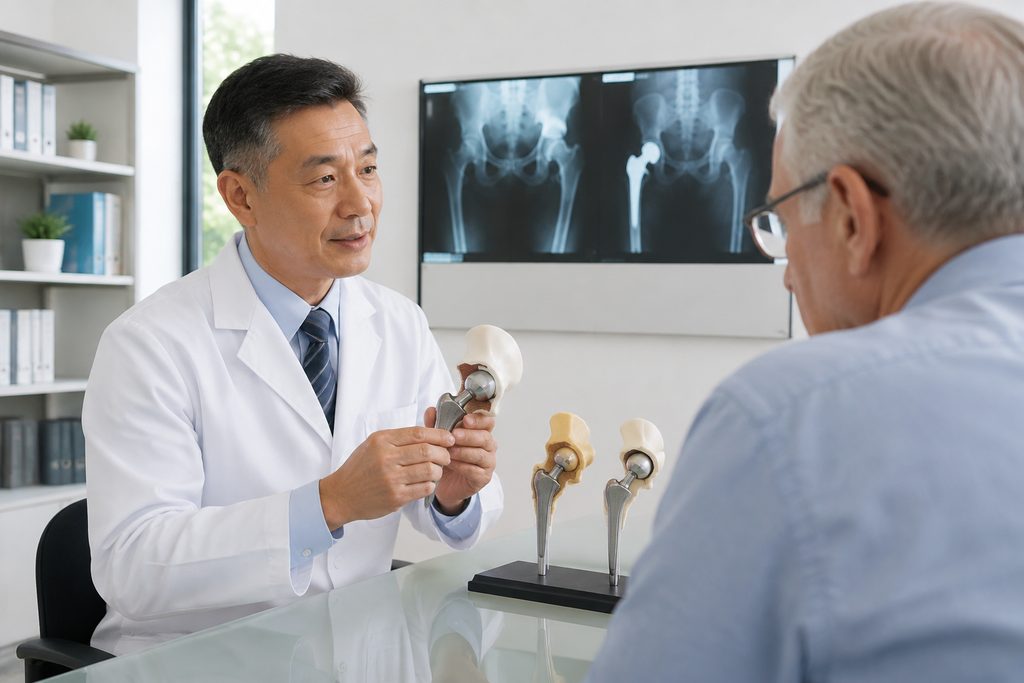
Have you ever wondered whether a failed hip replacement means living with pain forever? The short answer is no. But revision hip surgery is a different animal from the first operation. It demands more from the surgeon, the hospital, and you.
Revision Hip Surgery: The Short Answer
Yes, revision hip surgery is significantly more complicated than primary hip replacement. The procedure takes roughly twice as long. Blood loss runs higher. Infection rates climb from under 1% to 3-5%. The surgeon faces scar tissue, hidden bone defects, and components that may have loosened or fractured. But “more complicated” does not mean “impossible.” High-volume centers perform these operations weekly with outcomes that return most patients to walking without major pain. The real question is whether you end up in the right hands.
Why the added risk? The first surgery removes damaged cartilage and bone in a clean, predictable pattern. The revision starts with removing the old implant. Cement must be chipped out. Bone may have been eaten away by wear particles. The socket might be cracked. Every step introduces variables that a primary surgery never faces.
Who This Is Right For — and Who It Isn’t
Revision surgery suits patients whose original implant has failed in a way that affects daily function. That includes loosening, infection, instability, or fracture around the implant. You should pursue it if pain limits walking, disturbs sleep, or no longer responds to medication and physical therapy.
A good candidate typically has:
- Confirmed mechanical failure on X-ray or CT, not just vague pain
- Bone stock adequate enough to support a new implant, possibly with augments or grafts
- No active systemic infection, or an infection that has been treated in a staged protocol
- Realistic expectations about recovery time and final function
Who should not rush into revision surgery? A patient with mild discomfort and no clear mechanical problem on imaging. Someone with uncontrolled diabetes, smoking, or severe vascular disease that impairs bone healing. And anyone whose pain is primarily coming from the spine, nerves, or soft tissues rather than the implant itself. The worst outcome is a revision that does not solve the pain because the pain was never coming from the hip.
We have also seen patients with infected implants fly across continents hoping for a quick fix. That is not how this works. Infection cases often require two operations months apart. Anyone promising otherwise is not being honest with you.
The Options, Compared
Revision hip surgery is not one operation. It is a family of procedures. What you need depends on what failed. The table below lays out the main pathways a surgeon might take.
| Approach | What It Involves | Typical Operating Time | Hospital Stay | Best For |
|---|---|---|---|---|
| Single-stage revision | Remove old implant, place new one in same operation | 2-4 hours | 3-7 days | Aseptic loosening, no infection |
| Two-stage revision | Remove implant, place antibiotic spacer, wait 6-12 weeks, then new implant | Two operations, 1.5-3 hours each | 3-5 days per stage | Confirmed or suspected infection |
| Component-only exchange | Replace only the liner or the femoral head, keep the stem and cup | 1-2 hours | 1-3 days | Isolated liner wear, early instability |
| Complex reconstruction | Add augments, cages, or structural allograft to rebuild lost bone | 3-6 hours | 5-10 days | Severe bone loss, pelvic discontinuity |
Which column fits you depends on one test above all: whether infection is present. A blood test for CRP and ESR, plus a joint fluid aspiration, answers that in most cases. If infection is ruled out, a single-stage revision is the default. If infection is confirmed, the two-stage route is non-negotiable in most high-volume centers. Component-only exchange is the least invasive option and works well when the problem is caught early — before the metal parts have damaged the bone around them.
How Complicated Is Revision Hip Surgery, Really?
The complexity is not theoretical. It shows up in every measurable outcome. A 2021 study in The Journal of Arthroplasty reported that revision total hip arthroplasty carried a 30-day readmission rate of 6.1%, versus 3.2% for primary cases. Operative time averaged 138 minutes for revisions against 94 minutes for primaries. Transfusion rates doubled. These are not small differences.
What drives the difficulty? Bone loss is the big one. When an implant loosens, the body responds by absorbing bone around it. By the time you feel pain, the socket may have lost 30% or more of its supporting structure. The surgeon then has to rebuild that foundation before placing a new cup. That may mean metal augments, cages, or bone graft. Each adds time and risk.
Scar tissue is the second challenge. The first operation leaves a thick capsule of fibrous tissue. Cutting through it safely without damaging the sciatic nerve or major blood vessels takes experience. The femoral nerve, the femoral artery, and the sciatic nerve all sit close enough to be injured by an aggressive or rushed approach.
And then there is the implant itself. Removing a well-fixed stem can require an extended osteotomy — literally splitting the femur open lengthwise to get the old stem out. That is a controlled fracture. It heals, but it adds months to recovery and changes the rehabilitation plan entirely.
So when you ask how complicated revision hip surgery is, the honest answer is: considerably more than the first one, and the complication rate tracks directly with how many of these the surgeon does per year.
What Revision Hip Replacement Cost China Looks Like
Revision hip replacement cost China typically runs between $18,000 and $35,000 at top-tier public hospitals, depending on implant type and bone defect complexity. Private international hospitals in Shanghai or Beijing charge more — often $40,000 to $60,000. Compare that to the United States, where the same procedure commonly bills at $50,000 to $90,000 before insurance negotiation. Even at the high end, China comes in 40-60% below US list prices.
What does that number include? At most Chinese hospitals, the quoted price covers the implant, surgeon fees, anesthesia, operating room time, and a standard ward bed for the expected stay. It does not include preoperative imaging if you need new CT scans, extended ICU care, blood products beyond a certain threshold, or a private room upgrade. Those are billed separately.
What drives the variance? The implant. A standard revision stem and cup with a highly cross-linked polyethylene liner costs far less than a trabecular metal cup with augments and a modular stem. If you need a custom triflange implant for severe pelvic bone loss, the implant alone can exceed $15,000. Bone graft adds another $2,000 to $5,000 depending on whether it is allograft or synthetic.
For international patients, the coordination process also adds a layer. Hospital international departments charge a premium for English-speaking staff and expedited scheduling. That premium is real, but it is still far below what a Western hospital bills for the same operation.
Practical Considerations: Records, Visa, and Follow-Up
Revision surgery abroad is not like booking a primary hip replacement. You are bringing a failed operation to a new surgeon who has never seen you. That surgeon needs everything from the first surgery: the operative report, the implant labels with exact model and size, serial X-rays from immediately after surgery through today, and any blood work related to infection. Without the implant labels, the surgeon may not know what removal tools to have ready.
Visa logistics matter too. Medical treatment in China falls under the S2 visa category, not the M visa, which is for commercial trade. You apply with an invitation letter from the hospital, your passport, and supporting medical documents. Family members traveling with you also apply for S2. Processing times vary by consulate, so start this at least six to eight weeks before your intended travel date.
Payment at Chinese public hospitals is prepaid. You deposit an estimated amount at admission, and the hospital draws from it as services are delivered. International insurance is usually reimbursement-based, meaning you pay first and file claims after. Private international hospitals in China — including those in our private hospital network — may bill your insurer directly if they have an agreement in place.
Language is the quiet obstacle. Top-tier Chinese hospitals are enormous. A single orthopedic department may see 500 outpatients in a morning. Signs are in Chinese. Pharmacy, imaging, and billing are in different buildings. A bilingual companion who knows the hospital layout turns a four-hour maze into a 90-minute visit. That is not a luxury. It is the difference between getting the right tests ordered and missing your imaging window entirely.
Follow-up after returning home is the piece most patients forget. You will need X-rays at six weeks, three months, six months, and one year. Your local orthopedic surgeon can do those. But that surgeon needs a clear operative report and a direct line to the Chinese team for questions. Make sure the hospital provides discharge documentation in English before you leave.
Frequently Asked Questions
Most patients stay in the hospital for 3 to 7 days after a single-stage revision. You will walk with a walker within 24 hours. Crutches or a cane for four to six weeks is typical. Full recovery — meaning walking without aids and returning to most daily activities — takes three to six months. If you had a two-stage revision for infection, add the six to twelve weeks between operations. Bone graft or structural reconstruction pushes recovery toward the longer end of every range.
Some component-only exchanges can use smaller incisions, but a full revision is not a minimally invasive procedure. The surgeon needs wide exposure to remove the old implant safely and assess bone damage. Any hospital claiming to do a complex revision through a 3-inch incision is either doing a different operation or misleading you. What matters more than incision length is whether the surgeon uses modern techniques like extended trochanteric osteotomy when needed and has access to revision implant systems.
At high-volume centers, roughly 85-90% of revision implants are still functioning well at ten years. That is lower than the 95% ten-year survival for primary hips, which is why surgeons try to preserve the original implant whenever possible. Infection cases have a lower success rate because the bacteria can hide in biofilm and resurface years later. The single biggest predictor of success is surgeon volume — someone doing 50 or more revisions per year has materially better outcomes than someone doing 10.
Shanghai has several hospitals with strong orthopedic departments. The best hospital for revision hip replacement Shanghai depends on your specific failure mode. Hospitals with high annual joint replacement volume and dedicated revision teams are the priority. Look for a department that publishes its revision volume or at least performs enough primary cases to maintain deep experience with complex reconstruction. Our orthopedics department rankings break down which hospitals lead in joint surgery across China, including Shanghai.
Some agencies sell all-inclusive packages that bundle surgery, hotel, transport, and translation. They can simplify logistics, but read the fine print. A package that quotes a fixed price before the surgeon has reviewed your imaging is guessing. Revision surgery pricing depends on bone loss severity, which only shows up on CT. A legitimate process starts with a remote review of your records and imaging, followed by a written second opinion. Only after the surgeon confirms what procedure you need can anyone give you a real price. Be wary of packages that skip that step.
Your Next Step
Revision hip surgery is more complicated than the first operation — that is the honest truth. But complication is a problem of preparation, not a reason to avoid treatment. The patients who do best are the ones who gather complete records, choose a surgeon who does this work weekly, and understand the recovery timeline before they commit.
We are China Medical Services, a coordination team that connects international patients with top-tier Chinese hospitals. We are not a hospital, and we do not diagnose or treat anything. What we do is handle the logistics — hospital matching, record translation, appointment coordination, and bilingual support on the ground. If you are considering revision surgery in China, start with a conversation. Send us your imaging and operative reports. We will help you understand your options and whether this path makes sense for you. No pressure, no promises we cannot keep.
Your hip failed once. That does not mean you are out of options. It means the next decision matters more.
For more medical information and treatment options in China, visit chinamedservices.com (China Medical Services).
