Robotic Surgery China SE Asia: When da Vinci Isn’t Accessible at Home
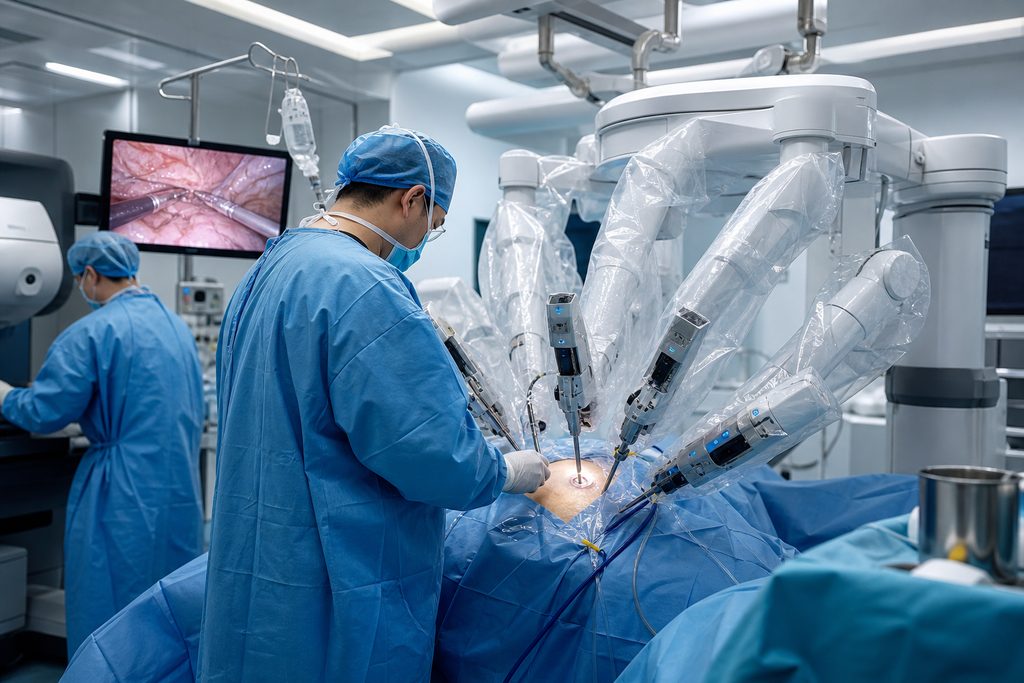
You have probably heard that traveling abroad for surgery means accepting lower standards. A compromise. Something you do only when you have no other choice.
The numbers tell a different story.
China now operates more da Vinci surgical systems than any country outside the United States. Over 370 systems installed as of early 2025. Surgeons here perform more than 120,000 robotic-assisted procedures annually. When a surgeon has done the same complex procedure thousands of times, the data on outcomes shifts in ways that challenge old assumptions about where the best care lives.
But the question that brings most international patients to our inbox is simpler than all that. You searched for robotic surgery options because da Vinci is not available at home, or the wait is impossibly long, or the quote you received would wipe out your savings. You want to know if China is a real option.
It is. With specific conditions. Let us walk through exactly what that means.
The Short Answer on da Vinci Robotic Surgery Cost China
The da Vinci robotic surgery cost in China typically runs 60% to 80% less than what you would pay in the United States, Australia, or Western Europe. A robotic prostatectomy that might cost $40,000 to $65,000 in the US often falls between $12,000 and $20,000 at a top-tier Chinese hospital. Robotic hysterectomy packages start from approximately $10,000 to $15,000.
Those are real figures. Not estimates pulled from thin air. Our team has coordinated enough cases to see the invoices.
But cost alone is not the whole picture. The price advantage exists because China’s hospital infrastructure operates on a fundamentally different economic model than Western healthcare systems. Volume drives down per-procedure costs. A surgeon at a major Beijing or Shanghai hospital may perform 400 robotic prostatectomies in a year. A surgeon in a mid-sized Western city might do 40. That repetition does not just affect price. It affects outcomes.
The caveat: these prices apply at China’s top-tier public hospitals through their international departments. Private international hospitals charge more, though still significantly less than Western equivalents. And you cannot simply book a surgery online like a hotel room. There is a process. We will cover it.
Who This Is Right For — and Who It Isn’t
Robotic surgery in China makes the most sense for a specific kind of patient. Someone who needs a procedure that is well-suited to robotic techniques, who faces a long wait or prohibitive cost at home, and who is healthy enough to travel.
Good candidates typically include:
- Patients needing prostatectomy, hysterectomy, colorectal resection, or thoracic procedures where robotic precision offers clear advantages over open surgery
- Those facing wait times exceeding 6 months in their home country for a condition that should not wait that long
- Patients who have received a confirmed diagnosis and surgical recommendation but cannot afford the procedure locally
- Individuals who are mobile, stable, and cleared by their home physician for international travel
Who should not pursue this path:
- Patients with unstable cardiac or respiratory conditions that make long-haul flights risky
- Those whose condition requires emergency surgery within days or weeks — international coordination takes time
- Individuals seeking experimental or unproven procedures not supported by clinical evidence
- Patients unwilling to stay in China for post-operative monitoring, which typically requires 10 to 21 days depending on the procedure
Being clear about who should stay home is not discouraging anyone. It is protecting people from making a difficult situation worse. We have turned away cases where the travel risk outweighed the surgical benefit. Any reputable coordinator will do the same.
The Options, Compared
When da Vinci surgery is not accessible at home, patients from Southeast Asia, the Middle East, and Western countries typically weigh a few alternatives. Here is how they stack up.
| Factor | China (Top-Tier Public) | Thailand (Private Hospital) | South Korea (Tertiary Hospital) | India (Private Corporate Hospital) |
|---|---|---|---|---|
| Robotic prostatectomy cost | $12,000–$20,000 | $18,000–$28,000 | $25,000–$38,000 | $8,000–$14,000 |
| da Vinci systems nationally | 370+ | 15–20 | 50+ | 70+ |
| Annual robotic case volume (top center) | 1,500+ | 300–500 | 600–900 | 400–700 |
| JCI-accredited options | Yes (multiple) | Yes (widely available) | Yes (multiple) | Yes (multiple) |
| English-speaking surgical team | International dept. only | Standard | Limited | Standard |
| Typical wait for surgery | 2–4 weeks post-consult | 1–3 weeks | 2–6 weeks | 1–3 weeks |
| Post-op stay required | 10–21 days | 10–14 days | 10–21 days | 7–14 days |
India offers the lowest headline prices. Thailand and South Korea market themselves aggressively to medical tourists with polished international patient programs. But China’s position is distinct: unmatched robotic case volumes at major centers, and a depth of subspecialty expertise that comes from serving a domestic population of 1.4 billion.
The right choice depends on what you are optimizing for. If budget is the only consideration, India leads. If you want a well-established medical tourism infrastructure with minimal coordination friction, Thailand or South Korea may appeal. If your priority is a surgical team that has performed your specific procedure thousands of times, China’s top-tier robotic centers become hard to ignore.
What the Best Robotic Surgery Hospital in Beijing for International Patients Actually Offers
The search for the best robotic surgery hospital in Beijing for international patients usually leads to a short list of institutions. Peking Union Medical College Hospital. Chinese PLA General Hospital. Beijing Friendship Hospital. Each runs multiple da Vinci systems and handles international cases through dedicated departments.
But naming hospitals only gets you so far. What matters is what happens when you arrive.
At a top Beijing robotic surgery center, the international patient pathway typically works like this. You send your medical records, imaging, and biopsy results ahead of time. The surgical team reviews everything and confirms whether you are a candidate for robotic surgery specifically. Not every patient is. Sometimes a conventional laparoscopic approach is actually better. A reputable hospital will tell you that rather than automatically agreeing to a more expensive robotic procedure.
If robotic surgery is appropriate, the team provides a treatment plan with a cost estimate. You travel to Beijing. You meet the surgeon in person. Pre-operative testing happens over one to two days. Surgery is scheduled. Post-operative monitoring continues until the surgical team clears you to fly home.
The hospitals with da Vinci robot in Shanghai follow a similar model. Ruijin Hospital, Zhongshan Hospital, and Huashan Hospital all operate multiple systems and maintain international patient offices. Shanghai’s advantage for some patients is simply logistical: more direct international flights, a more expatriate-friendly urban environment, and slightly more English signage throughout the city.
But here is what no hospital website will tell you upfront. Navigating a Chinese public hospital without Mandarin fluency is exhausting even for locals. For an international patient, it is nearly impossible without support. Registration counters, lab slips, pharmacy instructions, discharge paperwork — none of it is in English. This is not a criticism. It is simply the reality of a healthcare system built for a domestic population. Understanding this before you arrive prevents a lot of frustration.
Is Robotic Surgery Cheaper in China Than at Home? Breaking Down the Numbers
The short answer is yes. The longer answer requires looking at what is included and what is not.
A robotic prostatectomy at a US hospital might bill at $40,000 to $65,000 for the hospital and surgeon fees alone. That figure often excludes anesthesia, pathology, and post-operative care, which can add another $5,000 to $10,000. The same procedure in China at a top-tier public hospital’s international department typically runs $12,000 to $20,000 inclusive of the surgeon fee, hospital stay, operating room costs, and standard post-operative monitoring.
The gap widens further for procedures like robotic hysterectomy. Patients searching for a book robotic hysterectomy package China option will find all-inclusive international patient packages starting around $10,000 to $15,000. Comparable packages in the US or Australia frequently exceed $35,000.
What drives the difference? Three factors. Labor costs for hospital staff and surgical teams are lower. Malpractice insurance burdens are minimal compared to the US. And volume — Chinese surgeons operating at high robotic case volumes achieve efficiency that reduces per-procedure time and complication rates, which in turn shortens hospital stays.
But you need to budget for costs beyond the hospital bill. Round-trip flights. Accommodation for your recovery period. A bilingual medical companion if you are not fluent in Mandarin, which we strongly recommend. Visa fees. These add several thousand dollars to the total. Even accounting for all of that, the all-in cost typically lands at 50% to 70% less than paying out of pocket in a Western country.
What Is the Success Rate of Robotic Prostatectomy in China?
Patients searching for what is the success rate of robotic prostatectomy in China are usually asking two things. Does the surgery remove the cancer completely? And will I recover urinary continence and sexual function?
On oncologic outcomes, published data from major Chinese centers show results consistent with international benchmarks. A 2023 study from a leading Shanghai urology center reported positive surgical margin rates of 12% to 15% for organ-confined prostate cancer, comparable to the 11% to 16% range reported in large Western series. Five-year biochemical recurrence-free survival exceeds 85% for intermediate-risk disease at experienced centers.
On functional outcomes, the numbers reflect what you would expect from high-volume surgeons. At 12 months post-surgery, continence recovery rates of 85% to 92% are reported. Erectile function recovery varies more widely — 50% to 70% depending on patient age, baseline function, and whether a nerve-sparing technique was possible.
These are not guarantees. No ethical surgeon offers guarantees. But the data aligns with what the volume argument would predict: surgeons who perform several hundred prostatectomies annually tend to achieve outcomes at or above international norms.
The question worth asking is not whether Chinese robotic surgeons are competent. The published evidence says they are. The question is whether the specific surgeon and hospital you are considering can demonstrate their own outcome data. The best centers track and share this information. Ask for it.
Practical Considerations: Records, Visas, and Follow-Up
Planning robotic surgery abroad means managing logistics that have nothing to do with medicine and everything to do with whether your trip goes smoothly.
Medical records come first. You need a complete dossier: confirmed diagnosis, imaging reports (preferably DICOM files on a CD or USB), pathology slides and reports, a referral letter from your home physician recommending surgery, and a summary of any prior treatments. Chinese hospitals will not proceed without a confirmed tissue diagnosis for cancer cases. If your home diagnosis is unclear, expect to repeat the biopsy in China.
Visa requirements are straightforward but specific. Medical treatment in China falls under the S2 short-term private affairs visa category, not the M business visa. The S2 requires an invitation letter from the Chinese hospital confirming your treatment arrangement. Processing typically takes one to two weeks at most Chinese embassies and consulates. Your accompanying family member applies for the same S2 category. Do not let anyone tell you to apply for an M visa for medical purposes. That is incorrect and risks rejection at the border.
Follow-up after returning home requires planning. Your Chinese surgeon will provide a detailed discharge summary and recommendations for ongoing monitoring. You need a local physician willing to receive those records and manage your post-operative care. Identify that physician before you travel. Most are cooperative when they understand the situation, but assuming rather than confirming is a mistake.
Language remains the single largest practical barrier. Hospital international departments have English-speaking coordinators, but their availability is limited. Floor nurses, lab technicians, and administrative staff communicate in Mandarin. A bilingual medical companion bridges this gap for the duration of your hospital stay and follow-up visits. It is not a luxury. It is the difference between understanding your discharge instructions and guessing at them.
Frequently Asked Questions
Can I book robotic surgery in China without traveling there first for a consultation?
In most cases, no. Chinese public hospitals require an in-person consultation before scheduling surgery. The surgeon needs to examine you, review your imaging personally, and confirm the treatment plan. What you can do remotely is submit your records for a preliminary review. The surgical team will tell you whether you appear to be a candidate and provide a provisional treatment plan and cost estimate. But the final decision and scheduling happen after you arrive. Some private international hospitals offer more flexibility, but even they typically want to see you before committing to a surgery date.
What happens if something goes wrong during or after the surgery?
Chinese hospitals carry liability insurance, and international departments have protocols for managing complications. But the legal framework for medical malpractice in China differs significantly from Western countries. Compensation amounts are lower. Litigation is difficult for foreign patients. The practical protection is choosing a hospital with strong clinical outcomes and a well-established international patient program that has dealt with complications before. Ask directly about their complication rates and management protocols. A hospital that answers transparently is one you can trust more than one that dodges the question.
Will my insurance cover robotic surgery in China?
Most Western health insurers do not have direct billing arrangements with Chinese public hospitals. Some international insurance plans with global coverage may reimburse treatment at JCI-accredited facilities in China, but pre-authorization is essential. Contact your insurer before making any commitments. Get written confirmation of what they will cover. Do not assume. Patients who skip this step sometimes find themselves with a reimbursement denial and a bill they did not plan for.
How long do I need to stay in China after robotic surgery?
For a robotic prostatectomy or hysterectomy, plan on 10 to 14 days minimum after discharge from the hospital. The hospital stay itself is typically 3 to 7 days. Your surgeon will want to see you for at least one follow-up visit before clearing you to fly. Some patients stay longer — up to 21 days — if they want the catheter removed and a final check before traveling. Long-haul flights immediately after abdominal or pelvic surgery carry a risk of deep vein thrombosis. Your surgeon will advise on the safe window for your specific case. Listen to that advice.
Your Next Step
Robotic surgery in China is not the right answer for everyone. But for patients facing unaffordable quotes or year-long waits at home, it deserves serious consideration. The combination of high surgical volumes, modern da Vinci systems, and costs that run 60% to 80% below Western prices creates an option that did not exist a decade ago.
Our team at China Medical Services helps international patients navigate this path. We are not a hospital. We do not provide medical advice or make diagnoses. What we do is handle the coordination that makes treatment in China feasible: identifying appropriate hospitals and surgeons, arranging remote record reviews, coordinating in-person consultations, providing bilingual medical companions, and supporting you through discharge and follow-up planning.
If you want to understand whether robotic surgery in China fits your situation, reach out for a free consultation. We will ask about your diagnosis, review what you have already done, and give you an honest assessment of your options. No pressure. No sales pitch. Just the information you need to make a decision you can feel confident about.
For more medical information and treatment options in China, visit chinamedservices.com (China Medical Services).
