Robotic Urologic Surgery in China: How to Book It Right
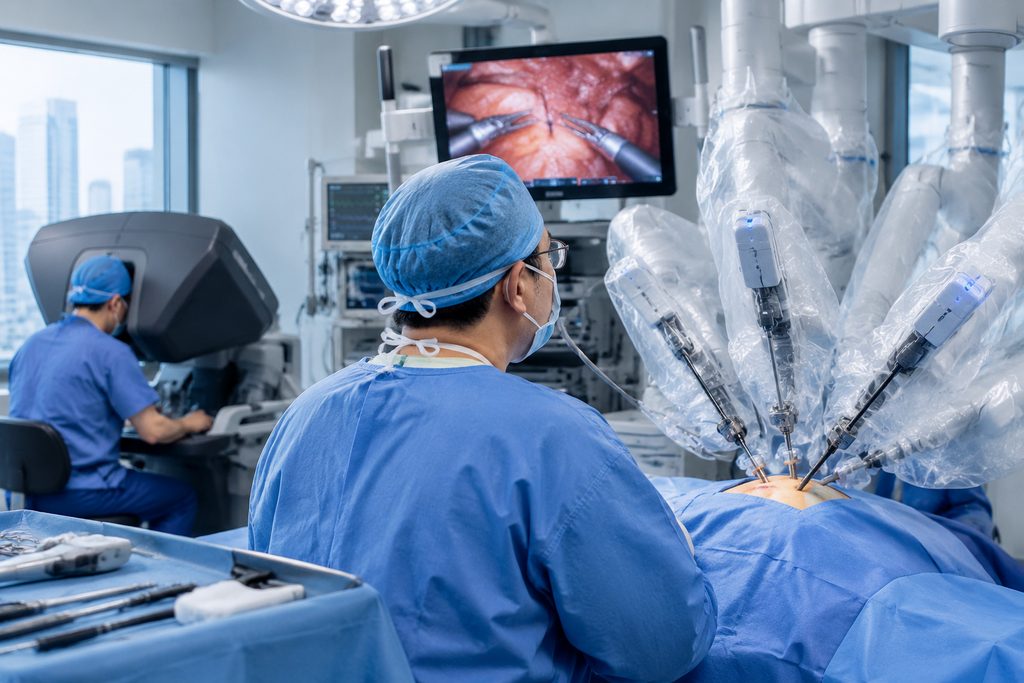
Robotic Urologic Surgery in China: How to Book It Right
What if the robotic prostatectomy you were quoted $45,000 for in the United States could be performed in Shanghai for a fraction of that — by a surgeon who does several hundred of them a year? Robotic urologic surgery in China is no longer a well-kept secret among international patients. It is a real, structured option. The hard part is not the surgery itself. It is the booking.
Our team at China Medical Services coordinates hospital access for foreign patients across 340+ top-ranked hospitals in 37 cities. What follows is the honest version of how this works — including the parts that trip people up.
Key Takeaways
- Robot-assisted procedures for prostate, kidney and bladder conditions typically run $12,000–$30,000 in China’s top public hospitals, versus $40,000–$150,000+ in the US, depending on complexity.
- China’s high-volume centers give surgeons far more annual case exposure than the average Western urologist — volume is the single biggest quality signal to look for.
- The real obstacle is not cost or quality. It is access: public hospital outpatient slots cannot be reserved from overseas, and surgery requires an in-person consultation first.
- Foreign patients need an S2 visa for short-stay medical treatment — not an M visa, which is for commercial and trade activity only.
The Problem: You Have a Diagnosis, a Quote, and No Clear Path
A 62-year-old man in Ohio is told his prostate biopsy came back positive. His urologist recommends robot-assisted radical prostatectomy. The hospital’s financial office hands him an estimate: $48,000, assuming his insurance covers 70% after deductible. He waits six weeks for a surgical date. Then he waits again when the schedule shifts.
This is not an unusual story. It is the default. In the United States, the average wait from urologic cancer diagnosis to surgery frequently stretches past 45 days, and patients in some metropolitan areas report longer. Costs for robotic prostatectomy vary wildly by state — from roughly $35,000 at a lower-cost facility to well over $135,000 at a major academic center, according to published hospital charge data.
Meanwhile, the clinical outcome data has largely converged. Robot-assisted surgery is robot-assisted surgery. The difference between a good center and a great one comes down to surgeon volume, team experience, and how complications are managed when they occur.
So the question shifts. It is no longer “can I afford this?” It becomes “where do I get the best version of this operation, at a price that does not require a second mortgage?”
Why China’s Top Urology Centers Deliver Results
Clinical Volume Changes Everything
China’s leading public hospitals are enormous. A single top-tier center may perform more robotic urologic procedures in a year than a mid-sized American health system does across all its sites combined. Fuwai Hospital, for context, is the world’s highest-volume cardiac surgery center at over 14,000 operations annually — a scale that reflects how Chinese tertiary hospitals concentrate expertise.
Urology follows the same pattern. Surgeons at hospitals ranked in the Fudan University Hospital Rankings’ specialist reputation lists for urology are operating constantly. That repetition matters. Studies on surgical outcomes consistently link higher annual surgeon case volume to lower complication rates and better functional recovery in prostate and kidney surgery.
You are not getting a lesser operation. In many cases, you are getting one performed by someone who has done it more times this year than your local surgeon has done in five.
Technology and Efficiency at Scale
Robotic platforms — including the da Vinci system and China’s domestically developed alternatives — are standard equipment at major Chinese tertiary hospitals. Imaging is fast. Pre-operative workup that takes three weeks to schedule in some Western systems can be completed in two or three days once you are on the ground.
That compression is not a shortcut. It is a function of hospital infrastructure built to process very high patient volumes without the insurance pre-authorization bottlenecks that slow everything down in the US.
Cost Advantage Without Quality Compromise
Here is the objection we hear most: “If it’s that cheap, something must be wrong.”
It is not cheap because it is worse. It is cheaper because labor costs, facility overhead, and administrative burden are structurally lower in China. The same robot, the same technique, the same implants — different economics. A cardiac bypass that costs $120,000+ in the US runs $12,000–$20,000 at a top Chinese public hospital. Urologic robotic procedures follow a similar ratio.
| Procedure | Typical China Cost (Top Public Hospital) | Typical US Cost |
|---|---|---|
| Robot-assisted radical prostatectomy | $15,000–$28,000 | $40,000–$135,000 |
| Robotic partial nephrectomy | $14,000–$26,000 | $38,000–$110,000 |
| Robotic radical cystectomy | $20,000–$35,000 | $60,000–$150,000+ |
| Robotic pyeloplasty | $10,000–$18,000 | $30,000–$80,000 |
These are ranges. Final figures vary by hospital, case complexity, implant selection, and length of stay. Anyone who quotes you a single fixed number before reviewing your records is guessing.
How Booking Actually Works: The Step-by-Step Reality
This is where most international patients get stuck. China’s public hospital system does not work like a Western private practice. You cannot simply email a hospital and reserve a surgical slot.
Here is the sequence that works:
Step 1 — Records review and written second opinion. You send your existing imaging, pathology reports, and clinical notes. The relevant Chinese urology specialty reviews them and provides a written analysis with treatment direction. This costs $300–$500 and takes several business days. It tells you whether China is even the right answer for your case.
Step 2 — Video consultation. If the written opinion supports it, you speak directly with the Chinese specialty team online. You explain your symptoms, goals, and concerns. They explain what they would recommend. A standard international department video consult runs $100–$300; a top-specialist consultation is $500–$800; a multidisciplinary team review is $1,500–$2,000.
Step 3 — Appointment coordination. Only after a feasible plan is agreed does booking begin. This is where the hospital’s international department or VIP channel becomes relevant. Standard public outpatient registration cannot be reserved from overseas — you queue on the day. To lock in a senior specialist and English-language service in advance, you go through the international/VIP pathway, which typically costs 1.5–2x the standard fee.
Step 4 — Visa and travel. You apply for an S2 visa, the short-stay category used for medical treatment and private affairs. Family accompanying you applies for S2 as well. Stays beyond 180 days require S1. Requirements shift, so confirm current rules with your nearest Chinese embassy or consulate. The M visa is for commercial and trade activity and is not the medical route.
Step 5 — Arrival, consultation, surgery. In-person consultation happens first. Surgery follows only after the surgeon examines you directly. No reputable Chinese hospital operates on a patient they have not seen.
Choosing the Right Hospital and Surgeon: What the Numbers Mean
The Fudan University Hospital Rankings are the closest thing China has to a national quality benchmark. Two things matter when reading them.
The general hospital ranking (Top 100) uses letter tiers — A++++ down to A — and does not assign individual numerical positions. Anyone claiming a hospital is “number 3 in China” is inventing a statistic. The specialist reputation rankings are different: 45 specialties each have a ranked Top 10, so you can legitimately say a hospital is ranked among China’s top 10 for urology.
Beyond rankings, look at three things:
- Annual robotic case volume in your specific procedure — not the hospital’s total surgical output
- Whether the international department handles foreign patients routinely, or only occasionally
- Complication management infrastructure — ICU capability, blood bank, interventional radiology backup
You can browse urology and related specialties through our department-by-department Top 10 hospital listings, or filter by city using pages like Shanghai and Beijing, where the largest concentration of Fudan-ranked hospitals sits — 18 and 21 respectively.
Who is this not right for? Patients who cannot travel for three to four weeks total. Patients whose condition requires immediate intervention — a 10-day booking window is not realistic for an emergency. And patients who need continuity with a single Western surgeon they already trust. Robotic urologic surgery in China works best for stable, planned, elective cases.
Practical Considerations: Visas, Payment, and Follow-Up
Public hospitals in China require prepayment. Insurance is typically reimbursed after the fact, not billed directly — although some private international hospitals do offer direct billing with select insurers. Bring a credit card with a sufficient limit and confirm with your bank that international transactions will not be blocked.
Language is the biggest practical hurdle. A top Chinese hospital may see 10,000+ outpatients in a single day. Signage, registration systems, and pharmacy queues operate in Chinese. Bilingual medical companion services run from $300 per day for a half or full day of registration assistance, queue navigation, payment help, interpretation, and accompaniment — we do not promise to secure a specific named specialist, only to coordinate as effectively as possible.
Plan your follow-up before you fly home. Ask for operative notes, imaging on disc, pathology reports in English, and a written post-operative plan your local urologist can execute. Arrange a telehealth check-in for the two-week mark. Recovery after robotic urologic surgery typically involves a catheter for 5–14 days depending on the procedure, and your home physician needs to know exactly what was done.
Frequently Asked Questions
Not for standard public outpatient channels — those require same-day registration in person. Advance booking of a senior specialist requires going through the hospital’s international or VIP department. Surgery always follows an in-person consultation, never a remote agreement alone.
For robotic prostatectomy at a top public hospital, budget $15,000–$28,000 for the surgical episode, plus international/VIP access fees (roughly 1.5–2x standard), flights, accommodation for 3–4 weeks, and companion services. Total realistic range: $25,000–$45,000. Private international hospitals run higher. Ranges vary by hospital and case complexity.
This is the right question to ask. Before discharge, obtain complete operative and pathology documentation in English and a written complication-management plan. Establish contact with your local urologist before you leave China, not after. Serious complications requiring intervention are uncommon in elective robotic urology, but they are not zero — and every patient should have a plan for that scenario.
Your Next Step
Robotic urologic surgery in China is a legitimate, well-documented option for patients facing high Western costs or long waits — provided you understand that the surgery is the easy part and the logistics are the hard part. Start with your records. Get a written opinion before you book a flight.
We are a medical coordination service, not a hospital. We do not diagnose or treat. We connect international patients with the right Chinese specialty teams, handle appointment coordination through official hospital channels, and provide bilingual support on the ground. If you would like to explore whether this path fits your case, start with a free consultation — no pressure, no obligation, just a clear assessment of your options.
This article is for informational purposes only and does not constitute medical advice. Treatment decisions should always be made in consultation with qualified physicians who have reviewed your individual case.
For more medical information and treatment options in China, visit chinamedservices.com (China Medical Services).
