Sir Run Run Shaw Hospital Hangzhou: Western-Managed Access for International Patients
Key Takeaways
- Sir Run Run Shaw Hospital (SRRSH) is one of the few Chinese hospitals with a Western management lineage, directly linked to Loma Linda University Health, which shapes its unique patient safety culture.
- The hospital’s International Medical Center provides a streamlined path for foreigners, bypassing the chaos of public registration with English-speaking coordination and transparent pricing.
- Navigating payment remains the biggest practical hurdle—the hospital operates on a deposit-based, pay-as-you-go system that can confuse patients accustomed to post-treatment billing.
- Genuine safety and clinical quality are exceptionally high, but the patient experience depends entirely on using the correct entry channel; walking in through the main public lobby without preparation will lead to frustration.
The Problem: When Waiting Is Not an Option
A patient in Vancouver with a herniated disc might wait 18 months for a surgical consultation. In London, a hip replacement queue can stretch beyond a year. These are not anomalies—they are structural features of single-payer systems stretched to their limits. Sir Run Run Shaw Hospital international patient price structures, combined with a Western-managed operational model, offer a concrete alternative for people who cannot afford to wait.
The math is stark. A complex laparoscopic procedure that costs $45,000 in the United States and comes with a four-month scheduling delay might cost $8,000 to $14,000 at SRRSH. The wait time? Often two to three weeks from initial contact to surgery. This is not marketing language. It reflects a system where high patient throughput, lower labor costs, and a management philosophy imported from Southern California converge to produce something genuinely unusual in global healthcare.
But the price tag alone does not tell the full story. What makes SRRSH different from any other top-tier Chinese hospital is its DNA. It is the only hospital in mainland China formally established through a partnership with an American academic medical center—Loma Linda University. That partnership is not historical trivia. It shaped everything from the hospital’s governance structure to its nursing protocols to the way it handles an international patient walking through the door.
Who We Are
We are not a hospital. We do not provide medical treatment, make clinical diagnoses, or recommend specific surgeons. Our team functions as logistical architects for international patients entering the Chinese healthcare system. We handle the friction points—hospital matching, appointment coordination through official international department channels, bilingual medical companion services, visa guidance, and accommodation logistics. We connect you with China’s top-tier medical institutions, including Sir Run Run Shaw Hospital, and then make sure you never face a language barrier or bureaucratic dead end alone.
Why a Western-Managed Hospital in Hangzhou Delivers Different Results
A Management Philosophy That Prioritizes Patient Safety
The term “Western-managed hospital Hangzhou cost” gets searched because patients intuit something important: management philosophy shapes clinical outcomes. At SRRSH, the Loma Linda influence is not cosmetic. The hospital adopted Loma Linda’s nursing administration model from its founding in 1994. Nurses operate with a degree of clinical autonomy that is uncommon in Chinese public hospitals. Medication reconciliation protocols, surgical timeout procedures, and patient identification checks follow standards that will feel familiar to anyone treated in a JCI-accredited American facility.
In 2006, SRRSH became the first public hospital in China to receive JCI accreditation. It has maintained that credential through successive review cycles. For a foreign patient evaluating “is Sir Run Run Shaw Hospital safe for foreigners,” this accreditation provides a concrete, verifiable benchmark. JCI surveyors examine over 1,200 measurable elements across patient care, infection control, anesthesia safety, and medication management. The hospital passed. Repeatedly.
Also worth noting: SRRSH was among the earliest adopters in China of computerized physician order entry (CPOE) and barcode medication administration. These systems reduce the kind of transcription and dispensing errors that account for a significant portion of preventable adverse events in hospitals worldwide. The technology is not flashy. It is the unglamorous infrastructure that keeps patients alive.
Clinical Volume That Builds Expertise
A surgeon who performs 300 minimally invasive liver resections per year simply operates at a different level of proficiency than one who performs 30. This is not speculation—it is the central finding of volume-outcome research spanning decades. SRRSH surgeons operate at volumes that are difficult to match in most Western centers. The hospital handles over 100,000 inpatient admissions and more than 2.5 million outpatient visits annually.
Consider the general surgery department. Laparoscopic and robotic-assisted procedures that might be reserved for only the most straightforward cases in a community hospital in Europe are routine here. The hepatobiliary and pancreatic surgery team manages complex cases referred from across eastern China. For a patient researching “English speaking hospital Hangzhou medical packages,” the clinical depth means that the surgeon assigned to your case has likely handled a similar presentation dozens of times in the past year.
The cardiology and interventional radiology departments reflect the same pattern. High case volumes drive procedural efficiency. Shorter procedure times mean less anesthesia exposure. Less anesthesia exposure correlates with fewer postoperative complications. The benefits compound.
Cost Structure That Makes Financial Sense
Let us address the question patients actually ask: what is the Sir Run Run Shaw Hospital international patient price compared to going home and waiting? A cardiac ablation procedure that bills at $90,000 to $120,000 in the United States typically costs between $15,000 and $22,000 through SRRSH’s International Medical Center. A total knee replacement: $12,000 to $18,000 versus $35,000 to $55,000 in the US or approximately £12,000 to £15,000 in UK private hospitals.
These prices are not low because corners are cut. They are low because Chinese physician salaries are a fraction of American physician salaries, hospital construction costs are lower, and the administrative overhead that consumes an estimated 25% to 31% of US hospital expenditures is far leaner in the Chinese system. The clinical outcomes for common procedures are comparable. For some high-volume surgeries, complication rates at top Chinese centers actually run lower than Western averages—a function of the volume-outcome relationship mentioned earlier.
One structural difference to understand: SRRSH operates on a deposit system. You will be asked to place a deposit upon admission, against which daily charges are drawn. When the deposit balance runs low, you add more. At discharge, any remainder is refunded. This pay-as-you-go model can feel unfamiliar if you are accustomed to receiving a single bill weeks after treatment. But it is the standard operating procedure across Chinese hospitals, and the International Medical Center staff are experienced at walking foreign patients through the process.
What You Need to Know Before Going Alone
SRRSH is an outstanding hospital. It is also a massive Chinese public institution, and walking in unprepared carries real risks. These barriers are structural, not personal. But they will define your experience if you do not address them in advance.
- Registration Without Chinese Language Skills Is Nearly Impossible: The public registration system uses Chinese-language interfaces. Even the self-service kiosks require reading Chinese. Queues form early. The specialist you need may have no available public slots for days or weeks. The International Medical Center solves this, but you must contact them before arriving—not after you have already stood in the wrong line for an hour.
- Payment Infrastructure Does Not Match Western Expectations: SRRSH accepts UnionPay, WeChat Pay, Alipay, and some international credit cards at the International Medical Center. However, foreign credit card acceptance is not universal across all hospital payment terminals. Daily transaction limits on foreign cards can also create problems when a large deposit is required. Cash deposits in RMB are accepted but logistically impractical for large amounts. Wiring funds in advance through the international department is the most reliable approach.
- Medical Records Must Be Professionally Translated: The International Medical Center has English-speaking staff, but the consulting specialist will need your imaging reports, pathology slides, and prior treatment summaries in Chinese. Google Translate is not adequate for a radiology report. Professional medical translation is a prerequisite for an accurate consultation.
How We Help You Navigate This
These barriers exist for structural reasons—language, payment systems, and administrative procedures designed for a domestic patient population. Our role is to handle each one before it becomes your problem.
Before you travel, we coordinate directly with the International Medical Center to confirm specialist availability, secure an appointment slot, and provide an estimated cost breakdown based on your specific case. We arrange professional translation of your medical records. We advise on the appropriate visa category—an S2 visa for short-term medical treatment, or an S1 visa if your treatment and recovery will extend beyond 180 days. We handle the logistical scaffolding so that when you arrive in Hangzhou, you walk into a scheduled appointment, not a chaotic registration hall.
During your hospital visit, a bilingual medical companion accompanies you. This person handles registration, payment deposits, queue management, and real-time interpretation during consultations. They translate the specialist’s questions and your answers accurately—not just the words, but the clinical nuance. They ensure you understand the treatment plan, the medication instructions, and the follow-up schedule before you leave the consultation room.
If surgery is required, we coordinate admission logistics, deposit payments, and communication between the surgical team and your family. After discharge, we assist with medication procurement, follow-up appointment scheduling, and recovery accommodation arrangements. For patients who begin with a remote video consultation and later decide to travel for treatment, the consultation fee is credited in full toward the on-the-ground coordination service.
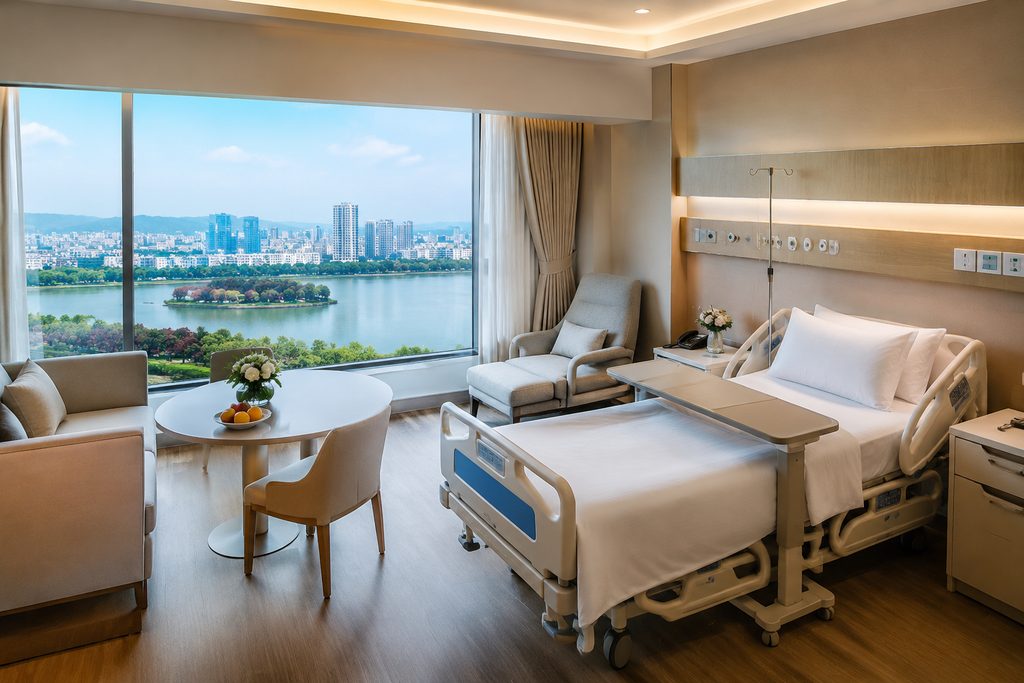
The International Medical Center at SRRSH is the correct entry point for any foreign patient. It provides English-speaking administrative staff, expedited specialist access, private inpatient rooms, and pricing transparency that the public channel simply cannot offer. We ensure you reach that entry point efficiently and with all the necessary preparation completed.
Frequently Asked Questions
Yes. SRRSH holds JCI accreditation—the most widely recognized international healthcare quality standard—and has maintained it continuously since 2006. Its founding partnership with Loma Linda University Health established patient safety protocols, nursing governance structures, and medication management systems modeled on American academic medical center standards. Infection rates, surgical complication rates, and patient safety indicators are monitored and benchmarked. For common surgical procedures, clinical outcomes are comparable to those at reputable Western hospitals.
The International Medical Center accepts direct inquiries by phone and email, but response times vary and specialist availability is not always immediately clear. The alternative—which we facilitate—is to have a bilingual coordinator contact the center on your behalf, submit your translated medical records for specialist review, confirm a consultation date, and provide a cost estimate before you commit to travel. You cannot book a specific surgeon or surgery date from overseas through the public registration system; that requires an in-person consultation first. The International Medical Center channel is the only viable path for pre-arranged international care.
Patient feedback consistently highlights the clinical competence of the specialists and the cleanliness of the International Medical Center inpatient wards. The most common point of friction mentioned in reviews is the payment process—the deposit system and the need to top up balances during extended stays can cause confusion for patients accustomed to post-discharge billing. Reviews also note that while the International Medical Center staff speak English, not every department’s support staff do, which is why having a bilingual companion throughout the hospital visit significantly smooths the experience.
SRRSH’s International Medical Center offers comprehensive health screening packages that range from basic executive physicals (approximately $500 to $800) to extensive multi-day evaluations with advanced imaging (approximately $2,000 to $4,000). For treatment rather than screening, the center builds customized packages based on the specialist’s recommended treatment plan. A laparoscopic cholecystectomy package, for instance, typically includes the surgeon’s fee, anesthesia, operating theater costs, standard inpatient stay, and basic medications—priced as a bundled estimate rather than an unbundled series of unpredictable line items. Each package is quoted individually based on the specific case and the specialist’s assessment.
Your Next Step
Sir Run Run Shaw Hospital represents a genuine bridge between Chinese medical capability and Western management standards. The clinical quality is real. The cost advantage is structural, not promotional. The International Medical Center provides a functional pathway for foreign patients. But the gap between knowing the hospital exists and actually receiving treatment there is filled with logistical challenges that can overwhelm someone navigating them alone. That gap is what we close. If you are considering SRRSH for your care, our team can provide a candid assessment of whether your case is a good fit and what the process would actually look like—no pressure, no sales pitch, just practical guidance from people who do this work every day. Reach out for a free consultation and we will walk you through the specifics.
For more medical information and treatment options in China, visit chinamedservices.com (China Medical Services).
