Russian Patient Medical Service to China: Full Treatment Support from Moscow & St. Petersburg
Have you ever calculated the true cost of waiting? Not just the financial toll, but the physical one. For a patient in Moscow or St. Petersburg facing a serious diagnosis, a six-month queue for advanced surgery can feel like a sentence. The global healthcare landscape has shifted. Proximity no longer dictates quality. More Russian families are looking east, not west, for timely, high-volume clinical expertise. They are asking a pragmatic question: can we access world-class surgery in three weeks instead of six months? The answer is yes. But the path requires a guide who knows the terrain.
Key Takeaways
- Chinese top-tier hospitals perform volumes of complex procedures that dwarf Western centers—for example, Fuwai Hospital completes over 14,000 cardiac surgeries annually, creating a depth of experience that directly impacts safety and outcomes.
- All-inclusive coordination for patients from Russia eliminates the friction of language barriers, visa logistics, and hospital navigation, transforming a complex international move into a structured, predictable process.
- Direct hospital-to-hospital cost comparisons show savings of 60-80% against US private sector pricing, but patients must plan for upfront deposits and the structural impossibility of bypassing the in-person consultation requirement.
- Safety and accreditation are verifiable. The top 5% of China’s 35,000+ hospitals are ranked by the Fudan University system and often hold JCI accreditation, matching the standards you would expect in Berlin or Seoul.
The Problem: When Waiting Lists Become a Clinical Risk
A diagnosis lands. The clock starts. In many regions, the gap between diagnosis and definitive treatment has stretched beyond safety margins. A patient requiring a complex orthopedic reconstruction or a minimally invasive cardiac intervention might wait months. That wait is not passive. Disease progresses. Pain intensifies. Anxiety corrodes quality of life. For Russian families with the resources to travel, the question becomes: where in the world can we go *now*? The traditional route—flying to Western Europe or the United States—often presents a financial cliff. A cardiac bypass quoted at $120,000 in the US becomes a barrier, not a solution. This is the precise moment when full medical treatment packages China from Russia shift from an abstract concept to a viable rescue strategy.
The numbers are stark. The average cost of a hip replacement in a private US facility can exceed $40,000. In a top-tier Chinese university hospital, the all-inclusive price—surgery, prosthesis, and a private recovery suite—often falls between $10,000 and $15,000. The savings are structural, not a reflection of compromised quality. They stem from different labor economics and massive operational scale. For a patient in Moscow weighing a life-altering surgery against their life savings, that delta is everything.
Who We Are
We are China Medical Services. We do not hold a scalpel. We do not diagnose. We are not a hospital. We are the operational backbone that connects you, a patient in Russia, with the specific surgeon and facility in China that best matches your diagnosis. Our team exists to de-risk the journey. We translate medical records into clinical Chinese before you pack a suitcase. We secure appointments through official international departments. We ensure a Russian-speaking medical interpreter stands beside you when the surgeon draws the incision line on your skin. We handle the architecture of the trip so you can focus entirely on recovery.
Why Full Medical Treatment Packages China from Russia Deliver Results
The logic is simple. Volume breeds mastery. Chinese public hospitals operate at a scale almost unimaginable in the West. A single orthopedic department might handle 100 joint replacements in a day. This creates a clinical environment where rare complications are not rare to the surgeon. They have seen it. Fixed it. Refined the protocol. For the patient, that translates to safety.
Clinical Density: The Fuwai Phenomenon
Consider cardiac surgery. Fuwai Hospital in Beijing is not just a leading center; it is the world’s highest-volume cardiac surgery hospital. They perform over 14,000 cardiopulmonary bypass procedures annually. Compare that to a prestigious US center like the Cleveland Clinic, which performs roughly 4,000. This density matters. Studies consistently link high surgical volume to lower mortality rates in complex procedures. A Russian patient needing a valve replacement is not just buying an operation. They are buying the statistical probability of a better outcome, backed by a surgical team that performs the same maneuver multiple times daily.
All-Inclusive Cost Structures from Moscow to Shanghai
When families search for Moscow to Shanghai surgery cost all inclusive, they are often trying to avoid a nightmare of hidden invoices. The anxiety is justified. A fragmented journey—booking flights, a hotel, a translator, and a hospital separately—leads to financial leakage. A coordinated package consolidates this. A typical Moscow to Shanghai surgery cost all inclusive package for a major procedure includes the visa invitation letter, airport pickup, the surgeon’s fee, the anaesthetist’s fee, the implant or prosthesis, a private inpatient room, post-operative medication, and a rehabilitation stay. You are looking at a single number, not a spreadsheet of variables. For a complex spinal fusion, this might run $18,000 to $25,000 door-to-door. The equivalent bill in a private London hospital often passes £60,000 before you buy a plane ticket.
But the price is not the only draw. The speed is the real luxury. Once on the ground and after the mandatory in-person consultation, surgery is typically scheduled within days, not months. For a patient in severe pain, that rapid progression is the entire point.
Is Treatment in China Safe for Russian Patients? The Evidence
This is the question that keeps families up at night. Is treatment in China safe for Russian patients? The honest answer is that it depends entirely on where you go. China has 35,000 hospitals. The bottom tier is not where you want to be. But the top 5%—the 340+ hospitals we work with—operate at a global standard. We are talking about Joint Commission International (JCI) accredited facilities. We are talking about hospitals ranked on the Fudan University Hospital Ranking, a rigorous peer-review system that evaluates clinical reputation and research output.
Safety is not a slogan. It is a checklist. It is verifying that the hospital’s infection control protocols match international benchmarks. It is ensuring the blood bank is modern. It is confirming that the intensive care unit is staffed by intensivists, not just rotating residents. The answer to “is treatment in China safe for Russian patients” is a qualified yes—provided you stay within the ecosystem of top-tier university hospitals in Beijing, Shanghai, and Guangzhou. A JCI-accredited hospital in Shanghai is functionally equivalent to a JCI-accredited hospital in Singapore or Istanbul. The standards are the standards. The language, however, is not the same. That is where the danger of going alone creeps in.
How to Arrange Medical Travel from St. Petersburg to Beijing: The Logistics
The question of how to arrange medical travel from St. Petersburg to Beijing starts with a document, not a ticket. The Chinese medical visa is the S2 visa. This is a short-term private visit visa annotated specifically for medical treatment. It is not a tourist visa. It is not a business visa. Applying for an M visa to receive surgery is a fast track to rejection at the border. The S2 requires an invitation letter from the Chinese hospital. Getting that letter is the first hard step. A hospital international department will not issue it without seeing your case summary and confirming they can treat you. This is a chicken-and-egg problem. You need the letter to book the visa, but you need the hospital to accept your case to get the letter. Our team breaks this loop by facilitating the case review and securing the official documentation before you apply at the Chinese Visa Application Service Center in Moscow or St. Petersburg.
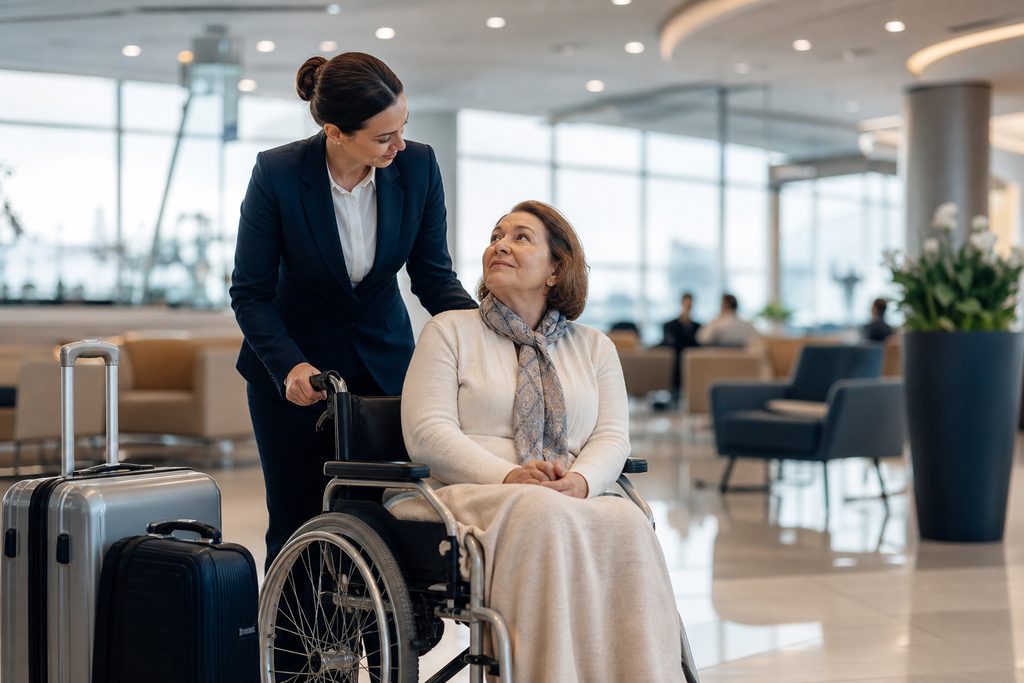
Flights are straightforward. Direct routes from Pulkovo Airport (LED) to Beijing Capital (PEK) or from Sheremetyevo (SVO) to Shanghai Pudong (PVG) are frequent. The flight time is roughly 7 to 8 hours. A patient traveling post-diagnosis is often uncomfortable. We coordinate wheelchair assistance, medical clearance with the airline, and ground transport that takes you directly from the arrival gate to the hospital admission desk. No navigating a foreign metro. No hailing a taxi while dizzy. Just a clean handoff.
Best Hospitals in China for International Patients: Prices and Specialties
When you search for the best hospitals in China for international patients prices, you are really searching for the intersection of clinical excellence and administrative transparency. The international departments of China’s top hospitals are designed for this exact purpose. They charge more than the public wards—typically 1.5 to 2 times the local rate—but they offer English-speaking (and sometimes Russian-speaking) coordination, private rooms, and a billing system that international patients can understand.
| Specialty | Recommended Hospital | City | Price Indicator (USD) |
|---|---|---|---|
| Cardiac Surgery | Fuwai Hospital | Beijing | $12,000 – $20,000 (CABG) |
| Oncology | Fudan University Shanghai Cancer Center | Shanghai | $15,000 – $30,000 (Complex resection) |
| Orthopedics | Peking University Third Hospital | Beijing | $10,000 – $18,000 (Joint replacement) |
| Neurosurgery | Huashan Hospital | Shanghai | $20,000 – $35,000 (Tumor resection) |
| General Surgery | Peking Union Medical College Hospital | Beijing | $8,000 – $15,000 (Laparoscopic) |
These are not “cheap” prices. They are rational prices. They reflect a system where the surgeon’s salary is not a multi-million dollar line item on your bill. The best hospitals in China for international patients prices reflect the cost of delivery, not the cost of a legal defense fund. For a deeper dive into specific departments, you can review our breakdown of the top-ranked specialty centers across the country.
Book Cancer Treatment China with Russian Translator: The Oncology Pathway
Oncology is the most emotionally charged field in medical travel. You are not just fighting a disease; you are fighting time. To book cancer treatment China with Russian translator support is to acknowledge that a miscommunication in oncology can be catastrophic. A misunderstood chemotherapy dosage. An allergy not properly conveyed. A surgical margin discussed imprecisely. The stakes are absolute.
China has become a significant player in oncological surgery and integrated therapy. The volume of certain cancer resections—esophageal, liver, nasopharyngeal—dwarfs Western numbers simply due to prevalence and population. A surgeon who does 300 liver resections a year may see anatomical variations a lower-volume surgeon sees once a decade. When you book cancer treatment China with Russian translator support through our service, the translator is not just a language converter. They are a medical interpreter trained in oncological terminology. They sit in on the consultation with the oncologist. They translate the PET-CT report into Russian on the spot. They ensure you understand the staging, the protocol, and the prognosis before you sign the consent form. This removes the terrifying isolation of being a patient who cannot speak the language of their own healing.
What You Need to Know Before Going Alone
The barriers are real. We do not sugarcoat this. Walking into a Chinese public hospital alone as a Russian speaker is an exercise in controlled chaos. Here is what breaks first:
- Visa Timing: The S2 visa is not issued on a whim. The consulate requires a stamped invitation from the hospital. A hospital will not stamp it without a confirmed booking. A booking requires a deposit. The loop is tight. A single error resets the clock by weeks.
- The Payment Wall: Chinese public hospitals are pre-payment systems. You deposit a lump sum—often $10,000 to $20,000—on a hospital cashier card before a scalpel is lifted. WeChat Pay and Alipay dominate. Foreign credit cards often fail at the terminal. You need a local payment solution or a coordinator who can front the float.
- The Consultation Rule: You cannot fly in and go straight to surgery. There is no way around the face-to-face consultation. The surgeon must physically examine you. This is a legal and clinical requirement. Plan for a few days of pre-op diagnostics and assessment. Anyone promising a “fly-in, fly-out” surgery without a consultation is lying.
How We Help You Navigate This
We close the gap between your home in St. Petersburg and the operating room in Shanghai. The process starts with your medical records. We translate them into professional clinical Chinese. We do not use machine translation for a pathology report. We use medical translators. We then match your case to the specific department head who specializes in your condition. We present the case, secure the acceptance letter, and courier the visa invitation to your address in Russia.
When you land, a bilingual coordinator is at the gate. They take you to the hospital. They register you. They hold the payment card, explain every line item on the deposit receipt, and walk you to the blood draw. During the consultation, they interpret. Not just the words, but the tone. The hesitation. The confidence. They give you the information you need to consent freely. After discharge, they manage the pharmacy pickup, the follow-up imaging schedule, and the final clearance letter for your flight home. You focus on breathing, sleeping, and healing.
We have seen the alternative. Patients clutching Google Translate in a crowded hallway, missing their queue number, dehydrated and confused. The system is excellent. The navigation is brutal. We are the navigation. To understand the full scope of how we support you on the ground, visit our patient support service page.
Frequently Asked Questions
We understand the financial strain. The hospital deposit is non-negotiable and must be paid upon admission. However, the coordination service fees can often be structured to align with milestones—an initial retainer for case review, with the balance due upon visa issuance. We are transparent about this from the first call. We never surprise you with a bill.
Usually, yes, but they will almost always repeat the imaging. A top-tier surgeon trusts their own hospital’s MRI machine and radiologist. Bring your DICOM files on a CD or USB stick for comparison, but budget for a fresh set of scans in China. It is standard practice and part of the clinical safety net.
Complication management is where a high-volume hospital proves its worth. These centers have deep ICUs, rapid response teams, and the specialist density to handle a bleed or an infection immediately. Your coordinator remains with you, communicating with your family back in Russia and ensuring the medical team explains every intervention. You are not alone in the system.
Yes. The international VIP wards are designed for this. They typically feature a private room with a sofa bed and an attached bathroom. One family member can stay overnight. We also assist with nearby accommodation if they need more space. Recovery is faster with a familiar face in the room.
Your Next Step
The decision to travel for surgery is never easy. It is a calculus of trust, cost, and urgency. China’s top-tier medical system offers a compelling answer to all three—high-volume expertise, transparent pricing, and rapid scheduling. The missing piece is the bridge. That bridge is built on precise medical translation, visa logistics, and a human being who meets you at the arrivals gate and does not leave your side until you are cleared to fly home.
If you are holding a scan result in Moscow or St. Petersburg and wondering what comes next, we are ready to review your case. You can learn more about how we connect international patients with China’s leading hospitals on our homepage. There is no pressure. There is just a conversation about whether this path makes sense for you.
For more medical information and treatment options in China, visit chinamedservices.com (China Medical Services).
