Sarcopenia Screening in China: A Guide for International Patients
When 68-year-old Margaret from Oregon noticed she could no longer lift her carry-on into the overhead bin, she assumed it was just age. Her doctor in Portland mentioned something called sarcopenia — age-related muscle loss — and suggested she get tested. What Margaret discovered was that a proper screening program in the United States would cost her over $2,000 out of pocket, with a two-month wait for a specialist appointment. She started searching for alternatives, and that search led her to China. This guide explains what sarcopenia screening involves, why the sarcopenia screening cost China is often a fraction of Western prices, and how international patients can access reliable testing at accredited hospitals.
## Sarcopenia Screening in China: The Short Answer
A complete sarcopenia screening package at a top-tier Chinese public hospital typically costs between $150 and $400, depending on the hospital tier and whether you choose the standard or international department. That includes body composition analysis, grip strength testing, gait speed assessment, and a specialist consultation. The caveat is that these prices apply to the standard outpatient pathway, which requires you to navigate a busy Chinese hospital without English-speaking staff. The international or VIP department costs roughly 1.5 to 2 times more but provides English service and a smoother experience.
## Who This Is Right For — and Who It Isn’t
Sarcopenia screening makes sense for adults over 60 who have noticed unexplained weight loss, declining grip strength, or difficulty rising from a chair. It’s also reasonable for younger adults with chronic conditions — kidney disease, cancer recovery, or prolonged corticosteroid use — that accelerate muscle breakdown.
## The Options, Compared
The table below compares the realistic alternatives for a patient considering sarcopenia screening abroad. Prices are in USD and reflect what international patients typically pay.
| Option | Typical Cost | Wait Time | English Support | Best For |
|---|---|---|---|---|
| US hospital outpatient | $1,200–$2,500 | 4–8 weeks | Yes | Patients with full insurance coverage |
| China public hospital (standard) | $150–$400 | Same week | Limited | Budget-conscious, self-directed patients |
| China public hospital (international dept.) | $300–$700 | 1–2 weeks | Yes | Patients wanting comfort and clarity |
| China private international hospital | $500–$1,200 | Within days | Yes | Insurance direct-billing, Western-style care |
| TCM hospital wellness assessment | $100–$300 | Same week | Varies | Patients also interested in rehabilitation |
Which column suits you depends on two things: how much hand-holding you need, and whether you want to combine screening with a broader health check. The standard public pathway is the cheapest but demands patience and some Mandarin. The international department sits in the middle — real specialists, English coordination, still affordable.
## How Is Sarcopenia Diagnosed in China?
The diagnostic criteria used at Chinese hospitals follow the Asian Working Group for Sarcopenia (AWGS) 2019 consensus, which is the regional standard adapted for Asian body types. Three measurements drive the diagnosis.
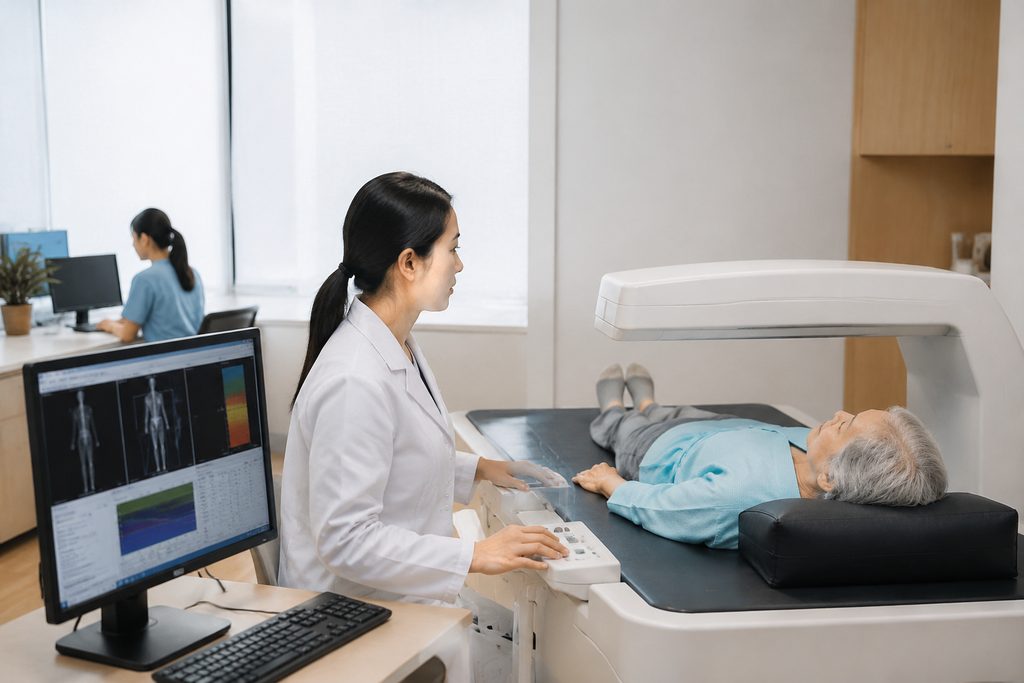
Muscle mass is assessed through bioelectrical impedance analysis (BIA) or dual-energy X-ray absorptiometry (DXA). Most Chinese hospitals use BIA because it’s fast and inexpensive. DXA is more precise and available at larger centers.
Muscle strength is measured by handgrip dynamometry. The AWGS cutoff is below 28 kg for men and below 18 kg for women.
Physical performance is tested through gait speed (usually a 6-meter walk) and the five-time chair stand test. A gait speed below 1.0 m/s suggests impaired performance.
A diagnosis of sarcopenia requires low muscle mass plus either low strength or low performance. Some hospitals also run blood panels for vitamin D, inflammatory markers, and thyroid function to rule out reversible causes. If you’re weighing whether sarcopenia screening in China is safe, the short answer is yes — these are non-invasive tests with essentially no risk. The bigger question is whether the hospital you choose follows AWGS criteria and provides results in English.
## What It Costs and How Long It Takes
The sarcopenia screening cost China figure breaks down roughly like this at a standard public hospital: body composition analysis $30–$60, grip strength and gait testing $20–$40, blood work $50–$120, and a specialist consultation $20–$50. At an international department, add a coordination and English-service premium.
Timing matters too. A standard outpatient visit takes half a day. You arrive in the morning, complete the tests, and see the specialist the same day or the next. Results for blood work come back within 24 to 48 hours. If you want a written report in English, allow an extra day or two.
For patients combining screening with a broader executive health checkup — cardiac, metabolic, and imaging — expect two to three days and a total cost of $800 to $2,000 depending on scope.
## Practical Considerations for International Patients
Records first. Bring any existing lab results, medication lists, and a short summary of your symptoms in English. Chinese hospitals can work with English documents, but a translated summary speeds things up considerably.
Visa category. For medical treatment in China, the applicable short-stay category is the S2 visa, which covers medical treatment and private affairs. Family members accompanying you apply for S2 as well. The M visa is for commercial and trade activities and has nothing to do with medical care — don’t let anyone tell you otherwise. Requirements change, so confirm with the latest embassy or consulate guidance and the supporting documents your hospital provides.
Payment. Public hospitals require prepayment. International insurance is typically reimbursed after the fact, not billed directly. Private international hospitals often bill insurers directly — a meaningful difference if you carry coverage from a major global insurer.
Language. This is the practical hurdle most patients underestimate. A top Chinese hospital can see 10,000 or more outpatients in a single day. Signage, registration, and queue systems run in Chinese. Without support, a simple screening can turn into a stressful half-day of guesswork.
Follow-up. Ask for a written report with reference ranges and a clear diagnosis line before you leave. Once home, share it with your primary care doctor. Sarcopenia management — resistance training, protein intake, vitamin D — is something your local physician can supervise.
If you want to understand how Chinese hospitals are organized before committing, our overview of top-ranked hospitals by city is a useful starting point. Patients specifically asking about the best hospital for sarcopenia screening in Shanghai will find several strong options, including university-affiliated geriatrics departments and private international hospitals with English-speaking staff.
Do I need a referral to book sarcopenia screening in China?
No referral is required for most hospitals. You can register directly with the geriatrics or rehabilitation department. That said, public hospital outpatient slots cannot be reserved from overseas in advance — you typically register on the day. If you want a confirmed appointment before you fly, the international or VIP department is the realistic route.
Is sarcopenia screening in China safe, and will I understand the results?
The tests themselves are non-invasive and low-risk. The real risk is communication. If you don’t speak Mandarin, insist on an English report or arrange a bilingual companion. A result you can’t read is a result you can’t act on.
Can I combine sarcopenia screening with a full health checkup?
Yes, and many international patients do. Executive health packages at Chinese hospitals often bundle body composition, cardiac screening, and lab work. Ask for the geriatric or executive health package specifically, and confirm what’s included before you pay.
What if the screening finds something serious?
Sarcopenia itself is manageable, not an emergency. But if testing reveals an underlying condition — kidney disease, malignancy, or a metabolic disorder — you’ll want a clear next-step plan. Chinese hospitals can provide further workup, but any treatment decision should involve your physician at home. We never promise outcomes, and neither should anyone else.
## Your Next Step
Sarcopenia screening in China is affordable, fast, and clinically sound — provided you choose the right hospital tier and solve the language problem before you arrive. The testing is straightforward; the navigation is not.
China Medical Services is not a hospital and does not provide diagnoses. We connect international patients with 340+ top-ranked hospitals across 37 cities, coordinate appointments through official international departments, and provide bilingual medical companions who handle registration, payment, and translation on the ground. If you’d like to discuss whether screening in China fits your situation, start with a free consultation — no pressure, no obligation, just a clear conversation about your options.
*This article is for informational purposes only and does not constitute medical advice. Always consult a qualified healthcare provider about your individual situation.*
Frequently Asked Questions
Yes. The hospitals used for international patients are JCI-accredited and follow the same international safety standards as top hospitals in the US and Europe. Surgical teams perform high volumes of procedures — often more than their Western counterparts — which studies show leads to better outcomes.
Costs vary by procedure and hospital, but international patients typically save 40-80% compared to US prices — even when factoring in travel and accommodation. A consultation with our team will give you an exact, all-inclusive quote with no hidden fees.
Send us your existing medical reports to get started. We handle everything from hospital selection and appointment scheduling to visa assistance and post-operative recovery planning. Your medical records are reviewed by the specialist before you even book a flight.
For more medical information and treatment options in China, visit chinamedservices.com (China Medical Services).
