Saudi Patients Treatment in China: Your Complete Companion Guide
Cancer treatment cost China for Saudi patients runs roughly 70–90% below what the same protocols cost in Riyadh, Jeddah, or Dammam. That is not marketing language. It is the structural reality of a healthcare system that performs over 4.8 million cancer-related hospital admissions annually across 35,000+ hospitals, with the top 5% delivering outcomes that increasingly match Western benchmarks. If you are a Saudi patient or family member weighing treatment abroad, China sits in a strange position: enormous clinical volume, aggressive technology adoption, and a price point that makes long-haul travel financially rational. But the system is not built for foreigners. That is the honest tension this guide addresses.
Key Takeaways
- China’s top-tier hospitals handle case volumes Western centers rarely see — Fuwai Hospital alone performs over 14,000 cardiac surgeries per year, the highest globally.
- Equivalent surgical procedures typically cost one-fifth to one-tenth of US prices; a cardiac bypass that runs $120,000+ in America is $12,000–20,000 at a top Chinese public hospital.
- Public hospital outpatient departments cannot be pre-booked from overseas — you must either arrive for same-day registration or use the hospital’s international/VIP channel, which costs 1.5–2x the standard rate.
- Language is the single biggest failure point. Without a bilingual companion, navigating a hospital that sees 10,000+ outpatient visits daily is genuinely difficult.
The Problem: When Treatment at Home Hits a Wall
Saudi Arabia has invested heavily in healthcare infrastructure. The Kingdom’s Vision 2030 health transformation has built new hospitals and recruited international talent. But for certain complex conditions, the gap between what is available domestically and what exists elsewhere remains wide. Oncology is the sharpest example. According to the Saudi Health Council’s 2023 cancer registry report, cancer incidence in the Kingdom grew 29% between 2015 and 2022, with breast, colorectal, and thyroid cancers leading the rise. Wait times for advanced radiotherapy at public tertiary centers in Riyadh can stretch 6–10 weeks for non-urgent cases. For patients with aggressive disease, that delay is terrifying.
Then there is cost. A single cycle of pembrolizumab (Keytruda) in Saudi private hospitals runs $4,500–6,800. In China’s top public hospitals, the same drug — now produced domestically under license — costs $1,200–2,400 per cycle. Multiply that across a 6–12 cycle protocol and the difference is $20,000 to $50,000. That is before surgical costs. A Whipple procedure for pancreatic cancer in a JCI-accredited Saudi private hospital runs $35,000–55,000. At Shanghai’s Zhongshan Hospital or Beijing’s Peking Union Medical College Hospital, the same procedure costs $9,000–16,000 through the international channel.
What happens if nothing changes? Patients either accept delayed treatment, deplete family savings, or travel to London or Houston where costs run 3–5x China’s rates for comparable clinical quality. China is not the answer for everyone. But for a growing number of Saudi families, it is the rational answer.
Why China Delivers Results for Saudi Patients
Clinical Volume Creates Surgical Muscle Memory
Chinese surgeons operate at a scale that is hard to comprehend from outside. A senior thoracic surgeon at Shanghai Chest Hospital performs 400–600 lung cancer resections annually. The average US thoracic surgeon performs 60–80. Volume does not guarantee quality — but for technically demanding procedures, repetition builds a level of intraoperative judgment that no textbook can teach. The Fudan University Hospital Ranking, China’s most authoritative hospital assessment, evaluates 45 clinical specialties annually. In oncology, cardiac surgery, orthopedics, and neurosurgery, the top-ranked Chinese departments report annual case volumes 5–10x their Western counterparts. For Saudi patients, this matters because it means the surgical team has seen your exact presentation hundreds of times before.
Technology Adoption Without the Bureaucratic Lag
China’s top hospitals adopted robotic surgery faster than almost anywhere else. By 2024, China had installed over 380 da Vinci robotic systems — the second-largest installed base globally after the US. But the more consequential shift is domestic innovation. Chinese manufacturers now produce surgical robots, proton therapy systems, and CAR-T cell therapy platforms at 40–60% of Western equipment costs. That translates directly into lower procedure prices. Shanghai Proton and Heavy Ion Center treats approximately 1,000 patients annually at $35,000–50,000 for a full course — versus $150,000–250,000 for equivalent proton therapy in the US. The technology is not second-rate. It is simply priced for a domestic market that cannot bear Western price points.
Cost Advantage Without Quality Compromise
Lower cost does not mean lower quality. It means lower labor costs, higher patient throughput, and state-subsidized infrastructure. Chinese cardiac surgeons earn $80,000–150,000 annually versus $500,000–900,000 in the US. Hospital construction costs in China run 50–70% below Western equivalents. And because Chinese public hospitals operate on volume-based economics, fixed costs are spread across vastly more patients. The clinical outcome data supports this model. A 2022 study in The Lancet comparing surgical outcomes across 28 countries found that Chinese tertiary hospitals achieved 30-day mortality rates for major abdominal surgery statistically indistinguishable from US and European benchmarks — at roughly one-sixth the cost. For Saudi patients asking “is chemotherapy safe in China,” the evidence says yes, when delivered at a Fudan-ranked center with standardized protocols. The risk is not the medicine. It is navigating the system.
What Treatment in China Actually Looks Like: A Step-by-Step Walkthrough
Here is the unvarnished process for a Saudi patient seeking treatment at a Chinese top-tier hospital. This is not a brochure sequence. It is what actually happens.
Step 1: Remote evaluation. You send existing medical records — pathology reports, imaging (CT/MRI/PET-CT on disc), lab results, current medication list — to the hospital’s international department or a coordination service. A specialist reviews them and issues a written opinion: whether they can treat your condition, what protocol they recommend, and an estimated cost range. This written second opinion typically costs $300–500 and takes 5–10 working days. It is the single most valuable pre-travel step you can take. It prevents flying 7,000 kilometers only to learn the hospital cannot help.
Step 2: Visa. Medical treatment in China requires an S2 visa, annotated for medical purposes. Accompanying family members also apply for S2. The application requires an invitation letter from the Chinese hospital, proof of the hospital relationship, and standard documentation. Processing takes 5–15 working days depending on the embassy. The M visa is for commercial and trade activities — it is not applicable to medical treatment. Do not let anyone tell you otherwise.
Step 3: Arrival and registration. You fly into Beijing, Shanghai, Guangzhou, or Chengdu. The hospital’s international department registers you, creates a medical card, and schedules your first specialist consultation. Through the international/VIP channel, you can typically see a senior specialist within 3–7 days of arrival. Through the standard public channel, you register the same morning and wait in line — sometimes for hours, sometimes until the next day.
Step 4: Face-to-face consultation and admission decision. The specialist examines you, reviews your records, and decides whether to admit you for surgery or treatment. This is the critical gate. No Chinese public hospital will schedule surgery without an in-person consultation first. If the specialist agrees to treat you, admission typically follows within 1–2 weeks for urgent cases, 2–4 weeks for non-urgent.
Step 5: Treatment and recovery. Surgery is performed. You recover in-hospital. For major procedures, expect 7–14 days of inpatient recovery before discharge. Your family member stays nearby — most top hospitals have international wards with single rooms and family accommodation.
Step 6: Return home and follow-up. You fly back to Saudi Arabia with a complete discharge summary, imaging, and medication plan. Follow-up consultations happen via video. Your Saudi physician receives the full record and manages ongoing care.
Choosing the Right Hospital: What Saudi Patients Must Evaluate
Not all Chinese hospitals are equal. The gap between a Fudan Top 100 hospital and an average provincial facility is enormous. Here is how to evaluate your options honestly.
| Factor | Top-Tier Public (Fudan Top 100) | Private International (JCI-Accredited) |
|---|---|---|
| Cost for major surgery | $9,000–20,000 | $25,000–60,000 |
| English-speaking staff | Limited — international department only | Yes — throughout the facility |
| Insurance direct billing | Rarely — prepay, then claim | Common — direct settlement |
| Specialist access | Senior specialists, high volume | Western-trained, lower volume |
| Wait time for surgery | 1–4 weeks after consultation | 3–10 days |
| Best for | Complex oncology, cardiac, neurosurgery | Routine procedures, pediatric, obstetrics |
For Saudi patients seeking oncology care, the strongest options cluster in Shanghai and Beijing. Fudan University’s Shanghai Cancer Center ranks among China’s top 10 for oncology and handles over 15,000 new cancer cases annually. Peking Union Medical College Hospital brings a century of complex-case experience. Zhongshan Hospital in Shanghai excels in liver surgery and cardiovascular procedures. If you are researching specialty-specific hospital rankings, the Fudan specialty reputation list is the authoritative reference — it ranks the top 10 hospitals for each of 45 specialties, including oncology, cardiac surgery, and orthopedics.
For cardiac bypass surgery specifically, Fuwai Hospital in Beijing is the global volume leader with over 14,000 cardiac surgeries annually. A coronary artery bypass graft there runs $12,000–20,000 through the international channel. That is the procedure many Saudi patients ask about when they search for how to book cardiac bypass surgery China package. The honest answer: you cannot book a “package” like a hotel room. You book a remote evaluation, then a consultation, then the hospital schedules surgery. Anyone promising a fixed-price surgical package before a specialist has reviewed your angiogram is not operating through legitimate hospital channels.
Practical Considerations: Documents, Payments, and What to Bring
Bring everything. Every scan, every lab report, every medication list, every prior surgery note. Chinese specialists will re-read your imaging themselves — they do not rely on the written report alone. If your MRI or CT is older than 3 months for a progressing condition, expect to repeat it in China. That is not upselling. It is clinical prudence.
Payment works differently than in Saudi Arabia. Chinese public hospitals require prepayment — you deposit funds at admission, and the hospital deducts as treatment proceeds. International credit cards are accepted at major hospital international departments, but transaction limits apply. UnionPay, Visa, and Mastercard work at top-tier facilities. For large deposits, a bank transfer before arrival is often smoother. Private international hospitals like United Family and Jiahui accept direct insurance billing from major international insurers — but their procedure prices run 2–4x public hospital rates.
For the medical visa China for Saudi patients treatment route, start the S2 application early. The hospital’s international department issues the invitation letter after your remote evaluation is accepted. Embassy processing in Riyadh or Jeddah takes 5–15 working days. Do not book flights until the visa is approved. And bring a family member. Chinese hospitals expect family to handle logistics — meals, pharmacy runs, paperwork. One companion is the minimum. Two is better for extended stays.
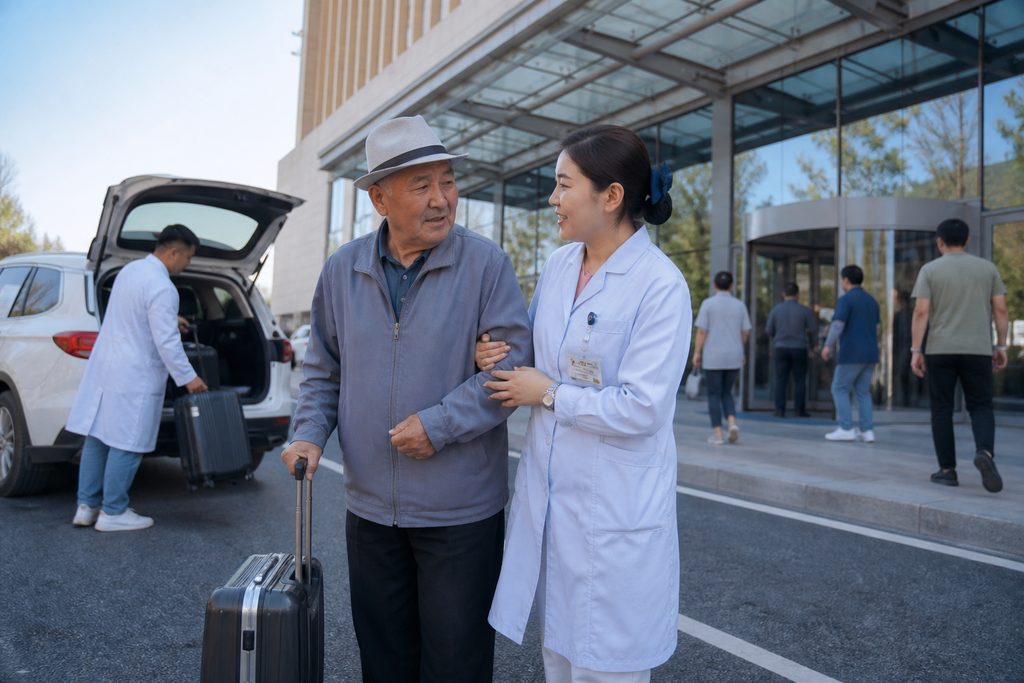
Language is the hard truth. In a public hospital seeing 10,000+ outpatient visits daily, no one has time to translate. The international department staff speak English, but the moment you leave that office, you are in a Chinese-language environment. This is where a bilingual medical companion changes the experience entirely — someone who queues, registers, translates, and navigates while you focus on treatment. It is not a luxury. For many patients, it is the difference between a manageable experience and a genuinely stressful one.
Frequently Asked Questions
At Fudan-ranked or JCI-accredited hospitals, yes. Chinese oncology departments follow NCCN and ESMO clinical guidelines, and chemotherapy protocols are standardized. The drugs are the same molecules used globally — many are now manufactured domestically under license. The safety risk is not the medicine; it is choosing a low-tier hospital without proper quality controls. Top-tier centers report chemotherapy-related mortality rates comparable to Western benchmarks.
Liver transplant recovery follows the same timeline in China as elsewhere. Expect 2–4 weeks in-hospital after surgery, then 3–6 months of close outpatient monitoring before returning to normal activity. Full recovery takes 6–12 months. Chinese transplant centers — particularly at Renji Hospital in Shanghai and West China Hospital in Chengdu — perform among the highest volumes globally. But transplant eligibility for foreign patients is strictly regulated. You must be evaluated individually, and organ availability follows China’s national allocation system. No legitimate hospital will promise a transplant date before evaluation.
Your Chinese hospital provides a complete discharge summary, imaging on disc, and a detailed medication plan. Your Saudi physician takes over ongoing care. For complications, video follow-up with the Chinese specialist is available — typically $100–300 per consultation. For surgical complications requiring physical evaluation, you may need to return to China. This is rare but real. The remote evaluation before travel is designed to minimize this risk by confirming treatment suitability upfront.
Through the standard public channel, no. You see whichever specialist is on duty. Through the international/VIP channel, you can request a specific senior specialist — but confirmation depends on their schedule and your case complexity. Coordination services can facilitate this, but no one can guarantee a specific surgeon on a specific date. Be wary of anyone who promises otherwise.
Your Next Step
China offers Saudi patients something genuinely rare: world-class clinical volume at prices that make treatment abroad financially survivable. But the system rewards preparation. The patients who have the best experiences arrive with complete records, a confirmed remote evaluation, and someone on the ground who speaks the language. That is what China Medical Services does — we are a coordination team, not a hospital. We do not diagnose or treat. We help you identify the right hospital, navigate the S2 visa process, and arrange bilingual support so you can focus on getting better. If you are weighing treatment in China, start with a conversation. The remote evaluation is the lowest-cost, highest-value step you can take. Everything else follows from there.
For more medical information and treatment options in China, visit chinamedservices.com (China Medical Services).
