Second Opinion in Chengdu: A Quick Guide for International Patients
Key Takeaways
- A written second opinion from a top Chengdu hospital typically runs $300–500, while a video consultation with a specialist ranges from $100–800 depending on the tier of the hospital.
- Chengdu is home to West China Hospital, one of China’s largest and most respected medical centers, and the city’s international departments offer English-language support for foreign patients.
- The biggest barrier is not cost — it’s access. Public hospital outpatient appointments cannot be booked from overseas in advance, and navigating a hospital that sees tens of thousands of patients daily without Mandarin is genuinely difficult.
- Before committing to travel or treatment, a remote second opinion gives you real information to work with — no guesswork, no pressure.
What if the diagnosis you received isn’t the whole story — or the treatment plan you were handed isn’t the only option?
That question drives thousands of international patients to seek a second opinion in Chengdu every year. And the first thing most of them want to know is simple: what does a second opinion cost in China, and is it worth the effort?
This guide answers that directly. We cover pricing, how to get a second opinion from a Chinese hospital, what Chengdu’s top facilities offer international patients, and the practical steps that trip people up.
The Problem: When “Wait and See” Isn’t Good Enough
In the United States, the average wait time to see a specialist can stretch past 30 days in many metropolitan areas, according to annual physician survey data. In the UK, the National Health Service consistently struggles to meet its 18-week referral-to-treatment target, with some specialties reporting waits well beyond that. For a patient facing a cancer diagnosis or a complex cardiac condition, those weeks feel like months.
Cost compounds the anxiety. A single specialist consultation in the US without insurance can exceed $500. Advanced imaging — an MRI, a PET scan — can run into the thousands. And that’s before any treatment begins.
So patients start looking elsewhere. They search for alternatives. They hear about China’s top hospitals, the surgical volumes, the technology. But then they hit a wall: How do you actually get a Chinese hospital to review your case when you’re sitting in another country?
That’s the gap a second opinion service fills.
Why a Second Opinion from China Delivers Real Value
China’s top-tier hospitals aren’t just busy — they’re operating at a scale that produces genuine clinical depth. Understanding why that matters helps you evaluate whether a second opinion is worth pursuing.
Volume Creates Expertise You Can’t Replicate Elsewhere
West China Hospital in Chengdu, affiliated with Sichuan University, is one of the largest single-site hospitals in the world. Its annual outpatient volume exceeds 5 million visits. That kind of throughput means specialists there see rare presentations regularly — not once a year, but weekly.
Fuwai Hospital in Beijing performs over 14,000 cardiac surgeries annually, making it the highest-volume heart surgery center globally. For context, the Cleveland Clinic — consistently ranked among America’s best — performs roughly 4,000. Volume doesn’t automatically equal better outcomes, but research consistently links higher surgical case loads to improved results, particularly for complex procedures.
When a Chengdu specialist reviews your file, they’re drawing on patterns from thousands of similar cases. That perspective is genuinely different from what a lower-volume center can offer.
Diagnostic Speed Without the Queue
One structural advantage of China’s large hospitals is diagnostic turnaround. At West China and similar facilities, a patient can often complete bloodwork, imaging, and specialist consultation within a single day or two — a process that might take weeks to coordinate in a fragmented Western system.
For a second opinion, this means the reviewing physician has access to a full picture quickly. They’re not waiting on records from three different providers.
Cost That Reflects Structural Differences, Not Quality Gaps
Here’s the objection we hear most: “If it’s cheaper, is it actually as good?”
It’s a fair question. The answer lies in understanding why costs differ. Physician salaries in China are lower than in the US — not because training is inferior, but because of broader economic factors. Hospital overhead is structured differently. And pharmaceutical pricing is negotiated centrally, often resulting in lower drug costs.
None of that means the clinical work is lesser. West China Hospital is ranked among China’s top hospitals by the Fudan University Hospital Rankings, the country’s most widely cited hospital quality index. Its specialists train for the same duration as their Western counterparts and publish in the same international journals.
If you’re comparing hospitals, look at departmental rankings rather than overall reputation. The Fudan specialist reputation rankings list the top 10 hospitals for 45 individual specialties — a more useful signal than a general “best hospitals” list.
What a Second Opinion in Chengdu Actually Looks Like
There’s no single format. The right approach depends on how much information you need and how quickly you want it. Here are the realistic options.
Written Second Opinion
You send your existing examination reports — imaging, pathology, lab results, discharge summaries. The relevant specialty department at a Chengdu hospital reviews them and returns a written analysis with treatment suggestions and direction.
This is the most common starting point. It requires no travel, no visa, and no time off work. Turnaround typically ranges from a few days to two weeks, depending on the complexity of the case and the hospital’s current workload.
Cost: $300–500 for a written opinion from a top-tier hospital specialist. The document is for reference — it is not a prescription and does not replace an in-person evaluation.
Video Consultation
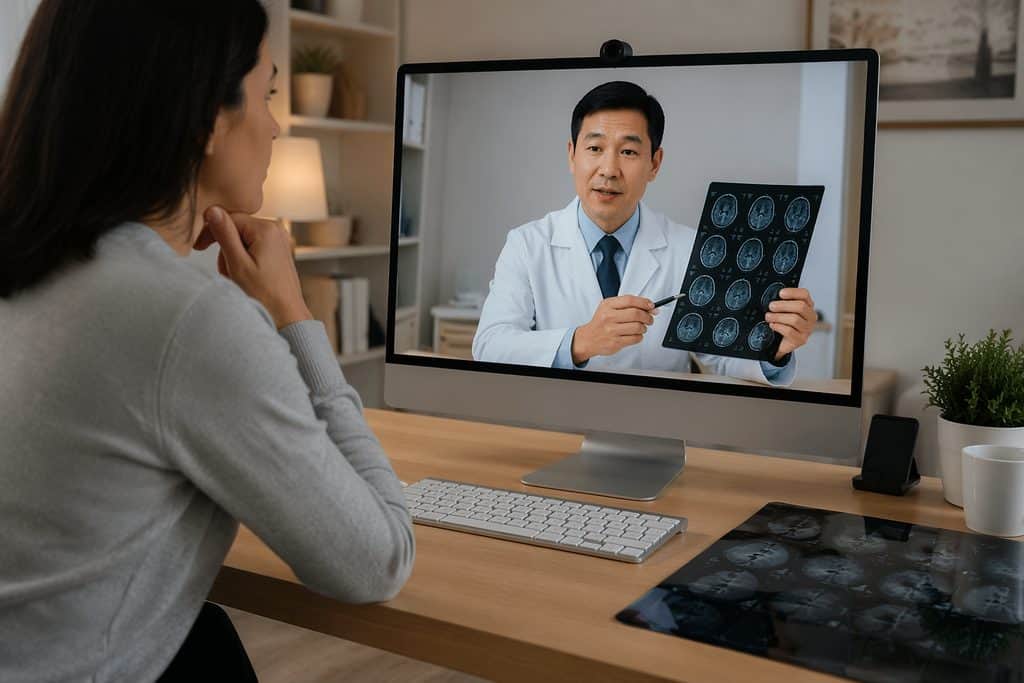
In addition to submitting records, you speak directly with the Chinese specialty team online. You explain your symptoms, ask questions, and hear the medical team’s recommendations in real time.
Video consultations work well when you have specific questions that a written summary can’t address — nuances of surgical approach, recovery expectations, or whether a particular treatment is even appropriate for your situation.
Cost varies by hospital tier: $100–300 for a standard international department consultation, $500–800 for a top specialist, and $1,500–2,000 for a multidisciplinary team (MDT) review where several specialists weigh in together.
Proxy Consultation
Some patients want a physical visit to a specific hospital or specialist. In a proxy consultation, you designate the city, hospital, department, or doctor. A coordinator registers on your behalf, creates the hospital medical card, and conducts an in-person visit using your materials.
This is useful when you want a specialist’s opinion but can’t travel yet. Any later admission remains subject to hospital rules and availability.
In-Person Visit After Remote Evaluation
If the remote review clarifies a feasible plan and you agree to proceed, the next stage involves coordinating arrival, hospital communication, and available logistics. We can assist with this — but we never promise admission, treatment success, priority access, or any clinical outcome. Those decisions belong to the hospital and your treating physician.
| Service Type | Typical Cost Range (USD) | Best For |
|---|---|---|
| Written second opinion | $300–500 | Initial review, no travel required |
| Video consultation (standard) | $100–300 | Specific questions, real-time discussion |
| Video consultation (top specialist) | $500–800 | Complex cases needing senior expertise |
| MDT video consultation | $1,500–2,000 | Multi-specialty conditions (e.g., oncology) |
| In-person specialist coordination | $800–1,200 | Physical exam with a designated expert |
All prices are estimates. Final quotes depend on the hospital, the complexity of your case, and current department availability. Prices vary by hospital and case complexity.
One detail worth knowing: any consultation fee is credited in full toward on-the-ground coordination services if you proceed with treatment in China within 90 days. It’s a one-time credit applied to the coordination fee — never to hospital treatment charges.
How to Get a Second Opinion from a Chinese Hospital: Step by Step
Yes. The written second opinion and video consultation options are both fully remote. You submit your records digitally, the Chinese specialty team reviews them, and you receive their analysis without leaving your home country. Travel is only necessary if you decide to pursue in-person evaluation or treatment.
That happens, and it’s not necessarily a problem — it’s information. A second opinion is not a verdict. It’s an additional perspective from a specialist who has reviewed your case independently. Discuss any differences with your treating physician. In some cases, the second opinion confirms the existing plan; in others, it opens up options you hadn’t considered.
West China Hospital has an international department that handles foreign patient inquiries and remote case reviews. Availability depends on the department and current workload. Submitting your records is the first step — the hospital will confirm whether they can provide a meaningful opinion for your specific case.
Recent imaging (DICOM files or high-resolution scans), pathology reports, laboratory results, a summary of your diagnosis and treatment history, and any relevant surgical reports. If your records are not in English or Chinese, translation can be arranged. The more complete your file, the more useful the review will be.
Your Next Step
A second opinion is not a commitment to treatment. It’s a conversation — one that gives you more information than you had before. Whether you’re facing a new diagnosis, weighing a major surgery, or simply want to know if there are options your current care team hasn’t mentioned, the process starts with a records review.
China Medical Services connects international patients with top-ranked Chinese hospitals through written second opinions, video consultations, and on-the-ground coordination. We are not a hospital and do not provide diagnoses or treatment. We handle the logistics — records, scheduling, interpretation, and navigation — so you can focus on the medical decisions.
If you’d like to explore what a second opinion from a Chengdu hospital could look like for your situation, reach out for a free consultation. No pressure, no obligation — just a conversation about your options.
This article is for informational purposes only and does not constitute medical advice. Always consult a qualified healthcare provider before making treatment decisions. Prices and service availability are subject to change.
Frequently Asked Questions
Yes. The hospitals used for international patients are JCI-accredited and follow the same international safety standards as top hospitals in the US and Europe. Surgical teams perform high volumes of procedures — often more than their Western counterparts — which studies show leads to better outcomes.
Costs vary by procedure and hospital, but international patients typically save 40-80% compared to US prices — even when factoring in travel and accommodation. A consultation with our team will give you an exact, all-inclusive quote with no hidden fees.
Send us your existing medical reports to get started. We handle everything from hospital selection and appointment scheduling to visa assistance and post-operative recovery planning. Your medical records are reviewed by the specialist before you even book a flight.
For more medical information and treatment options in China, visit chinamedservices.com (China Medical Services).
