Second Opinion in China for Nigerian Patients: Cost & How to Start
Key Takeaways
- A written second opinion from a top-tier Chinese hospital typically costs $300–500, and a video consultation runs $100–800 depending on the specialist level — a fraction of what most Nigerian families spend on a single trip abroad.
- You do not need a visa, a flight, or a hospital bed to get one. Records go digital, the specialty reviews them, and you receive a written analysis before committing to anything.
- The hard part is not the medicine. It is the logistics: public hospital outpatient slots cannot be booked from abroad in advance, and surgery is only scheduled after an in-person consultation.
- Treat any second opinion as guidance, not a prescription. It informs your decision — it does not replace your treating physician or guarantee an outcome.
The Problem: When the Diagnosis Leaves You With No Good Options
Nigeria loses thousands of patients every year to medical travel. Cardiology, oncology, orthopedics, fertility — the pattern repeats. A diagnosis lands, the local specialist says the case is complex, and the family starts pricing flights to London, Dubai, or Mumbai.
The numbers explain why. Out-of-pocket spending makes up roughly 70% of total health expenditure in Nigeria, according to World Health Organization tracking, and a single cardiac procedure abroad can exceed $50,000 before flights and accommodation. For most families, that is not a medical decision. It is a financial one.
Then there is the waiting. A referral to a UK specialist can take weeks just to reach triage. By the time a family has raised funds, booked tickets, and cleared immigration, months have passed since the original scan. Tumors grow. Hearts weaken. Windows close.
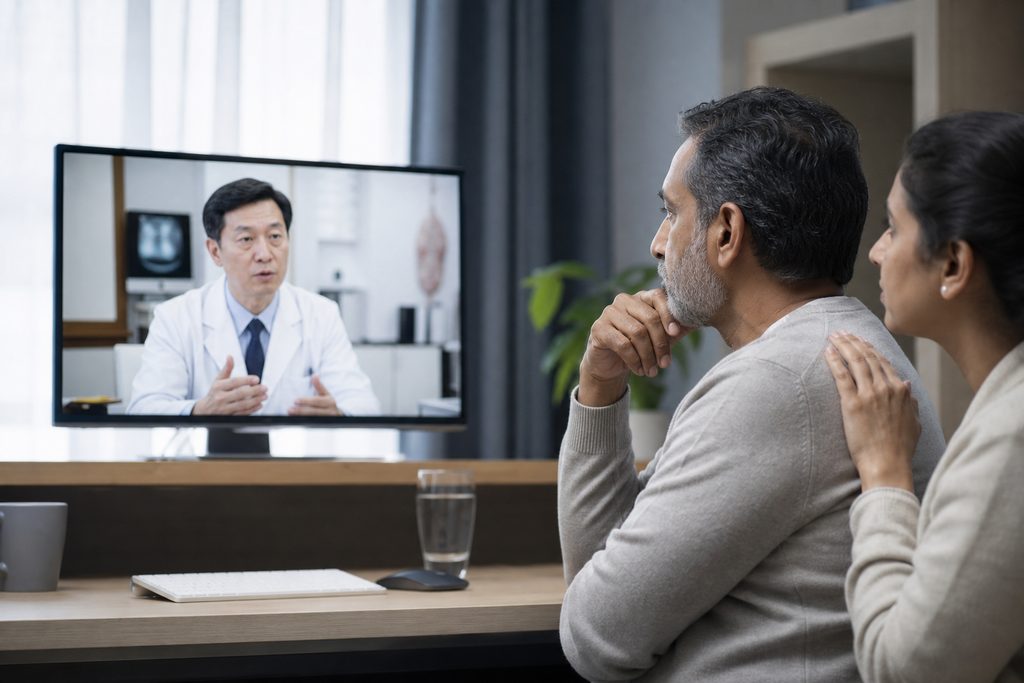
What most families never consider is that they can get a serious expert review of their case — from a hospital that performs more of that specific procedure than almost anywhere on earth — without leaving Lagos, Abuja, or Port Harcourt. That is what a second opinion in China for Nigerian patients actually means in practice. No flight. No visa queue. Just records, a review, and an answer.
Why China Delivers Credible Second Opinions
China’s hospital system is enormous — over 35,000 hospitals nationwide. The top 5% of them, ranked by the Fudan University Hospital Rankings and JCI accreditation, sit in a different tier entirely. Our network covers 340+ of those top-ranked hospitals across 37 cities, and the clinical volume inside them is difficult to grasp until you see it.
Volume That Changes What a Surgeon Knows
Fuwai Hospital in Beijing performs more than 14,000 cardiac surgeries a year — the highest volume of any heart center globally. A surgeon operating at that pace encounters variations and complications that a lower-volume colleague may see a handful of times in a career. That matters enormously for a second opinion. You are not asking whether the doctor read the textbook. You are asking whether they have seen your specific problem fifty times before.
The same logic applies across specialties. Fudan’s specialty reputation rankings name a top 10 for each of 45 disciplines — oncology, cardiac surgery, orthopedics, reproductive medicine, neurosurgery. When a Nigerian patient’s file reaches one of those departments, it reaches a team that treats that condition as routine.
Costs That Reflect Structure, Not Compromised Care
Here is the question every family asks: if it is cheaper, is it worse? The honest answer is that the cost gap comes from structural economics, not from cutting corners on the medicine.
Labor costs, hospital operational efficiency, and sheer patient volume all push unit prices down. A coronary artery bypass graft at a top Chinese public hospital typically runs $12,000–20,000. The same procedure in the United States frequently exceeds $120,000. Same technique. Same equipment. Different cost base.
That gap is what makes the second opinion model so useful for Nigerian families. You spend a few hundred dollars to find out whether the expensive trip is even necessary — or whether it should be redirected to a different hospital entirely.
Remote Review Before Any Commitment
A second opinion does not require you to choose China as your treatment destination. It requires you to send your records and let a specialist read them. If the Chinese team agrees with your local diagnosis, you have confirmation. If they see something different, you have information worth acting on. Either way, you have paid for clarity, not for travel.
What a Second Opinion in China Actually Costs
Below are the current service tiers. All figures are in USD and represent coordination and review fees — not hospital treatment charges, which are billed separately and vary by hospital and case complexity.
| Service | Typical Cost | What You Receive |
|---|---|---|
| Written second opinion (top-tier hospital specialist) | $300–500 | Written analysis of your existing reports, treatment suggestions, direction — for reference only, not a prescription |
| Video consultation (standard public or private international department) | $100–300 | Live discussion with the specialty team plus record review |
| Top-specialist video consultation | $500–800 | Online session with a senior specialist in your condition |
| Multidisciplinary team (MDT) video consultation | $1,500–2,000 | Several departments review your case together |
| Hospital appointment coordination | from $300 | Registration, medical card creation, scheduling — refunded in full if the appointment cannot be secured |
| Bilingual medical companion | from $300/day | Queueing, registration, payment assistance, wayfinding, interpretation |
One detail worth knowing: any consultation fee is credited in full toward on-the-ground coordination if you proceed to treatment in China within 90 days. It applies to the coordination fee only — never to hospital treatment charges — and it is a one-time credit.
Ask for the quote in writing before you pay anything. A legitimate provider will separate its own coordination fee from the hospital’s treatment estimate. If those two numbers are blended into one vague figure, ask why.
How to Get a Second Opinion From a Doctor in China: The Actual Steps
The process is simpler than most people expect, but the sequencing matters. Here is how it runs from a Nigerian patient’s perspective.
Step one — gather your records. You need recent imaging (CT, MRI, PET), pathology reports if a biopsy was done, discharge summaries, lab results, and a current medication list. Digital copies are fine. DICOM files for imaging, PDFs for everything else. If reports are handwritten or poorly scanned, that slows the review.
Step two — translation. Chinese specialists read English, but clinical nuance survives better with a proper medical translation. This is not Google Translate territory. Pathology phrasing and staging language need accuracy.
Step three — specialty matching. The file goes to the department that actually handles your condition, not a general international office. A lung nodule goes to thoracic surgery or respiratory medicine. A pediatric cardiac defect goes to a pediatric cardiac center.
Step four — the review itself. For a written opinion, expect several business days. For a video consultation, you will get a scheduled slot and an interpreter if needed.
Step five — the written output. You receive the specialist’s analysis: what they see in the records, whether they agree with the existing plan, what alternatives exist, and what further testing might be needed.
Notice what is absent from that list. No embassy visit. No flight. No hospital registration desk. Those come later, and only if you decide to pursue treatment in China.
Second Opinion in China vs India for Nigerian Patients
India has long been the default medical travel destination for Nigerian patients, and that reputation is not unearned. It has established pathways, large diaspora networks, and competitive pricing. So why consider China instead?
Three differences stand out. First, subspecialty depth in high-complexity cases. China’s top hospitals concentrate extraordinary volume in specific disciplines — cardiac surgery, oncology, neurosurgery — and that concentration shows up in how they handle rare or advanced presentations.
Second, the technology stack. Chinese top-tier hospitals deploy surgical robotics, proton and heavy-ion radiotherapy, and advanced imaging at a scale few countries match. For a patient whose case hinges on a specific technology, that availability is the whole decision.
Third, the second opinion pathway itself. China’s remote consultation infrastructure has matured quickly, and a written review from a Fudan top-100 hospital is now accessible without travel in a way it simply was not a decade ago.
Where India may still win: shorter flights from Lagos, a longer history of hosting Nigerian patients, and established community support. Those are real factors. Weigh them honestly.
Do not choose a destination based on price alone. A $4,000 saving on a procedure is meaningless if the hospital lacks the subspecialty team your case requires. Match the hospital to the condition first. Then compare costs.
Practical Considerations for Nigerian Patients
Visa category. If you later decide to travel to China for treatment, the correct visa is the S2, which covers short-stay medical treatment and private affairs. Stays exceeding 180 days use the S1. Accompanying family members apply for the S2 as well. Be careful here — the M visa is for commercial and trade activity and has nothing to do with medical treatment. Requirements shift, so confirm current rules with the Chinese embassy or consulate in Nigeria and bring supporting hospital documents.
Payment. Chinese public hospitals generally require prepayment, with insurance reimbursement handled afterward. Private international hospitals often bill insurers directly. Nigerian health insurance rarely extends to overseas treatment, so plan for self-funding. International card limits and naira-to-dollar conversion both need checking before you commit to a large transfer.
Language. This is not a minor point. A top Chinese hospital can see tens of thousands of outpatients in a single day. Signage, registration systems, and pharmacy counters operate in Chinese. Without interpretation, even a simple follow-up visit becomes exhausting. Budget for a bilingual companion if you travel.
Follow-up after returning home. Ask the Chinese team, in writing, what monitoring your local physician should perform and at what intervals. Get the imaging on physical media before you leave. Continuity of care depends on it.
Records and privacy. Send records through a channel you trust. Ask how your files will be stored and whether they will be deleted after the review.
Frequently Asked Questions
Yes. Written second opinions and video consultations are both designed for exactly this. You send existing examination reports, the relevant specialty reviews them, and you receive written analysis and treatment suggestions. No visa, no flight, no hospital visit required. The opinion is for reference only and is not a prescription.
China’s top-ranked hospitals are JCI-accredited in many cases and handle very high patient volumes, which supports safety and quality. That said, safety depends on your specific case, the hospital you choose, and how well your condition is managed before and after travel. No provider should promise you an outcome or guaranteed admission — we do not, and you should be cautious with anyone who does.
A written second opinion runs $300–500, and a video consultation $100–800 depending on specialist level. Compare that with the cost of a single international trip — flights, accommodation, and consultations — which can easily exceed several thousand dollars before any treatment begins. The second opinion exists to help you decide whether that trip is necessary at all.
That is often the point. You will receive a written rationale explaining what they see in your records and why they reached a different view. Take that document to your treating physician and discuss it. Two informed opinions are better than one — and your local doctor remains central to your care either way.
It depends entirely on the diagnosis. Fudan’s specialty reputation rankings name a top 10 for each of 45 disciplines, and the right choice for a cardiac case is not the right choice for a fertility case. Our team can help match your records to the appropriate department, but the clinical decision always belongs to the hospital.
Your Next Step
Getting a second opinion is not a rejection of your current doctor. It is a second set of expert eyes on a decision that carries real consequences — and for Nigerian families weighing an expensive journey abroad, it is the cheapest clarity available. Send your records, get an answer, then decide. Nothing is committed until you choose to commit.
We are China Medical Services, a coordination service that connects international patients with 340+ top-ranked Chinese hospitals across 37 cities. We are not a hospital, and we do not diagnose or treat anyone. What we do is handle the logistics: medical translation, appointment coordination through official international departments, bilingual accompaniment, and visa guidance. If you would like to understand your options, start with a free consultation — no obligation, and no pressure to proceed.
This article is for general information only and does not constitute medical advice. Treatment decisions should always be made with a qualified physician who has reviewed your individual case. Costs vary by hospital and case complexity.
For more medical information and treatment options in China, visit chinamedservices.com (China Medical Services).
