Serviced Apartment VIP Stay China: Premium Long-Term Recovery Accommodation
Key Takeaways
- Premium serviced apartments near top-tier Chinese hospitals typically range from $80 to $350 per night, a fraction of comparable medical recovery suites in the US or Europe.
- True VIP recovery accommodations bundle nursing support, hospital transport, and dietary services — not just a nice room. Knowing what to verify before booking prevents costly mismatches.
- Language barriers and fragmented booking systems make independent arrangements risky. A single miscommunication about post-operative needs can compromise recovery.
- Long-term stays of 30 days or more unlock significant rate reductions. The real value lies in negotiating the right package, not just finding the cheapest nightly rate.
The Problem: Recovering Far From Home, Without the Right Support
According to a 2023 report by the Medical Tourism Association, over 70% of international patients cite post-discharge accommodation as a major source of anxiety when planning treatment abroad. This is not a minor logistical detail. It is the phase where complications surface. Where pain management, wound care, and mobility restrictions collide with an unfamiliar city, an unfamiliar language, and a hotel room designed for tourists, not patients.
You have traveled across the world for a cardiac procedure at Fuwai Hospital or a complex orthopedic surgery at Peking Union Medical College Hospital. The operation went well. You are discharged after five days. The surgeon says you need three more weeks of rest before flying home. Your hotel room has a beautiful view but a bathroom door too narrow for a walker. Room service ends at 9 p.m. The front desk does not understand “I need a wound dressing change.” This is the gap between medical tourism and recovery reality. And it is the gap that a properly chosen serviced apartment VIP stay in China is designed to close.
Who We Are
We are not a hospital. We do not provide medical treatment or clinical diagnoses. Our team at China Medical Services acts as your logistical architects — we bridge the gap between you and China’s top-tier medical expertise. We maintain a database of over 340 top-ranked hospitals across 37 cities. We know which recovery accommodations sit closest to the cardiac surgery center in Beijing and which serviced residences in Shanghai have worked with post-oncology patients before. We handle the coordination so you can focus entirely on healing.
What a Serviced Apartment VIP Stay in China Actually Delivers
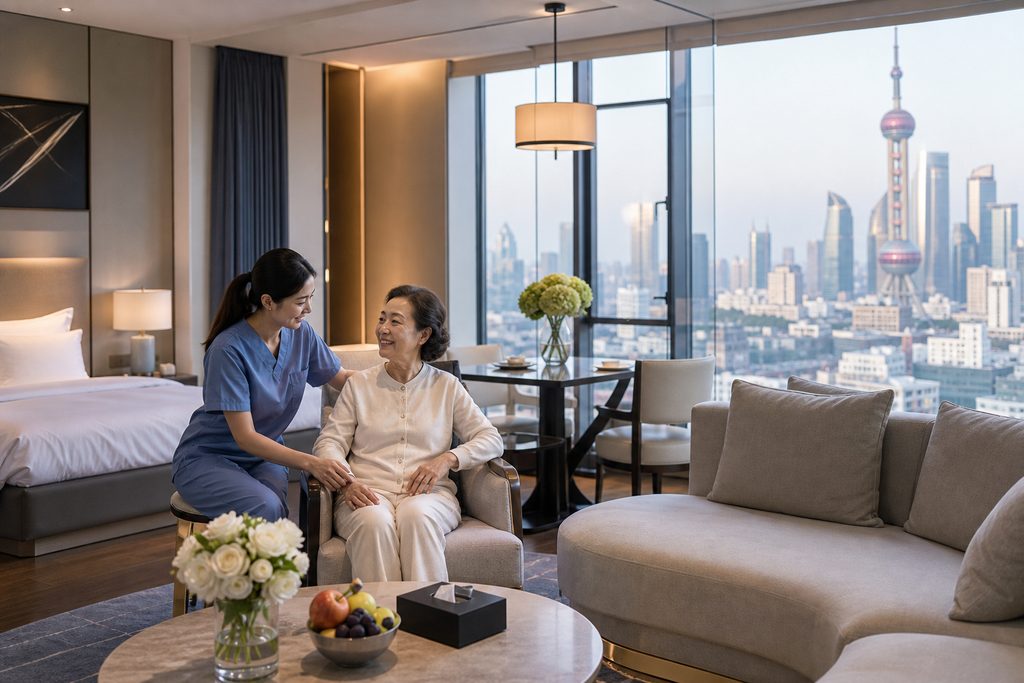
The term “VIP stay” gets thrown around loosely. In the context of medical recovery in China, a legitimate serviced apartment VIP stay means something specific. It is not a standard hotel room with a fruit basket. It is a residential unit — typically one or two bedrooms — with a full kitchen, washing machine, and wide doorways. More importantly, it is a package of services built around a patient’s needs.
What Is Included in a Medical Tourism Recovery Apartment in Beijing
When our team arranges a premium recovery apartment in Beijing for a post-surgical patient, the baseline typically includes daily housekeeping with hospital-grade disinfection protocols, three medically tailored meals delivered to the door, a dedicated point of contact who speaks English and Chinese, and scheduled private transport to follow-up appointments. Some properties near the Beijing hospital cluster in the Dongcheng district offer additional nursing visits — a registered nurse stops by every other day to check vitals and wound sites. This is not intensive home care. But for a stable patient recovering from a knee replacement or a laparoscopic procedure, it is often exactly what is needed. The cost of extended stay accommodation for medical patients abroad varies wildly based on these inclusions. A bare apartment might run $80 per night. The same unit with nursing checks, transport, and meals can reach $250 per night. The price reflects the invisible labor — the coordination, the bilingual staff, the clinical oversight.
Best Luxury Recovery Accommodation in Shanghai for Medical Tourism
Shanghai offers a different landscape. The best luxury recovery accommodation Shanghai medical tourism patients can access clusters in the former French Concession and Pudong, near Jiahui International Hospital and Shanghai East International Medical Center. These are not hospital wards. They are full-service residences with gyms, pools, and concierge desks. What makes them “medical tourism ready” is the staff training. Several properties we work with have nursing coordinators on retainer. They can arrange a physiotherapist to visit your apartment for rehabilitation sessions. They know which pharmacies stock imported medications. A two-bedroom suite in a Pudong serviced residence, configured for a patient and a family caregiver, starts at approximately $200 per night for stays over 21 days. The same apartment booked directly through a travel site without the medical package would be cheaper — but you would not have the nursing coordinator, the hospital shuttle, or the dietary team. That trade-off matters.
Serviced Apartment VIP Stay China Price: Breaking Down the Numbers
The serviced apartment vip stay China price question has no single answer. It depends on city, proximity to the hospital, length of stay, and the service layer you require. But we can provide clear ranges based on our coordination experience across Beijing, Shanghai, Guangzhou, and Chengdu.
| City | Standard Serviced Apartment (per night, 30+ days) | VIP Recovery Package (per night, 30+ days) |
|---|---|---|
| Beijing (Dongcheng / Chaoyang) | $80 – $130 | $180 – $280 |
| Shanghai (Pudong / French Concession) | $100 – $160 | $200 – $350 |
| Guangzhou (Tianhe / Yuexiu) | $70 – $110 | $150 – $240 |
| Chengdu (Jinjiang / High-Tech Zone) | $60 – $100 | $130 – $220 |
These figures come from actual bookings coordinated for international patients in 2024 and early 2025. The VIP recovery package includes the apartment, daily housekeeping, three meals, airport and hospital transfers, a bilingual coordinator on call, and either daily or every-other-day nursing check-ins depending on the property. Rates drop further for stays exceeding 60 days. A patient recovering from spinal surgery in Chengdu paid $115 per night for a two-bedroom VIP package on a 90-day stay — roughly the cost of a mid-range hotel room in London, but with a nurse visiting twice weekly and a driver on standby for follow-up MRIs at West China Hospital.
Compare this to the US market. A post-surgical recovery suite in a skilled nursing facility averages $350 to $500 per day. A medical recovery apartment in Miami with comparable services runs $400 to $600 per night. The structural cost difference is not about quality — it is about labor economics and real estate pricing. China’s top serviced residences compete on service, not just square footage.
How to Find a Premium Long-Term Stay After Surgery in China
Patients often ask how to find premium long-term stay after surgery in China without a local contact. The honest answer: it is difficult to do well on your own. The search process is fragmented. Most high-quality serviced apartments do not list their medical recovery packages on Booking.com or Airbnb. They work through hospital international departments and medical coordination agencies. A patient searching independently will find hundreds of apartments. Almost none will have the clinical support infrastructure that recovery demands.
Here is the practical path. Start by identifying your hospital and surgeon. The hospital’s international department can often recommend nearby accommodations — but their list is usually limited to one or two partner properties. Those properties may or may not suit your budget or your family’s needs. This is where a broader search becomes valuable. Our team maintains relationships with over 40 serviced residences across China’s major medical cities. We know which ones have step-free access from the parking garage to the elevator. We know which ones allow family members to stay in the same unit without an extra charge. These are not details you can verify from a listing page.
When you are ready to book a VIP serviced apartment for post surgery recovery in China, the timeline matters. The best units near Fuwai Hospital or Peking Union Medical College Hospital book out weeks in advance, especially in spring and autumn when international patient volumes peak. Last-minute bookings rarely secure the right configuration. We recommend locking in accommodation at least three weeks before your scheduled admission date. This gives enough time to confirm the nursing schedule, arrange dietary protocols, and coordinate the first post-discharge transport.
Before You Book: Three Things That Go Wrong
We have seen what happens when patients try to arrange recovery stays independently. The problems are predictable.
- Language Gaps in Medical Translation: A patient recovering from thyroid surgery in Shanghai needed a specific low-iodine diet. The apartment’s kitchen staff spoke no English. The patient’s dietary restrictions, translated via a phone app, came out as “no salt” — which the kitchen interpreted literally, resulting in bland but iodine-rich seaweed soup. A bilingual coordinator would have caught this in 30 seconds.
- Proximity vs. Accessibility: An apartment may be 800 meters from the hospital on a map. But if that 800 meters includes a pedestrian overpass without elevator access, a patient on crutches cannot make the journey. Our team physically inspects routes between apartments and hospital outpatient buildings.
- Hidden Charges for Caregivers: Some serviced apartments charge an additional “guest fee” for a family member staying in the unit, even if they are sleeping on the sofa. This fee can be $30 to $60 per night, undisclosed until check-in. We negotiate these terms upfront and include them in the quoted price.
How We Help You Navigate This
These barriers exist for structural reasons. China’s serviced apartment market is built primarily for business travelers, not medical tourists. The medical recovery layer — nursing visits, hospital shuttles, dietary coordination — is an overlay that requires active management.
Our process starts with your clinical needs. What surgery are you having? What will your mobility restrictions be at discharge? Do you need daily wound care or just observation? Will a family member travel with you? We match these requirements against our database of properties. We present two or three options with transparent pricing, including all service fees. Once you choose, we handle the booking, confirm the nursing schedule, arrange the first post-discharge transfer, and ensure the apartment is set up before you arrive — grab bars installed if needed, fridge stocked per dietary requirements, emergency contact numbers posted by the phone.
During your stay, our bilingual coordinator remains reachable. If a wound looks concerning at 10 p.m., we can arrange a video consultation with your surgeon’s team or, if necessary, a car to the emergency department. This is not concierge fluff. It is the safety net that lets you focus on recovery instead of logistics.
Frequently Asked Questions
Some hospital international departments have preferred partnerships with nearby serviced residences. This can work well if the property meets your needs. However, hospital referrals are usually limited to one or two options. You may not get competitive pricing or the specific configuration your recovery requires. We often supplement hospital recommendations with additional options that offer better value or more suitable layouts.
This is common. Complications happen. Surgeons extend stays. Our agreements with serviced residences include flexible date-change clauses. We adjust the booking as your clinical situation evolves. If you are discharged earlier than planned, we negotiate refunds for unused nights where possible. If you need to extend, we handle the extension at your existing rate whenever feasible.
It depends on the property. We explicitly verify door widths, elevator dimensions, shower configurations, and step-free access before recommending any unit. For patients who cannot transfer independently or require two-person assistance, a serviced apartment may not be appropriate — a rehabilitation facility with 24-hour nursing would be a safer option. We tell patients this directly. A nice apartment is not a substitute for clinical care.
Three to four weeks is ideal. The best units near top hospitals fill quickly, especially during spring (March to May) and autumn (September to November) when international patient volumes peak. Last-minute bookings are possible but limit your options significantly. If your surgery is already scheduled, securing accommodation should be your next priority after confirming your hospital admission date.
Yes. Stays exceeding 45 days almost always unlock better rates. Stays beyond 90 days can bring the nightly cost down by 20% to 30% compared to the standard 30-day rate. We negotiate these terms on your behalf before you commit. The key is to lock in the long-stay rate from the start — not to book 30 days and hope for a discount on extension.
Your Next Step
Recovery after surgery is not the time to gamble on accommodation. The right apartment, with the right support services, protects the investment you have already made in your health. It reduces stress, prevents complications, and lets you heal with dignity. The wrong apartment does the opposite.
If you are planning treatment in China and need clarity on where you will recover — not just a list of addresses, but a plan that accounts for your specific procedure, your mobility needs, and your budget — our team is ready to help. There is no charge for the initial consultation. We will ask about your surgery, your timeline, and your preferences. Then we will tell you honestly what is possible and what it costs. No pressure. Just the information you need to make a clear-eyed decision.
For more medical information and treatment options in China, visit chinamedservices.com (China Medical Services).
