Shanghai Changhai Hospital Urology: Minimally Invasive Prostate and Kidney Stone Surgery
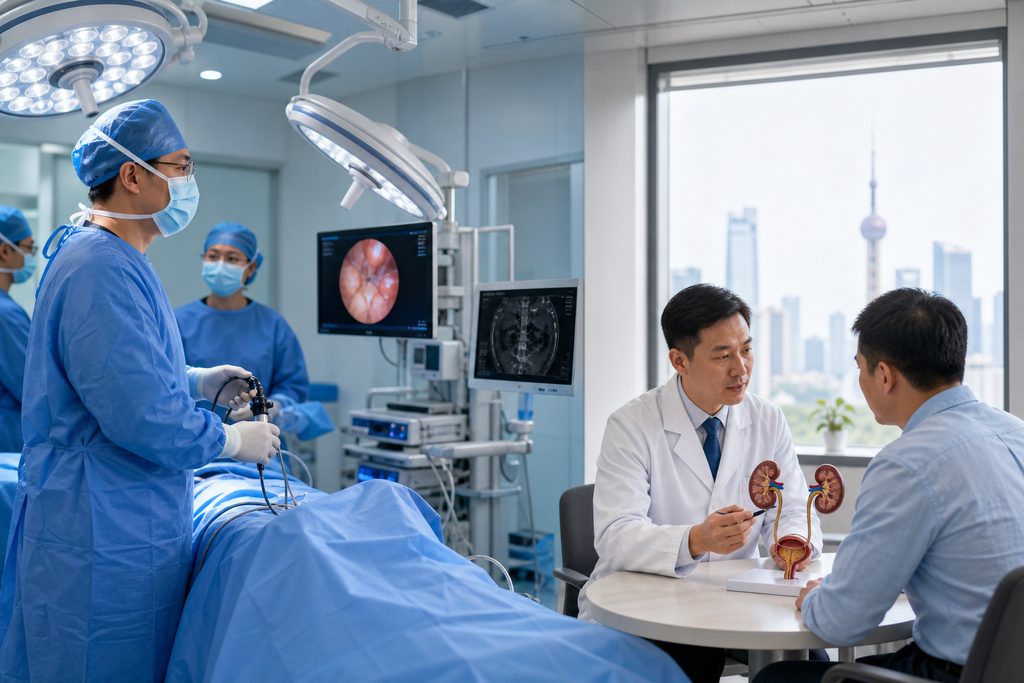
When 54-year-old Robert from Manchester first saw the estimate for his prostate surgery, he nearly choked on his tea. £14,000. That was the quote from a private hospital in London. His NHS wait time? Eighteen months minimum. Robert needed another option. He started searching for alternatives and landed on a question that thousands of patients ask every year: can I get world-class urological surgery in China for a fraction of the cost? The short answer is yes. The realistic answer is that doing it alone is a logistical nightmare. That is where we come in.
Key Takeaways
- Shanghai Changhai Hospital performs over 8,000 urological procedures annually, making it one of the highest-volume centers in Asia for minimally invasive stone and prostate surgery.
- A holmium laser enucleation of the prostate (HoLEP) in Shanghai costs roughly $8,000 to $12,000, compared to $30,000 to $45,000 in the United States.
- Public hospital outpatient clinics cannot be pre-booked from overseas; you must physically attend a consultation before any surgery is scheduled, which creates a major barrier for international patients traveling without local support.
- You do not need to navigate this alone. A bilingual medical companion handles registration, payment, translation, and scheduling so you can focus entirely on recovery.
The Problem: When Your Body Will Not Wait for a Bureaucracy
Benign prostatic hyperplasia affects approximately 50% of men by age 60. By 80, that number climbs past 90%. Kidney stones are not far behind — roughly 1 in 10 people will develop one in their lifetime, and recurrence rates hit 50% within five years without proper intervention. These are not rare conditions. They are common, painful, and when left untreated, they destroy quality of life.
But getting treated quickly in Western healthcare systems is increasingly difficult. In Canada, the median wait time for urological surgery after seeing a specialist stretches past 16 weeks. In the UK, the NHS target of 18 weeks from referral to treatment is missed for tens of thousands of patients annually. Private care is faster. It is also brutally expensive.
Robert’s situation is not unique. It is the norm for anyone without unlimited funds or top-tier insurance. And that is before we even talk about the patients from regions with underdeveloped urology services, where advanced laser lithotripsy or holmium laser enucleation simply is not available at any price.
Who We Are
We are not a hospital. We do not provide medical treatment, diagnose conditions, or give clinical advice. Our team acts as your logistical architects — the bridge between you and China’s top-tier medical expertise. We maintain a database of 340+ top-ranked hospitals across 37 cities, each vetted against the Fudan University hospital rankings and JCI accreditation standards. When you contact us, we match your specific urological condition to the right surgical team, coordinate your hospital appointment through official international channels, arrange bilingual medical companions for every step of your visit, and guide you through the S2 visa process. We handle the friction. You handle healing.
Why Shanghai Changhai Hospital Delivers Results in Urology
Changhai Hospital, affiliated with the Naval Medical University, is not just another big Chinese hospital. Its urology department is consistently ranked among the top five in China by the Fudan University specialty reputation rankings. For international patients asking is Shanghai Changhai Hospital good for kidney stones, the surgical volume alone tells the story. The department runs one of the largest minimally invasive stone surgery programs in the country, with a particular focus on percutaneous nephrolithotomy and flexible ureteroscopy with laser lithotripsy. They see complex cases — staghorn calculi, bilateral stones, patients who have failed multiple prior procedures — on a weekly basis that would be considered unusual at a typical Western teaching hospital.
Surgical Volume Drives Precision
There is a straightforward correlation in surgery: the more you do, the better you get. A 2016 study in The Lancet examining over 2 million procedures found that for every doubling of hospital surgical volume, the risk of post-operative death dropped significantly. Changhai’s urologists operate at a scale that most Western surgeons never approach. A senior urologist here might perform 300 to 400 holmium laser enucleation procedures in a year. Compare that to a busy US surgeon who might do 50 to 80. When you are dealing with something as delicate as preserving urinary continence and erectile function during prostate surgery, that volume gap matters.
Technology Without the Wait
Changhai was an early adopter of holmium laser enucleation of the prostate in China. The department runs multiple high-power holmium laser platforms, advanced flexible ureteroscopes, and the full suite of endourological equipment needed for same-session stone clearance. This is not experimental technology. HoLEP has been endorsed by the American Urological Association and the European Association of Urology as a size-independent gold standard for surgical BPH management. The difference is access. In Shanghai, you can often schedule surgery within two to three weeks of your initial consultation. In many Western public systems, you are waiting months for the same technology.
Cost Advantage Without Quality Compromise
Let us address the elephant in the room directly. Lower cost does not mean lower quality. It means structurally different healthcare economics. Chinese hospital charges are not inflated by the same layers of insurance administration, malpractice premium overhead, and pharmaceutical markup that drive US prices. A minimally invasive prostate surgery cost Shanghai patient receives is typically $8,000 to $12,000 for a HoLEP procedure, inclusive of hospital stay, operating theater fees, and surgeon charges. Kidney stone surgery via flexible ureteroscopy with laser runs roughly $5,000 to $8,000. These are not budget procedures in a developing-world facility. These are internationally benchmarked surgeries performed with the same equipment used at Mayo Clinic or Charité Berlin, at roughly one-fifth to one-third of the cost.
| Procedure | Estimated Cost (USD) | Typical US Cost (USD) |
|---|---|---|
| HoLEP (Holmium Laser Enucleation) | $8,000 – $12,000 | $30,000 – $45,000 |
| Flexible Ureteroscopy + Laser Lithotripsy | $5,000 – $8,000 | $15,000 – $25,000 |
| Percutaneous Nephrolithotomy (PCNL) | $7,000 – $10,000 | $25,000 – $40,000 |
Prices are estimates and vary by hospital channel, case complexity, and length of stay. The Changhai Hospital urology price list is not published as a static document; final quotes are provided after reviewing your medical records and imaging. Our team obtains these quotes on your behalf before you travel.
What You Need to Know Before Going Alone
We are going to be honest about the barriers because pretending they do not exist helps no one. China’s top public hospitals are extraordinary medical institutions. They are also enormous, crowded, and almost entirely Chinese-language environments. Showing up without a plan is not adventurous. It is a recipe for frustration.
- Visa Requirements Are Specific: Medical treatment in China requires an S2 visa with a notation specifying the purpose of medical treatment. This is not a tourist visa. You need an invitation letter from the hospital, a confirmed treatment plan, and documentation that can withstand consular scrutiny. Applying for the wrong visa category — an L tourist visa, for instance — can result in denial or complications at the border. Your accompanying family members also need S2 visas. We guide you through this documentation process and coordinate with the hospital’s international department to produce the correct invitation materials.
- Payment Is Upfront and Mostly Cash: Chinese public hospitals require a deposit before admission. This is typically paid via cash, UnionPay card, or domestic bank transfer. International credit cards are not reliably accepted at public hospital counters. WeChat Pay and Alipay dominate daily transactions, but linking a foreign card to these platforms is inconsistent. You need to plan for substantial upfront payments. Our team helps you understand the exact deposit requirements and can facilitate payment logistics to avoid surprises at the admissions desk.
- Language Barriers Are Absolute: A top surgeon at Changhai almost certainly reads English-language medical literature. That does not mean the nursing staff, the registration desk, the pharmacy counter, or the CT scan technician speaks English. Informed consent discussions, post-operative instructions, medication labels, and discharge summaries will be in Chinese. Without a bilingual medical companion, you are relying on translation apps for conversations about surgical risks and recovery protocols. That is not a position anyone should be in.
How We Help You Navigate This
These barriers are not flaws in the Chinese healthcare system. They are structural realities of a system designed to serve a domestic population of 1.4 billion people. International patients are not the default user. Our entire service exists to bridge that gap.
Before you travel, we collect your medical records, imaging studies, and diagnostic reports. We translate them into clinical Chinese and submit them to the urology department at Changhai or whichever center best matches your condition. We obtain a preliminary treatment recommendation and a cost estimate — the closest thing to a Changhai Hospital urology price list you will get before a formal consultation. We coordinate your S2 visa invitation letter and advise on travel logistics, accommodation near the hospital, and expected length of stay.
Once you land in Shanghai, a bilingual medical companion meets you. This person handles registration, queues for your outpatient consultation, translates your conversation with the surgeon in real time, and ensures you understand the diagnosis and proposed surgical plan. If surgery is scheduled, they manage the admission deposit, escort you to pre-operative testing, and remain available throughout your hospitalization for communication with the nursing team. After discharge, they translate your medication schedule, follow-up instructions, and coordinate any necessary post-operative consultations before you fly home.
This is not a luxury concierge service. It is functional, practical support that makes the difference between a smooth treatment experience and a disorienting, stressful ordeal. Our coordination fees start from $300 for hospital appointment coordination, with full bilingual companion services from $200 per day. Any consultation or coordination fee you pay is credited in full toward on-the-ground coordination services if you proceed with treatment within 90 days.
Frequently Asked Questions
Most patients stay in the hospital for two to three nights after HoLEP surgery. A urinary catheter remains in place during this time, typically removed on the second or third post-operative day. Once you can urinate comfortably on your own, you are discharged. Light activities resume within a week. Heavy lifting and strenuous exercise should be avoided for four to six weeks. The majority of patients report significant improvement in urinary flow within the first month. Full recovery of bladder function can take three to six months, and transient urinary urgency or mild incontinence is common in the early weeks — this resolves with pelvic floor exercises in the vast majority of cases. Your surgeon at Changhai will give you a detailed recovery timeline specific to your prostate size and overall health.
You cannot book a specific surgery date or a fixed-price package before an in-person consultation. That is the rule at every Chinese public hospital, including Changhai. The surgeon must examine you, review your imaging personally, and assess your fitness for anesthesia before scheduling any procedure. What we can do is arrange your outpatient consultation appointment through the hospital’s international department, submit your records for preliminary review, and obtain an indicative cost range so you know what to expect. Once the surgeon confirms the surgical plan during your face-to-face consultation, the procedure is typically scheduled within one to three weeks. Our coordination service ensures this process moves as efficiently as possible, and if for any reason we cannot secure the appointment we committed to, we refund our coordination fee in full.
Changhai’s urology department is widely regarded as one of the best in China for complex stone management. The Fudan University specialty rankings consistently place it in the top tier nationally. What sets it apart is the combination of high surgical volume, extensive experience with percutaneous nephrolithotomy for large or staghorn stones, and access to the full range of laser and endoscopic technologies. Other excellent urology centers exist — Peking University First Hospital and West China Hospital in Chengdu also run top-ranked programs. The right choice depends on your specific stone burden, anatomy, and travel logistics. We help you make that determination based on your imaging and medical history, not a generic recommendation.
Changhai Hospital is a tertiary academic medical center with full intensive care capabilities, interventional radiology backup, and 24-hour emergency surgical coverage. Complications from minimally invasive urological procedures — significant bleeding, infection, ureteral injury — are rare but possible anywhere in the world. The hospital’s standard of care includes managing these complications. What differs for international patients is the post-discharge follow-up. If you return home and develop a problem, your local urologist will need to take over your care. We strongly recommend establishing a relationship with a urologist in your home country before traveling, so you have a safety net in place. We can also coordinate a remote video consultation with your Changhai surgeon if questions arise after you return home. Video consultations with top specialists start from $500, and that fee is credited toward any future coordination service if you need to return.
The best urology hospital in China for foreigners depends on what you need. For prostate surgery and stone disease, Changhai Hospital in Shanghai is a leading choice due to its surgical volume and technology. For urological oncology — bladder cancer, kidney cancer, prostate cancer — Peking University First Hospital and Fudan University Shanghai Cancer Center are also top-ranked options. What matters more than the hospital name is whether the specific surgeon who will operate on you has deep experience with your particular condition. We help you identify that match. The hospital’s international patient infrastructure also matters: some top urology centers have dedicated international wards with English-speaking nursing staff, while others operate entirely in Chinese. We factor this into every recommendation because a brilliant surgeon is less helpful if you cannot communicate with the team managing your post-operative pain and catheter care.
Your Next Step
Robert from Manchester had his HoLEP procedure at Changhai Hospital four months ago. He flew home two weeks after surgery, catheter-free and with a flow rate he had not experienced in a decade. His total cost, including our coordination service, bilingual companion, flights, accommodation, and the surgery itself, came to just under £13,000 — less than the private hospital quote for the procedure alone. He returned to work three weeks after landing.
Your situation is your own. Your prostate size, stone burden, medical history, and personal priorities are unique. What we can tell you with confidence is that China’s top urology centers offer surgical outcomes comparable to the best Western hospitals, at a fraction of the cost, with dramatically shorter wait times. The trade-off is navigating a foreign healthcare system with real language and logistical barriers. That is exactly what we solve.
If you are considering prostate or kidney stone surgery and want to understand your options in Shanghai — including a realistic cost estimate based on your specific case — request a free consultation with our team. We will review your situation, recommend the right hospital and surgical approach, and give you a clear picture of what the journey looks like from start to finish. No pressure. No hard sell. Just the information you need to make an informed decision.
For more medical information and treatment options in China, visit chinamedservices.com (China Medical Services).
