Shanghai Pregnancy Care for Foreigners: The Red House Hospital Obstetrics Guide
You have probably heard that navigating pregnancy in a foreign country is a logistical nightmare. The language barrier. The unfamiliar hospital system. The fear of something going wrong and not being able to communicate. For many expat women in Shanghai, this anxiety is compounded by a single, persistent rumor: the best Chinese public hospitals are not set up for foreigners. The reality is more nuanced. One institution, the Obstetrics and Gynecology Hospital of Fudan University—known universally as the Red House Hospital—has been quietly serving Shanghai’s international community for years. Understanding its system, its costs, and its real limitations is the difference between a stressful experience and a well-managed one.
Key Takeaways
- Red House Hospital delivers over 15,000 babies annually, making it one of China’s highest-volume maternity centers, with specialized fetal medicine and high-risk pregnancy units that handle complex cases most private clinics transfer out.
- The hospital operates a public general ward and a VIP/international wing; the VIP section is the realistic path for non-Chinese speakers, offering private rooms and English-capable coordination at roughly one-third the cost of Shanghai’s private international hospitals.
- You cannot book a delivery package online from overseas. An in-person registration and initial consultation are mandatory before any admission or delivery date can be confirmed, which creates a timing challenge for those planning travel solely for childbirth.
- All financial transactions run on a prepaid deposit system. International insurance is almost never directly billed; you pay upfront and seek reimbursement, and the hospital’s network status with your insurer should be verified in writing before you commit.
The Problem: A High-Stakes System Not Built for Walk-Ins
Shanghai’s public healthcare system serves a population larger than many countries. A top-tier obstetrics hospital like Red House sees a daily outpatient volume that can exceed 3,000 visits. The administrative flow is designed for speed and volume, not for hand-holding. For a foreigner who does not read Chinese characters, the standard registration kiosks, hallway signage, and payment windows become a maze. The core tension is this: the clinical expertise is world-class, but the patient experience in the general wing assumes you can navigate it independently in Mandarin. This gap is what drives many expats toward expensive private hospitals. But the trade-off is real. Private hospitals in Shanghai, like Jiahui or United Family, offer a seamless English-speaking environment. What they often lack is the depth of a massive public hospital’s neonatal intensive care unit (NICU) or the ability to manage a sudden maternal complication on-site without an emergency transfer. Red House has 370 beds and a dedicated high-risk pregnancy unit. When a delivery becomes complicated, the specialist is down the hall, not across the city in an ambulance.
Why Red House Hospital Delivers for International Pregnancies
The question “is Red House Hospital good for foreign pregnancy” gets asked constantly in Shanghai expat forums. The answer is not a simple yes or no. It is good in specific, definable ways that matter for clinical safety, and challenging in others that matter for comfort. Understanding the structure is key.
Clinical Volume That Private Centers Cannot Match
There is a direct, well-documented relationship between hospital delivery volume and maternal outcomes. A 2019 study in The Lancet examined over 11 million births and found that hospitals handling fewer than 1,000 deliveries per year had significantly higher rates of severe maternal morbidity compared to those handling over 3,000. Red House Hospital delivers more than 15,000 babies each year. Its labor and delivery unit manages multiple births simultaneously, 24 hours a day. Anesthesia services are available around the clock—a critical point, as some smaller private facilities in Shanghai have anesthesiologists on-call rather than in-house. The hospital’s fetal medicine center handles complex prenatal diagnoses, including fetal echocardiography and invasive genetic testing, that often require referral to a separate center in a smaller hospital system.
The VIP International Wing: A Practical Middle Ground
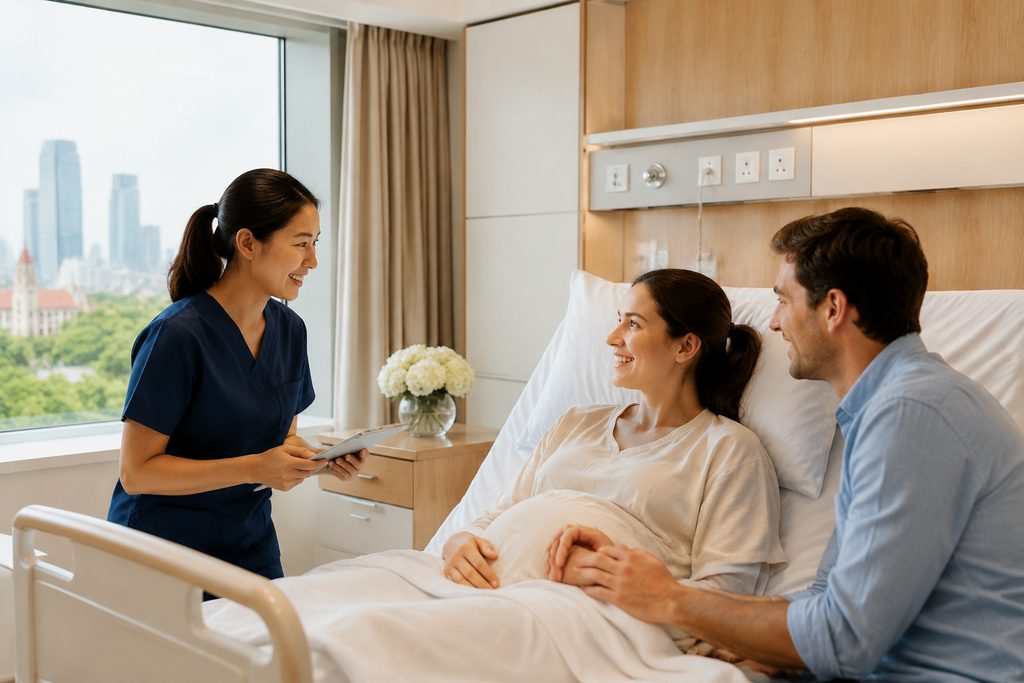
The general obstetrics ward at Red House is a high-efficiency public unit. Shared rooms are standard. Privacy is minimal. The nursing staff, while clinically excellent, are not hired for English proficiency. For a foreign patient, this environment is overwhelming. The hospital’s VIP clinic and international ward operate on a different model. Consultations are longer. Appointments are scheduled, not just queued. The delivery rooms in the VIP section are private, and the postpartum recovery rooms are single-occupancy with space for a partner or family member to stay. A bilingual coordinator, not a full translator, is typically available to help bridge communication with the medical team. This is not a five-star hotel experience. It is a functional, medically robust environment where a non-Chinese speaker can feel reasonably oriented. The cost for this is higher than the public wing, which brings us to the central question of pricing.
Red House Hospital Shanghai Maternity Package Cost: What the Numbers Look Like
The “Red House Hospital Shanghai maternity package cost” is not a single fixed number. It varies by delivery type, room choice, and whether any complications arise. The figures below are based on standard vaginal delivery and uncomplicated cesarean section packages in the VIP/international section, as of current pricing structures. They are quoted in Chinese Yuan (CNY) with approximate USD equivalents at a 7.2 exchange rate.
| Service Component | Public General Ward (CNY) | VIP International Ward (CNY) | Approx. USD (VIP) |
|---|---|---|---|
| Vaginal Delivery Package | 5,000 – 8,000 | 28,000 – 40,000 | $3,900 – $5,600 |
| Cesarean Section Package | 10,000 – 15,000 | 50,000 – 70,000 | $6,900 – $9,700 |
| Prenatal Care (Full Course) | 3,000 – 5,000 | 8,000 – 15,000 | $1,100 – $2,100 |
| Epidural Anesthesia (if not included) | 1,500 – 2,500 | Often bundled | Bundled |
| Additional Night (Private Room) | N/A | 1,500 – 2,500 | $210 – $350 |
These packages typically cover a standard length of stay—3 nights for a vaginal delivery, 4 nights for a cesarean. They include the delivery itself, routine newborn care and vaccinations, and basic postpartum monitoring. They do not cover treatment for pregnancy complications, NICU stays, or any specialized neonatal interventions. Those are billed separately. Compare this to a private international hospital in Shanghai, where a vaginal delivery package often starts at 60,000 CNY and can exceed 100,000 CNY for a cesarean. The Red House VIP option is not cheap by local standards, but it represents a significant saving over the fully private route while keeping you inside a hospital with a Level III NICU. That NICU capability is the reason many Chinese families and a growing number of informed expats choose this hospital. If your baby needs respiratory support at birth, you do not want to be in a facility that has to call an ambulance.
How a Foreigner Actually Gives Birth at Red House: The Step-by-Step Timeline
The process for a foreigner to deliver at this hospital is not complicated, but it is rigid. “How does a foreigner give birth in Shanghai” at a public hospital follows a fixed sequence that cannot be shortcut by paying more. The hospital’s registration system requires an in-person visit to create a medical file. This is non-negotiable.
Step 1: Initial Registration and File Creation. You go to the hospital with your passport and your current visa. Go to the VIP/international clinic building, not the main public outpatient hall. The staff there will help you create a hospital medical card. This card is your identity in the hospital’s system for all future visits. Without it, nothing else happens. The registration fee for the VIP clinic is around 300-500 CNY.
Step 2: First Prenatal Consultation. After registration, you see an obstetrician. The doctor will review any prior prenatal records you bring. If you are already in your second or third trimester and have had care elsewhere, bring printed reports. The doctor will order a standard set of blood tests, an ultrasound, and possibly a fetal echocardiogram depending on your history. This first visit can take half a day.
Step 3: Booking the Delivery Package. Once the initial workup is complete and the doctor confirms you are suitable for delivery at the hospital, you can discuss the delivery package. The hospital will ask you to prepay a deposit. For the VIP ward, this deposit is typically 30,000-50,000 CNY. This deposit is drawn down against the final bill. The hospital will give you a receipt and a package confirmation. This is your booking. There is no online portal. No email confirmation with a booking ID. It is a paper receipt and an entry in the hospital’s internal system.
Step 4: Ongoing Prenatal Visits. You will be given a schedule of follow-up appointments. In the VIP clinic, these are at set times and the wait is usually manageable. You will have routine ultrasounds, glucose tolerance testing, and Group B strep screening as you would in any Western system. All results are given in Chinese; you will need to translate them or have a bilingual companion help you understand the key indicators.
Step 5: Admission for Delivery. When labor begins, or on the scheduled date for a cesarean, you present at the hospital’s emergency or labor and delivery entrance with your hospital card, passport, and deposit receipt. The nursing staff will admit you. Your partner or a companion can stay with you in the private delivery room. The delivery is managed by the on-duty obstetric team. You do not choose your delivering doctor unless you have privately arranged with a specific specialist in advance, which is possible but requires an additional coordination fee and the doctor’s agreement.
Step 6: Discharge and Settlement. After your stay, the hospital calculates the final bill. Your deposit is applied, and you pay any balance or receive a refund. The hospital provides a detailed invoice and a discharge summary. You will need these documents for insurance reimbursement and for your baby’s subsequent passport and visa applications.
What the “Foreigner Childbirth Shanghai Hospital Price” Comparison Actually Reveals
When researching “foreigner childbirth Shanghai hospital price,” most people look at the delivery package cost in isolation. That is a mistake. The real comparison involves three factors: the base package, the risk of out-of-pocket NICU costs, and the insurance reimbursement pathway. A hospital that charges 80,000 CNY for a delivery but has a 24-hour in-house NICU may ultimately cost you less than a 60,000 CNY delivery at a facility that transfers a distressed newborn to a public hospital, where the NICU bill is separate and can reach 100,000 CNY in a week. Red House’s VIP package sits in a strategic middle ground. Its NICU is part of the same hospital system, so a transfer is internal.
But the insurance issue is the real sticking point. Red House Hospital is a public institution. Its international wing can provide a detailed invoice in English, but it does not have direct billing agreements with most international insurers. A few major carriers have established a direct payment relationship, but this is the exception. Most patients pay the full amount upfront and file for reimbursement. If your insurance plan requires pre-authorization for delivery, you must secure that authorization before you pay the deposit, and you must confirm in writing that the hospital’s documentation will satisfy your insurer’s claims department. Some insurers require itemized bills in English with specific diagnosis codes. The hospital’s billing office will provide what they have; they will not customize it for Aetna or Cigna. This is a point of friction that catches families off guard. A bilingual coordinator can help you review the invoice before you leave the hospital to ensure the codes and descriptions match what your insurer expects.
Practical Considerations: Documentation, Visas, and Post-Birth Logistics
Giving birth in China triggers a cascade of paperwork that goes well beyond the hospital discharge. The hospital will issue a medical birth certificate, which is the foundational document for everything that follows. You must then obtain an official birth certificate from the local notary office. This notarized document is what you will use to apply for your child’s passport at your home country’s consulate in Shanghai. The process is sequential and cannot be rushed. The hospital’s discharge summary and the notarized birth certificate are also required for your child’s visa or residence permit application. Your baby is not automatically a Chinese citizen; they will need a dependent visa linked to your own status. The Exit and Entry Administration Bureau in Shanghai processes these applications, and you must begin this process within 60 days of the birth. Our team has seen families underestimate this timeline and end up on an overstay, which is a serious legal problem. The visa category for a foreigner coming to China specifically for childbirth is the S2 visa, which covers private affairs including medical treatment. It is not an M visa—that is strictly for commercial trade and business. An S2 visa is typically issued for a stay of up to 180 days. If you plan to arrive in your third trimester and stay through the postpartum period, this is sufficient. If you need longer, the S1 visa applies. Your hospital admission confirmation and deposit receipt serve as supporting documents for the visa application at the Chinese embassy or consulate in your home country.
Language during labor is a primal concern. The VIP wing has English-speaking coordinators, but they are not present in the delivery room at all times. The midwives and nurses on shift may speak limited English. Pain management options, including epidural anesthesia, are available and commonly used, but you should discuss your birth plan with the doctor during a prenatal visit and have a written, translated summary in your file. Do not assume that your preferences will be understood in the moment without this preparation.
Frequently Asked Questions
You cannot fully book and secure a delivery date remotely. The hospital requires an in-person registration and initial consultation to create your medical file. What you can do beforehand is have a bilingual coordinator visit the hospital on your behalf to confirm current package availability, pricing, and the specific documents you will need to bring. This proxy consultation, which we can arrange, ensures you arrive with a clear plan and no surprises. The actual booking happens at your first in-person visit.
Red House Hospital has a Level III NICU and a maternal intensive care capability on-site. This is its single greatest advantage over a private clinic. If a complication arises, the escalation is internal. You are not transferred to an unfamiliar public hospital in an emergency. The specialist team is within the same building. This structural safety net is the primary reason to consider a high-volume public hospital for delivery in Shanghai, despite the administrative friction.
Most international insurers will reimburse for delivery at a licensed hospital, but Red House is often classified as an out-of-network provider. You will need to pay the full amount upfront and submit a claim. Before committing, send your insurer the hospital’s Chinese name and address and ask for written confirmation of coverage and the reimbursement rate for out-of-network inpatient maternity care. Some plans cover 80% of usual and customary charges; others have a fixed limit. Get the answer in writing. The hospital’s English invoice is generally sufficient for claims, but confirm this with your insurer as well.
The VIP ward is English-capable, not English-native. The coordinating staff speak functional medical English. The obstetricians often read English medical literature but may have varying comfort levels with spoken English. The nursing staff’s English is limited. The environment is set up to accommodate a non-Chinese speaker with the help of a companion or translator. It is not an immersive English-speaking experience like you would find at United Family. Expect to bridge the language gap with preparation, translation apps, and ideally a bilingual support person.
Your Next Step
Choosing where to deliver your baby is one of the most consequential decisions you will make during your time in Shanghai. Red House Hospital offers a combination of high-risk clinical capability and a dedicated international pathway that is unique among Shanghai’s public hospitals. It also demands a level of administrative navigation and upfront financial preparation that can feel daunting if you are handling it alone. Our team at China Medical Services works with this hospital’s VIP wing regularly. We handle the proxy registration, the package confirmation, the bilingual accompaniment during key prenatal visits, and the discharge paperwork reconciliation with your insurer. We are not a hospital, and we do not provide medical advice or diagnoses. What we provide is a clear path through a complex system, so you can focus on your
For more medical information and treatment options in China, visit chinamedservices.com (China Medical Services).
